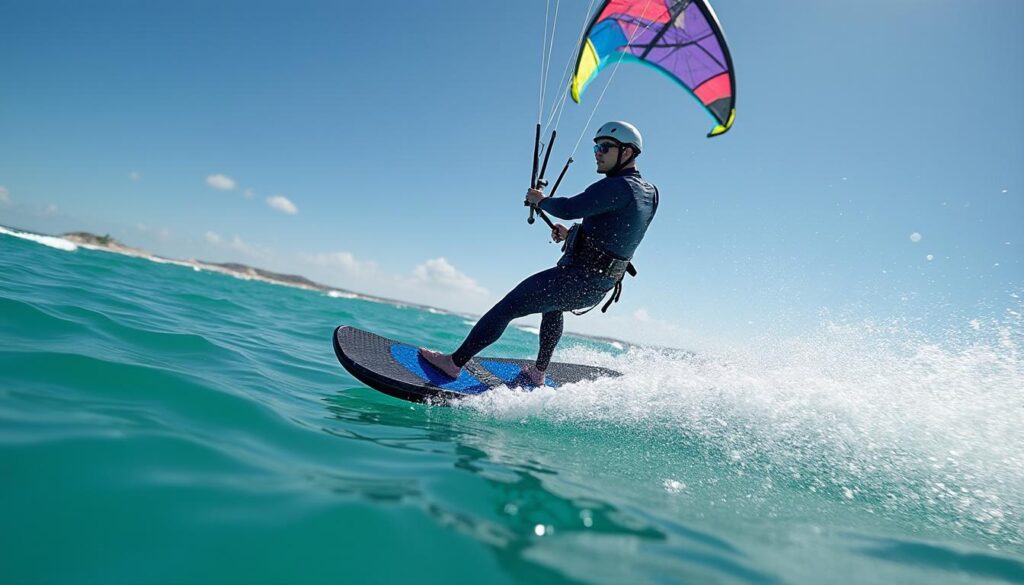
When the kite pulls, the water is almost flat and the board lifts off the chop, the feeling is clear: the foil board is no longer just an accessory, it is the heart of your session. With foil boards for kitesurf today you can fly above the water with just a few knots of wind, tackle messy waves and turn a mediocre spot into a playground. But between volumes, materials, aspect ratios and masts of a thousand sizes, it’s easy to burn your budget and end up with a setup that doesn’t work for your spot. This content dives into shapes, technical choices and board–foil pairings, with particular attention to those who want to learn kitesurf in foil version in Italy, from kitesurf Salento to the northern lakes.
Whether you come from twintip, from small surfboards or are looking for the first real upgrade to your quiver, understanding how a kitefoil board is made and how it interacts with the hydrofoil is the key to progressing. From generous volumes for beginners to compact boards for freeride and freestyle, through masts best suited to the choppy Adriatico and the glassier Ionio, every choice has concrete effects on safety, fun and your learning curve. The goal is clear: to get you out of the water with a feeling of control, not survival.
In short
- Volume and size: for kitefoil, volume close to or slightly below the rider’s weight accelerates progression, while beginners fare better staying a bit more generous.
- Materials: carbon for those pushing big jumps and aggressive maneuvers, hybrid constructions for freeride use and kitesurf for beginners who want robustness above all.
- Hydrofoil and aspect ratio: low/medium AR wings (5–6) help you take off early and stabilize the flight, high AR (7–8+) are for speed, glide and advanced downwind.
- Mast and spot: 75 cm ideal for learning, 85–95 cm to handle the chop and waves typical of many spot kitesurf Puglia and the rest of Italy.
- Matching to your spot: light wind and flat water require more volume and large front wings; strong wind and chop allow shorter boards and more nervous setups.
Foil Boards for Kitesurf: board anatomy and why it changes your way of riding
A kite foil board, seen from the outside, looks like just a shorter board with a mounting plate underneath. In reality it’s a small high-tech boat: it must plane, accelerate, make the hydrofoil work correctly and, at the same time, forgive stance errors while you’re still getting used to flying. In the context of kitesurf Italia, this versatility is fundamental, because you can go in an instant from a calm Ionio to a kitesurf Adriatico ruffled by thermal wind.
The internal structure is almost always high-density foam with a noble-fiber skin (fiberglass, carbon or hybrids) and two-component resins. This combination allows you to obtain stiffness underfoot to transmit every micro-movement to the foil, but also resistance to beginner impacts: too rearward sits, violent touchdowns, side falls. A board that is too soft absorbs energy, slows pumping and makes riding imprecise, while an excessively rigid but brittle board is a nightmare on spots with shorebreak like some stretches of kitesurf Lecce.
The hull shape is another key point. Modern kite foil boards often use double concave hulls, rounded edges and bevelled rails to prevent the board from digging in suddenly when you touch the water. Imagine a session with short maestrale chop on the Ionio: a sharp straight edge would catapult you forward at every touch, while a rounded rail slides over the water and allows you to recover flight in a few meters. This difference, in practice, is the thin line between a productive session and an hour spent picking up the board.
Volume also plays a different role compared to wingfoil. In wingfoil you plan for liters well above body weight, because you must start from standstill using only your wing. In kitefoil, the kite helps a lot in the starts, so it is possible to use boards with less volume and shorter length, to have direct feeling and fast rotations. However, those transitioning from twintip to foil and who fear the starts can still opt for slightly more generous volumes, just to have a few extra seconds of stability before takeoff.
The position and type of bindings (strapped or strapless) further change the board’s personality. With three straps you can set up powerful jumps, land more compactly and better control foil rotation. Strapless offers freedom of movement, smoother surfing on waves and, above all, more sensitivity in feeling the foil beginning to cavitate. On many Mediterranean spots, where the vento Salento can rise in minutes and the sea changes face, having that sensitivity underfoot is a huge advantage.
In short, the foil board is not a simple support for the hydrofoil: it is the filter between your body and micro-variations of wind and water. Understanding how it is built will allow you to choose a model that works for you, not against you.
Materials, carbon yes or no for the kite foil board?
The question always comes back: do you really need carbon on a kite foil board? The weight difference on modern models is not as extreme as people think. The real distinction is in stiffness and the ability to withstand hard landings. If your goal is to push hard in foil freestyle, perform big jumps, kiteloop with a foil and aerial maneuvers, a board with a carbon structure or targeted reinforcements in load points makes sense. Withstanding impacts better means fewer micro-cracks and more precision even after many sessions.
If instead the goal is chill freeride, exploring new best kitesurf spots Italy without stressing the material and maybe saving some money, a quality hybrid glass/carbon or full glass construction is more than sufficient. The money saved can go into a second foil with a different aspect ratio or an extra kite to better cover the wind range.
For those starting foil who come from kitesurf for beginners on twintip, the priority is not having the lightest board in the world, but a robust and predictable board. The first months of foil mean flat landings, hits on the nose and boards scraping the bottom when you get out distracted from the beach. In this phase, investing in a serious course or a dedicated helmet – here a useful guide: choosing the right helmet for kitesurf – matters much more than 300 grams less on the board.
The key message is simple: carbon is not a medal to show off, but a tool for those who push their limits hard. If you identify more as a rider who wants long, relaxed sessions and a board that doesn’t cause anxiety at every scrape with the sand, you can stay calm with less extreme and more affordable constructions.
This overview of the board’s anatomy and materials naturally brings us to the next question: how do you pair board and hydrofoil to truly get the flight you dream of?
Hydrofoil, mast and aspect ratio: how to match the right foil to your kite board
The hydrofoil is the submerged wing that, with the speed created by the kite’s pull and the board’s glide, generates the lift that makes you “lift” off the water. It consists of the mast, fuselage, front wing and stabilizer. Every element influences the sensations underfoot, from stability to how the board enters a turn. A balanced foil board but mounted with the wrong foil for your level is like a race bike with city tires: you will never exploit its potential.
The mast is the first element to consider. The most common sizes for kitefoil range from 75 to over 95 cm. A 75 cm mast makes everything easier at the beginning: less violent falls, less leverage, slower reaction. It’s ideal for those doing their first flights, for shallow lakes or for spots where the tide leaves little margin under the foil. When you start to feel really stable, an 85 cm mast becomes the perfect “middle way”: more margin to get over the chop, more possible tilt without cavitation, possibility of more radical turns.
On Italian seas, where wind often arrives out of phase with wave motion, a longer mast helps keep the board well above the messy water. In the kitesurf Ionio, for example, a day with long swell and side-on wind makes you appreciate every extra centimeter of mast because you can draw clean trajectories between the crests. Conversely, on super shallow spots or with emerging rocks, it’s better not to overdo it to avoid turning every mistake into a scary touch.
At the center of everything, however, is the front wing and its aspect ratio (AR). It’s not enough to know the square centimeters: two 1000 cm² wings can behave completely differently if one is short and wide (low AR) and the other long and thin (high AR). The magic number is theoretically span²/area, but for you it’s more useful to understand what happens on the water.
Wings with low/medium AR (5–6) are more compact, stable and provide a lot of lift at low speed. This means easy takeoffs, support even when the wind drops for a few seconds and a naturally tighter turn. They are perfect for those starting with foil, for relaxed freeride and for playing on slow waves, typical of some sheltered bays of kitesurf Taranto.
When you go up to AR 7–8, the wing becomes more elongated and thin. The water “feels” it less, so you have less drag, more speed and a glide that continues even when you ease pressure on the bar. It’s the realm of those doing long distance, more dynamic maneuvers and long downwinds. The natural turn widens, but you can compensate by choosing shorter fuselages to regain agility.
Beyond that, with AR 9–10, you enter the territory of race foils or extreme downwinders: almost embarrassing glide, extremely high sensitivity to errors, low tolerance when foot position is off perfect. This is where expert riders move, not those who are just discovering foil.
To connect everything, look at this table that relates level, aspect ratio and typical use in kitefoil:
| Rider Level | Foil Aspect Ratio | Main Use | Characteristics on the water |
|---|---|---|---|
| Foil beginner | AR 5–6 | First takeoffs, slow freeride | Very stable, lots of lift, moderate speed |
| Intermediate | AR 6–7 | Freeride, first maneuvers, small waves | Good compromise between stability, speed and turning |
| Advanced | AR 7–8 | Downwind, fast carving, foil jumps | More glide, more speed, wider turns |
| Expert / Race | AR 9–10+ | Racing, long distance, high-performance foils | Maximum glide, high sensitivity, low forgiveness |
Once you understand the wing’s behavior, you can choose a board that complements it. Low AR foils with slightly more voluminous and longer boards for maximum stability; mid/high AR foils with more compact and rigid boards to transmit every input to the wings. It’s the right fit between these pieces that turns a hesitant rider into someone who carves fluidly and relaxed for the whole tack.
Short or long mast for Italian seas?
Imagine two friends, Luca and Marta, who decide to take the foil around various kitesurf holiday spots in Italy. Luca starts with a 75 cm mast, Marta with a 90 cm. In Porto Cesareo, with relatively flat water and shallow bottom, Luca goes in relaxed, has margin under the fin and learns to manage the first lifts. Marta instead touches often, gets nervous and doesn’t at all take advantage of her mast length.
A week later, they move to an kitesurf Adriatico spot with short and annoying chop. Here Marta’s 90 cm becomes gold: she flies above the water’s disorder, feels the foil fluid and continuous. Luca with the 75 cm is forced to work with legs and knees, touches the crests often and has to concentrate more to keep stable flight.
The moral? If you move across very different spots, an intermediate mast (around 85 cm) is the compromise that works almost everywhere. If instead your home spot has specific characteristics, match the size to the bottom and the wave type. The right mast is the one that allows you to make mistakes without fear, and to push when you feel ready.
Once it’s clear how the foil reacts to your choices, it’s time to talk about volumes and shapes of boards according to your rider’s path.
Volume, dimensions and level: choosing the right foil board to learn and progress
When switching from twintip to foil, the first fear is always the same: “Can I stay standing on that tiny board?”. It’s normal. For this reason, in the wingfoil world a simple rule was born (weight + 40 liters for beginners). In kitefoil the discussion changes a bit, because you have the kite helping in the starts and you can afford less voluminous boards, especially if you already have good balance from years on boards.
For a rider who wants to learn foil in kitesurf safely, a practical guideline is to keep volume close to your weight (in kg) or slightly above. If you weigh 75 kg, a foil board around 75–90 liters, with a generous width shape, will give you time to set the start, handle the first lift and, above all, recover many mistakes without “sinking” between errors.
As control increases, you can start lowering literage. Boards with volume equal to or slightly below your weight immediately give you more reactivity, fast turn entries and direct foil response. Here the level really rises: you start choosing your line, not suffering it. Advanced riders, with great confidence in kite management, can push to very compact boards, almost volume-less, designed more for tricks and jumps than for ease of takeoff.
For those starting from zero boards (no skate, surf or SUP background), it’s worth considering a “soft” phase. A period on larger boards, perhaps in the same spot where you took a kitesurf course, allows you to build posture, bar control and timing without the pressure of a too-nervous tool. You don’t need to stay on them for years; a few well-structured sessions are enough.
Here’s a concise list to quickly orient yourself on volume based on the situation:
- Absolute beginner boards + foil: volume above weight (weight + 20/30 liters), preferably long and wide board, sessions assisted by a kitesurf school.
- Intermediate kiter with good twintip base: volume close to weight (weight ± 0–15 liters), more compact shape but still generous in width.
- Advanced rider: volume below weight, short board, designed for quick maneuvers, jumps and rapid direction changes.
Every volume step should be accompanied by reflection on your spot. In a place that is constantly windy, you can afford less voluminous boards earlier, because the kite will pull you through lulls and let you focus on carving, speed and maneuvers. In fickle spots, with on/off wind, having a few extra liters means getting back to shore calmly instead of doing endless body drag.
Those who practice kitesurf Salento know this dynamic well: when the thermal comes in strong, compact boards and contained volumes give adrenaline sessions, but on borderline days, especially at the start and end of the season, stepping up a volume notch can be the difference between planing and sitting on the beach.
Inflatable board or hard board in kitefoil?
The small-car question: “Isn’t an inflatable better so it fits in the car?”. The answer, for kitefoil, is almost always no, except in specific cases. Inflatables make sense when liters are very high (over 110 liters) and when the goal is absolute flotation in the first steps of a discipline. In kitefoil, where volumes are often lower and a very precise response between foot and mast is needed, a hard board remains by far the most functional choice.
A hard board allows you to plane earlier, cut through chop better, and pump the foil with less wasted energy. An inflatable, by nature, absorbs some movements and tends to “bounce” on the water, delaying the moment the foil actually comes into play. If you train in spots with jagged waves or chop, every waste of energy becomes extra frustration.
The only scenario where an inflatable may make sense is for those who want a super large volume board to use maybe in combination with wing or SUP, and have major logistical problems with transport and storage. But for specific kitefoil use, and especially thinking about progression toward more dynamic maneuvers, the honest advice is to opt for a good rigid shape from the start.
Also on the safety front, a quality hard board, a good helmet and a trapeze suited for foil make more difference than half a kilo less in the backpack. To deepen the accessories that really affect comfort on the water, you can take a look at this guide on the best kitesurf harnesses and choose a model suitable for long foil sessions.
The choice of support, therefore, is not just a matter of convenience in the trunk, but a direct investment in the quality of every single outing at sea.
Conditions at your spot in Italy: how the wind decides your foil board
Foil has a superpower: it makes ridiculous those days when, with the twintip, you wouldn’t go out at all. But for this to work, the foil board must be tailored to your spot. Those who do kitesurf Ionio on the more sheltered side of the Ionio, with glassy water and regular thermal winds, will have different needs than those who fight the short chop of the Adriatic or gusts on an alpine lake.
At spots where wind is almost never lacking, you can afford more compact and less voluminous boards already at intermediate level. The constant pull of the kite helps you overcome wind holes and allows you to focus on carving, speed and maneuvers. Here more “radical” boards make sense because you can use them often, not just three times a year.
Conversely, if you live in an area where you have to do half a rite to see leaves move, the equation changes. A board with more volume and a larger front wing allow you to start with less wind, get back upright after touchdowns and return to shore even when the wind suddenly dies. It’s no coincidence that many riders from Italian lakes and some sheltered southern bays use boards slightly larger than average, even at advanced level.
Much also depends on the wave type. In the Adriatic, short and messy chop requires an intelligent combination of not-too-short mast, fairly compact board and rails that don’t catch in the water. On the Ionio, where the swell can be longer and cleaner, you appreciate a board capable of surfing the wave in foil without touching, with soft entries when you decide to land.
A valid strategy for those who frequent the same spots often is to have two main setups:
- Medium/strong wind setup: board with volume near or below weight, medium AR foil, mast 85–90 cm to stay high above the chop.
- Limit wind setup: same foil or slightly larger wing, mast perhaps slightly shorter if the bottom is a problem, board with 10–20 liters more to facilitate takeoffs and returns.
With two such combinations, you cover practically all typical conditions of kitesurf Italia without overturning your feeling between sessions. You always base yourself on the same gestures and adjust only what’s needed, instead of starting from scratch every time.
Example: adapting the same board to different spots
Take as a reference an 85-liter freeride foil board, used by a 78 kg rider. On a strong maestrale day on the Adriatic, mount a foil with AR 6.5 and 900–1000 cm², mast 90 cm. The board becomes an arrow: you take off immediately, stay above the chop, carve sharply and have fun even in wind holes. A week later, same board, but marginal wind on the Ionio with almost flat water.
Here the same rider can choose a larger front wing (e.g. 1200 cm², AR 5.5–6) and perhaps a mast of 80–85 cm if the bottom is shallower. The 85 liters becomes his “generous” board because the wind is low, and thanks to the bigger foil he manages takeoffs and returns with ease. Same board, two different souls, simply changing a few foil parameters.
For those who want to push more on the wave side, the world of foil surf also comes into play, closely related to kitefoil in terms of wings and aspect ratio logic. Understanding how the same wing reacts with different boards will give you more tools to better read every sea you meet.
In the end, the wind always decides. You choose whether to go with it using the right setup or to fight it with the wrong setup.
Setup, safety and progression: how to make your foil board work at its best
Once you’ve chosen the right foil board, the work is not over: the difference between a setup that “works” and one that “flies” is in the details. Strap position, foil mounting on the track, the relationship with your kitesurf harness and the choice of kites for each wind range completely transform the sensation underfoot. Here comes the most interesting part: experimenting, but with criteria.
Let’s start with the foil position under the board. Moving it forward or back on the track can change the point where the foil starts generating lift relative to your center of gravity. If you always feel “behind” on the board and forced to load the front foot a lot, the foil is probably mounted too far back. Conversely, if the board tends to rise by itself and you struggle not to nose up, you might have it too far forward. Small shifts of 5–10 mm already make a big difference.
When present, straps should be set not only according to foot length but also to the type of riding. More central and slightly rearward for jumps and aerial maneuvers, a bit more forward if your focus is carving and wave surfing. Those who prefer strapless must train sensitivity more, but gain huge freedom in weight shifts and management of touchdowns and strapless landings.
Safety goes hand in hand. A foil board, with mast and wings, deserves respect. Helmet, impact vest and good distance management from other riders become non-negotiable, especially in crowded spots and gusty conditions. Here the experience gained in basic and intermediate kitesurf school courses becomes useful: the same right-of-way rules and common sense apply, but with a more technical tool underfoot.
For progression, a good pre-session routine helps a lot. Check screw tightness, clean connections between mast and fuselage, integrity of straps and the strap pad reduce the risk of problems in the water to zero. A foil that vibrates or a board with loose inserts not only spoil the session but can ruin equipment and the whole day.
Finally, remember that the foil board does not live alone: test different kite pairings, experiment with slightly longer or shorter lines depending on your spot and listen to your body’s feedback at the end of the session. Good fatigue is that of legs and core, not the mental fatigue of someone who spent two hours fighting an unmanageable tool.
Three key points to remember every time you set the board
To close in a practical way, here are three simple points to mentally review before entering the water with your foil board for kitesurf:
- Check balance: verify that, in a neutral stance, you can stand with weight distributed between both feet without the board wanting to “nose up” on its own. If it does, correct the foil position on the track.
- Adapt the setup to the day’s wind: strong wind and chop? Longer mast, straps tightened. Light wind and flat water? You can soften the straps a bit, use larger wings and focus on clean takeoffs.
- Safety before performance: helmet, checks on screws and lines, respect distances. A good foil session is one you leave wanting to come back the next day.
With these tips, every time you place the board on the sand of your spot – be it Salento, Sicilia, Sardegna or a northern lake – you will know exactly why you chose that setup and what to expect from the sea. That’s what makes the difference between a rider who is subjected to the equipment and one who uses it to go where they want.
What volume should I choose for my first kitefoil board?
For a first approach to kitefoil, a good practical rule is to choose a board with volume close to your body weight in kg, or slightly higher if you don’t have much experience on other boards. For example, if you weigh 75 kg, a board between 75 and 90 liters will give you time to set the takeoff and handle the first flights without sinking at every mistake. As you improve, you can move to volumes below your weight to gain more reactivity and maneuverability.
Is a low or high aspect ratio foil better to start with?
To start, a hydrofoil with a low/medium aspect ratio is recommended, roughly between AR 5 and 6. These front wings offer a lot of stability, plenty of lift at low speed and tighter, more predictable turns. Foils with higher AR (7–8 and above) are intended for riders who are already confident, seeking more speed, downwind glide and specific performance. Starting with an AR that is too high makes learning harder and less safe.
Is a 75 cm mast sufficient for kitefoil at sea?
A 75 cm mast is excellent for learning and for spots with shallow bottoms, because it reduces the violence of falls and makes first flights easier. In open sea, especially in choppy or wave conditions, many riders prefer to move to 85–90 cm masts to stay higher above the water’s disorder and have more margin in turns. If you mainly sail at sea and already have basic foil control, an 85 cm mast is often the best compromise.
Does it make sense to use an inflatable foil board for kitesurfing?
In kitefoil the hard board remains the most functional choice. Inflatables make sense only at very high volumes, for those who need to learn balance or have serious space constraints in the car and at home. For typical kitesurf use, where volume is lower and a precise response to the foil is needed, a hard board allows easier takeoffs, more control in touchdowns and better transmission of energy in pumping.
Can I use the same foil for kitesurf, wing and surf foil?
Some modern front wings are designed to be multi-use and work decently in kitefoil, wing and surf foil, but each discipline has different needs. In kitefoil, smaller and faster wings are often used because the kite provides a lot of traction. In wing and surf foil you need larger wings to take off early using only the wing’s wind or the wave’s push. It’s possible to share a foil across disciplines, but to get the best performance it’s worth choosing setups (wing, mast, fuselage, board) specific or at least optimized for the main use you will make of it.