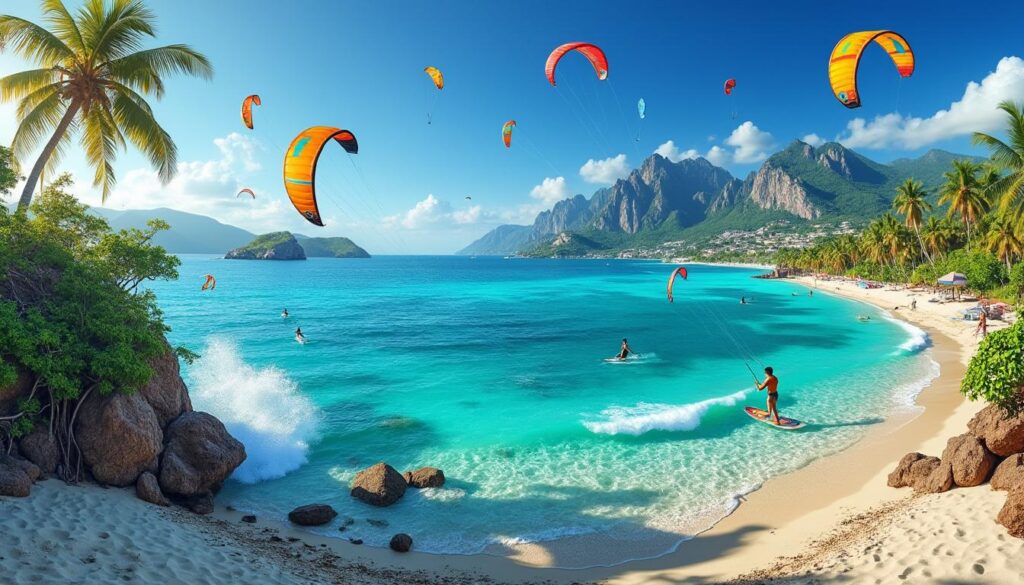
Kitesurf Punta Trettu is the name now heard on beaches all over Europe. Those looking for reliable wind, glassy flat water and shallow bottom to try new maneuvers always end up here, in the southwest of Sardinia, in front of Sant’Antioco. It’s not a postcard place to look at and that’s it; it’s a real training ground where every gust has a purpose and every leg helps you improve. Whether you come from Adriatic kitesurf spots, the Ionian kitesurf scene or the northern lakes, this spot has something to tell you about your technique, your relationship with the kite and how you choose your sessions.
At Punta Trettu the wind is not a “if it happens” bonus: it’s the main character. Summer thermals pump the Mistral well beyond what the forecasts show, the sandy bottom slopes gently and lets you walk for tens of meters, the lagoon dampens the swell and turns every water start into a clean, stress-free exercise. Here you’ll find schools, structured courses, equipment rental, camper areas, rooms a stone’s throw from the spot, bars with hot showers and a community of riders who really live for sessions, not for filtered photos. It’s one of those places that changes the way you see kitesurfing in Italy: more practical, more technical, more aligned with your real progression.
In short
- Punta Trettu is considered one of the best kitesurf spots in Italy thanks to flat water, shallow bottom and a very high percentage of windy days.
- The spot is dedicated almost exclusively to kite: no waves, no rocks, very few bathers, a controlled and safe environment for kitesurfing for beginners and advanced riders.
- Thermal winds and the Mistral work together: even when forecasts show 5–6 knots, on site you often ride between 15 and 20 knots.
- There are several kitesurf schools offering kitesurf courses for all levels, rental, storage, accommodation, camping and services for campers/vans.
- The lagoon is perfect for freestyle, big air and continuous technical progression, but it’s not suitable for windsurfing and foiling due to the shallow water.
Kitesurf Punta Trettu: why this Sardinia spot became legendary
When talking about kitesurf Sardinia, the names that come up are almost always the same: Porto Pollo, Cagliari, Chia. Yet in recent years it’s Punta Trettu that has stolen the scene, becoming for many the absolute reference in Europe for those who want to progress quickly and safely. People don’t come here just for photos; they come to learn kitesurfing, test new kites, push their riding level and do long sessions without having to fight with waves or annoying currents.
The strength of this spot lies in the combination of factors: its position in the southwest of the island, facing Sant’Antioco; a natural, closed and protected lagoon; the Mistral that enters cleanly from the northwest; thermal winds that often add up to 10 knots compared to what Windguru or Windfinder show on sunny days. It often happens that the forecast says 7–8 knots and instead you find yourself on the water with 17–18, planing fully with the twintip.
To understand how much this makes a difference, imagine Luca, an intermediate rider who normally kitesurfs in Lecce on the Ionian Sea. At home he spends whole weekends chasing wind, getting in the water when he can, often with short chop and gusts. Arriving at Punta Trettu, the story changes: a whole week with wind almost every day, smooth water, bottom that allows him to stop, breathe and retry a maneuver without fear of losing the board or being flipped by a wave. In four days he lands his first raley, improves upwind riding and truly understands how to manage the kite’s power.
Punta Trettu isn’t just fame: it’s an open-air laboratory for those who take their kitesurfing in Italy seriously. Some come from kitesurf Taranto, others from Liguria, France or Germany, and everyone says the same thing: “Here you feel every leg serves a purpose”. Less time wasted going upwind in choppy seas, more time working on technique, jumps, edging and bar control.
In a Mediterranean context where spots often have to deal with bathers, rocks, currents and limited space, this strip of land pointing straight toward Sant’Antioco has become a sort of ideal stage for pure kitesurfing. The secret is simple: remove everything that disturbs and leave only what matters, namely wind and manageable water. And that’s exactly what makes Punta Trettu a legendary spot for those who live for sessions and not for brochures.
Weather conditions and wind at Punta Trettu: how to really read the spot
The Salento wind has a reputation for being capricious, but Punta Trettu’s wind plays in a different category. The Mistral comes in from the northwest with a rare consistency for the Mediterranean and, thanks to the shape of the lagoon, arrives cleanly, without many holes. The real magic, however, is made by the thermals: on sunny days, the thermal gradient between land and sea amplifies the breeze by almost 10 knots more than the forecast models.
This means that if you look at Windguru in the morning and read 8–10 knots, you could easily find yourself in the afternoon with 18–20, perfect for a 9 or 10 meter kite. It’s what many riders say when they compare Punta Trettu to other kitesurf spots in Italy: where elsewhere the forecast is almost always optimistic, here it’s sometimes conservative. The practical effect is simple: fewer wasted days, more time on the water and steady progression.
For those planning serious kitesurf holidays, it’s an extra layer of certainty. You can schedule a week with high chances of effective sessions, instead of settling for two hours grabbed from an unstable front. And when it drops, it often does so gradually, giving you time to finish the trick, come back to shore, change kite—not with those sudden drops that force you to rush in.
Compared to other famous northern Sardinia spots like Porto Pollo, temperatures here stay milder for much of the year and the wind statistics are decidedly in your favor. To choose the right wetsuit and pack sensibly, it can be useful to take a look at the technical indications in this wetsuit guide for kitesurfing, which explains well how to cross seasons, thicknesses and average session durations.
Truly understanding Punta Trettu’s wind also means stopping living glued to weather apps and learning to look at the sky, the clouds, the temperature, the color of the water. It’s the same journey every rider must take, whether you’re studying the Mistral in Sardinia or the Tramontana in Salento: wind isn’t guessed, it’s observed and interpreted day after day.
Flat water, shallow bottom and kite zones: how Punta Trettu’s spot really works
One of the reasons Punta Trettu is so loved is its lagoon with flat, shallow water. The bottom is sandy, without sharp rocks or surprises underfoot, and it slopes gently for tens of meters. This means you can walk for a long time with the board under your arm, set up your water start calmly, relaunch the kite after a mistake and restart without anxiety, even during the early hours of your kitesurf course.
This configuration makes the spot perfect for kitesurfing for beginners, but also for advanced riders who want to work on technical maneuvers. Freestyle riders love Punta Trettu precisely because the sheet of water without chop allows you to push hard on the edge, load power and pop cleanly for raley, S-bend, handle pass. Those focused on big air appreciate the possibility to land on a forgiving mirror of water, without the violence of the waves at some ocean spots.
It’s important to know, however, that not all of the lagoon is “free”. Punta Trettu has two main kite zones where navigation is allowed. The rest of the area, while not crowded with bathers, is still subject to regulations and controls by local authorities. Local schools always explain the basic rules: trajectories, right of way, minimum distances, the correct way to enter and exit the water. These are not formalities; they are what allow dozens of kites to share the same water safely.
The extremely shallow water has another consequence: the spot is not suitable for windsurfing and foiling. Long fins and foils require depth that is lacking here, especially in the inner parts of the lagoon. If you’re looking for a place to foil, it’s better to look at other kitesurf spots with foil more suited to that discipline. Punta Trettu is designed for kite with twintip or small surfboard without very long fins, period.
Those coming from the surf or windsurf world are sometimes surprised: no waves to play with, no bottom turns, just that smooth plane of water that many underestimate until they put the board on it. Then it happens like with Marco, a long-time windsurfer: after two weeks at Punta Trettu he returns home and admits that in few other places he felt such total control of the board and the kite’s power. Precisely because you remove the wave element, all the focus goes to technique, posture and timing.
If you like to understand spots in detail, Punta Trettu is a small school of sea reading: you observe how depth changes with the tide, how darker channels signal slightly deeper water, how the direction of the minimal chop indicates rapid micro-changes in wind angle. When you learn to read this lagoon, it then seems easier to interpret any other spot, whether it’s the Ionian kitesurf in Puglia or the beaches of Tuscany.
On-site services: schools, storage, bar, camper facilities and accommodation steps from the spot
A perfect spot without services remains half a spot. Punta Trettu, however, has grown into a complete ecosystem for kitesurfers. Along the lagoon you’ll find several kitesurf schools offering courses, rental, water assistance, boat rescues and shady areas to rest between sessions. Courses range from “zero to rider” packages for absolute beginners to advanced coaching on specific tricks for those with years of kite experience.
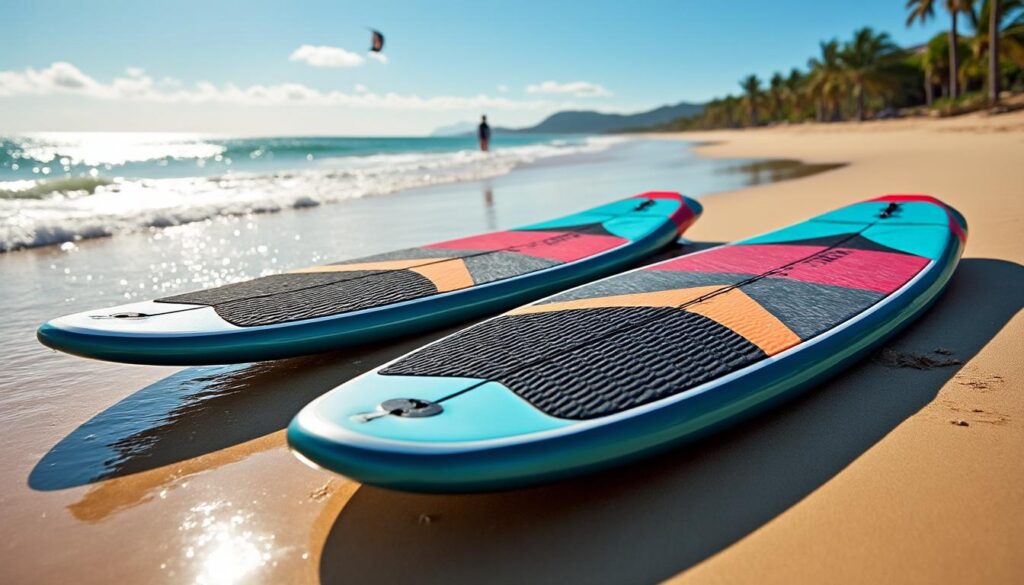
Many centers offer full rental: kites of various sizes, twintip boards, harnesses, wetsuits and accessories. If you want to choose the right board for your style, it helps to arrive with a clear idea in mind, perhaps after reading technical guides like the one on choosing a twintip kiteboard, so on-site you can really compare theory with practice in the water.
Logistics are well catered for: areas dedicated to equipment storage, spaces to rinse boards and harnesses, compressors or electric pumps to inflate kites, small workshops for quick repairs. After the session, the bar-kite café is the natural meeting point: sandwiches, simple dishes, cold beers and above all stories of successful jumps, epic crashes and upcoming trips. With hot showers available, those arriving in a camper or van can spend whole days between water and beach without ever feeling “camped”.
For those seeking more comfort, there are private rooms with bathrooms and independent entrances, just steps from the spot where you launch your kite. A huge advantage: you wake up, look out the window, see the kites already in the air and know exactly what to do. In the evening you can return, hang your wetsuit on the balcony, exchange a few words with your roommates (who will probably still have sand on their feet) and think about the next day’s session.
Finally, services for campers and vans: organized parking, electrical hookups, water supply, waste disposal, shaded areas. Many northern European riders arrive in Sardinia with their vans, combining the vagabond spirit with the security of knowing that Punta Trettu has everything they need. It’s no coincidence that reviews often mention a “family” atmosphere: the kite community here is made of faces that return every season, friendships born in the water and continued over a plate of pasta and a forecast check.
Kitesurf Punta Trettu for beginners and intermediates: courses, progression and safety
If you’re looking for where to learn kitesurfing in Italy, Punta Trettu is one of the first names you should consider. The combination of shallow water, constant wind, absence of waves and structured schools makes this spot a true gym for beginners. No fear of ending up offshore, no aggressive rip currents, no rocks: just useful time spent learning how to control the kite and manage the board under your feet.
A typical kitesurf course for an absolute beginner always starts with safety: correct equipment setup, quick-release systems, checking wind direction, choosing the launch zone. Then you move on to body dragging, relaunching the kite from the water, and the first fine control of the bar. Thanks to the shallow bottom, the passage to water start becomes less stressful: you can stand up, breathe, reposition the board, retry calmly until the movement becomes automatic.
For intermediate riders, Punta Trettu is a continuous testing ground. Those who already know how to plane but struggle with upwind riding find here the ideal place to correct posture, edging and power management. Without the wave variable, everything focuses on the quality of your board contact and bar timing. In a few days many riders notice improvements that at home, with less clean conditions, would require months of attempts.
A concrete example? Take Sara, who usually kitesurfs in Salento between the Ionian and Adriatic seas, always fighting short chop and unpredictable gusts. After three days of one-to-one coaching at Punta Trettu, she stops losing downwind meters, starts returning exactly where she launched and begins working on first direction changes with controlled transitions. The leap in quality comes precisely from the possibility to repeat the same maneuvers dozens of times in a single session without interruptions.
The lagoon’s schools often structure courses in modules:
- Basic lessons for absolute beginners: wind theory, kite handling, safety, first legs.
- Intermediate lessons: upwind riding, transitions, maintaining speed and first maneuvers.
- Advanced coaching: freestyle, jumps, rotations, technique refinement.
Many centers also offer “zero to rider” intensive packages over a few days, where you always move with a certified instructor, radio in the helmet and constant support. The radio is a game changer: it allows you to immediately correct posture or movement errors, as if the instructor were sitting on your board with you.
Another strong point of the spot is the real attention to safety. Despite the lagoon looking like a giant playground, schools insist on respecting right-of-way rules, kite zones and launch/landing procedures. Independent riders are always invited to get informed first about buoys, channels and school-reserved areas. This shared respect is what allows Punta Trettu to maintain its reputation as a “safe spot” even on the busiest days.
To better understand how Punta Trettu fits into the map of the best kitesurf spots in the Mediterranean, it can help to compare it with other Italian scenarios analyzed in guides like this overview of kitesurf spots: it will help you decide which sessions to do here and which to save for wave or windier spots.
Practical table: who Punta Trettu is suitable for and which riding styles
To choose your next kite destination well, it’s useful to see at a glance what Punta Trettu offers for different rider profiles.
| Rider profile | What they’re looking for | What Punta Trettu offers |
|---|---|---|
| Absolute beginner | Shallow water, zero waves, close instructors | Flat lagoon, sandy bottom and structured schools to learn safely |
| Intermediate | Improve upwind riding, control and transitions | Consistent wind and a water mirror that facilitates edging technique and direction changes |
| Freestyler | Flat water for technical maneuvers | Perfect playground for raley, handle pass and unhooked tricks |
| Big air rider | Sustained wind, soft landings | Manageable gusts and landings on smooth water, ideal to work on height safely |
| Foiler / Windsurfer | Greater water depth | Not suitable: water too shallow for long fins and foils |
In summary, Punta Trettu is the right place if you want to work on pure technique with a twintip and take your level up a notch without unnecessary fights with waves and currents.
Punta Trettu between kite holiday and Mediterranean culture: how to organize your trip
A trip to Punta Trettu is not just hours in the water. It’s a kitesurf holiday in a part of Sardinia that still feels authentic, where after the session you can sit in a village bar, order a typical dish and hear Sardinian dialect at the next table. Days revolve around the wind, of course, but when you leave the water you find a territory worth exploring at a relaxed pace.
Proximity to Sant’Antioco and the island of San Pietro allows you to alternate your days: morning in the water at Punta Trettu, afternoon wandering the town, evening strolling between alleys and harbors. Those coming from the Salento kitesurf world will surely notice similarities: strong sea, intense Mediterranean light, simple and tasty food, local communities proud of their land. Accents change, but the call of the sea is the same.
To organize the trip best, it’s useful to think about these elements:
- Period: spring and autumn are often the best seasons for wind and temperature, with less crowding than August.
- Accommodation: choose between private rooms close to the spot, B&Bs in nearby towns or equipped camper/van areas.
- Transport: ferry or plane to Sardinia, then car or van to reach the lagoon.
- Equipment: decide whether to bring all your gear or rely on local rentals.
- Alternative sessions: if the wind drops one day, you can explore other areas of kitesurf Sardinia or go on land and boat excursions.
Many riders choose Punta Trettu as part of a broader Mediterranean kite tour: a week here, a few days in Puglia among the kitesurf spots in Puglia on the Ionian Sea, maybe a stop in Sicily or Greece. Italy, seen from the kite perspective, is a mosaic of complementary spots: from the flat Sardinian lagoon to the Adriatic waves, from Salento thermals to Tyrrhenian swells.
From a lifestyle point of view, Punta Trettu speaks the language of those who love a simple life, made of few elements: wind, water, good food and a few chats at sunset. Don’t expect nightlife like a big city: here the best evenings are often those spent sitting on a bench or near the camper, with the kite shading you and the west wind still blowing even after you’ve stored the board.
Those who arrive with family still find a good balance: while one goes on the water, the other can explore nearby beaches, take the kids to discover the lagoon, go for bike rides or simply relax at the school’s bar. It’s the same combination that makes kitesurf destinations in Italy like Salento strong: the possibility to combine sporting passion and shared holiday without having to sacrifice either.
In the end, the true test of a place like Punta Trettu is simple: how much do you miss it when you return home? For many riders, the answer is “a lot”. And not only for the wind, but for that routine of slow wake-up, anemometer check, two words over coffee and then straight into the water. Once you try it, it becomes hard to accept returning to a life where wind is just something you hear behind the glass.
What is the best time to kitesurf at Punta Trettu?
The most appreciated season for kitesurfing at Punta Trettu runs from late spring to autumn, when the Mistral and thermal winds often work together. In these months you have a very high percentage of windy days, mild temperatures and less crowding compared to August. Winter can also offer nice sessions for more motivated riders, with thicker wetsuits and a few more disturbances.
Is Punta Trettu suitable for those who want to learn kitesurfing from scratch?
Yes, Punta Trettu is one of the spots most recommended in Italy for absolute beginners. Flat and shallow water, sandy bottom, constant wind and structured schools allow you to learn safely and progress quickly. The fact that you can often touch the bottom makes both body dragging and the first water start attempts less stressful.
Do you need to have your own equipment to kitesurf at Punta Trettu?
It’s not mandatory. On site you’ll find several schools and specialized centers that offer rental of kites, boards, harnesses, wetsuits and accessories. If you already have your setup and want to bring it, you can still use storage, repair and assistance services. Beginners often prefer to start with school equipment to test sizes and models before buying.
Is the spot safe even when it’s crowded?
Safety at Punta Trettu is based on two elements: the characteristics of the lagoon (shallow water, no waves, absence of rocks) and strict respect for kite zones and right-of-way rules. Even on the busiest days, schools insist on safety distances, correct trajectories and conscious use of equipment. If you’re an independent rider, it’s essential to get informed about local rules before entering the water.
Can I practice foiling or windsurfing at Punta Trettu?
Punta Trettu is designed practically only for kitesurfing with twintip or small surfboards. The bottom is very shallow and does not offer the depth necessary for foiling and windsurfing with long fins. If you’re looking for spots suitable for foiling or windsurfing, it’s better to head to other areas of Sardinia or Italy, where the water is deeper and conditions are optimized for these disciplines.