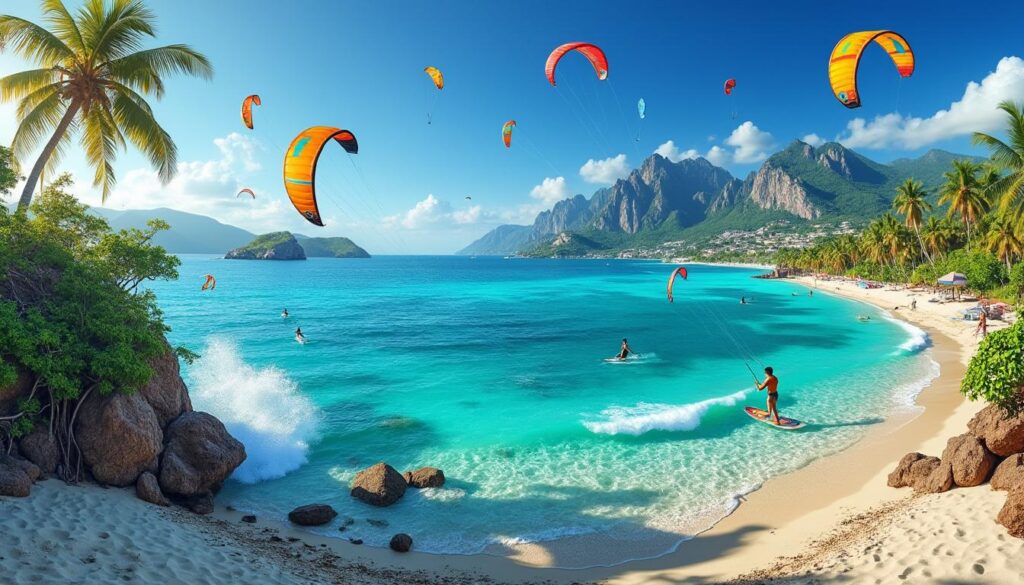
The wind calls you, the board is restless and every gust seems like an invitation to enter the water. Kitesurf is the sport that has turned Italian beaches into real playgrounds, where sailing, surfing and adrenaline meet. You don’t need to be a super athlete; what matters most is the desire to learn, respect for the sea and curiosity for a new way of experiencing the wind. From the first glides to the water start and the first jumps, every session is a mix of technique and instinct, of control and letting go. Those watching from the shore see only colorful kites, but those hooked to the bar feel something deeper vibrating.
In Italy, and especially in the South, kitesurf is not just a sport: it’s a small tribe made of spots, schools, rituals and schedules dictated by weather forecasts. Between kitesurf Salento, Sicily, Sardinia and the northern lakes, each area has its own character, its winds and its “unwritten rules.” Understanding how the kite works, choosing the right equipment, learning the first maneuvers and reading the wind are the key steps to truly enter this world. This content intends to guide you step by step, in direct and concrete language, to help you turn curiosity into real sessions, with your feet in the sand and the bar in your hands.
In short:
- Kitesurf combines sailing, surfing, wakeboarding and windsurfing into a single wind-powered sport.
- To learn kitesurf safely you need a structured course, suitable spots and correct equipment.
- Kitesurf for beginners requires respect for the sea, basic knowledge of the wind and constant supervision.
- Salento wind and the double Adriatic/Ionian exposure offer some of the most versatile conditions in kitesurf Italy.
- Helmet, impact vest, harness and kite selection are not details: they are what make a session “okay” or “never again.”
Kite Sports: what kitesurf is and why it has conquered Italy
The kitesurf, or kiteboarding, is a sailing sport in which a wing-shaped kite pulls the rider on a board. The wind becomes the engine, the board is your vehicle and the bar is the direct connection between what happens in the sky and how you move on the water. Unlike other sea sports, here you’re not just looking for the wave: you look for the right combination of wind direction and intensity, free space and water depth. When these elements align, the feeling is clear: the body stops fighting and begins to glide.
Kitesurf is relatively young but has a longer history than one might think. There are accounts as early as the 13th century of boats propelled by kites, and in the 19th century a certain George Pocock used four-line sails to pull carriages and boats. In the 20th century, between Samuel Cody with his “kites that lift people” and the Dutch Panhuise who patented the kiteboarding concept, the direction was clear: to harness the wind differently, more freely, more playfully.
The real breakthrough came between the ’80s and ’90s, when inventors and shapers began connecting powerful kites to skis, boards and buggies. It was in this period that the first inflatable kites and then twin-tip boards were developed. The Legaignoux brothers, with their inflatable prototype tested in Hawaii, turned a lab idea into a practicable and repeatable sport. From there, worldwide spread was a matter of a few years: from the windy bays of the Pacific to the coasts of the Mediterranean, kites began to color the skies.
In the context of kitesurf Italy, growth has been explosive. First Liguria, Tuscany and the northern lakes; then Puglia, Sicily, Sardinia and Campania. Each new school brought a mini community of students, and in a few seasons kitesurf went from “a strange sport” to a regular presence on many beaches. Today the best kitesurf spots in Italy are known across Europe: flat water in Sardinia, steady winds on alpine lakes, jumps at sunset in the South.
The true charm of kitesurf lies in how it changes your perception of the sea. You are no longer just a bather or a surfer waiting for the right wave, but someone who observes clouds, gusts and currents. The wind is no longer a nuisance that blows sand; it’s an ally to interpret. For this reason those who take up kitesurf soon end up speaking in knots, directions, window, edge — almost like a new language. And once learned, it’s hard to go back.
Many wonder if kitesurf is really for everyone. The honest answer is: for those willing to respect it. It’s not a “plug & play” sport: it requires a course, patience, controlled mistakes and lots of practice. But you don’t need a perfect body or years in the gym. You need the willingness to listen to those who know more, choose a reliable kitesurf school and accept that the first sessions will be more wind in the face than social media clips. It’s right there that a true bond with the sport is born.
Closing this first overview, one thing is clear: kitesurf is not just a fashionable sport, it’s a different way of inhabiting the sea. And if you’re wondering where to start, the next step is understanding how it’s really practiced, step by step, from the beach to the water.
How kitesurf works: technique, equipment and wind dynamics
To learn kitesurf without rushing the stages, it’s essential to understand what happens when you pull or push the bar, when you shift weight to your heels or toes, when you make the kite cross the wind window. It’s not magic: it’s physics made playful. The kite generates traction, the board converts it into glide, your body manages the balance between force and direction. If one of these three elements is out of phase, the session becomes hard work; if they align, gliding becomes smooth.
The basic equipment consists of a kite, bar, lines, board, harness and safety systems. The kite, wing-shaped, can be of type C, Delta, Bow or hybrid, each with different reactivity and power. The control bar is connected to the kite via four (or sometimes five) lines in Dyneema or Kevlar, materials that withstand enormous loads with minimal thickness. Pulling the bar toward you increases “pull,” pushing it forward releases it. It seems simple, but behind this gesture lies the entire control of power.
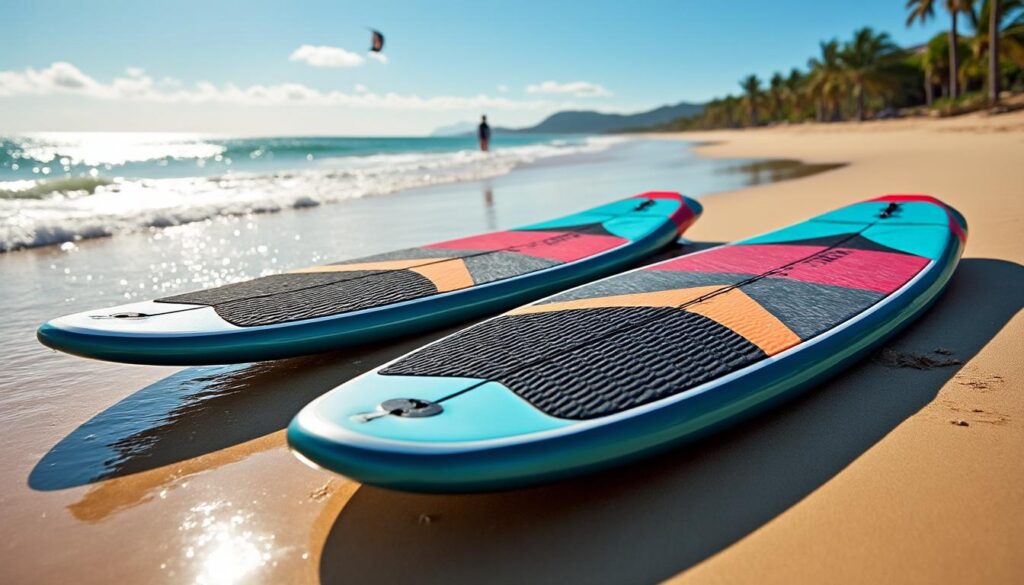
The board, almost always a twin-tip for beginners, is shorter and narrower than a classic surfboard. It allows you to ride in both directions without turning, you only need to switch the edge you ride on. Those who want to dive deeper into boards can take a look at the updated guide on the best kiteboard twintips 2026, useful to understand differences between freeride, freestyle and light wind models. The harness, waist or seat, transfers the kite’s traction to the pelvis, saving arms and shoulders: a good model makes the difference between 20 minutes of effort and two hours of continuous session.
To make the choice clearer, here is a concise overview of the main components:
| Component | Main function | Advice for beginners |
|---|---|---|
| Kite (wing) | Generates power by harnessing the wind | Choose a stable freeride model with wide depower |
| Bar + lines | Control of kite power and direction | Lines 22–24 m, simple and highly visible safety |
| Twin-tip board | Allows gliding in both directions | Slightly larger size to make starting easier |
| Harness | Transfers traction to pelvis and core | Comfortable, well-fitting model; check the hook |
| Helmet and impact vest | Protection from impacts and falls | Always worn, especially during learning |
The dynamics of a typical session start on land. You rig the kite, check lines and quick release, evaluate wind direction and intensity. Only when everything is OK do you proceed to launch, with an assistant holding the kite at the edge of the window while the rider positions downwind. Once airborne, the first minutes are for “feeling” the traction and doing basic figure eights without the board. Then you enter the water, position yourself in body drag, and only afterwards attempt the water start with the board on your feet.
Once gliding, the game is to manage the kite’s traction by moving it up to maintain power, while your feet control direction on the board’s edge. At first the body tends to stiffen and the rider tires; with experience you relax and let the harness work more. With regular sessions, in a few weeks a motivated beginner can tack in both directions, head upwind and stop under control.
On safety, there are no shortcuts. Helmet, impact vest and kite safety leash are not optional. To choose protections up to today’s needs, it can be useful to consult a dedicated guide such as this on kitesurf helmets 2026, designed for those who want to progress without taking unnecessary risks. A simple rule sums it up: if you don’t feel safe pulling the quick release, you’re not ready to be alone in the water.
Understanding how the kite really works is not a technical detail; it’s what allows you to read every gust as an opportunity instead of a threat. And once you make peace with the mechanics, the most fun part arrives: choosing where to go use it.
Spots and wind: kitesurf Salento, Adriatic and Ionian compared
When talking about kitesurf Italy, one of the South’s strongest cards is the presence of two different seas just a few kilometers apart. Kitesurf Salento plays precisely on this double exposure: Adriatic on one side, Ionian on the other. If one side is onshore and choppy, often the other is side or side-off and more manageable. This is where the famous Salento wind shows its character: tramontana that cleans the Adriatic, scirocco that charges the Ionian, maestrale that gives full-power days.
Imagine a rider, Luca, who arrives for his first week of kitesurf holidays in Puglia. He read about some spots on Instagram, but on the first day he finds rotated wind and choppy water where he expected flat water. The trick locals learn quickly is simple: you don’t choose the spot from the photo, you choose it from the bulletin. One day you ride on the Adriatic with long waves and steady wind, the next day you move to the Ionian to look for flatter water and cleaner gusts.
Between kitesurf Lecce and kitesurf Taranto opens a real corridor of spots: sandy bays perfect for beginners, stretches of coast more technical for those who love jumps and waves, windy areas that work with directions that elsewhere would be wasted. For those who want a complete picture of where to go based on level, seasons and wind direction, a useful resource is the overview on spots and kitesurf schools in Salento, which crosses real weather conditions with practical advice from local riders.
The interesting thing is how sessions change between kitesurf Adriatic and kitesurf Ionian. On the former, with tramontana well established, you often find orderly waves that allow work on surf with directional boards or foils, in addition to the classic twin-tip. On the latter, with strong scirocco, it’s not uncommon to find flat water zones behind natural sandbanks or shoals, ideal for freeride and early jumps. The result is that in a few days you can try conditions that in other places would require different trips.
Looking beyond Puglia, the map of the best spots in Italy is constantly evolving. Historic locals on Garda and Lake Como, windy bays in Sardinia, wave spots in Tuscany and Lazio, up to the big practice fields of Sicily. To get a global idea of the best kitesurf spots in Italy, it’s useful to compare different locations in terms of dominant winds, logistics, seabed and beach space, as many technical guides dedicated to this do.
From a conscious choice perspective, it’s also essential to know how to read a spot’s limits. Too crowded? Unstable wind? Seabed full of submerged rocks? These are all things that don’t always emerge on paper but completely change the value of a session. The advice remains the same: consult schools and local riders, especially on the first outings in new places; it’s the safest shortcut to a successful session.
In short, a true kitesurf spot Puglia is not just a pretty beach. It’s a package made of readable wind, manageable seabed, maneuvering space and onshore support. If one of these elements is missing, the spot becomes immediately more demanding, especially for beginners. And once you understand this logic, choosing the next destination becomes a much more interesting game.
Seasons, forecasts and tricks to choose the right session
Each sea has its own calendar. In Salento, for example, spring and autumn are often the most regular seasons for wind, with still pleasant temperatures and less crowded beaches. Summer brings thermals and lighter winds, perfect for beginners or for foil and larger boards. Winter, for those who don’t fear a thick wetsuit, offers maestrale and tramontana days that make advanced riders happy.
To choose the right session, the golden rule is simple: check the weather before, not during. Reliable apps, cross-checked weather models, spot webcams and, when possible, real-time feedback from schools and locals. The best decisions come when weather and local knowledge speak the same language. And next time you look at a map of Puglia, you won’t see just beaches: you’ll see potential kite trajectories.
Learn kitesurf: courses, schools and the journey from day one to the first glide
Those approaching kitesurf for beginners often have the same question in mind: “How long does it take to stand up and ride?” The truth is there’s no single answer, but there is a clear path. A good kitesurf course always starts on land, with theory about the wind, rigging the kite and safety, then moves to kite handling in body drag and finally to the water start. Thinking you can “skip” these steps is the fastest way to get injured and lose motivation.
A kitesurf school
To give you a clear idea of the typical path, here’s a concise list of the main phases:
- Briefing on land: basic theory on wind, the spot, safety and signals.
- Rigging equipment: connecting the lines, cross-checks, use of the quick release.
- Kite handling on land and in shallow water: wind window, power zone, depower.
- Body drag: being pulled in the water without the board to learn direction and recovery.
- Water start: positioning, timing between kite movement and push on the board.
- First tacks: speed control, direction change, stopping safely.
The body drag phase is the one many underestimate and want to skip, but it’s the one that truly builds confidence with the wind. Sliding in the water with only the kite teaches you to manage gusts, power losses and changes of direction without the “worry” of the board. It’s also where you learn to recover the board independently, a skill every rider must have to avoid turning every fall into an endless swim.
An often-forgotten point is the role of observation. Watching other students and more experienced riders, listening to feedback on the beach, recognizing others’ mistakes before making them yourself accelerates learning a lot. The best progression isn’t that of someone who “tries blindly,” but of someone who internalizes corrections and sensations, turning them into automatisms.
The journey from day one to the first glide can take from a few days to a few weeks of distributed practice. It depends on conditions, lesson frequency, physical preparation and the ability to listen. Working in wind that’s too strong or on complex spots at the start slows you down rather than speeds you up. For this reason, when choosing a course, logistics and the spots used matter as much as the number of hours planned.
In many parts of Italy, especially in the South, schools offer packages that combine lessons and onshore support even after the course, for the first “semi-autonomous” outings. It’s in these sessions, still monitored but less guided, that the beginner truly becomes a rider. And it’s precisely when you start choosing your own board, kite and harness that you enter the heart of the kite lifestyle.
Kitesurf equipment: kites, boards, harnesses and foils without getting fooled
Talking about kitesurf equipment doesn’t just mean listing items, but understanding which combinations actually work for your weight, level and the spot you’ll visit most. A kite that’s too large for the local average wind, an uncomfortable harness or a tiny board chosen only because it “looks pro” can turn every session into frustration. The goal is simple: find a setup that helps you progress with control and margin for error.
Choosing the kite is the first fork. For beginners, an all-round freeride model with good depower is the most logical path. Delta or hybrid Bow kites often offer easy water relaunch and wide wind windows, perfect for those who still need to learn how to manage gusts and lulls. Those aiming for freestyle or wave will find more specific models later, but the base remains the same: a stable kite, clear feel on the bar and an immediate safety system.
On the board, twin-tips dominate in volume among beginners and intermediates. The larger the board (within limits), the more it helps early starts and gliding in marginal wind. Later, directional boards for waves or foil boards dedicated to kitesurf can be considered for those who love flying above the chop with little wind. The foil, if approached after a solid twin-tip base, opens a completely new chapter: sessions possible with winds that once seemed unusable, silence and an almost surreal glide.
An element too often overlooked is the harness. It’s what holds your body and the kite’s power together. A model that shifts, rides up on the ribs or creates pressure points immediately ruins the session. To find the right balance between comfort, lumbar support and freedom of movement, it’s useful to rely on reviews and targeted tests, such as those dedicated to choosing the best kitesurf harness for different disciplines. Here the details matter: hook shape, back stiffness, closure system.
Equally important is the safety equipment: helmet, impact vest, buoyant wetsuit, line cutter. These are items nobody praises on social media but everyone appreciates when they’re needed. Especially in kitesurf for beginners, constant use of these protections should be the rule, not the exception. The real difference between an experienced and a reckless rider isn’t the number of tricks, but how they manage risk.
Finally, a note on equipment timelines: in 2026 the kite market is mature but constantly evolving in materials and details. There are ever lighter wings for light wind, boards with eco-friendly constructions and harnesses designed to reduce loads on the back and hips. Updating doesn’t mean changing setup every season, but knowing what exists and when a targeted upgrade makes sense.
The key rule remains this: the best equipment is not the most expensive, it’s the one that lets you go out more often, with more control and more margin for error. If every time you rig the kite you wonder whether it will “hold,” something in the choice needs review. If instead your mind is free to focus on maneuvers and the wind, then you’re on the right path.
Benefits, differences with surfing and why kitesurf creates a healthy addiction
Those coming from traditional surf often look at kite with a mix of curiosity and skepticism. The typical question is: “Is it really surfing if you’re pulled by a kite?” The answer lies in the feeling on the water. Kitesurf offers something different: it’s not just the wave, it’s a continuous dance with the wind. Average speed is higher, distances covered are greater, and the possibility to jump and play in the air adds a dimension that in classic surf only comes with very advanced maneuvers.
The technical differences between surf and kitesurf are clear. In surf there’s no kite: you wait for the wave, paddle and stand up for a few seconds of ride. The board is wider, longer, designed to float and catch the wave’s wall. In kitesurf the board is shorter and narrower, the wave isn’t necessary because the kite’s pull provides constant traction. Practically, on a decent wind day you do in kite the number of “starts” that in surf you might do in hours of waiting.
Another concrete aspect is luggage and cost. Surf requires less equipment: board and wetsuit can last years. Kitesurf involves kite, bar, harness, board, protections. The budget is larger, but the payoff in water, for many, is worth it. In a week of wind, hours spent gliding with a kite setup are often far more than the actual rides in surf, especially on crowded spots where catching the “good” wave becomes a lottery.
Among kitesurf’s less visible benefits is its impact on mind and body. Gliding on the water thanks to the wind triggers a powerful combination of dopamine and adrenaline, but also deep concentration. You come out physically tired but mentally strangely lighter. The body learns to work functionally: core, legs and back strengthen, balance improves, and the ability to make quick decisions is trained with every sudden gust.
For many, kitesurf also becomes a school of risk management. Being in an environment not “controlled” like the open sea, hooked to a powerful wing, forces you to develop attention, mental flexibility and the ability to read subtle signals: a change in water color, a line of gusts approaching, another rider in trouble. These skills, once developed on the water, transfer easily to land.
The sense of freedom is perhaps the element that creates the most positive “addiction.” Unlike other extreme sports, in kitesurf you’re not in continuous battle with the element. You don’t have to dominate the sea or the wind: you must go with them, find your rhythm within a greater force. And this ability to be swept along while staying clear-headed — to let go or pull the bar at the right moment — is something many riders recognize in daily life as well.
Compared to other board sports, those coming from snowboard, wakeboard or windsurf often find shortcuts in learning: familiarity with stance, edge and traction. But even those starting from zero, without a sports background, can reach a solid level in reasonable time if they accept that the priority isn’t a trick for a video, but mastery of wind, water and equipment.
Ultimately, kitesurf wins because it brings together speed, technique, nature and community. It’s not a solitary sport: the beach is a small village where people swap wind tips, comment on gusts and wait together for the right window to go out. And when you finish the session, with salt on your skin and your head still full of trajectories, you understand why so many people chose to leave the shore and “take the bar” seriously.
How many lessons are needed to start kitesurfing on your own?
On average you need between 8 and 12 hours of structured course with a kitesurf school to reach a level where you can start with the board and tack safely in moderate wind. The transition to full autonomy requires some additional supervised sessions in which you put into practice what you’ve learned, managing rigging, kite selection and returning to the spot on your own.
Is kitesurfing suitable for people who are not very fit?
Yes, kitesurfing does not require extreme strength but control and technique. The harness takes most of the traction onto the pelvis and core, while arms and shoulders guide the bar. With a well-structured course and equipment suited to your weight, it is possible to start even without great athletic preparation, provided there are no specific medical contraindications.
What wind is needed for a good kitesurf session?
For most students and intermediate riders, the ideal range is from 14 to 25 knots, depending on weight, kite size and board type. Winds that are too light make starting difficult, while winds that are too strong require advanced experience and smaller kites. Before every outing it is essential to check forecasts, direction and possible changes during the day.
Is it better to buy equipment right away or wait until after the course?
It is advisable to complete at least the basic course before investing in your own equipment. During lessons you can try different sizes and models and receive precise guidance on which kite, board and harness are best for your weight, level and usual spots. Buying too early increases the risk of choosing unsuitable material or having trouble reselling it.
Is kitesurfing dangerous?
Like all power sports in a natural environment, kitesurfing can be dangerous if practiced without training, without respect for safety rules or in conditions beyond your level. Taking a course with certified instructors, always using a helmet and safety device, choosing appropriate spots and not going out alone are the keys to drastically reducing risks and enjoying the sport responsibly.