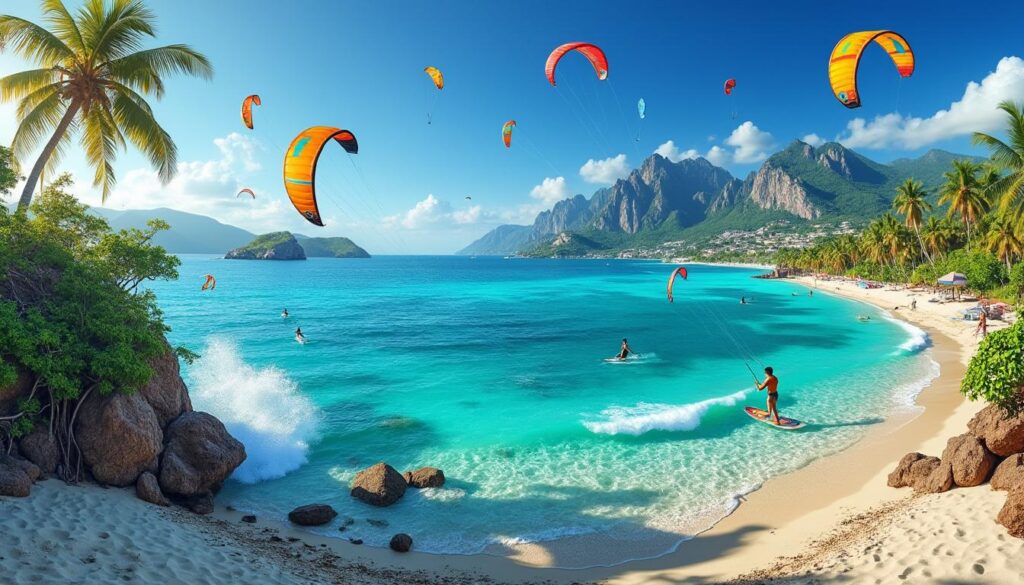
Constant wind, turquoise water, reefs that raise serious waves and a surf culture that in Hawaii is part of everyday life. Those looking for kitesurf in the middle of the Pacific don’t just find postcard beaches, but a real open-air laboratory where wind is taken seriously, like in Salento when the Mistral decides the day. Oahu and Maui are the two key islands for those who want to combine technical sessions with pure freeride moments, with spots ranging from workable flat water to waves that challenge even the most confident riders. The idea is not just “going on holiday,” but using the trip to grow, better understand your kite, and refine timing and sea reading.
A rider like Luca, who comes from kitesurfing the Adriatic and Ionian Seas, suddenly finds himself managing more regular trade winds, different currents and a shore break that doesn’t forgive water-start mistakes. Here you quickly realize that choosing the miglior spot kitesurf Italia is no longer enough: Hawaii forces you to change pace, to organize your days around the wind and not the other way around. Between Kailua, Kanaha, Ho’okipa and the other spots across the archipelago, every bay has its own character and its traps. Salento Kiter’s goal is not to sell a dream, but to give you concrete tools to plan a clear-headed, fun and above all safe trip, that brings you home with more control of the bar and less dependence on what brochures promise.
In short
- Oahu: accessible spots, relaxed atmosphere, often moderate wind, ideal for kitesurf for beginners and intermediates who want to get into the Hawaiian mood without immediately exposing themselves to huge waves.
- Maui: higher level, often stronger wind, significant waves; Kanaha and Kitebeach are the references for those who already have good board and kite control.
- Best period: trade winds more reliable from spring to early autumn, with some interesting winter windows for wave riders.
- Approach: don’t improvise; study the weather, talk to local schools, choose spots matched to your level, as you would for kitesurf Salento, kitesurf Lecce or kitesurf Taranto.
- Connections: a trip to Hawaii teaches many things you can bring back to your home spots in Italy, from Puglia to Sicily, improving wind reading and handling rougher sea conditions.
Kitesurf Hawaii: understanding wind, seasons and differences between the islands
When we talk about kitesurf in Hawaii, many only look at the photos. The real point, however, is the wind, which here is dominated by the northeasterly trade winds. They blow with a regularity that in Europe is seen only in a few times of the year, somewhat like the Salento wind when it comes in strong and holds for days. This means that, if you plan the trip well, you can schedule almost daily sessions, alternating choppy sea and more sheltered areas depending on the island you choose.
The trades generally stabilize between late spring and early autumn. During these seasons, windy windows are wide, especially on Maui and Oahu, which are the most exposed islands. Winter brings significant swells that thrill wave riders, but it requires a solid level, especially when the reef emerges and mistakes are costly. Here the same logic used to choose a spot kitesurf Puglia comes into play: wind direction, swell, tides and presence of obstacles.
An aspect that surprises many riders used to kitesurfing in Italy is the combination of steady winds and lateral currents. It’s not uncommon to find yourself pointing upwind more than expected to maintain position, especially during hours when the wind strengthens and the chop increases. Those coming from kitesurfing on the Ionian Sea, where you often ride on almost flat water, find themselves working more with their legs and managing gusts that require continuous power adjustments at the harness.
To avoid being caught unprepared, it’s always wise to set Hawaii as a natural extension of a kitesurf learning path started at home. Those coming from a good kitesurf course in the Mediterranean already have the basics to understand the wind window, manage self-rescue and handle the board in shore break. This baggage is useful when the Pacific decides to raise the tone and the waves begin to close on the shore one after another.
Many wonder whether winter or summer is more favorable. The answer depends on your goal: if the focus is freeride with stable wind and relative thermal comfort, the summer season is the most logical choice. If instead you aim for significant waves, you need to monitor winter swell reports and accept a greater margin of uncertainty. In both cases, the rule is the same that applies to any spot, from kitesurf Fuerteventura to the African ocean: never rely only on Instagram photos, but look at real data, wind charts and local reports.
Ultimately, understanding Hawaiian wind means learning to read a new context and then bringing that awareness back to your usual spots, whether kitesurfing the Adriatic, Ionian or some hidden bay in Puglia.
Ideal period for kitesurfing in Hawaii and planning sessions
Planning a kite trip here follows a logic similar to those organizing kitesurf vacations to other wind-reliable destinations, like in the case of kitesurf in Fuerteventura. Hawaii’s advantage is the combination of mild climate and regular trade winds. However, micro-differences between islands make a bit of study essential before booking accommodation.
A good strategy for a first trip is to allow at least ten full days, with room for two or three no-wind days or days when the sea is too big for your level. In the meantime, you can use breaks for wave surfing, SUP or simply to tour the island and better understand entry points, countercurrents and areas to avoid.
Just like for kitesurf in Tarifa, having a plan B is not a luxury but a necessity: a local kitesurf school for technical upgrades, rental of different boards, foil or a small surfboard in case of lighter winds, and perhaps some more sheltered alternative spots when the outer reef is working too hard.
In short, the wind in Hawaii is non-negotiable: you study it, anticipate it and then exploit it to the fullest with a clear head and a choice of spots consistent with your real level.
Kitesurf Oahu: Kailua, Makaha and the ideal spots to start and progress
Oahu is often the first landing place for those who dream of kitesurf in Hawaii. More populated, with a mix of city and nature, it offers a combination of spots that allow those who have trained at a spot kitesurf Puglia or other corners of kitesurf Italy to cut their teeth with steadier wind. The bay that attracts most riders is Kailua, a long stretch of light sand protected by an outer reef, relatively calm water and winds that, on good days, come in side-on, perfect even for kitesurf for beginners already autonomous on upwind edges.
Kailua is not just a beach; it’s a true open-air gym. The sea, generally less aggressive than the more exposed reefs, allows work on starts, speed control, transitions and first jumps in a relatively forgiving environment. Those coming from kitesurf Lecce or the long beaches of kitesurf Taranto find similar sensations of space and safety margin, but with a plus: the regularity of the trades which, on the right days, seem designed for those who want to progress.
Further from the comfort zone is Makaha, a decidedly more wave-oriented spot. Here the picture changes: reef, more substantial waves, an energy that doesn’t forgive sloppiness. For those used to moderate waves like many spots in kitesurf Ionio, Makaha represents a step up and requires careful reading of the wave sets and the sections that close on the reef. It’s not the place for first hooked edges, but rather for those who already know how to handle straps, a small surfboard and front-side surf maneuvers.
A typical day for Luca in Oahu could start with a morning wind check, pass through Kailua for a first warm-up and then, if level and conditions allow, move to more demanding spots in the afternoon. This mix of options makes Oahu an island interesting both for those coming out of an Italian kitesurf school and for those seeking serious waves but who don’t want to give up a quieter alternative if the Pacific turns up the volume.
Compared to many European spots, Oahu’s advantage is the coherence between wind and logistics: many spots are relatively accessible by car, with parking and services, and the surf culture is so rooted that no one is surprised to see boards and kites rigged in every corner of the coast. However, respecting local rules is fundamental: bathing areas, navigation lanes, spaces reserved for windsurfers. Ignoring these guidelines is not only disrespectful but also a real safety risk.
In the end, Oahu is the island that lets you move from the theory of a kitesurf course to practice in ocean water, with the possibility to manage mistakes and fears in a context that, if respected, returns clean sessions and lots of confidence on the board.
Oahu for those arriving from Italy: what to really expect
A rider who knows kitesurf Salento well is often used to two seas and a wind that changes mood depending on the Adriatic-Ionian channel. Landing in Oahu, they find a different situation: less variation within a few hours, but more influence from currents and reef. Someone experienced on a spot kitesurf Puglia with strong winds is advantaged in managing chop, but must reprogram instinct regarding safety distances from the reef.
The recommended gear for Oahu depends on weight and level, but many riders find it useful to have at least two kites: one around 9 m for windy days and an 11–12 m for softer scenarios. A classic twin-tip for freeride and, for those who want to try waves, a small surfboard gladly. The wetsuit in many seasons is more protection from the wind than from the cold: a shorty or light long-sleeve rather than a thick steamer.
The real impact for those arriving from Italy is not only technical but mental: in Oahu you no longer have the excuse “today the wind is inconsistent.” Here the ability to read the correct wind window, choose a coherent kite range and admit when the sea is above your level truly comes into play, returning to Kailua or a more protected spot. It’s this clear-headed attitude that transforms the trip to Hawaii into a lasting step up in skill.
Kitesurf Maui: Kanaha, Kitebeach and the realm of experienced riders
If Oahu is the island that introduces kitesurf in Hawaii, Maui is the playground for the hungrier riders. Here the combo of trades + reef + wave culture creates one of the most vibrant kite scenes in the world. In the Kanaha Beach Park area and the so-called Kitebeach, the wind often fills in more than on Oahu, especially in the central months of the season. This makes Maui perfect for those who already have secure control of water starts, upwind riding and early advanced maneuvers, and want to test themselves on stronger waves and currents.
Kanaha is a multi-level spot. The part closer to shore, with shallower water and reduced waves, is often used by those consolidating technique after the kitesurf for beginners phase. Further out, where the reef begins to create clean sections, small surfboards and foils come into play, with riders exploiting each gust to work on timing between turns and waves. Those used to kitesurfing the Adriatic, with often messy sea, discover here how different it is to surf waves that always form in the same spot.
Kitebeach, as the name suggests, is Maui’s kite heart. The wind can be more intense and gusty, especially on high-pressure days. For those who learned in more permissive spots like some bays of the kitesurf Ionio, this change of register requires a precise setup: careful bar trim, a more aggressive board stance and greater attention to not overpower the kite.
Maui is also a place where the average level in the water is high. It’s not uncommon to share the spot with professional riders, training sessions, photo-shoots. Beyond the myths, this means two things: constant inspiration, but also the need to keep orderly conduct, respect right-of-way and avoid random maneuvers in others’ trajectories. You’re not there to “show off,” but to improve, exactly as when you slot in among the strongest locals in kitesurf Salento on a windy day.
The combination of windsurf, surf and kite on Maui creates a unique wind-sport ecosystem. For this reason many riders choose to stay at least a couple of weeks on the island, alternating strong wind days with morning wave-surf sessions. The idea is not to accumulate meaningless kite hours, but to use each session as a building block to develop control, technique and safety.
Ultimately, Maui is not the island to choose as your very first kite baptism. It’s rather the natural step after gaining solid experience, whether you started in Puglia, Sardinia or, why not, other oceans like Dakhla or Zanzibar. Here the wind treats you like a rider, not a tourist.
Maui compared with European and Mediterranean spots
To really understand Maui, it helps to compare it with destinations many Italian riders already know. The constant and often strong wind partly resembles ocean spots like Dakhla, or certain full days in Fuerteventura or Tarifa. But the reef + wave culture mix brings Maui closer, in atmosphere, to places like Bali with its kitesurf spots, where the sea is not just background but a main actor.
A rider coming from a typical Mediterranean kitesurf holiday, perhaps used to spots like Paros or Corfu, here faces a continuity of swell that forces work on timing when entering and exiting the break. It’s a bit like transitioning from a flat spot in Puglia to a formed day on the west coast of Sardinia: the scenario changes, and so must your set of priorities in the water.
Many Italians who start from a solid foundation in a local kitesurf school find in Maui the ultimate proving ground to see if their technique really holds up. Between sustained wind, wave sections and a high average level, Maui gives nothing for free but returns a lot in terms of awareness. It’s a laboratory where skills acquired over years of kitesurfing in Italy are tested in the open ocean.
Best kitesurf spots in Hawaii: comparison between Oahu, Maui and other islands
To really choose the best kitesurf spots in Hawaii, it’s wise to look at the archipelago with the same logic used for kitesurf Italy: there is no “perfect spot,” there are spots suited to different levels, goals and weather. Oahu and Maui are the heart of the scene, but other islands offer lesser-known options that are not always suitable at first glance. The key is always to link wind, wave and logistics.
To get a clearer view, imagine comparing some characteristics as you would between kitesurf Salento, Sicily and Sardinia. Some look for strong and wavey wind, others prefer flatter water for freestyle, others want to enter the water only when waves exceed certain sizes. Hawaii allows all these variants, provided you don’t improvise.
A useful tool to put things in order is a comparative table that helps visualize quickly the main differences between the main spots of Oahu and Maui. It doesn’t replace contact with local schools or riders, but offers a basis to build an intelligent itinerary.
| Island / Spot | Recommended level | Water type | Average wind | Points of attention |
|---|---|---|---|---|
| Kailua (Oahu) | Independent beginner / Intermediate | Light chop, protective outer reef | Moderate trade winds, side-on | Bathing areas, respect navigation lanes |
| Makaha (Oahu) | Upper-intermediate / Wave rider | Reef waves, marked shallows | Variable wind, often gusty | Emerging reef, current |
| Kanaha (Maui) | Intermediate / Advanced | Chop + zones with waves, mixed bottom | Medium-strong trade winds | Crowding, reef in some sections |
| Kitebeach (Maui) | Advanced | Waves and chop, active reef | Often strong wind | High level of riders in the water, gusts |
Reading this table, it’s easy to see how Kailua plays a role similar to spots used for kitesurf courses and first independent outings in the Mediterranean: more space, less risk of overly demanding sea. On the other hand, Kanaha and Kitebeach resemble more technical destinations like Dakhla or certain Bali reefs, where a reading error can lead to a complicated return.
Other islands, like Kauai or the Big Island, offer less-traveled spots. However, logistics weigh more here: harder access, fewer schools, sometimes more extreme conditions. For a first trip, Oahu and Maui remain the most sensible mix between variety, relative safety and wind quality.
Just like with the miglior spot kitesurf Italia, the final choice depends on your starting point. A rider with years of experience on the Adriatic and Ionian can afford to push toward more technical spots. Those who have recently left a kitesurf school in Puglia or elsewhere in Italy will do well to build an itinerary centered on Kailua and the more inner area of Kanaha, with margins to grow day by day.
In the end, Hawaii’s real strength is not having the single “number one” spot, but a system of different spots that allow a natural progression, provided you don’t overstate your level.
Practical checklist to choose your spot in Hawaii
To make the choice concrete, it’s wise to think with a clear list to use before planning inter-island transfers or daily commutes. A good checklist could be:
- Real level: can you do a secure water start, upwind riding and return autonomously even with chop and current?
- Trip objective: freeride, wave riding, technical progression, foil, or a balanced mix?
- Logistics: do you have a rental car, space for equipment, accommodation near key spots?
- Equipment: do you have at least two kite sizes, a board suited to your weight and, if needed, an appropriate wetsuit?
- Local support: do you know a kitesurf school or local instructor to consult about conditions?
Answering these questions honestly before deciding whether to focus on Oahu, Maui or a mix of both will make the difference between a trip full of productive sessions and a series of days spent watching the ocean from the shore.
From Hawaii to kitesurf in Italy: how to bring the experience home
Once you’ve tasted Hawaiian wind, the temptation is to think every other spot is “less.” In reality, those returning to Italy with that mindset miss the trip’s real gift: the ability to better read your home spot, whether kitesurf Salento, the Tuscan coast or northern lakes. Comparing Hawaiian trades and local winds helps you understand how small details of orientation and intensity matter.
For a rider who frequents kitesurf Lecce, used to choosing each day between the Adriatic and Ionian based on the wind, the Hawaiian ocean becomes an advanced school in forecast reading. Once back, the same attention used to decide if Kanaha would be 25 knots can be applied to interpret a Scirocco disturbance or a strong Mistral in Puglia.
Equipment management also changes. Someone who had to handle strong gusts and reef waves in Maui learns to value precise setups, conscious trim and careful maintenance of kite and lines. This translates into greater safety when, in Italy, you find yourself perhaps on a spot kitesurf Puglia with strong but gusty wind, where a poorly tuned kite can turn the session into a pointless struggle instead of a focused workout.
From a mental standpoint, facing high-level spots like Kitebeach or Makaha helps develop deep respect for the sea. Those returning to Salento after seeing what a real ocean wave set means tend to take fewer unnecessary risks on days when the Adriatic or Ionian starts working hard. It’s not about fear, but about recognizing days when the sea asks for a step back or a gear change.
Practically speaking, Hawaii can be read as a masterclass that then applies everywhere: in kitesurf vacations to other ocean destinations, but also in the daily life of those who frequent Italian spots closer to home. The important thing is to avoid turning the experience into a mere exotic memory, and instead use it as a key to genuinely raise the level of every subsequent session.
Integrating the Hawaii experience into your progression path
In the end, the real question is: what changes in your way of learning and progressing after a trip to Hawaii? The answer lies in building a conscious path. Those coming out of a good kitesurf course in Italy have the technical basis, but often lack the habit of quickly reading new scenarios. Hawaii forces this ability, because every windy day is different and every spot has its own dynamics.
Once back home, it makes sense to continue the path with local instructors and schools, perhaps asking for advanced coaching sessions focused on the skills the ocean highlighted: chop management, wave timing, kite control in overpower conditions, advanced safety. This way the loop between kitesurf Hawaii and kitesurf Italy closes, creating a continuous growth flow instead of an isolated parenthesis.
Those who live in or often visit kitesurf Salento have an extra advantage: the presence of two seas, Adriatic and Ionian, allows you to replicate in miniature that “mental mobility” learned between Oahu and Maui. Knowing how to change spots based on the wind, without fixating on a single beach, is exactly the kind of flexibility that grows a rider.
What is the best time to kitesurf in Hawaii?
The trade winds are most consistent from late spring to early autumn, with steady wind especially on Oahu and Maui. Winter offers significant swells for wave riding, but requires a higher level and more flexibility regarding windy days. For a first time, many riders choose the summer season to combine reliable wind and generally more manageable sea conditions.
Are the Hawaii suitable for kitesurf beginners?
Hawaii is not the ideal place for the very first lesson, but a spot like Kailua on Oahu can be suitable for beginners already autonomous on edges and water starts, especially if followed by a local school. Those who haven’t taken a course yet should first learn in a simpler context, for example in Italy or the Mediterranean, and then use Hawaii as the next step in their progression.
What equipment is recommended for Oahu and Maui?
Many riders bring at least two kites (e.g., 9 and 11–12 m) to cover most wind conditions. A twin-tip freeride board is sufficient for most sessions, while a small surfboard is recommended for those aiming at waves. In many seasons a light wetsuit or shorty is enough, more to protect from the wind than from the cold.
How do Hawaiian spots compare with kitesurf spots in Italy?
Hawaiian spots offer more consistent wind and more substantial waves compared to many Italian spots, but the selection logic remains similar: evaluate wind direction, swell, bottom type and crowding. Those familiar with kitesurf Salento, the Adriatic or the Ionian find Hawaii more demanding, but they apply the same basic rules with even more attention to safety.
Is wave experience required to enjoy kitesurfing in Hawaii?
It is not mandatory if you choose more protected spots like Kailua or some inner areas of Kanaha, where the chop remains manageable. However, being comfortable with small-to-medium waves helps a lot, especially for entry and exit phases. Those aiming at more wave-oriented spots, like Makaha or Kanaha’s outer sections, should already know how to handle a small surfboard, right-of-way and timing on wave sets.