Foil Surf is the word you hear more and more often on the beach: that board with a submerged wing that makes you “fly” above the water, even when the wave is small or non-existent. If you’re wondering What is Foil Surf, How Foil Surf works and how to set up your first session without hurting yourself, you’re in the right place. Salento offers two seas, kitesurf Adriatico and kitesurf Ionio, and a capricious but generous wind: a perfect laboratory to understand how the foil turns every ripple into glide. Here we speak plainly, like after a session, with sand between your toes and your head still full of clean lines.
The goal is to give you concrete tools: a simple definition of Surf with Foil, the physical principles that lift you from the water, Foil Surf Equipment explained without frills, a safe learning progression and the mistakes to avoid. No easy promises: you learn with method, respect for the sea and a good kitesurf school or surf school that knows the vento Salento. We’ll follow a common thread, Luca, 32, who arrives in Puglia for his kitesurf holidays and wants to take advantage of small-wave days to try the foil. If you see yourself in that, good: grab the bar, breathe the salt, and get the foil board ready. Today you learn to read the water in 3D.
Foil Surf: essential definition and differences from classic surfing
Let’s be clear: Foil Surf means riding waves or wakes with a board equipped with an hydrofoil, a submerged wing connected to a mast that generates lift and raises the board above the surface. The feeling? A silky, silent glide, with reduced friction and constant speed, even when the wave stops pushing. Unlike traditional surfing, you don’t need a powerful lip: the foil exploits minimal energy and lets you draw long, fluid trajectories, often away from the crowded peak.
If you’re asking What is Foil Surf in simple terms, think of an inverted airplane wing working in the water. When you reach the right speed, the wing creates upward thrust, the board lifts and you “fly” a few dozen centimeters above the water. This produces two key effects: you glide faster for the same energy and you can connect wave sections that would leave you stuck with a normal surfboard. That’s why many riders talk about the Advantages of Foil Surf in terms of smoothness, speed and fun in marginal conditions.
How do you get into a wave? There are different options: paddle-in like in surfing, tow with a dinghy for first trials, wake behind a boat or even downwind on wind-formed seas. In Puglia, for example, when the kitesurf Ionio only gives chop and long wind waves, the foil lets you plane from one hump to another for kilometers. It’s the “hidden” line that classic surfers don’t see.
There are variants: foil kitesurf and kite foil if you use a kite, wing foil with a handheld wing, SUP foil with a paddle, and even eFoil with an electric motor. But the heart of Surf with Foil remains the same: exploiting hydrodynamic lift. The “magic” lies more in weight control and foil angle than in pure physical strength. Surfers learn to look for energy in the “empty” parts of the wave; kitesurfers find the management of pitch and roll familiar.
To grasp the scale of the change, imagine Luca in the Gulf of Taranto: a slow day, knee-high waves, empty lineup. With a voluminous foil board and a generous front wing, he catches a small shoulder, lifts in two pumps and moves to the outer face, away from the shore. He doesn’t fight for the peak, he doesn’t flee the whitewater: he simply flies from one section to another, as if the wave never ended.
The most obvious difference from classic surfing, besides the height above the water, is the trajectory. The foil prefers wide, gentle turns with a constant radius. No violent bottom turns on the lip: here you carve continuous arcs and coordinated pumps. Less spectacle for the beach, more enjoyment for the rider. And on windy days, when kitesurf Salento explodes on the Adriatico, the foiler can go out early or late, using leftovers and wind waves when kites deflate.
To recap: Foil Surf widens the windows for getting in the water, empties lineups, and enhances small spots. For a rider traveling among the best kitesurf spots Italy, it’s insurance against “flat” or nearly flat days. It’s the art of making any ripple perform. This is the first truth to take home.
How Foil Surf works: lift, control and water flows
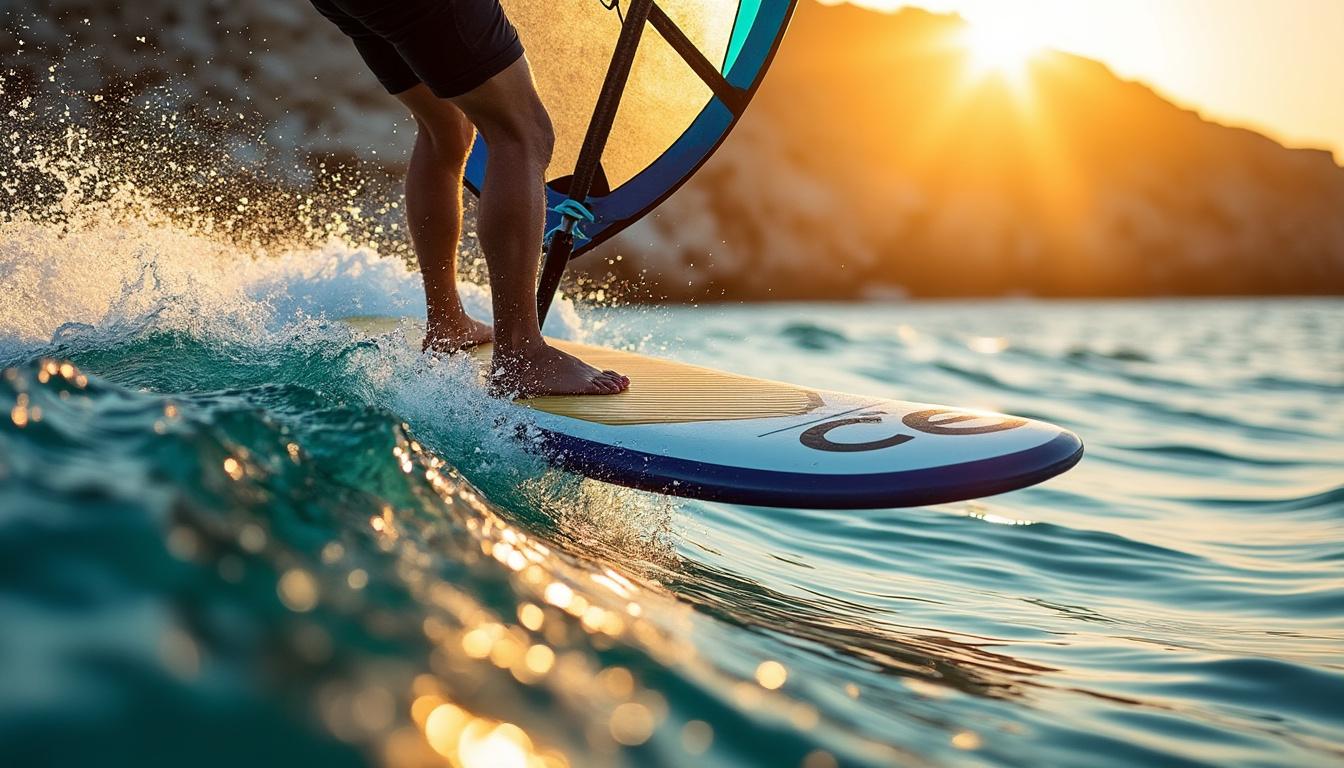
The crucial question: How Foil Surf works? The hydrofoil generates lift by deflecting water downward. The wing shape creates higher pressure below and lower pressure above; the difference produces vertical thrust. Simply put, when you accelerate, the wing “takes you” and lifts you until lift balances weight and drag. Less wetted surface, less drag, more speed. It’s the same logic as hydrofoils and foiling boats seen in the America’s Cup, applied in miniature under your feet.
In real riding, control happens across three axes: pitch, roll and yaw. Small weight shifts on the front or back foot adjust the wing’s angle and therefore the lift. Too much weight back and you climb like a plane at takeoff, then stall and fall; too much forward and the board sticks. The trick is finding the “neutral” trim and maintaining it with micro adjustments.
Critical speed depends on the front wing and conditions. All else equal, a larger wing produces lift at lower speeds: perfect for learning or for slow waves. A smaller wing, with a thinner profile, moves faster and turns tighter, but demands control. That’s why Foil Surf Equipment is not interchangeable: it must match your level, your weight and the waves you most often encounter between the Adriatico and Ionio.
Two phenomena to know: ventilation and cavitation. Ventilation is the intake of air on the profiles, typical when the wing gets too close to the surface or during aggressive maneuvers; the foil loses grip and “shoots you down.” Cavitation, rarer in surfing, is the formation of bubbles due to very low pressures on very fast profiles: you feel vibrations and loss of control. They are prevented with clean technique, sufficient mast depth and appropriate wings.
The pump is the human engine of the foil. With coordinated vertical movements of legs and torso, you momentarily increase the angle of attack and speed, regenerating lift without direct help from the wave. It’s the secret to linking flat sections, overcoming lateral currents or changing line. Train it on flat water behind small wakes, feeling the timing: push, lighten, glide.
How does all this translate into Salento water? A maestrale day on the Adriatico, short and fast waves: medium-high mast to keep depth, medium front wing, centered stance and eyes looking far ahead. On the Ionio with long swell and calm seas, a larger wing and wide carve, seeking energy at the “foot” of the swell. The wind changes? The energy flow you read changes too. This is where the foil teaches you to “see” what you used to ignore.
For those coming from kitesurf Italia, a natural bridge is the foil kitesurf: using the kite, lift arrives earlier and the trim is learned safely on flat water. Then you move to pure Surf with Foil when wave reading is ready. It’s a smart shortcut if you want to speed up learning without losing days.
When everything clicks, the sober magic of the foil happens: the water quiets, the sea becomes a treadmill, the body works finely. And you understand that physics is helping you, not complicating your life.
Micro-adjustments that change the session
– Move the back foot half a centimeter and feel the difference on the pitch. – Anticipate your gaze on the line of energy, not on the bow. – Keep your shoulders relaxed: stiffness creates oscillations. These details reduce the most common mistake: climbing too high and stalling. Remember: delicate legs, decisive trajectory.
If you internalize how it works before the power, every maneuver becomes simpler. Clean technique is the real accelerator of your progression.
Foil Surf Equipment: foil boards, foil board, wings and materials
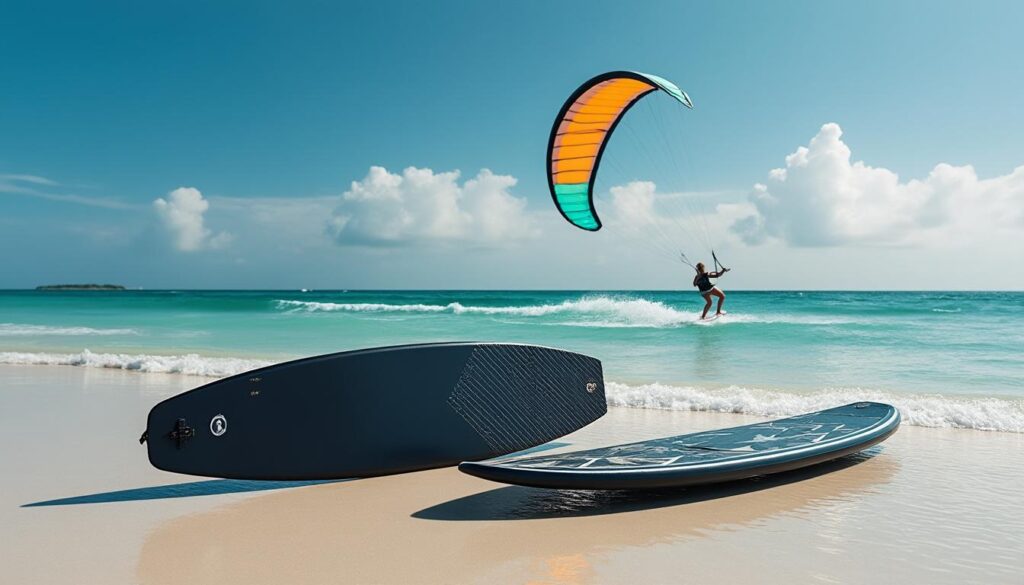
The choice of Foil Surf Equipment determines half of your progression. A foil board to start should have enough volume to float with margin (rider weight + 15/25 liters), a stable trim and an adjustable foil insert. Modern foil boards vary: compact shapes for maneuverability, full volumes for easy starts, raised noses for soft landings. The aim is to find a balance: starting stability, reactivity in flight.
The hydrofoil is modular: front wing, stabilizer (rear wing), mast and fuselage. The front wing determines much of the personality: larger surface = early lift and lower speed, smaller surface = higher speed and tighter turns but demands control. The stabilizer affects longitudinal stability; the mast, in aluminum or carbon, ranges between 60 and 85+ cm; the fuselage defines the lever arm and therefore directional stability.
Materials: aluminum and fiberglass for contained budgets and robustness; carbon for lightness, stiffness and reactivity. The most common mix today is an aluminum mast and carbon wings, to get precise feel without a huge price increase. If you often sail in kitesurf Lecce or kitesurf Taranto, spots with shallow or rocky bottoms, protect the foil with covers and consider masts that are not too tall for the first outings.
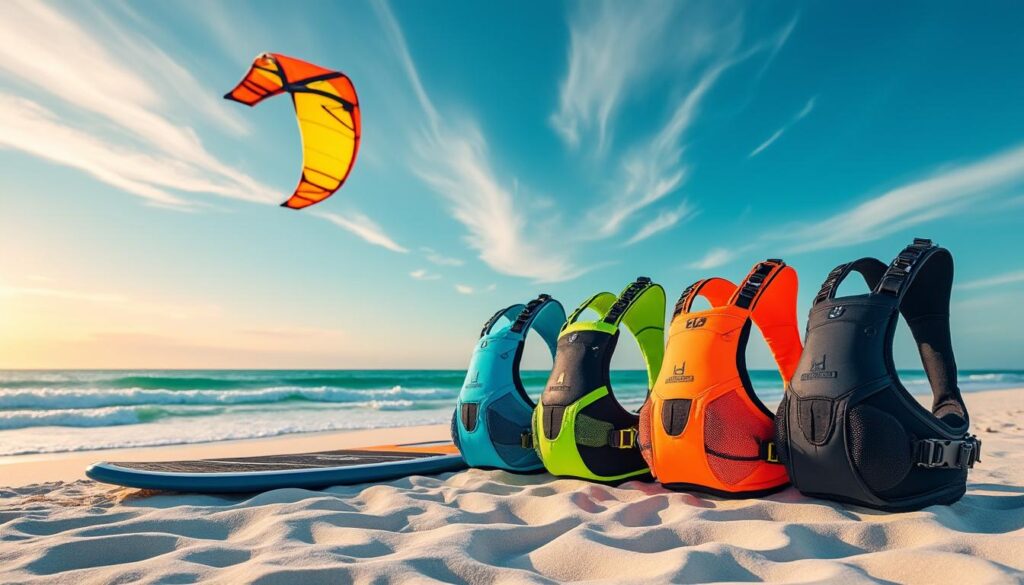
Essential accessories: a front or waist leash (specific for foil), a helmet and an impact vest (no discussion: put them on), a wetsuit appropriate for the season, booties if needed. In Puglia the water changes between Ionio and Adriatico: always check thermals and local tides.
Recommended setups by level and conditions
| Livello 🚀 | Ala anteriore 🦅 | Mast 📏 | Volume tavola 🧊 | Condizioni ideali 🌊 |
|---|---|---|---|---|
| Beginner | 1700–2000 cm² thick profile | 70–75 cm | +15/25 L over body weight | Slow waves, boat wakes, flat water with tow |
| Intermediate | 1300–1600 cm² | 75–85 cm | +5/10 L | Regular waves, moderate downwinds |
| Downwind | 1800–2200 cm² high AR | 80–90 cm | +10/20 L and slick shape | Wind swell long on Ionio or Adriatico |
Note: the measurements are indicative. Personal feel and wave reading matter more than the spec sheet. If you weigh 80 kg and want to How to start Foil Surf on small waves in San Foca, better a 1800 cm² wing and a voluminous board; if you already pump well and look for tight turns in Porto Cesareo, you can reduce surface and volume.
- 🛡️ Safety first: helmet and impact vest always with a foil.
- 🧰 Maintenance: rinse with fresh water, check screws and play every 2–3 sessions.
- 🧭 Spot check: bottom, currents, exit corridors, local rules of kitesurf Salento.
- 🧪 Test and adjust: move the foil in the box (further forward = more lift) and take notes.
- 🤝 Foil Surf lessons: half a day with an instructor shortens weeks of attempts.
Invest in a setup consistent with you and your spots, not with the hype of the moment. Equipment coherence is the number one ally of your technique.
How to start Foil Surf: progression, safety and Foil Surf Lessons
The best path for How to start Foil Surf is linear and safe. The goal is not “to get up once”, but to make controlled take-offs and stay flying while managing the pitch. A kitesurf school or a surf school experienced with foil gives you method, the right spots and a boat for towing. In the kitesurf Puglia area, between Lecce and Taranto, the offer has grown: get informed, try, and choose someone who really knows the two seas and local currents.
Phase 1 – Controlled tow (flat water): with a short rope behind a boat or dinghy, a voluminous board, big wing. Start on your knees, then stand. Find the neutral position: weight centered, shoulders relaxed, eyes forward. Lift a few centimeters, drop back, repeat. Here you learn sensitivity to lift without the chaos of the wave.
Phase 2 – Wake & pump: progressively release traction and play with the small wake. Enter and exit the “cone of energy” training timing and pump. Goal: 30–60 seconds of continuous flight with soft landings. Learn to breathe: inhale when you climb, exhale while you stabilize.
Phase 3 – Small slow waves (empty lineup): choose spots with deep water, no exposed rocks and moderate currents. Start outside, avoid bathing and surfer zones. Take knee-high waves, without the ambition of tight turns. Make a clean, long line. The foil is not in a hurry.
Phase 4 – Basic maneuvers: gentle turns, roll control, micro-carve. Introduce the first wide cutbacks only when altitude is stable. Remember: active feet, centered hips, look guides every turn.
Safety: the foil is rigid and sharp. Don’t surf in the middle of crowds, don’t release the board when you fall, protect your head and ribs. With strong wind and cross waves, evaluate if it’s sensible: a day for the kite foil can be perfect for sensible progression, while messy waves make Surf with Foil more nervous.
A coach’s trick: set a goal for the session (e.g. “5 controlled take-offs and 3 clean landings”). Then stop. Fatigue worsens technique and increases risk. Better two short, good days than one long, confused one.
Remember (3 key points) ✅
- 📅 Plan: weather first, tide and currents next. Check both seas: if the Adriatico is messy, often the Ionio is perfect.
- 🏫 Kitesurf course / Foil Surf lessons: with an instructor you shorten the curve, avoid bad habits and respect local rules. Consider a kitesurf school in Salento.
- 🛟 Safety: helmet, impact vest, the right leash and plenty of space around. Always.
Proceeding in phases, without skipping steps, makes learning stable. Patience today becomes control tomorrow.
Advantages of Foil Surf and when to use it between Adriatico and Ionio
The Advantages of Foil Surf are concrete and change your water calendar. First: smoothness. The foil dampens chop, cuts the noise of the wave and takes you on continuous trajectories. Second: speed. With less drag, you glide longer on the same energy. Third: versatility. Knee-high waves? No problem. Wind-scrambled waves? You can build a downwind session there. It’s the freedom to choose days you used to skip.
In Salento, the double sea is a natural advantage. Clean maestrale? The Adriatico leads with short, fast waves: perfect to train pump timing and transfers between humps. Calm scirocco? The Ionio is smooth with long, soft swell: there you build kilometer-long lines. And if you’re traveling for kitesurf Italy, putting a foil board in the car means guaranteeing more days on the water compared to someone who brings only a surfboard.
Then there’s crowding. Surf with Foil isn’t done in the middle of the peak: you stay farther out, on waves left free by surfers. Less conflict, more respect for everyone, and enough space to train maneuvers without worries. With a bit of practice, you start to “read” the useful lines outside the traditional circuit.
Synergies with other sports: if you already practice foil kitesurf, you have half the journey done on trim control; if you do wing, you immediately recognize pump and stance. Windsurfers who switched to foil report the same benefits: when the wind drops and chop disturbs, the foil keeps the brightness and fun.
Another often underrated plus is training. Foiling trains ankles, core, balance and proprioception like few water sports. This translates into tangible benefits across disciplines: better water starts in kite, cleaner landings in surf, finer body management on SUP.
So why doesn’t everyone do it? Because it requires humility and method. The initial curve is real, mistakes are paid with noisy slides and some bumps. But with the right Foil Surf Tips, adequate space and coherent equipment, the reward comes soon: long lines, zero crowds, sea exploited in every condition.
Practical Foil Surf tips for Salento
- 🧭 Spot kitesurf Puglia: on the Adriatico prefer sandy bottoms like San Cataldo; on the Ionio choose deep bays like Porto Cesareo for first take-offs.
- 🌬️ Vento Salento: gusty Maestrale? Go in when the thermal stabilizes, avoid hours of maximum turbulence.
- 🌊 Clean lines: look for banks that lengthen the wave; the foil loves long “empty” sections.
- 📸 Zero ego: no showing off among swimmers or surfers. Respect for the sea comes before likes.
- 📞 Contact a school: to learn kitesurf and foil together, a kitesurf course with a foil module speeds you up sensibly.
Using the foil intelligently means more time in the water and fewer lost days. In a territory with two seas like ours, it’s a session multiplier. Remember it when you pack the car: the foil is your plan B that often becomes plan A.
How difficult is it to start Foil Surf for a beginner?
With method and the right equipment, the curve is manageable. Start with tow on flat water, a large wing and a voluminous board. In 2–4 guided sessions you learn take-off and soft landings; from there you build stability and pump.
Is it better to start with an eFoil or directly with Surf with Foil?
The eFoil helps to understand lift and trim without depending on waves or tow, but it is expensive and does not replace wave reading. If the goal is Surf with Foil, the classic path (tow + small waves) with an instructor remains the most effective.
Which foil board to choose for 70–80 kg?
For first outings: volume equal to body weight +15/25 L, front wing 1700–2000 cm², mast 70–75 cm. When flight is stable, drop to 1300–1600 cm² and reduce volume for more maneuverability.
Which Salento spots are suitable for the first Surf with Foil?
Deep bays and sandy bottom: on the Ionio Porto Cesareo and Torre Lapillo; on the Adriatico stretches between San Cataldo and Frigole with sandy bottom. Avoid crowds, exposed rocks and strong lateral currents.
Are helmet and impact vest mandatory?
Strongly recommended. The foil is rigid and sharp: helmet and impact vest reduce risks to the head and chest, especially in the first 10–15 sessions when mistakes are more frequent.