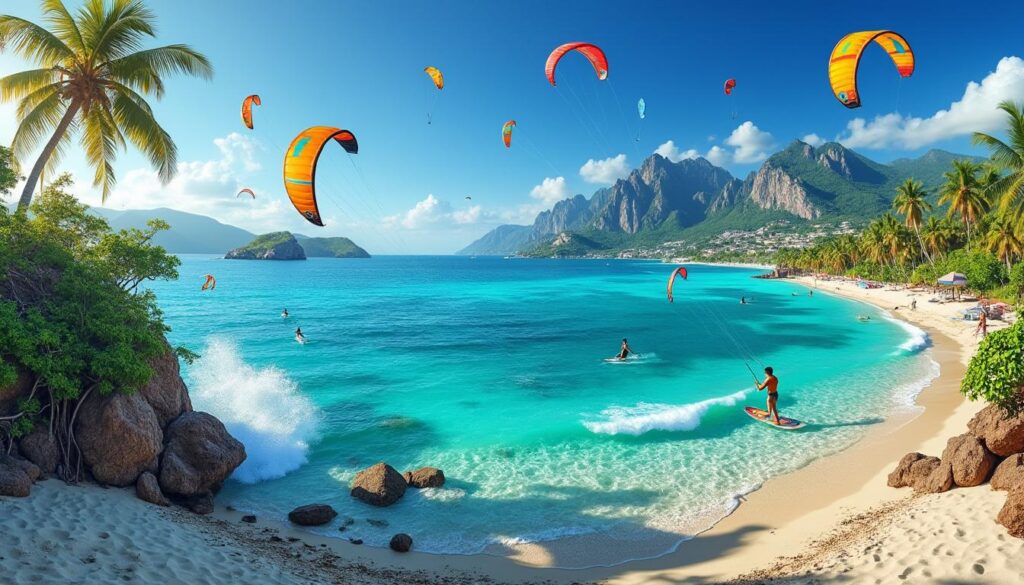
The Italian Kitesurf Championship has become the time of year when the wind really decides who’s in charge among the athletes. From stages on the Adriatic kitesurf to the warmest bays of the Ionian kitesurf, the national calendar brings together Big Air, Freestyle, Wave, Kitefoil and Wingfoil in a circuit that touches the entire peninsula. Jumps over 20 metres, borderline landings and millimetre-precise race tactics mix with beaches crowded with onlookers, local schools and youngsters watching the races dreaming of their first water start. The wind is no longer just a figure in a weather app: it becomes the final judge of every heat.
The official stages, coordinated by the national class and local associations, showcase everything kitesurf Italy has to offer: flat lagoons perfect for Freestyle, formed seas for Wave, and shallow-bottom spots ideal for kitesurf for beginners who want to get closer to competitive racing. A strong example is the Grado stage, in Friuli, where thirty athletes from across the peninsula compete in Big Air in front of the Al Bosco campsite, with the Adriatic Sea seeming drawn to leave room for kite trajectories. And while the best go for the Italian title, the local schools organise lessons, clinics and equipment trials for those who want to level up. The result is a circuit that doesn’t speak only to the pros, but to anyone who smells sea salt and wants to better understand how this world works.
- A national circuit with stages on the Adriatic, Tyrrhenian, Ionian and northern lakes, including Big Air, Freestyle, Wave, Kitefoil and Wingfoil.
- High-level Italian athletes, with around thirty riders selected for the most spectacular disciplines like Big Air.
- Spots and local schools that turn each event into an opportunity to learn, try equipment and experience kitesurf up close.
- Kitesurf Salento and Puglia kitesurf spots increasingly present as strategic hubs of the competitive and recreational movement.
- Focus on beginners: courses, beach briefings and clinics to safely introduce new riders to wind and competition.
Italian Kitesurf Championship: how the calendar and race formats work
To understand the Italian Kitesurf Championship: Calendar, Races and Athletes you first need to sort out acronyms, disciplines and formats. It’s not a single event, but a real tour of multiple stages, managed in collaboration between federations, kiteboarding class associations and local organisations. Each year an official calendar is published with the selected locations: open sea, lagoons, lakes, and in winter even snowkite on high plateaus. Each spot is chosen based on wind statistics, space on water and land, seabed safety and the presence of an organising kitesurf school in the area.
The main disciplines are four. Big Air, where jump height, aerial control and difficulty of tricks count; Freestyle, with unhooked tricks, spins and bar passes; Wave, that is surfing the wave using the kite only as propulsion; and Kitefoil, which brings the kite into race mode, often sharing the circuit with Wingfoil. Each discipline has its own format: in Big Air athletes have a “wind window” in which to pull the best jumps, while in Kitefoil courses follow buoy courses with fleet starts, very similar to Olympic sailing.
The calendar is built taking wind seasons into account. Early in the year, locations with favourable spring statistics are prioritised; in summer the caravan moves to thermally-ventilated spots and, when autumn arrives, the Adriatic and Tyrrhenian provide the right disturbances for Big Air and Wave. Experimental stages in new places are not missing, such as the one in Grado in Friuli, where Big Air arrived for the first time with thirty athletes from all over Italy ready to push to the physical limits.
Each stage has precise logistics: registration the day before or the morning of, skipper meeting on the beach, heat board displayed for all heats, and then off you go, first starts around 9 or 10 if the wind fills in. The finish is almost always in the late afternoon, around 5–6 pm, with awards on the waterline among boards on the sand and rolled kites. The overall championship ranking is based on points collected at each stage: those who are consistent and can adapt to different spots end up taking the tricolour title home.
For those watching from outside, the beauty of following this calendar is seeing how kitesurf changes from one spot to another. A stage with flat water and side-on wind pushes Freestyle; a chop-filled sea from the Mistral calls Big Air; a long swell with side-off wind provides a Wave contest to remember. The circuit, in short, is a journey through the best each best kitesurf spot Italy can produce throughout the year, and each stage is a puzzle piece that tells the story of a wind-driven Italy still little known to the general public.
The key point is this: the championship is not just a list of dates, but a way to learn to read the wind and the spots by watching the best at work, from north to south of the peninsula.
The Grado stage and the role of new spots in the Italian movement
A perfect example of how the calendar opens to new areas is the Grado stage, in Friuli-Venezia Giulia. For the first time, this North-East location hosted a FIV Italian Kitesurf Championship event in the Big Air specialty, bringing about thirty athletes from all over Italy to the stretch of sea in front of the Al Bosco campsite. Here conditions are particular: shallow seabeds, almost no waves, and regular spring winds that allow both races and sessions dedicated to those who want to learn kitesurf with the instructors of Kite Life FVG ASD, the same association coordinating the event.
The typical race day in Grado starts around 9 in the morning, with the first beach briefing. The sea stretch is secured, the take-off and landing area is defined, and from 10 onwards the action begins. Big Air finds its ideal stage here: acceleration on almost flat water, decisive pop and jumps that can exceed 20 metres in height. Judges evaluate height, control, composition of the tricks, and every landing absorbed on the feet is worth precious points. The competition window extends until 6 pm, taking advantage of every useful gust to complete the draw up to the final.
Around the competition moves an ecosystem that tells a lot about kitesurf Northern Italy. Partner accommodation – campsites, hotels, aparthotels – become the base for athletes, staff and the public. Between heats, those not racing get in the water to try equipment, test foils, and ask advice about setups. Organisers use the event to get tentative spectators closer: static kite demos on the beach, explaining safety systems, first body drags in shallow water.
This openness is fundamental for growing the movement. A boy or girl who maybe only knows kitesurf from social media, seeing the championship structure live, understands that there isn’t just the isolated hero doing the trick for the perfect clip, but an organised environment, with clear rules and growth paths. The Grado stage thus becomes a bridge between competition and everyday practice: those who race keep raising the bar, those who watch find the motivation to finally sign up for a kitesurf course.
The message that passes, ultimately, is simple: a new spot added to the calendar is not just another location on the map, it is an invitation to consider the whole North-East as a mature area for kite, on a par with historically better-known regions.
Athletes and categories: who competes for the title in kitesurf Italy
Talking about the Italian Kitesurf Championship: Calendar, Races and Athletes mainly means telling who gets into the water when the wind exceeds 25 knots and the gusts start selecting the most prepared. In recent years the level of Italian athletes has risen sharply, both among Big Air specialists and those aiming for foil and Wingfoil regattas with international ambitions. The group that attends the main stages includes around thirty riders selected for Big Air, plus youth and female categories that fill the Freestyle and Wave draws.
Race categories are designed to enhance different styles. There’s the Men’s Open, where the strongest names of the circuit meet, but also the Women’s category, increasingly competitive and spectacular, and the Junior classes, essential to provide continuity for the movement. Some stages also include masters or advanced amateurs, ideal for those transitioning from local spot rider to national competitor. In this way the championship becomes a real growth path: you start with local races, try a national stage, refine heat reading and pressure management.
Behind every athlete there’s a routine made of hours of water training, but also physical preparation, nutrition and studying the wind. Those aiming for the Big Air title look for spots with strong gusts, near home or away, to train pop timing and rotation control. Those living in areas like kitesurf Lecce or kitesurf Taranto, for example, exploit the Salento wind that in summer brings Mistral and thermals on two different seas: the Adriatic and the Ionian. This double exposure almost always allows them to find a useful window for training, simply switching coasts when the weather changes.
Alongside well-known names on the circuit, the championship makes room for new stories. Some come from traditional sailing schools and switch to Kitefoil for speed and the chance to compete in mixed regattas. Others start as kitesurf for beginners on a holiday in the south, fall in love with the feeling of flying over water and, within a few years, find themselves in a national heat pulling a 9-metre kite in 30 knots. These trajectories don’t happen by chance: behind them are serious schools, instructors who push for improvement and spots that allow volume time on the water in safety.
An often underestimated element is the work of the staff: judges, race directors, safety teams, doctors on the beach. Without them, no race could start. They are the ones who decide whether conditions are sufficient to launch the first heat, who stop the competition when the wind becomes unmanageable or when storm cells approach. Safety remains the priority, always. A 20-metre jump is only worth it if it’s within a managed context, with rescue means ready to intervene.
In the end, the championship tells the story of a community: athletes, coaches, schools, wind mechanics. Those who follow these races closely know it well: seeing an Italian rider climb the podium, after a season spent traveling, training and a few heavy crashes, also gives meaning to the session of the kid struggling with their first water start in a lagoon far from the limelight of competitions.
Schools, courses and growth paths towards competitiveness
Every athlete who appears in the national ranking has passed, sooner or later, through a kitesurf school that taught them to respect wind and safety. The typical path begins with a basic kitesurf course, often during kitesurf holidays in Puglia, Calabria, Tuscany or Campania. First you learn kite handling on land, then body drag, water start and the first reaches. To better understand these stages, a useful read is the detailed guide on kitesurf for beginners, which explains step by step each level jump.
After the first course, those who feel the push towards competition look for consistent spots and coaches with race experience. Some schools organise real clinics oriented to competition: heat analysis, choosing maneuvers to bring into the water, managing tension before the start. In disciplines like Kitefoil, this also involves theory moments: rules, laylines, right-of-way. Those who want to deepen the technical part also find dedicated resources on foil topics, such as the insights on kitesurfing foil technique, which help to better understand why the foil has become a cornerstone of the national calendar.
The transition from spot freestyler to heat athlete requires some key skills: repeating maneuvers with a high completion rate, maintaining control even when overpowered, and above all knowing when to risk and when to stick to safer tricks to pass the round. It’s a balancing act between spectacle and strategy. In Big Air, for example, a slightly lower jump landed cleanly often scores better than an extreme attempt half-closed with a crash.
Schools working in areas like kitesurf Salento or other Puglia kitesurf spots have an advantage: long seasons, two seas, variable winds. Here you can train everything. Light thermals for early foil outings, Mistral perturbations at 25 knots for big jumps, Sirocco to work on wave riding. This mix creates the perfect ground for those wanting to move from simple “go and come back” to the conscious use of the kite as a complete sporting tool.
The link between schools and the championship is clear: without a solid base of well-guided beginners, the level of the pros drops within a few seasons; without pros pushing hard in competition, young people have less motivation to progress. The national calendar holds this cycle together, showing on a large scale what schools cultivate every day in the spots.
Key spots of the calendar: Adriatic, Ionian, North and South compared
Visiting the stages of the Italian Kitesurf Championship: Calendar, Races and Athletes you discover how varied the wind geography in Italy is. The Adriatic offers long sandy beaches, often with shallow bottoms, ideal for Big Air and Freestyle. The Tyrrhenian mixes chop and more structured waves, a perfect ground for Wave and mixed events. The Ionian, especially in the south of the peninsula, gives days of crystal-clear water and steady wind, excellent for training jumps and foil. To these are added the northern lakes, where thermal winds create predictable, regular sessions.
For those planning moves based on races or training, it’s useful to look at Italy as a map of microclimates rather than regions. Some territories have become true hubs of competitive kitesurf. Puglia, for example, concentrates a series of spots ranging from Salento to the Gargano, with varying conditions depending on the coast and season. The article dedicated to the best Puglia kitesurf spots helps to understand how to move between Adriatic and Ionian following wind changes, information essential also for those following the race circuit.
Looking at a year of the calendar, it often happens that athletes move from the Adriatic kitesurf of the North-East to spots in the South of Italy within a few weeks. The contrast is clear: on one side lagoons and wide beaches, on the other more enclosed bays, rocks and mixed seabeds. Yet, it is precisely this diversity that makes the circuit interesting. Those aiming for the title must know how to adapt equipment and style: switching from a 12-metre freeride to a 9-metre C-kite, from a Freestyle twin-tip to a directional wave board or a race foil.
In the South, areas like the Ionian kitesurf and kitesurf Salento play a special role. The wind here is not negotiated: it’s studied, awaited and exploited. Autumn storms provide days that could easily serve as a preparation stage for the windiest stages of the national calendar. It’s not uncommon to see Northern athletes head here off-season for intensive days of training on two seas. The day a swell makes the Adriatic impracticable you jump to the Ionian and the session continues, with different light and waves behaving in the opposite way.
Also kitesurf Northern Italy plays an important role. Grado, as seen, is a symbol of this growth, but it’s not the only one. Other lake and marine spots offer ideal conditions for Kitefoil and Wingfoil, disciplines that require steady wind and wide water areas. Here the sailing culture is deeply rooted and the transition to competitive kite happens almost naturally, with many athletes coming from traditional Olympic classes.
In summary, the championship calendar sketches a wind-driven Italy that goes beyond the usual images of summer sea. Adriatic, Ionian and northern lakes become a continuous laboratory, where each stage helps to understand better where and how to train during the rest of the year.
Comparative table of the main types of spots in the circuit
To get oriented in kitesurf Italy, it’s worth comparing the typical characteristics of the different environments that host race stages or intensive training.
| Area | Type of sea/water | Typical wind conditions | Ideal disciplines |
|---|---|---|---|
| North Adriatic (eg. Grado) | Shallow bottom, flat water or light chop | Spring winds and thermals, medium-high intensity | Big Air, Freestyle, schools for beginners |
| Central-South Adriatic | Wide beaches, moderate waves with disturbances | Mistral, Sirocco, strong winds in autumn | Freeride, moderate Wave, mixed events |
| South Ionian (Salento, Calabria) | Crystal-clear water, mixed seabeds | Summer thermals, winter and autumn disturbances | Kitefoil, Big Air, pre-race training |
| Tyrrhenian | Structured waves, variable seabeds | Westerly disturbances, regular swell | Wave, advanced Freeride |
| Northern Lakes | Freshwater, regular thermals | Lake breezes morning/evening | Kitefoil, Wingfoil, technical training |
Reading this table with an athlete’s eyes means one thing: plan the year knowing where to find the right conditions for the discipline you want to push the most.
From beginner to experienced spectator: experiencing the races to learn kitesurf
The beauty of the Italian Kitesurf Championship: Calendar, Races and Athletes is that it doesn’t speak only to those already in the circuit. Each stage is an open-air school for those still making their first tacks. Watching a race from the beach, with the wind pushing sand into your ankles and kites passing overhead, is worth more than many hours scrolling videos on social media. You see how athletes set up the start, manage the downloop, prepare the take-off a second before the jump, dose power and speed.
For a beginner, attending a championship stage as a spectator is an opportunity to understand what it really means to “control the bar” when the wind rises. You notice who’s relaxed in the air, who lands softly, who pulls too early and gets launched forward. All of this can then be brought into one’s own practice, asking for advice from riders present or instructors from the schools attending the event. Many organisations use race days precisely to offer “clinic + race” packages, where part of the time is dedicated to following heats and another part to targeted technical sessions.
Another valuable aspect is contact with the equipment. At these events it’s common to find brand stands, demo boards, new kite models available for test rides, always supervised by instructors and experienced riders. To get oriented among equipment, a useful read before choosing is the focus on windsurf and kitesurf equipment, which helps understand differences between freeride wings, C-kites for freestyle, big air boards and foils dedicated to speed.
Those who come to kitesurf thanks to the races also discover something often left unsaid: the importance of safety and managing personal limits. Seeing an expert rider cancel a trick because the gust came in badly, or because the chop rose beyond the expected, teaches that knowing when to say “enough, I’ll go in” is part of the game as much as a successful jump. This mindset is fundamental for beginners, especially in crowded spots.
Many spots, especially in Puglia, Campania, Calabria and Tuscany, combine races with courses designed for newcomers. Articles like those on kitesurf destinations in Italy show how to plan a trip following wind, schools and maybe even a championship stage to watch live. So, instead of a generic seaside holiday, you find yourself living days marked by beach briefings, heat boards, starting whistles and personal sessions in your free time.
In the end, the best way to learn kitesurf is not only the course itself, but full immersion in wind culture: whole days spent watching the anemometer, commenting on jumps, understanding why one rider won a heat and another didn’t. The championship offers exactly this: a living laboratory where every gust tells something about how to improve on the water.
How do you enter the Italian Kitesurf Championship?
To participate in the stages of the Italian Kitesurf Championship you must be registered with a recognised school or association and possess the technical level appropriate to the chosen discipline. Generally, registration is done through your kitesurf school or online via the official channels of the kiteboarding class. Some stages have limited spots and selection based on ranking or results in local races.
Is the championship suitable for beginners?
The actual races are designed for intermediate and advanced riders, but each stage is very useful for beginners as well. You can follow the heats from the beach, talk to athletes and instructors, take part in specific clinics and book basic lessons with the organising school. It’s one of the best ways to understand how to set up a healthy progression towards competition.
What equipment is needed to start kitesurfing before thinking about racing?
To start you only need a freeride kite with a modern safety system, a compatible bar, an all-round twin-tip board, a harness, a suit appropriate for the season, a helmet and a flotation vest. At the beginning it is advisable to use the equipment provided by the school during the kitesurf course, so you can better understand sizes and styles before buying your own gear.
What are the best periods in Italy to follow kitesurf races?
The national calendar focuses between spring and autumn, when wind statistics are more favourable. Spring is ideal for stages on the Adriatic and northern lakes, summer for thermally-ventilated spots, while autumn brings disturbances suitable for Big Air and Wave, especially on the Adriatic and Ionian. Each year the exact dates are published on the official channels of the class and federations.
Is a minimum level required to train in the same spots as the championship?
No, the spots that host the races remain accessible even to those with a basic level, but it is important to respect take-off zones, areas reserved for competition and the indications of the local school. If you are still a kitesurf beginner, it is always better to get in the water assisted by an instructor or experienced riders to avoid problems on very windy days.