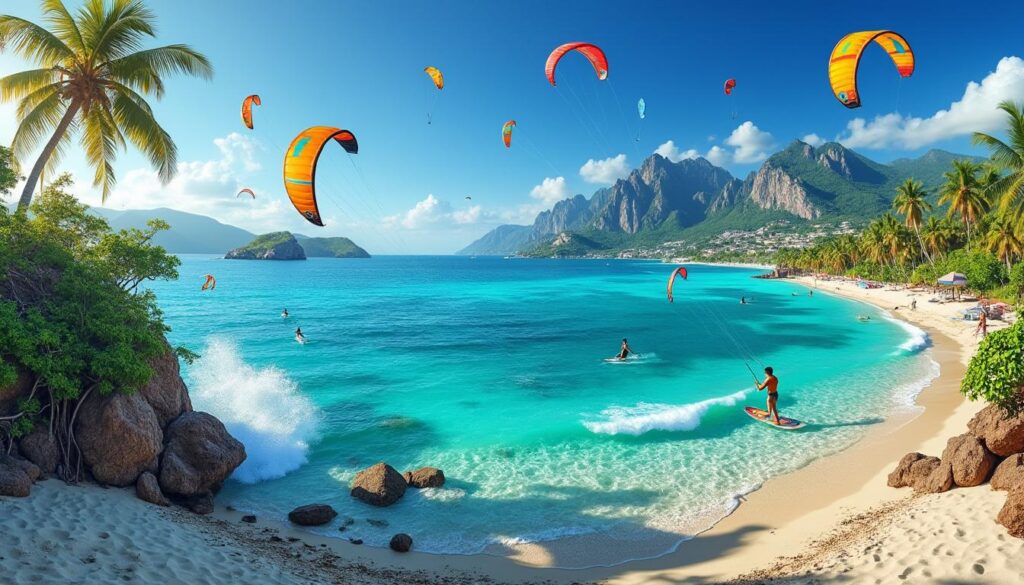
On the Tuscan coast the sea is not just umbrellas and sandcastles. Between pine forests, dunes and cliffs, the wind lights up colorful sails and boards that cut through the water with purpose. Kitesurf and surf in Tuscany have become, year after year, a true open-air laboratory for those who love gliding: from the historic spots of the Maremma to the Spiagge Bianche of Livorno, up to the sheltered lagoons ideal for beginners. Those who arrive here find varied conditions: long waves from Libeccio swell, almost flat sea with a steady Maestrale, afternoon thermals that save the session even when weather apps forecast calm seas.
This setting has given rise to a dense network of kitesurf and surf schools in Tuscany, trained instructors and active communities that live the sea all year round, well beyond the umbrella season. Days often start with a coffee at the lido bar while watching the sky, checking webcams and commenting on weather models. Beginners find structured paths, large boards and docile kites, while experienced riders chase the most favorable swells and the cleanest winds to launch into jumps and high-level rides. It is not a playground built on a drawing board, but a real coast, with its limits, its rules, its secret courtyards that locals share with those who show respect for the water and the wind.
In short
- Kitesurf Tuscany: Maremma, Livorno, Vada, Calambrone and Talamone are among the most active spots, with very different conditions from one another.
- Schools and courses: along the entire coast there are specialized schools offering kitesurf courses and surf lessons for every level, often active even out of season.
- Best seasons: spring and autumn are the most consistent periods for wind and waves, but with the right weather reading you can ride almost all year.
- Levels: Tuscany offers spots for kitesurf for beginners (lagoons, sheltered bays) and wilder areas for intermediate and advanced riders.
- Italian connection: those who love kitesurf Italy can combine the Tuscan coast with other hubs like Salento, Sicily and Sardinia for a true Mediterranean tour.
Kitesurf Tuscany: overview of the best spots between Maremma and Livorno
The first impression of Tuscany seen from the sea is a mix of pine scent, pale sand and wind that changes mood depending on the season. For kitesurf in Tuscany, the area that paved the way is the Maremma, north of Marina di Grosseto, where a strip of sand beyond the pine wood has become a national reference point. Here kite arrived in the early 2000s, when it was still almost unknown in Italy and you only saw windsurfers and some odd sail on the horizon.
In that area, today recognized as a site of natural interest, a true ecosystem has formed: equipped areas to rig the kite, shaded zones built with wood and reclaimed materials, schools with international instructors and services designed for those who spend whole days waiting for the right wind. This spirit, based on respect for the sea and the environment, has spread along the entire southern Tuscan coast, pushing more and more people toward kitesurf and, as a consequence, toward surf, wing foil and other wind disciplines.
Further south, the lagoon and gulf of Talamone offer another face of kitesurf Tuscany. There the landscape is dominated by the promontory and the nature reserve, with a bay that in certain conditions becomes a wind-stirred pool, ideal for those who want to train water starts or try the first runs safely. Local schools often structure courses modularly: beach sessions for theory, body drag in shallow water and then the first assisted departures. For those already autonomous, Talamone can offer days of steady Maestrale where the bay fills with sails running parallel to the coast.
Heading north, the province of Livorno is rougher. The cliffs limit easy water access, so kiters concentrate mainly at the extremities: the Spiagge Bianche of Vada and the stretch between Tirrenia and Calambrone toward the province of Pisa. At Spiagge Bianche the pale sand and turquoise water almost resemble a Caribbean spot, but the wind is not always linear. You need to know how to read the weather and accept some gusts to enjoy intense sessions, often with wind waves that allow small strapless rides.
In Calambrone, instead, kitesurf has coexisted with windsurf for years. The spot has a strong “wild” identity: the wind can be irregular, launching can be challenging when the sea rises, but those who have good board control recount memorable sessions, with long tacks and jumps on formed waves. It is not the ideal place for first independent attempts, but it is perfect as the next step after a solid base learned in calmer waters.
The real key to reading the Tuscan coast is matching each spot with wind direction. Maestrale, Scirocco, Libeccio, Grecale and local thermals combine with the shapes of the coast, creating very different situations a few kilometers apart. Those who organize kitesurf holidays for several days often move along the shoreline in search of the best spot for the day’s wind direction, somewhat like what happens for kitesurf Salento between the Adriatic and Ionian seas.
In this mosaic of beaches, pine woods and cliffs, the strong idea is clear: there is no single “best kitesurf spot in Italy”, but a constellation of places to choose carefully based on one’s level and the expected wind.
Kitesurf spots Tuscany vs Puglia and Salento: what really changes
For those already familiar with kitesurf Salento, Tuscany offers different sensations. In the heel of Italy the game is often between kitesurf Adriatic and kitesurf Ionian, with two seas that allow you to escape chop or waves by simply switching sides. In Tuscany the morphology is different: the coast is almost always exposed on the same face, but the design of gulfs, promontories and shoals creates surprising local differences.
Those who want an idea of comparisons between Italian spots can use comprehensive guides like this one on kitesurf spots in Puglia, and then place Tuscany on the same mental map. The result is clear: Italy, as a whole, is one big playground, and the Tuscan coast holds an important place for those seeking variety of conditions and a strong historic sailing culture.
The point of contact between Tuscany and Puglia remains one: the wind cannot be commanded, it must be learned. And those who do so consistently end up always finding their session, whether among the Maremma dunes or in front of the coastal towers of Salento.
This type of video is useful to study Tuscan spots in advance: observing how the wind enters, where locals rig their kites, how they move relative to the beach is almost a free lesson before actually getting in the water.
Kitesurf and surf schools in Tuscany: learning kitesurf safely
Those who watch the sails in the distance and think it’s all simple forget the most important step: learning kitesurf requires method, suitable spots and prepared instructors. The good news is that along the Tuscan coast a network of very active kitesurf and surf schools has developed, often founded by sailors with years of experience at sea. From Vada to Rosignano, from Marina di Grosseto to Talamone, up to the northern areas, school signs are not lacking and they offer clear paths for every type of rider.
Many of these realities have been working for over twenty years in sailing and water sports. The evolution was natural: from dinghies to windsurf, then to kitesurf and today also to wing foil. This background ensures one fundamental thing: a meticulous attention to safety, right-of-way in the water and wind management, which is the basis of any sail discipline. It is not just about flying a kite, but about truly understanding what is happening around you, reading the sky and respecting those who share the sea.
To understand how to navigate choices, it can be useful to look at what happens in other areas of kitesurf Italy. Guides like those dedicated to kitesurf courses on Garda show how schools structure programs: wind theory, body drag, bar handling, water start and autonomy. In Tuscany the model is similar, with strong customization based on the typical conditions of each spot.
Imagine a beginner rider, let’s call him Luca, who arrives at the end of April in Marina di Grosseto with zero experience. The school takes him in for a beginner kitesurf course of 3–4 days: first day theory and flying the kite on land, second day body drag in the water with the instructor alongside, third day first departures with the board. The difference between an improvised path and one managed by a serious kitesurf school is huge: faster times, fewer unnecessary falls, more awareness of real risks.
Kitesurf for beginners in Tuscany: where to really start
Not all spots are suitable for those taking their first steps. Cliffs, marked shorebreak, strong lateral currents and gusty wind can ruin motivation in a few hours. For this reason Tuscan schools tend to work in areas with some common characteristics: sandy bottom, beach space to rig safely, manageable wind and often relatively flat water thanks to natural barriers.
In Tuscany, the spots most used for basic courses combine precisely these elements. On ideal days, the instructor can stay near the student almost as if in a pool, following them on foot in shallow water or accompanying them with a larger board. This creates a very favorable context for kitesurf beginners, who can focus on the bar, posture and emotional control without adding too many external difficulties.
Serious schools also clarify immediately the rules of the kite beach: takeoff and landing areas, stretches reserved for more experienced riders, spaces for courses, mandatory use of the safety leash. This kind of discipline does not take away freedom; on the contrary: it guarantees that everyone can enjoy the wind without avoidable accidents.
For those who prefer to start with surf, the Tuscan coast offers several sandy beach breaks with soft waves on medium swell days. Often schools combine surf and kite lessons, using surf to train balance, wave reading and confidence with currents before moving to kite traction.
How to choose a kitesurf school in Tuscany: practical criteria
To avoid getting lost in the choice, it’s worth looking at some key elements before booking:
- Certified instructors: verify that they have recognized training and years of real sea practice.
- Recent equipment: modern kites with updated safety systems, bars in good condition, helmets and impact vests available.
- Spot used for courses: a sandy bottom and open space are better than a scenic but complicated place.
- Number of students per instructor: small groups mean more attention and faster progression.
- Insurance coverage: fundamental, especially for beginners.
Those who apply these filters, in Tuscany as in the rest of Italy, put themselves in the best conditions to turn the first contact with the kite into a true growth path, rather than a memory of fear or frustration. Here the sea gives no discounts, but rewards those who rely on the right guidance.
Watching a basic course on video before leaving helps to understand what to expect: timings, postures, typical mistakes. Arriving at the beach with these images in mind makes everything smoother from the first hours.
Seasons and wind in Tuscany: when to plan kitesurf and surf sessions
The element that decides everything, even before the spot, is always the same: the wind. In Tuscany the kiter’s and surfer’s calendar does not match the sunbather’s. The best days for kitesurf and surf in Tuscany are often concentrated in spring and autumn, when Atlantic depressions and thermal contrasts provide more stable winds and more organized waves.
Between March and June, low pressure systems moving across the Mediterranean can bring sustained Libeccio and clean Maestrale. The result is chopped spots, waves that can be surfed with directional boards and jump sessions for those who love big air. The waters are still cool, but with a good wetsuit you can ride without problems. Many schools open precisely in this period, taking advantage of ideal conditions for intermediate and advanced courses.
Summer changes the tune. On high pressure days the synoptic wind drops, but local thermals come into play. Some areas of Tuscany, especially stretches with a wide plain behind them and a temperature difference between land and sea, develop afternoon breezes that, although less intense, still allow outings with foil, wing or large kites. It’s the perfect time for those who want an introductory kitesurf course and don’t yet need 25 knots to have fun.
In autumn the atmosphere cools and the best ingredients return: more marked depressions, warm sea that releases energy, steady winds. October and November can be magical months for wave surf and kitesurf wave, with less crowded spots and low sunlight that turns every session into a natural film. Those willing to wear a thicker wetsuit are rewarded with conditions often superior to summer months.
Seasonal table: typical wind and conditions in Tuscany
| Period | Prevailing winds | Typical conditions | Advice for riders |
|---|---|---|---|
| March – May | Libeccio, Maestrale, Scirocco | Medium-strong winds, choppy sea, surfable waves | Ideal for intermediates and advanced riders, intensive courses, wave riding |
| June – August | Local thermals, breezes | Lighter wind, often calmer sea | Perfect for beginners, foil, wing, evening sessions |
| September – November | Maestrale, Libeccio, Scirocco | Stable wind, consistent waves, less crowded spots | Top for surf and kite wave, advanced progression |
| December – February | Variable storm winds | Often rough sea, unstable weather | For well-equipped experienced riders, careful spot choice |
This table is not a dogma, but a compass. In every season there are special windows: the perfect wave after a storm, the thermal day that exceeds forecasts, the Maestrale that lasts longer than expected. Weather apps help, but the real step up comes when you start to connect what models show with what really happens on your reference beach.
Many Tuscan riders keep a small session diary, noting wind, spot, tide and feelings in the water. Over time this notebook becomes pure gold: it allows anticipating certain situations and choosing more clearly where and when to go out. The same approach is used in other areas of Italy, from Lake Garda to Salento, and builds a truly shared wind culture.
Equipment for kitesurf and surf in Tuscany: setup, foil and wind management
A coast with such variable conditions requires a considered choice of equipment. Those who live kitesurf in Tuscany year-round know that one kite is not enough to cover the whole wind spectrum, from summer thermals to Libeccio storms. Many local riders set up an “intelligent” kit, with 2–3 sails covering from 12–13 knots up to beyond 30, plus a twin-tip board and, increasingly, a foil or a surfkite board.
For those building their quiver from scratch, it can be useful to consult concise guides like those dedicated to kitesurf equipment for the basic kit. The idea is simple: start with an essential setup but coherent with the rider’s weight, level and the spots most frequently visited. In Tuscany, where the wind can be light in summer and quite strong in autumn, a classic combination for an average-weight adult might be 9–12 meters, adding maybe a 7 for stormy days.
In recent years, kitesurfing foil has changed how days with light wind are experienced. When the thermal struggles to surpass 12 knots, a well-tuned foil allows you to fly over the water with sensations completely different from a twin-tip. Tuscan riders have started to fill bays in summer with silent foils, turning days that once would have been waiting into full sessions of continuous gliding.
Essential equipment for kitesurf Tuscany: reasoned checklist
To avoid forgetfulness and wrong investments, it’s always better to reason by priority. Here is a basic list, designed for frequent use along the Tuscan coast:
- 2–3 kites suitable for your weight, covering light, medium and strong wind.
- 1 twin-tip board with sufficient volume, especially in the first years.
- Comfortable harness (waist or seat) tried in-store, not chosen only online “sight unseen.”
- Wetsuit appropriate for the season: 4/3 or 5/4 with hood for winter and mid-season, 3/2 or shorty for summer.
- Helmet and impact vest, especially during the process of learning kitesurf.
- Safety leash and knife on the bar, to know and actually be able to use.
Those who want to explore foil or strapless surf can add specific boards, maybe starting with used but good-condition equipment recommended by experienced riders or trusted schools. The important thing is not to skip steps: try, ask, compare. Every sea has its unwritten rules, and Tuscany is no exception.
For those who like to dive into the technical detail of foil, it is useful to deepen topics like position, pumping and kite management with resources dedicated to kitesurfing foil and technique. Applying these concepts on Tuscan waters, where thermals often save the afternoon, can really change the quality of the season.
Living kitesurf and surf in Tuscany: lifestyle, travel and connections with the rest of Italy
Kitesurf and surf in Tuscany are not just sports, but a true weave of days marked by wind, tides and rhythms different from classic tourism. Those who organize kitesurf holidays here quickly discover that the program is not built around dinner in town, but around the next day’s weather forecast. The morning question is always the same: “What’s the wind doing today?”. The rest comes after: lunch, cultural visits, city strolls.
The Tuscan coast is also an excellent starting point for a broader kitesurf Italy tour. Many international riders combine a week between Maremma and Livorno with other hubs like northern Sardinia, western Sicily or the Salento heel. In a few moves you go from lagoons ideal for freestyle to wave bays, from closed and predictable seas to more exposed stretches.
Meanwhile, the kite culture grows. Schools organize events, equipment test days, clinics with top athletes who explain tricks and training methodologies. It’s not just about learning new maneuvers, but about sharing a certain idea of the sea: no posing, lots of substance, respect for those who were on those spots when kite didn’t yet exist.
A typical autumn scene: a group of riders coming out of the water at sunset, boards under their arms, dripping wetsuits, wind dying down. In a few minutes stories begin: who caught the best wave, who pushed furthest offshore, who finally landed their first decent jump. These small rituals, repeated beach after beach, build a sense of community that goes beyond the single spot.
Connecting Tuscany, Salento and the rest of Italy: a single wind route
For many Italian riders, Tuscany is a stop on a longer route. In spring you can start with Tuscan winds, continue in summer toward kitesurf Lecce and kitesurf Taranto between the Adriatic and Ionian seas, and maybe close the year in Sicily or northern Sardinia. Each area has its strengths: Tuscany offers a variety of conditions and a strong sailing background; Salento offers the game of two coasts and the Salento wind to decipher; Sicily alternates large lagoons with rougher wave spots.
This interconnection creates a true Mediterranean kite culture. Those who move learn to translate unwritten rules from one coast to another: never underestimate a shifting wind, don’t rely only on apps, listen to locals before going out. All elements that, once internalized, make every new destination more readable and less intimidating.
In the end, whether you’re inflating the kite in front of the Tuscan pinewoods or among southern olive trees, the gesture is the same: you take the bar, feel the pull and let the wind do the rest. The sea changes face, but the deep feeling of freedom remains the same.
What is the best season to kitesurf in Tuscany?
For kitesurfing Tuscany offers the best in spring and autumn, when the Maestrale, Libeccio and Scirocco winds are more frequent and stable. From March to June and from September to November you often find ideal conditions for intermediate and advanced riders, with choppy seas and surfable waves. Summer is more suited to beginners, foil and wing, thanks to afternoon thermals and generally calmer seas.
Are there spots suitable for beginner kitesurfing in Tuscany?
Yes. Many Tuscan schools operate in bays and stretches of coast with sandy bottoms, relatively flat water and beach space to rig safely. Some areas of the Maremma and certain stretches between Vada and Rosignano are used specifically for basic courses. It is important to rely on a kitesurf school that chooses the spot based on the day’s conditions and the students’ level.
Do you need a lot of equipment to start kitesurfing in Tuscany?
To start, the equipment provided by the school is enough: kite, bar, board, wetsuit, helmet and impact vest. Only after a complete course, when you are autonomous in handling the kite and safety, does it make sense to think about your own personal kit. In general, for those who want to practice regularly in Tuscany, a quiver of 2–3 kites, a twin-tip and a good wetsuit already covers most typical conditions.
Can I kitesurf in Tuscany outside the bathing season?
Yes, in fact many of the best days come precisely when the beach resorts are closed. In winter months and mid-seasons, with less crowded beaches and no bathers in the water, it is often possible to practice individually in stretches of coast occupied by umbrellas in summer, always respecting local ordinances and any reserved areas.
What is the difference between the Tuscan coast and Salento for kitesurfing?
Tuscany offers a long, relatively uniform coast, with gulfs, promontories and lagoons that generate different conditions depending on the wind, but essentially facing a single sea. In Salento, instead, the game is between kitesurf Adriatic and kitesurf Ionian: two distinct seas that allow you to choose the coast most suitable for the day’s wind. In both areas the key is the same: read the weather, listen to locals and choose the right spot for your level.