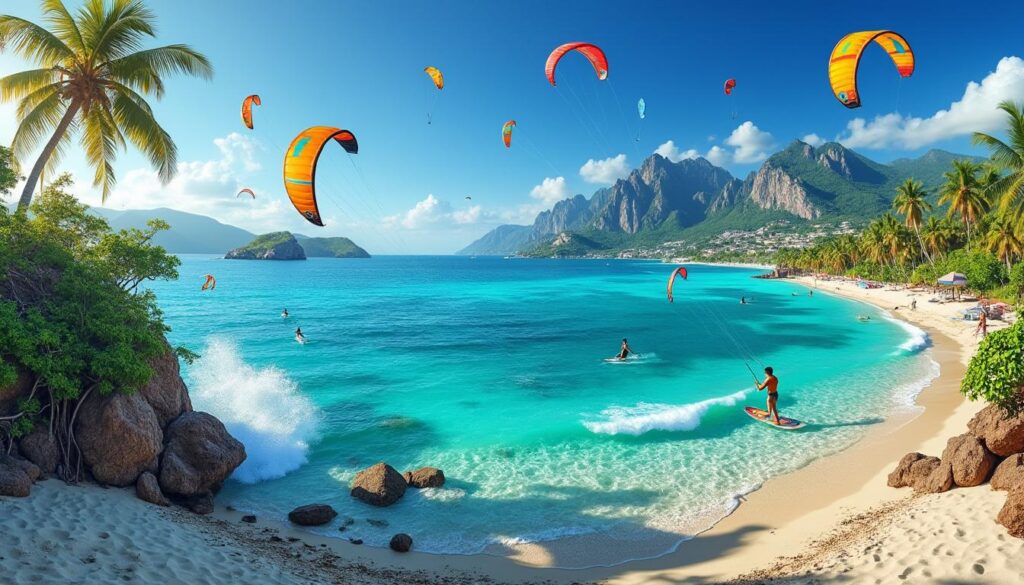
Kitesurf allo Stagnone di Marsala means constant wind, flat water up to the knees and a horizon that lights up at sunset. In this Sicilian lagoon, kiteboarding is not a vacation sidestep but a daily routine: you rig the kite a few metres from the water, set the bar and within seconds you’re planing. Those coming from other areas of kitesurf Italy are often surprised by how easy it is to get in the water, restart after a fall and return to shore without stress. The Stagnone was shaped by nature for those who want to learn, improve or simply rack up ride hours without wasting time.
The atmosphere is that of a true kite village: schools, rentals, accommodation facing the spot, bars on the lagoon. During the day beginners in full courses alternate with freestylers trying new tricks and foil fans gliding silently farther out. Wind statistics speak clearly: with over 300 windy days a year, Marsala justifies the nickname “wind city.” Between the Maestrale, steady north winds averaging 16–20 knots and Scirocco episodes that can exceed 30 knots, the lagoon becomes a perfect laboratory for every level. Those searching for the best kitesurf spot Puglia or other corners of the South often hear the name Stagnone in riders’ conversations, because people come here not only for the conditions but for a certain way of living kiteboarding: direct, simple, without tourist filters.
- Lagoon with flat, shallow water: ideal for learning and refining advanced techniques.
- Very frequent wind: Maestrale, north winds and summer thermals guarantee many sessions.
- Schools and courses for all levels: from the first body-drag to jumping with a grab.
- Kite lifestyle: accommodation very close to the spots, bars, restaurants and evenings among riders.
- Reference point in Sicily: among the serious candidates for the title of best kitesurf spot Italy.
Kitesurf allo Stagnone di Marsala: perché questa laguna è diversa da tutti gli altri spot
Those who already know kitesurf Salento, the kitesurf Adriatic or the winds of the kitesurf Ionian expect open sea, waves, currents. At the Stagnone di Marsala the scenario changes completely: the lagoon is enclosed by a system of islets, with only a few openings towards the sea. The result is an area of flat, sheltered water where even the chop is minimal and the surface stays “smooth” for most of the day. This makes the spot a technical gym where every mistake can be corrected quickly, without the weight of waves smashing into you while you try to get on the board.
The lagoon is made up of shallow, brackish waters that warm quickly in the sun. In summer, the temperature difference with the open sea generates regular thermals that often strengthen in the afternoon. It’s the typical day when you arrive, check the forecast, see 12–14 knots predicted and then find yourself with 18 knots from 14:00 to 18:00. For those who dream of long sessions with a medium-small kite, it’s a constant invitation to never take your feet off the board.
The town of Marsala is also known as the “wind city”. It’s not a postcard nickname but a fact every rider confirms as soon as they land. North winds are the most stable, with an average intensity between 16 and 20 knots from spring to autumn, while the Scirocco, when it comes in strongly, can easily exceed 30 knots. On those days the spot changes: beginners watch from the shore while more experienced riders set up smaller kites and prepare for “spicy” sessions full of powerful jumps, kiteloops and radical moves.
Compared to other contexts of kitesurf Italy, perceived safety here is different. The shallow water allows you to touch the bottom in many parts of the lagoon, even several metres from the shore. This detail lowers the mental pressure for beginners because it reduces the fear of “getting lost” in the middle of the sea. It’s much easier to focus on body position, bar handling and starting a water start without being blocked by anxiety. Even falls become part of the game: you get up, restart, and give yourself time to understand what to improve.
The Stagnone has over the years become a true hub of kite clubs, schools, camps and rental centres. This means infrastructure: car parks near the spot, equipment storage, compressors to inflate kites, showers, refreshment points. For those coming with family or non-kiting friends, the lagoon also offers a quieter side: walks among the salt pans, boat trips to the islets, sunset aperitifs. The typical day becomes a mix of sessions in the water and moments on land, with no dead time and without having to drive kilometres to find a place to eat or sleep.
Many riders who also frequent kitesurf in Salento or Sardinia tell the same thing: if you really want to focus on technique, the Stagnone is one of the most effective places to grow. No nearby waves, no strong lateral currents, no shore break flipping you at the start. Just you, the board, the kite and the consistency of gusts that carry you forward. Because of these characteristics, in recent years the lagoon has steadily entered lists of those looking for the best kitesurf spot Italy to learn or perfect their skills.
The heart of this place remains the wind: those who respect and study it find at the Stagnone a faithful ally to progress session after session.
When to go to the Stagnone: winds, seasons and best times for kitesurfing
Choosing the right period for kitesurf at the Stagnone di Marsala is the first step to turning an idea into a real session. The operating season, thanks to Sicily’s mild climate, is wide: you can ride almost all year round, with different intensities depending on the months. Spring and autumn are considered the golden window: less crowding than summer peaks, often more consistent wind and still pleasant water temperatures with a light wetsuit.
Between April and June many riders arrive wanting to combine intensive courses and long days. In this period the north winds are particularly reliable, with averages around 16–20 knots, and the lagoon starts to warm up. July and August see the thermal component explode: the internal water, warmer than the open sea, creates temperature differentials that feed afternoon breezes that are often surprising. The classic scene is this: calm morning, relaxed lunch, then around 14:00 the first kites in the sky and a crescendo that can last until sunset.
September and October are much sought after by those who want to combine kitesurf holidays and still-summery conditions but with less busy shores. The lagoon stays warm, winds maintain good frequency and the days are still long enough for a double session. Many schools offer packages and camps aimed at progression: consecutive days on the water, focus on clear objectives (like the first jump, toeside control, changing direction with style).
In winter the spot doesn’t shut down, it simply changes pace. Mostly the most motivated riders arrive, well equipped with thick wetsuits and thermal accessories. The advantage of these months is low attendance: more space on the water, free navigation lines, no waits at launch spots. Winds can be stronger and more unstable, but for those with a solid technical base the winter lagoon becomes a serious training ground without distractions.
The time of day also matters. If the goal is a relaxed session to get comfortable with the board, early morning or late afternoon are perfect: soft light, fewer riders, often cleaner wind. Those aiming for thermal explosions should watch the 13:00–18:00 window, when the combination of sun and thermal differential plays its best role. Monitoring local Stagnone wind reports and comparing them with your personal experience allows, over time, to “read” the spot almost instinctively.
To give a quick overview, here is an orientative summary of the main months:
| Month | Average wind | Crowding | Useful notes for kite |
|---|---|---|---|
| April–May | 16–22 knots N/NW | Low–Medium | Great for courses and progression; long wetsuit recommended. |
| June | 14–20 knots N + thermals | Medium | Warmer water, perfect mix of synoptic winds and thermals. |
| July–August | 12–18 knots thermals | High | Lots of sun, afternoon wind; ideal for kite holidays with friends. |
| September–October | 16–22 knots variable | Medium | Often very regular conditions, perfect for those who want to progress. |
| Winter | 18–30 knots variable | Low | For motivated riders with good winter gear. |
Cross-referencing this information with your available holiday time helps plan the trip smartly. Those coming from the boot, maybe after trying kitesurf on Lake Garda or the winds around Rome, find at the Stagnone a continuity of quality Italian spots but with a typically Sicilian character: intense, direct, uncompromising.
In every season the secret remains the same: check the wind beforehand, not during the session, and adapt your kite quiver to the chosen period.
Kitesurf for beginners at the Stagnone: learn quickly and safely
Anyone searching for kitesurf for beginners in Italy quickly encounters the name Stagnone. It’s no coincidence. The combination of shallow water, steady wind and wide spaces makes the lagoon one of the best places to learn kitesurfing without skipping stages but also without wasting hours. Local schools have structured their kitesurf courses specifically thinking of newcomers who arrive with a mix of excitement and fear: first you build a calm relationship with the wind, then you get into the water with a clear progression.
On average, with 2 full days of lessons you can already do a lot. The typical path starts with rigging the equipment and basic safety theory: the wind window, power zone, quick release usage. Then you move on to kite handling on land to teach your hands how to work with the bar. Only when these points are solid do you enter the lagoon for the first body-drags and, afterwards, for the water start. In this context, the lack of waves makes everything more readable: you can focus on just three fundamental things – kite power, body position, board direction.
A common mistake among beginners is thinking the kite is “very difficult” or that it takes weeks to stand up. In reality, learning time is subjective, but with a good kitesurf school and a spot like the Stagnone, progress comes quickly. Many students in 5–6 sessions already manage to edge in both directions and return to the starting point. The key is continuity: lessons close together, at least two consecutive days, so the body doesn’t forget what it learned the day before.
For those coming from areas like kitesurf Lecce, kitesurf Taranto or other parts of the South where the sea is often rougher, the feeling of control at the Stagnone is immediately evident. You don’t have to fight shore break to get out, you don’t have lateral waves that pull your sail down, you don’t lose your board every time you fall. This doesn’t mean kiting is risk-free, but the context helps you focus on technique with fewer elements to manage at once.
To start on the right foot, here are some simple but essential rules:
- Choose a certified school: IKO or FIV instructors, support boats and radio systems improve safety and learning.
- Don’t skip theory: understanding the wind and right-of-way priorities in the water prevents unnecessary accidents.
- Listen to your body: kitesurfing requires energy and focus; better to take short breaks than to push too hard.
- Always use a helmet and impact vest: light protections but decisive in case of impact with the water or equipment.
- Accept falls: they’re part of learning; every splash is one more piece of information to process.
Many schools at the Stagnone also offer packages that include accommodation close to the spot, so you can forget the car and live for a few days with a single goal: get in and out of the water as many times as possible. The routine becomes simple: wake up, check the wind, light breakfast, session, break, second session, sunset on the lagoon. And when you return home to your usual spots – whether the kitesurf Adriatic, the kitesurf Ionian or other stretches of coast – you’ll notice you’ve gained confidence and automatisms you previously lacked.
Those who want a broader idea of educational opportunities in the country can take a look at kitesurf schools in Italy, but one fact remains: the Stagnone is one of those spots where a beginner truly finds the right conditions to make the leap from curious to independent rider.
For those who feel the call of the wind but still have some fears, this Sicilian lagoon is the ideal compromise between adrenaline and control.
Schools, courses and rider life at the Stagnone: not just sessions, but a real lifestyle
The Stagnone is not just “a place where you go to kite”, it’s an environment that breathes kite from morning to night. Kitesurf schools face directly onto the lagoon: boards, kites and wetsuits are everywhere, hanging on racks or laid out in the sun to dry. Here you find beginner courses for those who have never held a bar, advanced freestyle lessons, foil coaching, sessions focused on improving jumps or upwind riding. Every level has its space and teaching method.
Many providers offer complete packages that include lessons, equipment rental, accommodation and, in some cases, transfers to and from the airport. This makes it easier for those arriving from afar who want a streamlined organization: you arrive, drop your luggage, grab a wetsuit and soon you’re on the water. On-site kite rental also allows you to travel lighter, especially if you fly with airlines that charge heavily for sports equipment.
A rider’s daily life at the Stagnone follows the rhythm of the wind. In the morning, before it strengthens, some dedicate time to stretching, a light run or a coffee with a view of the salt pans. When the breeze starts to be felt, the lagoon comes alive: kites rise, lines stretch, helmets and impact vests come back into action. During the peak of the day, schools alternate beginner lessons and improvement sessions for those already independent. Mixed groups are often seen in the water: someone attempting their first water start next to someone doing a clean backroll or testing the first unhooked tricks.
Off the water, social life is an important part of the scene. Bars and stalls facing the spot become natural exchange points: people comment on conditions, share advice on kite sizes and settings, and organize evening outings. The beauty of such a kite-focused place is that you don’t have to explain to anyone why you’re tired at 9 pm: everyone knows what it means to spend hours edging under the sun and wind. Evenings often end with a plate of local fish, a cold beer and a look at the forecast for the next day.
Accommodation follows the same thread. Around the lagoon there are resorts, B&B, holiday homes and residences popular among riders. Many of these lodgings are designed for those travelling with gear: spaces to hang wetsuits, secure areas to store boards and kites, breakfasts suited to those who want to start light but energized. For those seeking a more immersive experience, the kite camps organized at certain times of the year create temporary communities of riders, with days structured between water time, video feedback, evening theory and shared relaxation.
In this picture, the Stagnone fits into the mosaic of the liveliest kitesurf Italy destinations, alongside areas like the great spots of Sardinia, Garda or Salento. The difference is that here the concentration of services around a single lagoon creates an almost self-sufficient ecosystem: you can spend an entire week without moving far from the shore, yet feel a new atmosphere every day thanks to the mix of winds, people and light.
At the end, what holds everything together is the same unwritten rule that applies everywhere: respect the wind and the place. At the Stagnone this phrase resonates even more strongly because the lagoon gives you so much in terms of conditions, provided you treat it with care, both on the water and on land.
From comparison with other Italian spots to the appeal of Sicily: why the Stagnone remains a kite paradise
Anyone who travels Italy’s kitesurf spots knows each area has a different character. kitesurf Salento offers the dual option of kitesurf Adriatic and kitesurf Ionian, with open sea and conditions changing according to the wind. Garda gives precise morning thermals like clockwork, useful for steady training. Sardinia alternates lagoons, open sea and serious waves for those seeking high-level jumps. In this mosaic, the Stagnone occupies a special place: a unique lagoon with a concentration of favourable conditions that is hard to replicate elsewhere.
The almost total absence of waves across much of the usable area makes every manoeuvre more “readable”: those wanting to work on a new trick can focus on real mistakes without having to translate everything through surface chaos. Riders coming from more demanding spots, used to fighting chop and shore break, feel the difference from the first run. That’s why many freestylers, and also foil enthusiasts, choose the lagoon for intense training periods: repeated jumps, controlled landings, hours standing on the board without having to “survive” every return.
At the same time, the Sicilian dimension is felt in every detail. The salt pans, the islets surrounding the lagoon, the sunset that sets the water alight in orange and pink create a visual context that needs no filters. It’s not the classic glossy brochure image but a concrete, lived landscape that riders associate with long, full sessions. Here the kite isn’t a tourist accessory; it’s part of daily life: locals have learned to live with kites in the sky and vans full of boards parked along the road.
Another strength of the Stagnone is its ability to appeal to many types of riders. Beginners find a safe context to learn kitesurfing calmly. Intermediates who already edge well can use the lagoon to improve jumps, direction changes and early old-school tricks. Advanced riders or pros can exploit stronger wind days to test radical manoeuvres and complex sequences. In each case, flat water is the thread that links progression, control and fun.
Looking at the future of kiteboarding in Italy, spots like this play a key role. On one hand they offer a training ground for new generations of riders who can move from their first course to their first local competition without changing scenery. On the other, they attract practitioners from across Europe, helping put Italy – and Sicily in particular – on the map of must-visit kite destinations. Those who started at their home spot, perhaps following a kitesurf course near Rome or a lesson on the Garda, often sooner or later feel the call of the Sicilian lagoon as a natural stop on their journey.
To accompany this growth, it’s essential to keep the spirit that made the Stagnone special: respect for the nature of the reserve, attention to safety, real sharing between schools and riders. No forced tourist packaging, just the straightforwardness typical of places born on wind and water. In the end, whether you come from the North or the deep South, the feeling when you hook in and head out on your first run is the same: you have the wind, you have the sea, you have your kite. The rest is unnecessary.
In an Italy that increasingly offers well-equipped, professional spots, the Marsala lagoon continues to be a reference for those seeking not just a session but a true Mediterranean kite paradise.
Watching some videos of local sessions helps you get into the spot’s rhythm even before you arrive, and to understand which riding style inspires you most.
What is the best time to kitesurf at the Stagnone di Marsala?
The Stagnone lagoon works almost year-round, but the periods most appreciated by riders are spring (April–June) and autumn (September–October). In these months the wind is often more consistent, crowds are manageable and temperatures remain mild. In summer regular afternoon thermal winds arrive, ideal for those who want to combine holiday and kite. In winter you can still go out, but it is recommended for riders who are already autonomous and well equipped with thicker wetsuits.
Is the Stagnone suitable for someone who wants to learn kitesurfing from scratch?
Yes, the Stagnone is one of the best spots in Italy for beginner kitesurfing. The water is shallow and flat, the wind is frequent but often manageable and the schools are used to working with total beginners. Generally, with 2 days of intensive lessons you can reach the first water starts, and with a few more sessions you can already edge safely.
What kind of equipment is needed for a kite holiday at the Stagnone?
For most seasons you’ll need 1–2 medium-sized kites, around 9–12 m², a twin-tip board suitable for your weight and a wetsuit that varies by period (3/2 or shorty in the warmest months, 4/3 or 5/4 out of season). If you don’t want to travel loaded, many schools offer full rental of kites, boards and safety accessories like helmet and impact vest.
Is it necessary to book kitesurf lessons at the Stagnone in advance?
Booking in advance is strongly recommended, especially between June and September when attendance increases. This way you secure availability in the best time slots and can also take advantage of possible course+accommodation packages. Outside the high season it is sometimes possible to arrange last-minute lessons, but it is still advisable to contact the chosen school in advance.
Are there interesting alternatives to the Stagnone for kitesurfing in Italy?
Yes, Italy offers many valid spots: Salento with its Adriatic and Ionian winds, Lake Garda with morning thermals ideal for continuous training, Sardinia with lagoons and open sea, not to mention the areas around Rome. However, the Stagnone remains one of the few spots where you find in a single lagoon flat water, frequent wind, concentrated schools and a strong kite identity rooted in the Sicilian territory.