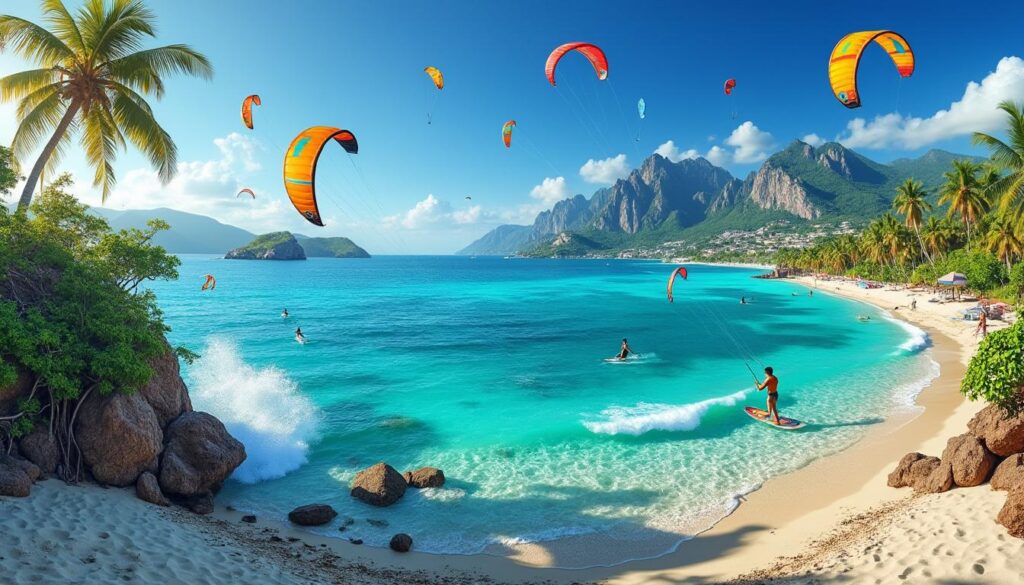
Cape Verde is that name that comes back to mind every time the thermometer drops, the waves call and the wind in Europe gets moody. An archipelago in the middle of the Atlantic, off Senegal, swept by the trade winds and surrounded by warm water that seems made for long kite sessions without gloves or a hood. Santa Maria, Kite Beach, Ponta Preta, Boa Vista, Salamansa: they are not just points on a map, but real settings where the wind comes in steadily between 15 and 30 knots for months on end. Anyone looking for winter kitesurfing finds a simple answer here: grab your board, prepare the small kites and be ready to rack up hours on the water.
But choosing well requires more than perfect photos on social media. Cape Verde offers 27 kitesurf spots, at least five very busy ones and many wilder ones. Each island has its own character, each bay its own combination of wind, wave, seabed and current. It’s the classic place where the rider who does their research rides happy, while the one who improvises spends more time struggling than having fun. Understanding the best season, reading the trade winds, distinguishing between flat water, chop and powerful waves makes the difference between a fully exploited holiday and a missed opportunity.
- Wind: northeast trade winds from November to June, 15–30 knots almost daily.
- Main spots: Sal (Kite Beach, Santa Maria, Ponta Preta), Boa Vista (Praia Carlota, Varandinha, Gatas), São Vicente (Salamansa, Baia das Gatas).
- Levels: from beginner kitesurf in sheltered lagoons to tough surfboard waves for advanced riders.
- Climate: warm water and air, the perfect combo for long sessions and fast progression.
- Style: relaxed vibe, a mix of African, Portuguese and Creole culture, ideal to combine kitesurf, holidays and local life.
Kitesurf Cape Verde: why these spots drive European riders crazy
Cape Verde has become one of the fixed poles of the global kitesurf scene because it manages to hold together three key elements: reliable wind, variable conditions and relatively simple logistics. Compared to many distant destinations, flights from Europe are manageable, especially to the islands of Sal and Boa Vista, and in a few hours you go from a down jacket to short-sleeve lycra. For those already riding between Fuerteventura, Tarifa or Dakhla, Cape Verde is the natural Atlantic extension, with a more tropical touch and a rougher character.
The archipelago is divided into two groups: the Barlavento islands, to the north, where the main kitesurf spots are concentrated (Sal, Boa Vista, São Vicente), and the Sotavento islands, to the south, less exposed to the winds kiters prefer. In practice, if the goal is kite, the question to ask is not “Should I go to Cape Verde?” but “Which Barlavento island should I choose?”. Here the trade winds come consistently from the northeast for most of winter and spring, offering almost copy‑and‑paste days: clear skies, side-on or side-shore wind, waves that build regularly.
One of the features that strikes those coming from a kitesurf spot in Puglia or a classic Adriatic kitesurf spot is the quality of the wind: straighter, less nervous, with less brutal gusts. This doesn’t mean it’s always “easy”: chop, current and waves can challenge those used only to flat lagoons. But for anyone wanting to truly progress, there’s nothing better than leaving the comfort zone. It’s the same leap riders from kitesurf Salento make when they move from the sheltered bays of the Ionian to full Mistral days on the Adriatic.
Many travelers imagine Cape Verde as an exclusively wave destination. In reality, the scene is much more complete. Kite Beach on Sal and the Praia das Gatas lagoon on Boa Vista offer ideal conditions for freestyle and big air on flat or almost flat water. Santa Maria and Salamansa are perfect for those who like a mix of chop and easy waves. Ponta Preta, Varandinha and Ponta Antonia, on the other hand, are the names that echo in wave rider discussions: long, powerful waves, perfect for strapless or surfboard style.
Another aspect not to be underestimated is the local vibe. Cape Verde is not a large resort built around kite, but an archipelago with a strong identity. Fishing villages, Creole music, simple tasty food, slow rhythms. After a session in Santa Maria or Sal Rei, you often end up talking with the locals over a plate of grilled fish, exchanging tips on where to go the next day depending on the wind. It’s the same spirit that animates realities like kitesurf Lecce or kitesurf Taranto: small communities, lots of passion, spots really known only by those who live there.
To summarize this first picture, Cape Verde is one of those places where you don’t ask if the wind will be there, only how strong it will be. Those who arrive prepared, with the right sail range and a good technical base, discover how easy it is to make concrete progress in a few days.
Comparison with the best kitesurf spots in Italy and the Mediterranean
Those who already know the best kitesurf spots in Italy and often move between Salento, Sicily, Sardinia or Calabria will find in Cape Verde a kind of natural “upgrade”. In Italy, the windiest periods are often spring and summer, with Mistral, Borino, Scirocco depending on the coast. In winter, instead, epic days alternate with completely calm ones. Cape Verde reverses the calendar: the peak season runs from November to June, precisely when many Italian spots take a break or become unpredictable.
A rider used to the Ionian kitesurf can find in Santa Maria a more regular wave and more stable wind, while someone coming from a windy northern spot, after studying contents like this guide to the best spots in Northern Italy, will discover how convenient it is to have 5–6 windy days in a row instead of squeezing sessions between one anticyclone and another. Cape Verde thus positions itself as a natural extension of the calendar for those who don’t want to limit kite to the Mediterranean summer season.
The real strength of this archipelago is repetition: session after session you can try the same tricks in similar conditions, correct mistakes, and gradually increase the challenge. It’s exactly what’s needed to go from a casual rider to a conscious one.
Watching some session videos from Cape Verde helps to understand the power of the place, but what really matters is arriving with a clear strategy: what type of conditions are you looking for? How much wave do you want to face? How solid is your upwind technique?
Best time for kitesurfing in Cape Verde: how to read the trade winds
The best time for kitesurfing in Cape Verde coincides with the firm entrance of the northeast trade winds, often called “Alisios”. In general, the window runs from November to June, with a peak of consistency between December and April. In these months, wind records show days between 15 and 25 knots as standard, with many days reaching 30 knots, especially in January and February. For those traveling with a complete quiver, it’s a paradise of choice: 7–8 meters for strong days, 9–10 for average conditions, 12 as a “safety kite” for rare lulls.
Temperatures help to make the most of sessions: water around 22–25 °C in the central months, air at about 24–28 °C. In practice, a shorty or a light 3/2 wetsuit is almost always enough, and many riders even choose to surf in lycra if they’re not particularly sensitive to cold. The body tires less compared to winter outings in Italy with a 5/4, hood and gloves, which allows longer time in the water, working on fine technique and reducing the risk of injuries from stiffness or cold.
To get a clear idea, it’s useful to visualize the wind season with a simple summary table:
| Month | Average wind strength | Wind reliability | Useful notes for kitesurfing |
|---|---|---|---|
| November | 15–22 knots | Good | Season start; great for learning kitesurfing and for motivated beginners. |
| December | 18–25 knots | Very high | Almost daily wind, ideal for courses and freestyle progression. |
| January | 20–28 knots | Very high | Windier period; perfect for big air and wave with small kites. |
| February | 18–28 knots | Very high | Waves often well formed, wave spots like Ponta Preta at their best. |
| March | 18–25 knots | High | Great mix of waves and more manageable water for intermediate levels. |
| April | 15–22 knots | Good | Softer conditions, perfect for training technique and maneuvers. |
| May–June | 12–20 knots | Variable | More suitable for foil and large kites; less crowded. |
From May onward the wind tends to drop, although it remains interesting for those with foils or wings who enjoy planing in lighter breezes. In these months you can alternate kite and pure surf, taking advantage of residual swells. Those who want to maximize hours on the bar should aim decisively for December to March.
When planning kitesurf holidays in Cape Verde it’s essential to adapt the quiver to the chosen period. In the middle of the Atlantic winter, a rider of 75–80 kg will often find a 7–9–11 m combination ideal, while lighter riders can go down a size. It’s the opposite logic to many Mediterranean summer destinations where 12–14 m is almost mandatory. Here the motto is: better to have one small kite extra than a big one that will always be flat in your suitcase.
The sense of this seasonal picture is simple: Cape Verde spins when much of Europe switches off the thermal wind. For those who don’t want to “hibernate” from November to March, it’s one of the most logical choices out there.
How to fit Cape Verde into a rider’s annual calendar
Those who already alternate kitesurf in Italy, the Canaries, Morocco and maybe a farther trip can use Cape Verde as the winter hub. A common strategy is this: autumn and spring between Salento, Sicily and Sardinia; summer in classic windy northern spots or on the islands; winter between Cape Verde, Dakhla or the Canaries. For those still building their path, reading resources like the comprehensive kitesurf guide for beginners helps to understand at what level to really face this archipelago.
In practice, Cape Verde doesn’t replace your home spots, it completes them. It’s the concrete answer to the question many riders ask at the end of autumn: “Now where can I ride with serious wind and warm water?”.
The images of Ponta Preta’s waves in mid-winter clarify why many wave riders book their holidays precisely between January and February.
Sal Island: Santa Maria, Kite Beach and Ponta Preta in detail
The island of Sal is the heart of kitesurfing in Cape Verde. It’s where most direct flights from Europe arrive and where many schools, kite camps, rental and repair shops have developed. Sal combines spots suitable for those who want to learn kitesurfing with extremely technical areas dedicated to wave and big air. For European riders, Sal is often the first contact with the archipelago: a mix of sandy beaches, reefs that work with powerful swells and a town like Santa Maria that lives practically from the sea and the wind.
The main spots are three: Santa Maria Bay, Kite Beach and Ponta Preta. Each has a distinct personality. Santa Maria, with turquoise water and sandy bottom, is the perfect school for board control, getting up and first tacks, especially on days when the wind is less aggressive. Kite Beach, more exposed, lends itself to “serious” training days: launching from the shorebreak, long tacks, maneuvers in real conditions. Ponta Preta, finally, is the wave sanctuary: waves that can become significant, delicate side-off wind to manage, zero margin for error.
Many riders organize a week on Sal alternating spots based on wind and swell. On full trade wind days, Kite Beach becomes a playground for those working on jumps, aerial control and power management. When a good swell comes in, everyone’s eyes turn to Ponta Preta, with the classic question: “Is today strapless or better to stay on twin tip?”. Santa Maria remains the refuge spot when looking for something less extreme, perhaps to go out relaxed after a couple of intense days.
This mosaic of conditions makes Sal a smart choice even for mixed groups: advanced riders can push out to Ponta Preta, while less experienced ones still find manageable conditions elsewhere. The important thing is to know from the start where you’re heading and not to be dragged into spots above your level just to follow the group.
Santa Maria Bay and Kite Beach: playgrounds for real progression
Santa Maria Bay is the postcard image many associate with Cape Verde: turquoise water, pale sand, fishing boats in the background. From a kite perspective, it’s an ideal spot to train getting up, board control and first jumps. The wind, slightly filtered by buildings and the shape of the bay, is a tad less aggressive than at Kite Beach, although on stronger days it remains demanding for beginners. Depth increases gradually, which helps those who still have some uncertainty in board recovery or relaunching.
Kite Beach, on the east side of Sal, is the classic high-energy spot: more direct wind, shorebreak to manage when entering and exiting, water that alternates almost flat sections with more decided chop. Here you often meet groups of riders working on advanced tricks, loops, rotations and big air. It’s not uncommon to see small kites flying high over the sea, with long and spectacular landings. For those coming from spots like the Ionian kitesurf on tense Mistral days, Kite Beach is a natural evolution: the same feeling of full-on wind in the face, but with more consistency and fewer holes.
In these spots gear choice matters a lot. A twin tip board with good surface helps manage power and get going even with less tension in the wind, while surfboards come into play when the sea rises and you want to start “reading” the waves. Local schools often offer kitesurf courses structured precisely around this alternation: first lessons in softer waters, progressive move to Kite Beach as confidence grows.
The same principle used in the courses of the best kitesurf schools in Italy comes into play here: build a solid base before chasing spectacular maneuvers. Santa Maria and Kite Beach are perfect for this path because they allow increasing difficulty without changing island or upsetting logistics. The result? Fast and concrete progressions, especially if you stay in the water day after day.
Ponta Preta: the wild side of Sal for serious wave riders
Ponta Preta is the name that makes wave riders’ eyes light up. It’s a spot on the southwest side of the island, exposed to the full force of the ocean. When the swell comes from the right direction, long, powerful waves form that can reach significant sizes. The wind, often side-off, makes riding very technical: the board slides on the face, with the kite needing millimetric management so as not to end up unloaded in the bowl. This is not a place to improvise: advanced level required, reef knowledge, maximum attention to safety.
For many European riders, Ponta Preta represents a true wave maturity test. Those arriving with a good surf base from Italian or Mediterranean spots can find here the perfect gym to refine bottom turns, cutbacks and speed control. It’s also the ideal place to closely observe local riders, often raised on this kind of wave, who show how the dialogue between kite and wave face can become fluid and natural.
In this setting, the kite is no longer just an engine for planing, but becomes a tool to dose precisely to leave space for the rail of the board and the reading of the section. A day at Ponta Preta, even just as a spectator on the beach, changes the way you see wave kitesurfing. It’s a clear reminder: the sea commands, you adapt.
Closing the Sal chapter, the message is direct: this island is not just “one more” on the list of destinations, it’s a complete laboratory where every rider can find their ideal playground, from first tacks to the most radical wave lines.
Boa Vista and São Vicente: lagoons, waves and endless beaches
If Sal is the scene’s heart, Boa Vista and São Vicente are the islands that complete the kitesurf picture in Cape Verde. Boa Vista is famous for its very long beaches, pale sand and a series of spots ranging from flat lagoons to more serious ocean waves. São Vicente, on the other hand, has a rougher, more authentic soul, with fishing villages and bays that seem designed for riders looking for flat water and clean wind.
On Boa Vista your eye immediately falls on Praia Carlota (Sal Rei), Praia das Gatas Lagoon, Ponta Antonia and Praia de Varandinha. Each name corresponds to a different environment, perfect to build a tailor-made week. The Sal Rei area, with the long Praia Carlota beach, offers relatively flat water near the shore and more formed waves offshore; the Gatas lagoon is the flat paradise for freestyle lovers; Ponta Antonia and Varandinha are top choices for characteristic wave sessions.
São Vicente, instead, revolves around two main spots: Salamansa and Baia das Gatas. Salamansa is a long beach rarely crowded, with constant wind and conditions that swing between flat water and small waves, ideal for those logging tacks and working on maneuvers without distractions. Baia das Gatas is a true protected lagoon: shallow, flat water and regular wind. The perfect ground for those wanting to learn new tricks or simply feel “glued” to the board.
For a rider coming from kitesurf for beginners in Italy, Boa Vista can be the ideal island for the first step beyond national borders. For those already comfortable among various kitesurf spots in Puglia or the coasts of Calabria, São Vicente offers a more “raw” environment, pleasant to explore calmly, a bit like discovering new lesser-known spots in southern Italy.
Boa Vista: from Praia Carlota to the waves of Varandinha
Praia Carlota (Sal Rei) is considered the island’s main spot. The beach is long, sandy, with flat or almost flat water in the first meters and small waves further out. The wind can be a bit gusty on some days, but this is exactly what attracts foilers: hydrofoil boards make the most of these conditions, turning even medium wind days into very long sessions. For groups with different levels, it’s a perfect compromise: experts go further out, less confident riders stay near the shore.
Praia das Gatas Lagoon is the name that lights up the eyes of those who live on pop, handle pass and controlled kiteloops. The lagoon, with shallow flat water, recalls the great training spots like the Moroccan lagoons or parts of the Ionian on perfectly flat days. The concept here is simple: remove almost all variables, leaving only technique. The risk, of course, is forgetting a bit about the “real” sea, but for those wanting to unlock a trick that won’t come out, spending some time here can work miracles.
Heading toward Ponta Antonia and Praia de Varandinha you enter a purer, wilder dimension. Ponta Antonia is often cited by intermediate riders who want to face serious but not extreme waves like Ponta Preta. It offers a mix of smoother stretches and important wave sections, with wind that remains manageable for those with a good base. Varandinha, on the west side, is a wide expanse of sand with crystalline water and significant currents: here the sea shows its most powerful face, ideal for those wanting to feel the force of the Atlantic unfiltered.
Those who choose Boa Vista often seek exactly this: space, variety and the possibility to combine days of boosted freestyle in a lagoon with serious wave days on practically empty beaches. It’s a logical choice for those feeling cramped in overly crowded spots and wanting to regain that sense of freedom that, after all, made everyone fall in love with kite.
São Vicente: Salamansa and Baia das Gatas, the authentic side of Cape Verde
Salamansa is a small fishing village that in recent years has become a reference point for kiters passing through São Vicente. The beach is long, the water alternates flat zones with light waves, the wind comes in consistently from November to June. It’s not a showy spot like Ponta Preta, but it’s one of those places where progress happens almost without noticing. Few obstacles, space, no traffic in the water. The dream of anyone tired of dodging kites on every tack.
Baia das Gatas, a short distance away, is a natural lagoon that seems drawn for kitesurf beginners and for those wanting to work on precision of movements. The shallow flat water allows concentration on starts, pointing upwind, transitions without the pressure of a shorebreak to manage or waves constantly disturbing your stance. It’s the type of spot an instructor would choose for an intensive kitesurf course focused on total autonomy.
São Vicente has a soul similar to many corners of southern Italy: small communities, the sea as the center of daily life, a calm rhythm. For those who live realities like kitesurf Salento or frequent less-touristy spots, there’s an immediate sense of familiarity. It’s not the place of organized fun, but of authentic sessions, where you leave the water feeling you’ve really spent the day at sea, not at a theme park.
Overall, Boa Vista and São Vicente show how Cape Verde is much more than a single famous island. The archipelago is a system of different worlds, and those who have time to explore them build a set of experiences no single spot can offer.
Required level, schools and practical tips to organize the trip
Facing kitesurfing in Cape Verde requires being honest with yourself: what is your actual level? The base spots, like Santa Maria, Kite Beach on mellow days, Praia Carlota or Baia das Gatas, are suitable even for those who have just finished an intensive course and know how to relaunch, ride upwind and manage a simple self-rescue. Wave spots like Ponta Preta or Varandinha, however, should be considered terrain for advanced riders used to handling powerful waves, currents and wind that is not always “textbook”.
For those who don’t feel completely confident yet, the smartest choice is to combine the trip with a kitesurf course at one of the many kitesurf schools on Sal and Boa Vista. Packages often include accommodation, lessons, rental and, in some cases, guidance to the best spot depending on the day’s weather. It’s an approach similar to what’s used in Italy, where beginners prefer to take their first steps with certified instructors on spots like those of kitesurf Calabria or kitesurf Napoli before tackling ocean conditions.
Organizing the trip, practically speaking, is relatively simple: direct or one-stop flights to Sal or Boa Vista, transfer to accommodation (often managed directly by kite camps), and then rider routine: wake up, wind check, spot choice, session, recovery, repeat. The decisive point is the quiver choice. In winter, for an average weight, it makes sense to aim for 7–9–11 m as a base, with a twin tip as the main board and, if you love waves, a strapless surfboard. Those planning to move to super flat lagoons may also consider a stiffer, more technical freestyle board.
Another concrete tip is to arrive physically prepared: the constant wind invites you to stay in the water for long periods, and without a minimum endurance base you risk burning out after the first two days. A simple but constant workout on legs, core and shoulder stability in the weeks before the trip can radically change the quality of the holiday.
Finally, always remember that Cape Verde is real ocean. Don’t panic, but maximum respect: helmet, impact vest, properly adjusted leash on the surfboard, knowledge of self-rescue procedures and the ability to read wave motion are as important as a brand-new kite.
Practical check-list before leaving for Cape Verde
To make the trip as smooth as possible, it’s worth building a small mental (or written) list of items to think about before departure:
- Documents: passport valid for the entire stay and check for any visa requirements.
- Insurance: medical-sports coverage that includes kitesurfing, not just lost luggage.
- Quiver: at least three kites, main twin tip, possible surfboard, spare bar if possible.
- Protection: lycra, water-resistant sunscreen, glasses with strap, hat for breaks.
- Safety: bar knife, thorough check of lines, quick release and leash before heading out.
- Technical preparation: confirmed upwind autonomy, kite relaunch from the water, self-rescue.
Those who face Cape Verde with this mindset of a conscious rider make the most of every day on site, instead of wasting time solving problems that could have been prevented at home.
What is the best time to kitesurf in Cape Verde?
The best time runs from November to June, with a peak of consistency between December and April. In these months the northeast trade winds blow between 15 and 30 knots, providing many kitesurfing days on the main islands such as Sal, Boa Vista and São Vicente. Those wanting to maximize time on the water should aim especially for January and February, when the wind is generally stronger and more regular.
Is Cape Verde suitable for kitesurfing beginners?
Yes, provided you choose the right spots and period and preferably rely on a local kitesurf school. Baia das Gatas on São Vicente, Praia das Gatas Lagoon on Boa Vista and Santa Maria Bay on mellow wind days are suitable for those who have just completed a basic course. For first tacks it is still recommended to follow structured lessons to safely handle ocean wind and currents.
Which kites should I bring for a week of kitesurfing in Cape Verde?
For a rider around 75–80 kg in mid-Atlantic winter, the most used combination is 7–9–11 m, with more use of the smaller sizes on strong wind days. Lighter riders can go down a size, while heavier riders may add a 12 m as a safety kite. A versatile twin tip and, for wave lovers, a strapless surfboard complete the ideal quiver.
Is it better to choose Sal, Boa Vista or São Vicente for kitesurfing?
It depends on your level and what you’re looking for. Sal is the most complete choice, with spots like Santa Maria, Kite Beach and Ponta Preta covering freeride to advanced wave. Boa Vista offers flat lagoons and very long beaches, perfect to mix freestyle, foil and waves. São Vicente is more authentic and quiet, with spots like Salamansa and Baia das Gatas ideal for training on flat water and clean wind away from crowds.
How does Cape Verde compare with the best kitesurf spots in Italy?
Cape Verde offers more consistent wind in the winter period compared to most Italian spots, where activity is concentrated in spring and summer. Italian spots, from Salento to Sardinia, remain unbeatable for variety and logistical ease during the high season, but between November and March few places compete with the combination of reliable trade winds and warm water of the Cape Verde archipelago. The ideal is to use Cape Verde to extend the kite year beyond the Mediterranean limits.