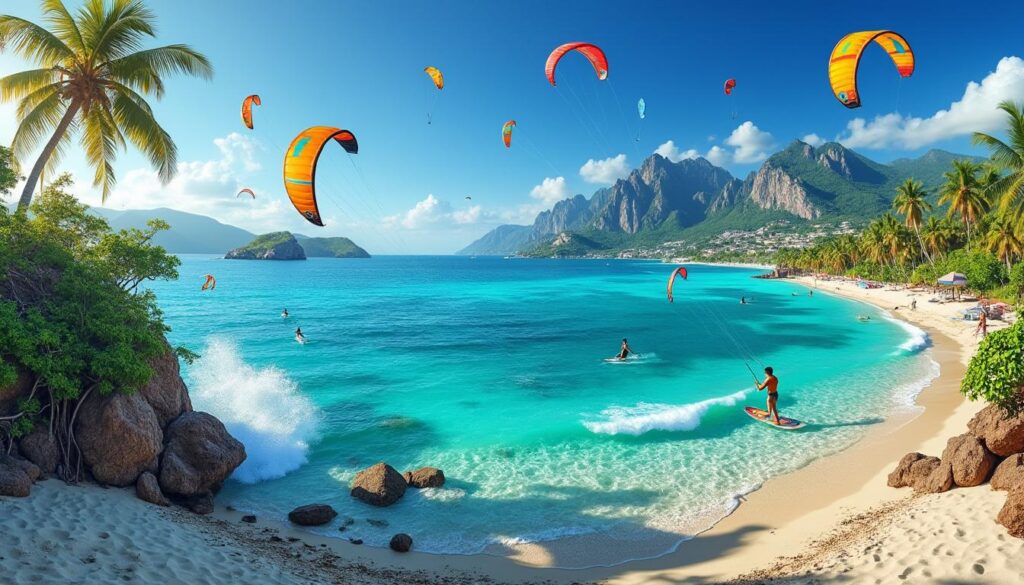
The wind pushes the wing, the board planes, the body lightens. The kitesurf is not just a sport: it is a direct and concrete way to converse with the elements, between water and sky. Understanding the true meaning of kitesurf means going beyond the social-media image of giant jumps and looking at what really happens: a rider connected to the kite by a few lines, who controls power with a bar and turns the wind into speed, freedom and pure technique. From the first experimental boards of the ’90s to today’s ultra-modern foils, the kite has moved from a “crazy” pioneers’ discipline to a structured sport, with schools, certifications and international competitions.
In kitesurf it does not matter to have superhero physiques, but to know how to read the wind, choose the right spot and respect some basic safety rules. It is a sport suitable for those starting from zero, provided they rely on a good kitesurf school and accept that the first days are needed to learn to handle the kite on land and in the water, before even thinking about jumps. From Puglia to Sardinia, passing through every kitesurf spot in Italy, more and more people organize their kitesurf holidays based on weather forecasts. The common thread is always the same: the right wind, an open mindset and the desire to progress.
- Kitesurf means being pulled by a kite while gliding on the water on a board.
- It was born between the late ’90s and early 2000s, evolving rapidly in safety, equipment and styles.
- To learn kitesurf you need lessons, appropriate equipment, a safe spot and wind between 12 and 24 knots.
- There are different disciplines: freeride, freestyle, wave, hydrofoil, big air and racing.
- In Italy stand out areas such as kitesurf Salento, kitesurf Sardegna, kitesurf Adriatico and Ionio.
Kitesurf meaning: what this sport really is and why it has conquered our beaches
For many, the word kitesurf initially means nothing. Then you happen to see from the shore those “people hanging from a kite” who race across the water, jump, land softly and go again. Then the question arises: what exactly is it, how does it work, could I do it too? From a technical point of view, kitesurf is a sailing sport: you use the wind as the only engine, via a wing (kite) handled with a bar, connected by long lines usually 22–24 meters. At your feet you have a board, usually a twin tip, with which you plane on the surface of the water.
The dynamic is simple to describe but intense to experience. The kite generates lift like an airplane wing: air flows faster over the top than underneath, a pressure difference is created and the wing pulls. Through the bar you control this traction, adjust the angle relative to the wind (power / depower), move within the wind window, accelerate, decelerate, jump. There is no hidden engine: everything comes from the balance between wind, board and body.
Compared to other board sports, here you are not pushed by a wave (surf) or by a cable (wakeboard), but by something you do not see: moving air. For this reason kitesurf immediately educates you to something fundamental: understanding the wind. Those who start kiting end up obsessively checking forecasts, watching the tops of trees, recognizing Maestrale, Scirocco, Tramontana just from the direction in which the waves ripple. It is the first real mindset shift.
The nice thing is that this sport is not reserved for elite athletes. With a well-structured kitesurf course and a few days of practice, many beginners reach their first water start and their first glides in a few sessions. Pure strength matters relatively little because traction transfers from the kite to the harness, offloading onto the hips and core, not the arms. Thus even people who are not super fit can enjoy kitesurf for beginners without feeling “out of category”.
Another key point of the meaning of kitesurf is its versatility: the same sport completely transforms by changing board and style. With a twin tip you do freeride and freestyle, with a directional you enter the waves in surf mode, with the foil you fly above the water in silence, with the race foil you cross the spot at impressive speeds. Each of these variants keeps the essence: extracting energy from the wind and playing with it safely.
To understand how much kitesurf has entered contemporary sports culture, just look at the Olympics: kite foil racing became an official discipline on the Paris 2024 program, with slim boards, extremely efficient wings and speeds that often exceed 30 knots perfectly controlled. On the other hand, on Italian beaches, kite is also the pretext to meet, explore new spots, organize downwinds with friends and live a lifestyle tied to the sea made of sessions, waiting for the wind and dinners with salt still on your skin.
If the meaning of kitesurf had to be summed up in a few words, it would be this: a sport that forces you to make peace with the wind and to respect its rules, in exchange for a feeling of glide that you will hardly find elsewhere. Once you taste that feeling, stopping becomes very complicated.
Basic components: kite, bar, lines, harness and board
To better understand what kitesurf is, it is useful to break it down into its main parts. The element that immediately catches the eye is the wing (kite). There are two macro families: LEI (Leading Edge Inflatable), inflatable with an air-rigid leading edge, and foil kites, with cells that fill with air in flight. On our kitesurf Italy spots, especially in Puglia, Sardinia and Sicily, LEIs are by far the most widespread because they float well, relaunch easily from the water and withstand long sessions in the Adriatic chop or among the Ionian waves.
Wings come in different sizes, usually from 5 to 17 m². The stronger the wind, the smaller the wing; the heavier you are, the more generous surface area you will need at the same wind intensity. The shape changes behavior: pure C-kites are twitchier, ideal for unhooked freestyle; Bow, Delta and SLE have huge depower, absorb gusts and are perfect for freeride and wave. If you want to delve into how to choose the right wing for your weight and the spot, there are specific guides like this on how to choose the kite sail.
The control bar is the helm of the system. Connected to the kite via 4 or 5 dyneema lines, it transmits every tiny movement to the sail: pulling one side makes the kite turn; pulling the bar towards you increases power; pushing it away reduces it. In the center you find the chicken loop that hooks to the harness and the quick release safety, which in an emergency unloads almost all the traction.
The harness is the point where the wind’s force meets your body. It can be a waist harness or a seat harness (with leg straps), soft or rigid depending on preferences and discipline. Choosing it well is as essential as choosing the wing, because the wrong harness will ruin your back and make you hate long sessions; to guide you better, an overview like the one on kitesurf harnesses can be useful, designed especially for those who want to improve comfort and control.
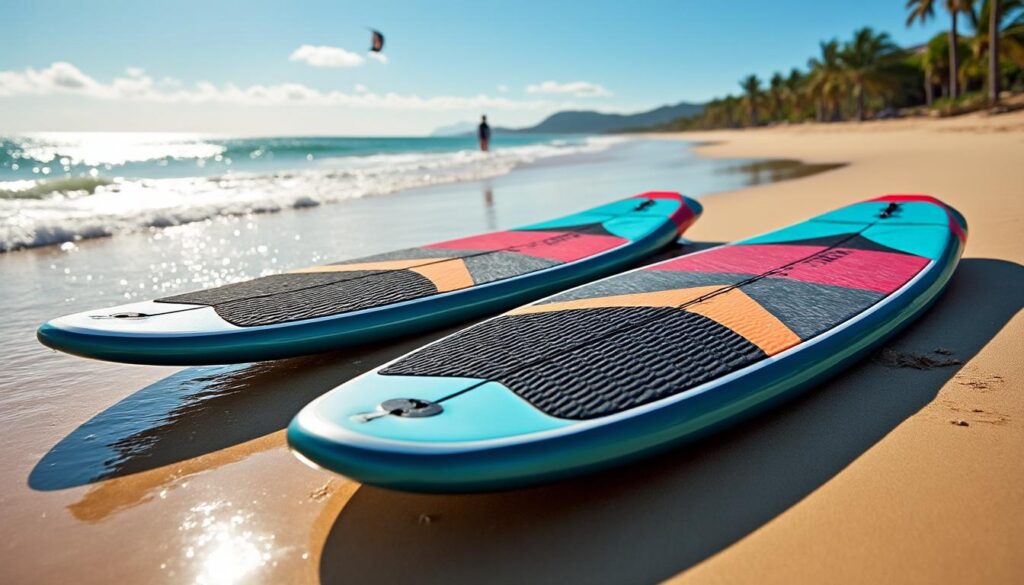
The last element, but not least, is the board. The most widespread is the twin tip, symmetrical, with bindings like a wakeboard. It is the one you start with and with which you can continue a lifetime between freeride, big air and some freestyle. There are also directional surf-style boards for waves, and foil boards with mast and wing, to fly above the water with light wind. Each board choice drastically changes the style of your session, but the heart of the meaning of kitesurf remains the dialogue with the wind.
How kitesurf works: wind, technique and first steps in the water
Imagine Marco, 35 years old, arriving in Salento for his first week of kitesurf holidays. He has watched videos on YouTube, already dreams of 10-meter jumps, but his initial reality is a helmet on his head, a trainer kite on the beach and an instructor repeating: “Watch the kite, breathe, let yourself be pulled little by little.” This is where you understand how kitesurf really works: first of all you learn to handle the wing, long before getting on the board.
The technical functioning revolves around four forces: lift, weight, thrust, drag. Lift pushes the kite upward, weight pulls it down, thrust moves it forward, drag slows it. As long as these forces are in balance, the wing remains stable in the air. By moving the kite in the wind window (the 180° area in front of you), you generate more or less power. The bar becomes an extension of your hands and instinct: a few extra centimeters of pull and the traction changes markedly.
In the typical path of kitesurf for beginners there are precise stages:
- Basic theory: wind, wind window, safety rules, release systems.
- Control of the kite on land: launches, landings, wing movement at 11–13–1 o’clock.
- Body drag in the water: without a board, you let the kite pull you to learn to manage its power.
- Upwind board retrieval with the body drag: essential because the leash to the board is never used.
- Water start: board at your feet, kite descending in a power stroke, the body lifting and beginning to plane.
The magic of the first successful water start is the moment when all the previous work aligns: flight technique, timing, body position. At that point, progression is a sequence of small goals: maintaining the tack, changing direction without sinking, doing the first controlled jumps, lengthening sessions until you return to shore with a smile on your face.
The ideal conditions to learn are 12–20 knots of wind, water not too rough and plenty of free space downwind, without obstacles. That is why many choose lagoon spots or protected bays, with sandy bottoms and lots of room for mistakes. In areas like kitesurf Salento, the locals know well when it is better to stay on the Adriatic side and when to move to the Ionian side, depending on Maestrale, Tramontana or Scirocco.
A good instructor also teaches you how to read the weather: you don’t go into the water if thunderstorms are approaching, there are sudden gusts or strong offshore wind without a support boat. Learning to say “not today” is an integral part of how kitesurf really works, and paradoxically it is what allows you to have fun for years.
The secret to feeling that “everything works” is the balance between kite power, board trajectory and body position. If you load the edge well on your heels, keep the kite at 45° and breathe, the glide becomes smooth and the idea of leaving the beach to move from one spot to another in Italy, from kitesurf Lecce to the north coast of Sardinia, begins to seem not only possible but almost inevitable.
Equipment and safety: what you really need for a controlled session
In addition to kite, bar, harness and board, kitesurf requires a series of safety accessories often underestimated by those who only watch spectacular videos. The minimum list includes: helmet, buoyancy aid, wetsuit, short leash connected to the safety line, line cutter. Each item has a specific function: the helmet protects from impacts with the board or other kites, the jacket helps you stay afloat when you are tired, the short leash allows the safety system to work as it should, the line cutter is the last resort in case lines become wrapped around the body.
Choosing the right helmet is not a detail: it needs to be light but protective, with good visibility and suitable for salt water. To guide you among modern models, there are dedicated resources like this guide to kitesurf helmets 2026, which explains how to balance safety and comfort, especially if you aim for long sessions in windy conditions. The same applies to the wetsuit: in the kitesurf Adriatico in spring or early winter, a poorly chosen wetsuit can ruin the best session.
A serious mistake, still too common among novices, is the use of the leash to the board. The international kite community has effectively banned it for years because the “boomerang” risk is real: a fall, the leash tightens and the board comes back at you with the force of the wave, which can cause serious head and spine injuries. Instead you learn the upwind body drag, a skill that any good kitesurf school considers mandatory before declaring a student independent.
The choice of board also impacts safety and progression. A wider and more voluminous twin tip helps with starts in light wind and forgives many position errors. As you progress, you will move to more compact, more responsive sizes, capable of loading the edge and relaunching explosive jumps. To get a clear idea of the most modern sizes and profiles, you can take a look at the guide dedicated to the kitesurf twin tip, designed precisely for those who want to choose a board without being fooled by design alone.
Once you understand the logic of gear and safety, the functioning of kitesurf becomes almost intuitive: you prepare the set according to the wind, check every detail before leaving, give yourself some “mental rules” (no new tricks at the end of a session, no solo outings with uncertain forecasts) and then, when you are in the water, you focus on the simplest and truest thing: feeling the wind in your hands and under the board.
| Element | Role in kitesurf | Why it is fundamental |
|---|---|---|
| Kite (wing) | Generates traction by harnessing the wind | Without a wing suited to weight/wind you don’t plane and can’t control power |
| Bar + lines | Connects the rider to the kite and controls direction/power | It is the “handlebar” of the system, integrates the main safety devices |
| Harness | Transfers traction to the body | Allows long sessions without destroying the arms and back |
| Board | Transforms traction into planing on the water | The right size makes water starts, tacking and controlled jumps easier |
| Helmet + jacket | Physical protection and flotation support | Reduces the risk of injury and helps you in moments of fatigue |
History of kitesurf: from kite-drawn carriages to Olympic foils
To fully understand the meaning of kitesurf, it is worth taking a leap back in time. The idea of being pulled by the wind with a kite is not new at all: already in the 1200s in China kites were experimented with to move loads, and between 1820 and 1830 the Englishman George Pocock used a four-line kite to pull a carriage across the countryside near Bristol. In 1901, Samuel Franklin Cowdery crossed the English Channel with a hybrid between a hot-air balloon and a kite: the concept of a “vehicle towed by the sky” was already there, in seed form.
The step toward something more similar to today’s kitesurf arrives in the late twentieth century. In 1977, Dutchman Gijsbertus Adrianus Panhuise filed one of the first patents describing a system for practicing water sports with a kite. He did not immediately achieve commercial success, but he laid an important foundation. In the ’80s and ’90s the use of traction kites exploded: they were applied to skis, skateboards, canoes, sports like buggying and kitesailing grew thanks to inventors like New Zealander Peter Lynn.
The real leap comes with the Legaignoux brothers, French, who at the beginning of the ’80s began working on an inflatable kite that could be relaunched from the water. Their WI.P.I.K.A. (Wind Powered Inflatable Kite Aircraft) patent is effectively the grandfather of today’s LEIs: inflatable leading edge, internal struts, natural buoyancy and the possibility of restarting in the water. Without this invention, kitesurf in open sea would have remained a game for a few daring heroes.
In the ’90s other key innovations followed: the Roeseler brothers patented the Kiteski with a large delta kite and reel systems, while shapers like Jimmy Lewis, together with pioneers like Lou Wainman, began to develop the first functional bidirectional boards, forerunners of modern twin tips. Between the late ’90s and early 2000s the big brands that still dominate the market (Cabrinha, Naish, F-ONE, etc.) were born and kitesurfing began to populate iconic spots like Tarifa, Hawaii, Cape Verde.
At the time kites were much more radical: few depower systems, rudimentary safety, no reliable quick releases like those of today. Kitesurf was perceived as an extreme, high-risk sport, practiced by a reckless niche. The turning point came with the growing attention to safety and training. In 2001 the IKO (International Kiteboarding Organization) was founded, aiming to standardize courses, levels and safety protocols; at the same time, federations like the FIV in Italy began to integrate kite into the world of sailing.
In 2008 kitesurf was recognized by the ISAF as the fastest wind-powered craft on the planet, with record speeds over 55 knots over 500 meters. Records like that of Alex Caizergues (over 57 knots) and feats like Francisco Lufinha’s very long ocean downwinds show what a well-equipped rider can do on the right spot. It is the period when big air contests like the Red Bull King of the Air were born, where 20–30 meter jumps and off-scale kiteloops redraw the perceived limits of the sport.
At the same time the era of the kitefoil opens. Thin boards with a mast and high-efficiency wings allow planing with 8–10 knots of wind, revolutionizing the concept of “light wind”. The foil also transforms style: less impact on the water, higher average speed, the ability to sail when others are forced to stay on the beach. It is no coincidence that the foil was chosen for Olympic competitions: it represents the most advanced and technical side of modern kitesurf.
In Italy, while all this happens, spots multiply. From the Stagnone di Marsala in Sicily to the coasts of kitesurf Sardegna, from the northern lakes to the Adriatic up to kitesurf Ionio in Puglia, the community grows and matures. Structured schools, local associations and beach safety rules that regulate take-off and landing areas are born. Kitesurf enters common language: it is no longer a “sport for a few crazy people”, but a concrete option for those who want a complete, technical sport deeply connected to nature.
Watching a rider today flying on a foil or nailing a megaloop at 25 meters high means seeing decades of experimentation, errors, improvements in materials and spot cultures. The history of kitesurf is the story of how a simple idea — being pulled by the wind with a kite — became a global, multi-style discipline in continuous evolution.
From the first C-shape sails to modern kites: evolution of safety and performance
An often underestimated aspect of this history is the evolution of types of kites. In the early 2000s C-kites dominated: very curved profile, little depower, lots of power and direct response. Perfect for those seeking explosive maneuvers, but demanding and less forgiving of mistakes. The arrival of Bow and SLE/Delta changed everything: a flatter leading edge, bridles with pulleys that increase depower travel, the possibility of keeping the same kite in a much wider wind window.
A practical example: a 12 m² C-kite works well between 15 and 20 knots; a good SLE of 12 can safely cover a range like 12–26 knots, absorbing gusts without turning every puff of wind into an uncontrolled launch. This increase in “manageability” has opened kitesurf to a huge audience of new practitioners, allowing better adaptation of the wing to variable conditions, as often happens on the kitesurf Adriatico or on windy Sardinian spots.
At the same time safety systems were perfected: quick releases became standardized, long leashes connected to the kite work on a front line that almost completely neutralizes the wing, bars integrate increasingly reliable “single front line flag out” systems. This has a direct impact on the perceived meaning of kitesurf: from a “no-brakes” sport to a discipline where you can, with the right training, control and switch off power when needed.
The evolution of materials has had an equal impact. Polyester ripstop fabrics specific to kites, often produced by companies like Teijin, resist UV rays and repeated flex stresses better. Kevlar, high-tenacity Dacron and targeted reinforcements extend sail life and allow thinner, more stable and efficient profiles. At the same time, board shapes have become more varied: twin tips with channels, optimized rocker, refined rails, foil masts in aluminum or carbon with increasingly performing wings. The combination of these elements makes kitesurf today a less “brutal” and more refined sport, where technique and sensitivity count as much as courage.
The end result is that, in 2026, kitesurf is a sport where you can take the first steps with equipment much safer than that of the pioneers, but you can also push to very high technical levels if you wish. Each session tells a piece of this evolution: from the first glide at 12 knots with a generous delta kite to the first flight on a foil with 9 knots of thermal wind against an Ionian sunset.
Styles, disciplines and kitesurf lifestyle across Italy, Salento and the Mediterranean
Once you understand what kitesurf is and how it works, the next question is: how do you want to live it? This sport is not monolithic: it divides into different disciplines, each with its own culture, type of session and even way of choosing the spot. In Italy, and particularly across Puglia, Sardinia, Sicily and the northern lakes, you can find them all concentrated within a few dozen kilometers of coast.
The starting point for almost everyone is freeride. Take the twin tip, the wing you feel most comfortable with, and go back and forth, working on tacking, transitions, some basic jumps. It is the freest form of kitesurf: you look where the wind blows, choose the side of the coast that works best, check there are no obstacles, launch the kite and enjoy the glide. In areas like kitesurf Salento, with two seas and often thermal winds, freeride allows you to quickly change scenery, moving from flat water to chop and waves within a few kilometers.
From here many move toward freestyle, where the focus is on aerial maneuvers, often unhooked from the harness: raley, S-bend, handle pass, aggressive kiteloops. Here C-kites or some twitchier hybrids come back into play, boards have more rocker and channels for soft landings and the physical level required rises considerably. It is a discipline widely seen in international contests and attracts those who love the sport’s more acrobatic component.
Those who feel the call of the wave move to wave riding. Directional boards, often strapless, smaller kite and generous depower, focus on surf lines rather than jump height. Here the kite becomes almost an elevator to reach the right section, then it is left high to “breathe” while the real push comes from the wave. In Italy, open-sea spots in Sardinia, some Adriatic swells and Ionian beach breaks offer more than decent conditions for those who want to combine surf and kite.
Finally, the latest big frontier is hydrofoil. With a good foil you can turn a 10-knot day, once considered “dead”, into a full session. The feeling is particular: once you get on the foil the water’s resistance disappears, the noise fades, every bar input translates into precise movements. For those who want to enter this world, resources like how to start with kitefoil or focuses on kitesurf foil boards help choose mast, wing and setup without blind jumps.
Each of these disciplines tells a slightly different lifestyle story, but the common thread remains the same: organize your life around the wind. Those who do kite end up adapting work hours, weekends, even their children’s school holidays to windows of stable wind. You no longer plan “I’ll go to the beach from this day to that day”, but “during this period statistically the Maestrale works, I look for accommodation near a safe spot and a reliable school”. The Mediterranean, from this point of view, is an amazing playground: summer thermal winds, winter storms, sheltered bays, internal lagoons.
On the social level, kitesurf brings together people who would never meet in everyday life: students, entrepreneurs, craftsmen, doctors, pro riders, families with children, active retirees. In the water everyone is equal before the wind: what matters is the ability to read the spot, respect right-of-way rules, and pay attention to others. After the session, friendships are born that often go beyond kite: organized trips together, gear swaps, advice from those who have already tried a certain spot kitesurf Puglia or a remote mountain lake.
In daily life, kitesurf also becomes a powerful mental ally. Many describe it as a form of active meditation: in the water you cannot ruminate on work problems, you must be focused on the here and now, on the kite moving, the gust arriving, the wave forming. This total presence is one of the reasons why, year after year, more and more people decide to learn, even at 40, 50, 60 years old.
Kitesurf Italy: spots, wind and Salento’s particularities
Placing kitesurf in the Italian context means talking about a true mosaic of conditions. Alpine lakes offer regular thermal wind in summer, the Tyrrhenian coast alternates intense swells with flat days, the Adriatic is more capricious but delivers memorable days, while the Ionian can surprise with long and consistent Scirocco spells. In the middle of all this, kitesurf Salento occupies a particular place: two seas (Adriatic and Ionian), many bays with different exposures, local winds that often strengthen due to thermal effects.
Those who organize kite holidays in Puglia quickly learn that the real trick is not choosing “the most beautiful beach”, but matching wind direction and intensity to the right spot. Strong Maestrale? Better look for flatter water on the Ionian side. Long Scirocco? Some Adriatic spots can work great for consistent waves. Cooler Tramontana in spring and autumn? There are sheltered bays perfect for kitesurf for beginners, with sandy bottom and plenty of room to maneuver.
To navigate between schools and spots in the heel of Italy, there are dedicated guides like this one on spots and kitesurf schools in Salento, which cross-reference wind, bottom type, rider level and onshore services. Thinking this way — starting from the wind and not postcard photos — is the most concrete way to exploit the potential of the best kitesurf spot in Italy for your level.
Broadening the view, the peninsula also offers other important hubs: the Stagnone in Sicily for flat water and race foil, the west coast of kitesurf Sardegna for waves and strong winds, some lagoons in Tuscany and Lazio, up to the northern lakes famous for near-minute thermal timings. The real strength of kitesurf Italy is this variety: you can start in a quiet lake and, a few years later, find yourself doing downwinds among dunes, cliffs and lagoons on different islands, never leaving the Mediterranean.
In the end, the kitesurf lifestyle in Italy is made of early alarms to catch the thermal, quick lunches on the beach with your wetsuit half unzipped, group chats where forecasts are commented on and meetings at the right spot are set. The wind becomes the most reliable clock: when it turns, you know it’s time to drop everything and “take the bar”.
Learning kitesurf: path, physical and mental benefits, who can start
We arrive at the practical question: who can do kitesurf and how do you really start? The good news is that this sport is more inclusive than it first appears. You don’t need to be a professional athlete or one of those twenty-somethings featured in commercials. You need three basic ingredients: knowing how to swim, wanting to learn patiently and respecting the wind.
A typical kitesurf course usually includes on average 6–10 hours, spread over several days. In the first part you work on land: learning to rig and de-rig the equipment, recognize on-shore, side-shore and off-shore wind, use safety systems, launch and land the kite with the help of an assistant. Then you move to shallow water for body drags, learning to be pulled by the wing without a board and to recover the board even when it ends up upwind. Only after these steps do you get to the water start.
Physically, kitesurf is a complete but smart workout. It heavily involves the core (abdominals, lower back, hips), legs and glutes, while the arms work relatively little if you use the harness correctly. An hour-long session with moderate wind is comparable to a good low-to-moderate intensity cardio workout, with the advantage that you have so much fun you don’t perceive it as “fatigue”. Over time you develop balance, hand-eye coordination, reflexes and concentration abilities.
The mental benefits are perhaps even more surprising. Kitesurf forces you to stay present: if your mind drifts through worries and problems, the kite notices immediately. Managing the wing, the waves, the other riders requires constant awareness of what is happening around you, like long meditation in motion. It’s no coincidence that many describe sessions as a “mental reset”: you get out of the water tired but with a light mind, as if the wind had swept away some useless thoughts.
In terms of age, there is only one real limit: the minimum weight. Below 30 kg it is difficult to safely handle the kite’s traction and properly trigger release systems. Above this threshold, if there are no serious orthopedic or cardiac problems (to be evaluated with your doctor), you can start at virtually any age. There are children who take their first tacks in super-controlled mode and adults who start at 50, finding in kite a second sporting youth.
Those who fear “not being up to it” often change their minds already after the first hours of ground handling. The technical aspect matters much more than raw physical strength: learning to use depower, body position and the correct choice of wing, you will realize that the wind is not to be “challenged” but listened to and managed. This change of approach makes kitesurf practicable for a long time, with steady progress and, above all, safely.
Finally, on the social level, entering the kite world opens doors beyond sport: shared trips, unexpected professional networks, new friendships with people who live in different cities and towns but regularly meet at the same spots. It is one of those cases where “learning a new sport” actually means changing a piece of everyday life.
How long does it take to learn kitesurfing from scratch?
With a well-structured kitesurf course you usually need on average 6–10 hours of lessons to reach the first water starts and the first short glides. The actual time depends on wind, spot conditions, lesson frequency and personal coordination ability. After the course, a few solo sessions in shallow safe water help consolidate the basics quickly.
Is kitesurfing dangerous for beginners?
Like all action sports in a natural environment, kitesurf carries risks, but these are greatly reduced by following a few rules: take a course with qualified instructors, always use a helmet and buoyancy aid, choose spots suitable for your level and respect weather forecasts. Modern equipment features safety systems (quick release, effective depower) that allow you to quickly dump the kite’s power in case of problems.
What minimum equipment is needed to practice autonomously?
To go out autonomously you need at least: a kite suitable for your weight and the spot’s average wind, a bar with lines and a modern safety system, a harness, a board (usually a twin tip), a wetsuit appropriate to the water temperature, a helmet, a buoyancy aid and a short leash connected to the safety line. The leash to the board should not be used: you learn to recover the board with the upwind body drag.
Is it better to learn kitesurfing on the Adriatic or the Ionian Sea?
There is no single best sea: it all depends on the day’s wind direction and the rider’s level. The Adriatic often offers thermals and chop, the Ionian can provide strong wind and regular waves with Scirocco or Maestrale. In areas like Salento, having access to both seas is an advantage: you choose each time the most suitable spot based on safety, beach space and wind direction.
At what age can you start kitesurfing?
In general a minimum weight of around 30 kg is recommended, rather than a precise age, to be able to safely handle the kite’s traction and release systems. Above this threshold, children and adults can start with adapted programs, provided they can swim and the course is run with specific equipment, in safe spots and with qualified instructors. There is no real maximum age limit if physical and medical conditions allow it.