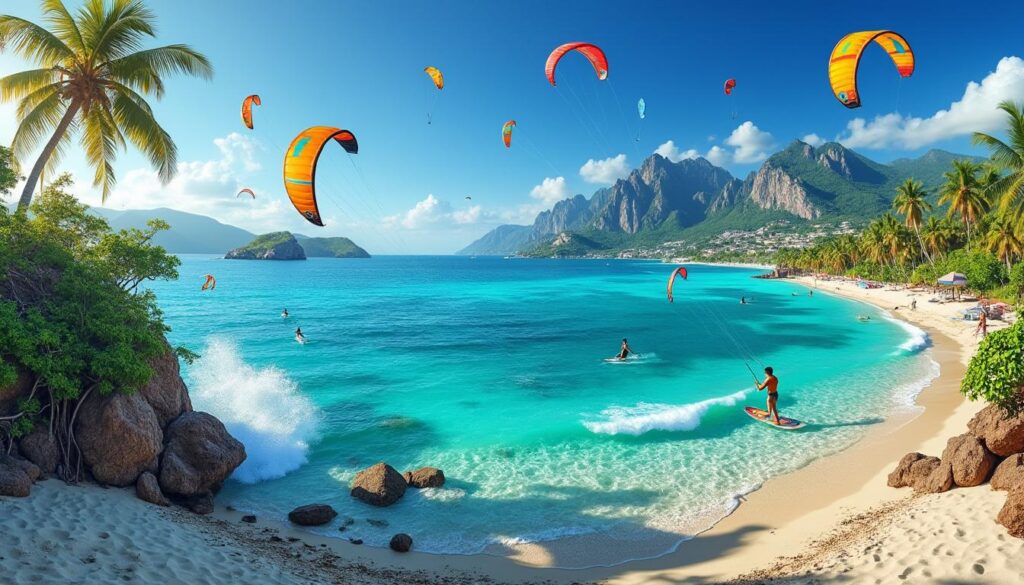
The Roman coastline is not just beach umbrellas and sun loungers. When the westerly wind tightens and the sea ripples, the colorful kites appear between Ostia, Fregene, Torvaianica and Anzio, and the coast turns into a huge wind-driven playground. Anyone dreaming of kitesurf in Italy discovers that you don’t need to cross half the Mediterranean: with the right schools, a few hours of theory and the first launches in the water, Rome becomes a perfect base to learn and progress, whether you’re on your first session or already comfortable on the board.
Along these kilometers of beach coexist spots suitable for beginner kitesurfers, highly organized areas with authorized summer kite zones, and winter home spots where local riders meet to share sessions, downwinders and weather tips. From historic clubs like the Lega Navale in Ostia to newer academies, every kitesurf school on the coast has a distinct character, a teaching style and a “tribe” with which riders organize kitesurf holidays across Italy, from the Tyrrhenian Sea to kitesurf Salento and the most remote kitesurf spots in Puglia.
- Rome is perfect for learning kitesurf: lots of schools, varied spots and summer thermal wind.
- Kitesurf is not an extreme sport for a few: with a method, a structured kitesurf course and proper equipment it is safe and progressive.
- Ostia, Fregene, Maccarese, Torvaianica and Anzio are among the key spots close to the Capital.
- Course prices range from full packages (around €350–400) to single or introductory lessons.
- Gifting a kite lesson is a concrete idea to help someone discover the sea in a new way, even if they don’t consider themselves very sporty.
Kitesurf Rome: why the Capital’s coastline is a true spot for riders
When people talk about kitesurf Rome, many still imagine something “exotic” and far away. In reality the mix of summer thermal wind, easily accessible sea and organized schools makes the Roman Tyrrhenian one of the most complete areas for those who want to learn kitesurf without going too far from the city. The warm air rising from inland and the cooler air over the sea often create that afternoon thermal wind that makes every kiter smile: regular direction, intensity between 13 and 20 knots, perfect for the first glides on a twin tip.
The beauty of Rome is also the variety: in winter, with empty beaches, riders can easily move between different stretches of coast to look for the ideal wind orientation. In summer the authorized kite areas come into play, created precisely to reconcile safety, bathers and the desire for sessions. Thus, within less than an hour’s drive you can find flatter conditions to set up your first reaches and zones with waves for those who want to start playing with the surf board.
This balance makes the Roman coastline a real gym for those starting from zero and a convenient starting point for those who then want to explore the best kitesurf spots in Italy in other regions. Many schools in fact organize trips to kitesurf Salento, Sardinia or Sicily, creating a natural bridge between the Capital and the classic kitesurf spots of the Adriatic and Ionian seas.
A typical example? Imagine Luca, 34, who works in the city center and spends his days at a computer. He starts with a kitesurf course in Ostia, uses late afternoons for the first land lessons, then on weekends attempts his first assisted outings. In a few months, between winter sessions with a thick wetsuit and thermal afternoons in Focene, he feels ready to join a kite trip to the south, maybe following a guide like the one on spot and kitesurf schools in Salento. The path is natural, and it starts right from the Roman wind.
Those who consider kitesurf an “extreme sport” have often never seen a lesson up close: radio linked to the instructor, helmet, vest, areas separated from bathers, weather briefings before entering the water. With discipline and method it becomes a structured activity, with clear steps and progression rates that respect your pace. It is this combination of controlled adrenaline and organization that is growing the kite community in Rome year after year.
In short, the Roman coastline works like a large laboratory where you can learn to read the wind, choose the right spot and build confidence on the board, without leaving the Capital. Once you understand this, it becomes hard to look at Rome’s sea only as a backdrop for an aperitif.
Kitesurf Rome: overview of the best spots on the coast
Each kitesurf spot in Rome has a distinct character. Some are perfect for initial progression, others offer more intense sessions with waves and strong wind. Knowing where to go based on season and wind direction is the key to avoiding days wasted waiting for a gust that will never arrive.
The stretch between Marina di San Nicola and Anzio lines up several kite areas, both summer and winter. There are zones like Torre Flavia, ideal for those working on the waterstart thanks to shallower, more sheltered water; others like Maccarese – La Rambla or Focene, more exposed and frequented by riders with some experience behind them. Ostia remains the historic heart, with realities like the Lega Navale and areas managed by structured schools offering both courses and rental.
The best logic? Don’t fall in love with a single spot. Learn to think “like in Salento”: direction, intensity, tides and waves before looking at the postcard. If the wind is too onshore in one place, it can be cleaner 15 km to the north or south. Local riders move this way, and those who join their decisions improve faster and with less frustration.
This mosaic of conditions makes Rome a particular case in the Italian kitesurf context: it is not a “single spot” like many iconic kitesurf spots in Puglia, but a true system of connected spots. Those who understand it stop asking “if we’ll go out” and simply start choosing where.
Learning kitesurf in Rome: courses, schools and progression from the first kite to the first reach
If you’ve decided to learn kitesurf, the temptation to “try it alone” with a friend’s wing is strong. It’s also the quickest way to get hurt and hate the sport at the first gust. On the Roman coast now all serious schools repeat the same mantra: start with a structured course, because the kite is tamed with technique and respect, not with force.
The base is always the same: wind theory, safety, kite handling on land, body drag, and only after that waterstart with the board. Each kitesurf school works with slightly different programs, but the general scheme remains unchanged and follows international standards. The first lesson often doesn’t even involve entering the water: it’s fully dedicated to understanding the wind window, power zone, quick-release systems and fine control of the bar.
A typical course on the Roman coast lasts several hours spread over multiple days, precisely to respect assimilation times. Some centers offer 6–8 hour packages, others work in modular steps, so faster learners can move to the next phase earlier. The important thing is not to skip stages: the Roman sea forgives little the impatient, especially when a strong libeccio perturbation comes in.
The golden rule for beginners is simple: you don’t need to be an athlete, you need to be consistent. Some riders come from surfing, snowboarding or skateboarding and have an advantage in board feeling. Others, who have never set foot on a board, recover with attention, listening to the instructor and a real desire to understand how the wind works. The only real requirement is to know how to swim and feel reasonably comfortable in the water.
To get a broader view of how schools work across the country, many Roman instructors recommend resources like this overview of kitesurf schools in Italy, useful for comparing methods, certifications and teaching approaches. Rome fits into this national network with a mature offering, close to that of more famous hotspots like kitesurf Sardinia or the aforementioned kitesurf Salento.
In the end, what really makes the difference is not the school’s name but the quality of the relationship with the instructor. A good teacher knows how to balance encouragement and frankness, stops you when you’re overdoing it, puts you back on land when you feel “already pro” and pushes you out again when you’re stuck. This dynamic, experienced on every beach, is the true engine of progression.
How much does a kitesurf course in Rome cost and what does it really include
On prices, the Roman coast offers fairly uniform solutions, with some differences between historic schools and smaller realities. Generally, a complete basic course is between €350 and €400, divided into multiple lessons. Alternatively, some schools offer a flexible system of single lessons, around €50 per hour, ideal for those who want to spread the cost over time or already have experience and just want a few hours of targeted coaching.
For those who simply want to understand if kite is for them, it’s common to find 2-hour introductory lessons at around €90–100, often with complete equipment included. A typical example is the 2-hour intro in Ostia at about €95 per person, enough to try the pull of the wing, learn how to control the bar and feel the body being pulled by the wind in full safety, under the watchful eye of the instructor.
Almost always the course price includes all technical material: kite, board, bar, harness, flotation vest, helmet and wetsuit, at least in the cooler seasons. In many cases radio headsets are also included to maintain constant contact between student and instructor during the first waterstarts.
The expense item to keep in mind is possible transfers between spots: if the wind doesn’t cooperate in one spot, the school may decide to move the lesson to a more exposed area. It’s a positive sign, because it means they follow the wind, not logistical convenience. Those who rely on serious structures appreciate this “mobile” approach.
To get a clear picture, a rough table of typical costs on the Roman coast can be useful:
| Type of lesson/course | Approximate duration | Average price | Equipment included |
|---|---|---|---|
| Introductory kitesurf lesson Ostia | 2 hours | About €95 per person | Yes, complete |
| Complete basic kitesurf course Rome | 6–8 hours total | €350–400 | Yes, complete |
| Advanced private lesson | 1 hour | About €50 | Usually yes, check with the school |
| Equipment rental (for independents) | Half day | Variable, €50–80 | Kite, board, bar, harness |
Understanding the real value of a course also means looking beyond the price. A good package teaches you to read weather portals like Windguru and Windfinder, to choose the right kite for the 13–20 knots typical of the Roman thermal, to manage auto-rescue and safety procedures. One well-done lesson is always worth more than two improvised hours.
Where to kitesurf in Rome: a practical guide to spots from the north to the south of the coast
The highlight of kitesurf Rome is undoubtedly the spots. From north to south, each stretch of coast has its own logic of wind, waves and beach management. Knowing them saves you from wasting time on empty runs and allows you to build a session calendar calibrated to season and level.
Marina di San Nicola is one of the most appreciated summer spots: when the kite area is active, it becomes an orderly zone where courses and independent riders coexist without chaos. Further south, Campo di Mare offers another dedicated kite area usable in summer, often chosen by those seeking a compromise between convenience and clean wind. Both spots are interesting for those living north of Rome who want to reduce travel time.
Moving on, the Torre Flavia area is a small winter and mid-season gem: from October 1st to April 30th, when the beach is not occupied by bathers, the area inside the breakwater offers calmer and shallower water, with little swell. It’s a perfect context for those working on the first reaches and turns, with less “sea noise” compared to more open spots. The added value? It’s located in a nature reserve, so the environment makes the session even more enjoyable.
Heading toward the city, Maccarese – La Rambla emerges, one of the liveliest summer hubs for kitesurfing. Here there is a dedicated area where courses are held, equipment can be rented and you can breathe that community atmosphere that helps a lot those taking their first steps. Not far away, Focene offers another summer kite area, close to Fiumicino airport: often generous wind, enough space to launch and land, a “crew” atmosphere where people know each other and help on the beach.
Arriving in Ostia, the picture becomes even richer. The Lega Navale manages a kite area usable in summer, reserved for members, often used as a base for structured courses. L’Oasi, a historic establishment, becomes in winter one of the reference spots managed by schools like Kiterevolution: here lessons, rentals and sessions for riders of different levels are held. In the summer season the famous first and third gates come into play, which over the years have become true symbols of Roman kitesurf, although municipal authorization comes and goes and must be checked season by season.
Further south, Torvaianica features a well-organized summer kite area, with an active school and regular courses, while Anzio often offers interesting conditions for those looking for a slightly rougher sea and wanting to test the progress made in more sheltered spots. On some swell and wind days, this area becomes the preferred playground for kitesurf wave enthusiasts, also inspired by the achievements of Italian athletes who have written important chapters in the discipline.
What do all these beaches have in common? The need to respect clear rules: distance from bathers, launch and landing corridors, dedicated areas. Kite is not a “solo” sport: it’s lived in a group, people help each other with ground maneuvers, monitor the sky and keep an eye on conditions for everyone. Learning to move within this system is part of the progression as much as learning the first upwind leg.
Kitesurf Rome all year round: seasons, wind and strategy for choosing the spot
One of the most frequent questions from those who look at the sea from the city is: “Is kite only done in Rome in summer?”. The answer is clear: you can kitesurf all year round. The way spots are experienced changes between summer and winter, but the relationship with the wind remains the same: you study it, anticipate it and respect it.
In summer the protagonist is the thermal wind: it usually rises in the early afternoon, strengthening between late afternoon and evening, with intensity often between 13 and 20 knots. These are ideal conditions to work on waterstart, first headings and speed control. The downside? The massive presence of bathers. For this reason you can go out only in authorized kite areas, where takeoff and landing zones are well defined and supervised.
In winter the story changes. Beaches empty, and the sea becomes almost exclusively the domain of surfers and kiteboarders. Summer restrictions lapse, and riders can freely choose the stretch of coast best suited to the day’s perturbation, whether it comes from maestrale, libeccio or scirocco. This is where the ability to read forecasts comes into play: portals like Windguru and Windfinder become the daily “Bible” to organize outings and decide when it’s worth loading the car.
Practically, for many schools the most intense teaching season runs from spring to early autumn. Temperatures are milder, the wetsuit is less demanding and beginners feel more at ease. But the most motivated riders soon discover that some of the best sessions arrive on cold, clear winter days, when the wind blows harder and the wave line cleans up.
A key tip for those starting to feel autonomous is not to get stuck only on “your” city spot. True maturity comes when you learn to combine season, wind direction and the session’s technical objective. Want to work on speed and the first long reaches? Look for a flater spot with medium wind. Want to start feeling the wave under the board? Watch for swells and coordinate outings with more experienced friends.
This planning ability, typical also of riders who frequent more distant spots like kitesurf Sardinia spots or the Ionian kitesurf in Puglia, turns your practice from a simple hobby “when it happens” into a real ongoing relationship with the sea and wind. And all this, on the Roman coast, is less than an hour’s drive from the ring road traffic.
Kitesurf equipment in Rome: sail, board, wetsuit and safety to start off on the right foot
Once you’ve tasted the kite with a few lessons, the question comes up: “When does it make sense to buy equipment?”. On the Roman coast, as in much of kitesurf Italy, the most honest answer is: wait until you are truly autonomous in kite control and waterstart. Before that it makes more sense to use the school’s gear, which is regularly updated and adjusted by your instructor to the day’s conditions.
When you start planing consistently, you can think about your first personal set. Here the second-hand market comes into play, a real ally for those who don’t want to empty their bank account. Roman riders, like many Italian kiters, rely on specialist portals and local communities to find kites and boards a few years old but still in excellent condition. A 2020 kite will cost more than a 2015 one, but often offers better feel, a wider wind range and updated safety systems.
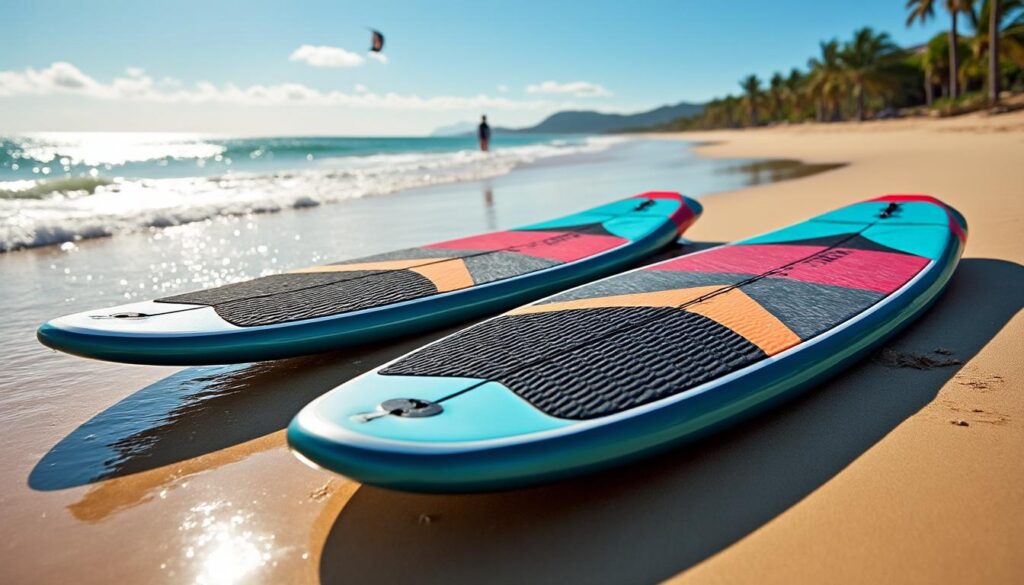
For the typical wind of the Roman coast, a basic quiver could include two kites: one around 12 m² to ride between 14 and 20 knots, and one around 9 m² to handle 20–25 knots safely. The go-to board for beginners remains the twin tip, symmetrical in both directions, ideal for getting familiar with takeoffs and first turns. If you want to dive deeper, resources like the guides to the best kiteboard twin tips of the moment help navigate sizes, flex and shape.
Besides kite and board, the basic list includes:
- Harness (around €80–100 new), which lets you transfer kite pull from the arms to the hips.
- Wetsuit 4–5 mm, perfect for Rome in both spring and winter, with an average price between €200 and €400.
- Helmet and impact vest, strongly recommended, especially in the initial phases.
A good strategy is to start with a new wetsuit (because thermal comfort is fundamental) and used kite/board. The feeling of warmth and freedom of movement keeps you happily in the water, even when the thermal drops and the air becomes crisper. Kite and board, instead, can very well come from a rider who is updating their quiver.
Those who get hooked quickly soon discover parallel worlds like foil or boards specific for the wave. But the advice is clear: master the twin tip first, then think about foil boards and specializations. Good basic control will prevent every outing from turning into an endless struggle with the equipment. In this sense, technical guides on foil and how to choose the right kite according to the wind, similar to those dedicated to the Salento wind, are very useful for the Roman rider planning the future of their setup.
Finally, safety is not optional. The helmet, often underestimated, is an accessory many riders now consider standard, as much as the safety leash. The Roman sea, especially in winter, can throw up serious conditions: good protective equipment and clear group procedures make the difference between a challenging but fun session and a poorly handled situation.
Kitesurf holidays, gifts and community: living Rome as a base for kite in Italy
Kitesurf in Rome is not just lessons and equipment, but also a lifestyle and relationships. Many start with a gifted lesson: a voucher for a 2-hour intro in Ostia or another spot on the coast has become a popular gift idea among friends and couples who want to share something different from the usual material object. Often the recipient doesn’t consider themselves “sporty”, but discovers in the water a side of themselves they hadn’t imagined.
Gifting a kitesurf course means telling someone: “I see you capable of grabbing the bar and letting the wind pull you.” You don’t need an athlete’s body; you need the willingness to step out of your comfort zone, like when you decide to try a discipline in an iconic place such as kitesurf Punta Trettu or a classic kitesurf spot in Puglia. Rome, with its accessibility, is the ideal gateway for that first spark.
The coast’s schools are not just learning places, but real gathering points. They organize dinners, weather evenings, video screenings, trips to other Mediterranean spots. Vans full of boards and wings leave from Rome heading to kitesurf Taranto, to the Adriatic kitesurf or to the two seas of the Ionian kitesurf. Those who started planing between Ostia and Fregene soon find themselves discovering the diversity of winds and seas across the rest of Italy.
This group dimension has a powerful effect on motivation. When you know friends are monitoring Windguru to organize the next Saturday session, it’s easier to keep your body fit, work on flexibility and think about nutrition that keeps you light but energetic in the water. Kite becomes a sort of weekly compass rather than an occasional pastime.
At the same time, many riders use Rome as a “gym” before aiming for more technical spots in Italy and the Mediterranean. Some plan kitesurf holidays mixing days of smart working in the city with long weekends in destinations like Sardinia, Sicily or Salento. The advantage is clear: you arrive at the big spots already seasoned, with good basic control, ready to take advantage of every knot of wind instead of spending half the trip starting over.
In the end, Rome’s real value as a kite capital is not only in the knots of wind or the kilometers of beach, but in the ability to ignite and sustain your relationship with the sport over time. From a simple gift voucher can come a path that leads you, season after season, to read the sea with completely new eyes.
Serve essere molto allenati per iniziare kitesurf a Roma?
No. To start kitesurfing in Rome you only need to know how to swim and feel comfortable in the water. Schools structure courses progressively: first wind theory and safety, then kite handling on land, and finally entries into the water. A minimum of mobility and endurance helps, but no particular athletic abilities are required, just consistency and the willingness to learn.
Quanto tempo ci vuole per diventare autonomo nel kitesurf sul litorale romano?
With a basic course of 6–8 hours and some additional supervised outings, many students begin to make their first reaches independently. To feel truly confident in different wind conditions, however, more sessions are needed, often spread across a season. The key is frequency: those who go out regularly, even in winter with a proper wetsuit, progress faster.
Dove è meglio fare le prime lezioni di kitesurf a Roma?
For the first steps it’s useful to choose spots with relatively flat water and clear organization, such as the kite areas managed by schools in Ostia, Maccarese, Focene or Torvaianica. In winter and mid-season places like Torre Flavia, with calmer water inside the breakwater, are excellent for practicing waterstarts and initial runs. The important thing is always to follow the instructor’s guidance on choosing the spot.
Quando conviene comprare l’attrezzatura rispetto a usare quella della scuola?
It makes sense to think about personal equipment when you control the kite safely, can launch regularly and know your preferred wind ranges. Before that it’s better to use the school’s material, updated and suited to the day’s conditions. When you decide to buy, many Roman riders start with recent used gear (especially for kites) and a new wetsuit to ensure thermal comfort.
Il kitesurf a Roma è sicuro d’estate con tanti bagnanti in spiaggia?
Yes, if practiced in authorized kite areas and by scrupulously following the rules. In summer it’s forbidden to go out with the kite in bathing zones; for this reason there are corridors and reserved stretches of beach, often managed by schools. Here takeoffs and landings are organized, the distance from bathers is guaranteed and instructors and riders help each other to keep safety high.