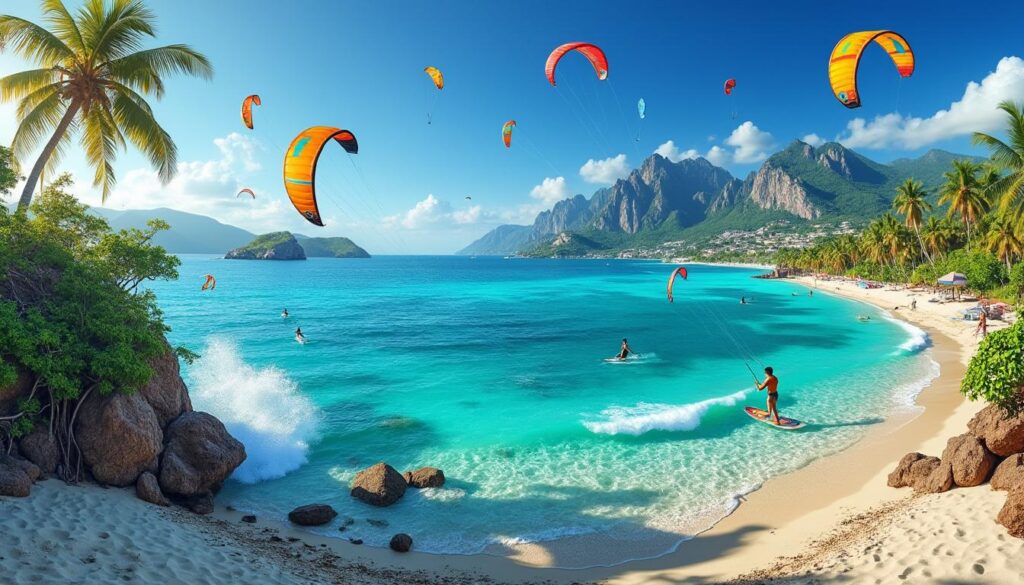
Kitesurf Sharm el Sheikh means reliable wind, pool-flat water and kilometres of shallow lagoon that look made for kiting. On the Red Sea the thermal wind kicks in early, strengthens by midday and often delivers sessions until sunset. Riders coming from more unstable spots in kitesurf Italia are taken aback: here it’s not about “if” you go out, but “with which kite size” you enter the water. The schools, the well-equipped beach centres and hotels with direct access to the lagoon make everything even easier: you arrive, rig the bar, take a couple of steps and you’re already on the board.
The beauty of Sharm is the balance between a protected environment and room to manoeuvre. The coral reef shapes natural turquoise pools, while beyond the lagoon the Red Sea opens with regular chop and small kickers for those who want to attempt bigger jumps. In the same day a beginner rider can practice the water start near the shore, while a kitefoiler racks up long legs in the outer area. Not to mention the surroundings: dry light, warm climate even in winter, relaxed post-session atmosphere with mint tea, spot banter and planning the next kitesurf holidays between Egypt, Dakhla or Tarifa.
- Wind: thermal and steady, especially between March and November, ideal for quick progression.
- Lagoons and flat water: perfect for kitesurf for beginners, freestyle and foil.
- Organised kite centres: transfers, storage, rentals and kitesurf courses for every level.
- Mare + desert combo: intense sessions and, off the water, excursions in the Sinai and the coral reef.
Kitesurf Sharm el Sheikh: why the Red Sea is an accelerator for progression
Sharm el Sheikh has become one of the references for kitesurf on the Red Sea because it combines three key elements: steady wind, predictable water and wide spaces. For those coming from more capricious spots, maybe from the Adriatic or some spot kitesurf Puglia where the wind shifts, the feeling here is almost unreal. You look at the flags: taut from morning to evening, with few gaps and few surprises. It’s the perfect ground to work on technique, bar control and transitions safely.
An imaginary rider, let’s call him Luca, arrives in Sharm after a summer battling on/off wind on the Ionian. Here, in a full week, he manages to unlock moves he had chased for months: confident upwind, first tacks, kite control in toeside. The reason isn’t magic, but the combination of moderate but consistent wind and the absence of real waves in the lagoon. You can repeat the same exercise twenty, thirty times in a row without wasting time recovering the board in shore break.
From the instructor’s point of view, Sharm is an open manual for learning kitesurf. The typical progression in the lagoon follows very clear steps: kite handling on land, body drag, water start, first controlled legs. In such linear conditions, the instructor can focus on small details that make the difference: shoulder position, pressure on the heels, timing of the power stroke. The result? Intense sessions, but with less frustration compared to certain spots in the kitesurf Adriatico where currents and chop complicate everything.
Sharm remains interesting also for those who already have a good level. On windier days the outer part of the lagoon offers regular chop, ideal for working on old-school jumps, controlled kiteloops and first attempts at handle pass. Some centres organise guided downwinders along the coast, where the Red Sea shows its wilder side. The contrast between the deep blue of the water and the yellow of the desert behind creates a frame that makes every run feel more intense.
We must not forget the comparison with other international Mediterranean spots, like Tarifa or Paros. In places like the European wind capital the chop is often more chaotic and the number of riders on the water much higher. In Sharm, instead, the atmosphere is more relaxed and the kite density reduced in many periods of the year. For this reason many Italian riders choose Sharm as an intermediate step between the first “easy” spots and the windier, more demanding destinations.
The takeaway is simple: if the goal is to progress in a concrete way, Sharm el Sheikh works like an open-air technical gym, where every gust works for you.
Wind conditions in Sharm: what to expect during the year
The key to Sharm is the thermal wind born from the contrast between the hot desert and the cooler surface of the Red Sea. Basically, when the sun starts to beat down, the air over land warms and rises, drawing cooler air from the sea. This creates a regular thermal wind that settles almost every day in a range perfect for 8–12 metre kites for an average rider.
The best seasons generally run from spring to late autumn, with the central months being the windiest but also the hottest. In winter the situation becomes more variable but still usable for those willing to wear a slightly thicker wetsuit. The big advantage compared to many spots of kitesurf Italia is the percentage of truly rideable days: here the stats work in favour of your desire to get sessions.
Before leaving it’s always worth checking local forecasts and updated statistics from the beach centres. Often weather apps underestimate the Red Sea thermal, so the advice is to trust the historical spot data more than a single online forecast. Those used to the vento Salento know well that thermals have their own character and Sharm is no exception.
The final message? Here the wind is not a guest, it’s the host: if you respect it and read it well, it rewards you with clean, frequent sessions.
Lagoons, reefs and bottoms: how to read the kitesurf spots in Sharm el Sheikh
The kitesurf Sharm el Sheikh spots are spread along the coast with fairly different characteristics, but with a common thread: lagoons protected by the coral reef. The typical structure is this: strip of sand, area of shallow crystal-clear water with sandy or mixed bottom, then, beyond the reef, deeper sea and wave movement. Knowing where each zone starts and ends is essential both for beginners and for experienced riders who want to push a bit more.
Back to Luca, our imaginary rider. On his first day at the spot, the instructor has him walk along the shoreline. He points out where the sand gives way to coral, the lagoon entrances, the buoys marking safe limits for kites. In ten minutes of walking, Luca already has a precise map of the playing field in his head. This “on-foot” approach is still the most effective to avoid finding yourself body dragging over the reef at low tide.
Many centres use actual maps on a board on the beach, with arrows for wind direction, zones for launches and landings, areas reserved for the kite school and lanes for foilers. It’s a system similar to what you now see at the best miglior spot kitesurf Italia, but here the reef factor adds another layer of attention. The concept is simple: where the lagoon is wide and clean, the risk drops and progression accelerates.
In practice, most sessions in Sharm are played out in flat or slightly rippled water. This is where those doing kitesurf for beginners find paradise: no waves to flip your board, no weird currents pulling you sideways. Just you, the kite and the wind to read. In these conditions the water start ceases to be an insurmountable obstacle and becomes a clear, repeatable sequence of movements.
For more advanced riders, legs toward the outer edge of the lagoon offer different conditions: regular chop for aerial jumps, small kickers to push for more powerful tricks. Sometimes a slight wave forms on the reef, not enough to call it true wave riding but enough to have fun with a few bottom turns and improvised cutbacks.
Understanding where you are at all times relative to the reef is the real skill to develop here. Always maintain a good safety bearing and don’t let yourself be carried too close to the coral zone — that’s the non-negotiable rule every rider should keep in mind before hooking into the chicken loop.
Main lagoons and comparison of typical conditions
Each lagoon around Sharm offers a different mix of depth, exposure to wind and infrastructure. To better orient yourself, here is a useful comparative summary to keep in mind when choosing where to go based on your level.
| Area | Water characteristics | Recommended level | Strengths |
|---|---|---|---|
| Protected lagoons near hotels | Very flat water, shallow sandy bottom, almost no chop | Beginners and intermediates | Ideal for kitesurf courses, water starts, first upwind legs |
| Outer areas beyond the reef | Deeper sea, regular chop, slightly stronger wind | Intermediates and advanced riders | Perfect for jumps, guided downwinders and intensive training |
| Channels between reef and lagoon | Mix of flat water and small waves, light currents | Intermediates with good direction control | Technical transitions, practice kite control in tighter spaces |
This modular structure makes Sharm a spot suitable for mixed groups: beginners can stay close to shore with the school, more experienced riders can push out to the external area. Everyone, however, shares the same frame: a lively Red Sea, light on chop, that demands respect but rewards with smooth gliding.
The key point to remember is that, in every lagoon, the bottom and the reef write the rules of the game: knowing them before going out transforms a simple outing into a solid, aware session.
Learn kitesurf in Sharm: schools, courses and safety for beginners
For those looking for a structured kitesurf course, Sharm el Sheikh is one of the most concrete options just a few hours’ flight from Italy. The local kitesurf schools now have years of experience with European riders, organising full packages with lessons, accommodation and daily transfers from the spot. The goal isn’t to sell you the illusion of becoming a pro in three days, but to get you out of the water with solid, safe basics, ready to be consolidated later at your home spot in Italy, whether that’s kitesurf Lecce, kitesurf Taranto or a northern lake.
A typical path for kitesurf for beginners starts with short theory sessions and long practice. You work immediately on kite control in safety, with the harness unhooked, relaunches and body drag. Only when the student controls the wind on the bar without constantly looking at the sail do you move to the water start. Here Sharm’s lagoon makes the difference: no waves, no gloves, just warm water and space.
Many schools use helmets with radios to communicate in real time while the student tries to get up on the board. A “bend your knees a bit more”, “pull the bar only when you feel the kite full” or “aim for a straight line, not the beach” arrives in the ear at the exact moment it’s needed. This kind of direct feedback drastically changes progression speed, especially in the first days.
Safety remains the common thread of every lesson. Before each session there is a briefing on the day’s conditions, the limits to respect and the signals to use with the instructor. The quick release function is explained, procedures in case of board loss and strategies to return to the beach in self-rescue if something goes wrong. Sharm is not a playground without rules: it’s a powerful spot that must be treated with respect.
To keep energy high, schools alternate intense practice moments with short shaded breaks. Water, sunscreen, some dried fruit or salty snacks: small details that keep the mind clear and the body from giving in to effort and heat. In this sense, the rider lifestyle on the Red Sea is not very different from that of someone living the kitesurf Salento: eat light, listen to your body, go in the water when the wind is really ready.
The lesson to take home is that Sharm is not just a travel destination, but an ideal context to build serious technical foundations, to be reused later anywhere you want, from kitesurf Ionio to seeking new spots in Greece, Spain or beyond.
Practical checklist to choose a school and course in Sharm
To avoid turning enthusiasm into improvisation, it’s wise to arrive in Sharm with clear ideas about what to look for in a kite school. A small checklist can make the difference between a well-spent week and an improvised course.
- Certifications and language: make sure instructors are certified and speak a language you feel comfortable with, ideally Italian or good English.
- Number of students per instructor: for the first days, two students per kite is the maximum recommended to maintain attention and safety.
- Modern, well-maintained equipment: recent kites, bars in good condition, leashes and impact vests available in different sizes.
- Safety plan: presence of a rescue boat, clear briefing on recovery procedures and navigation limits within the lagoon.
- Transparency on timing: a good course doesn’t promise miracles, but a realistic progression, adapted to your pace.
Following this checklist means treating the wind and the spot with the seriousness they deserve, turning every hour on that Red Sea into a concrete step forward.
Equipment, wind and comparison with the best kitesurf spots in Italy
Leaving for Sharm with the right setup is half the job. Many centres offer full rental, but having at least part of your own gear helps you feel at home. In general, for an average-weight rider the most used range will be between 8 and 12 metres, with an all-round twin tip board. Those who love foil can also play with slightly larger sizes, taking advantage of the light morning wind or less charged days.
Those coming from the kitesurf North Italy scene or the alpine lakes will immediately notice the difference in air density and wind steadiness. Here the kite feels “full” even when the knot number doesn’t look impressive on paper. The surrounding desert heats the air and creates a flow that, once ignited, remains stable for hours, without the sudden lulls or nervous gusts typical of spots surrounded by mountains.
Comparing Sharm with some of the miglior spot kitesurf Italia like Salento, Lake Garda or Sardinia, two clear aspects emerge: first the frequency of windy days, second the regularity of waves (or rather, their absence in the lagoon). In Salento, for example, the vento Salento plays between two seas, Ionian and Adriatic, offering variety but also more complexity in reading the conditions. On the Red Sea, instead, the game is more linear: if the thermal enters, you already know what to expect.
Many riders use Sharm as a testing ground to try new boards or kites, before taking them around the Mediterranean: from Corfù to Paros, from Fuerteventura to Bali. It’s no coincidence that on the Salento Kiter portal there are more and more travel stories that touch the Red Sea and other iconic spots like Fuerteventura or Zanzibar. The idea is to build your kite year as a series of coherent chapters: technique in the lagoon, strong wind elsewhere, surf when possible.
An often underestimated aspect is preparing the body for session continuity. Unlike many Italian spots where the wind comes every other day, in Sharm you risk having good wind almost every day. This means repeated strain for legs, back and shoulders. Introducing some mobility and light strengthening exercises before leaving makes the holiday less tiring and more enjoyable on the water.
The central idea is simple: use Sharm as a laboratory to sharpen technique and equipment, so when you return to your home spot in Italy you’ll know exactly what to ask of your kite and your body.
Comparative table: Sharm vs typical Italian spots
To have an even clearer picture, here is a concise comparison between Sharm and three typical situations of kitesurf Italia, useful for planning your session calendar.
| Area | Wind type | Water | Usefulness for progression |
|---|---|---|---|
| Sharm el Sheikh (Red Sea) | Constant thermal, 15–25 knots frequent | Flat lagoon, outer reef with light chop | Perfect for technical foundations, freestyle and controlled foil |
| Salento (Ionian/Adriatic) | Thermals and systems, variable directions | From flat to wave, depending on wind and spot | Great school for wind reading and adapting to spots |
| Northern Italian lakes | Thermals driven by orography, sometimes irregular | Short chop, sometimes confined spaces | Ideal to work on control and starts in more demanding conditions |
Looking at this table it’s easy to see why many riders choose a combo: Sharm to build clean technique, Italy to train adaptability and character. Two sides of the same coin, united by the same desire to grab the bar and let the wind pull you.
Beyond the spot: lifestyle, sea and next destinations after Sharm
Kitesurfing in Sharm doesn’t end when you unhook the chicken loop. Off the water you’ll find an environment where sea and desert meet without filters. Days start early, with a look at the palms outside the hotel to see how much the wind is already working. A lighter than heavy breakfast, quick gear check, then transfer to the lagoon with other riders, between jokes and comparisons of the day’s forecasts.
After the session the energy changes pace. Some stay on the beach to watch the last sunset runs, others dive with mask and snorkel to peek at the coral reef, some prefer a hot tea and a local dish to reorder their strength. It’s a simple lifestyle, made of wind, salt water and real conversations. Without the glossy veneer of mass tourism, but with the essentials a rider needs to feel in the right place.
For those who live kite year-round, Sharm is often a step in a longer path. After consolidating technique and confidence here, many look towards other Mediterranean and beyond destinations: Corfù, Paros, Cape Verde, Zanzibar. On Salento Kiter you’ll find trip reports like kitesurf in Paros or winter sessions in Dakhla, all connected by a common thread: the search for solid wind and authentic spots.
Another element that links Sharm to the kitesurf Italia scene is the community aspect. In many periods of the year you’ll find the same faces here that populate Salento’s beaches in summer or Sardinia’s shores. People talk about spots, new gear, how to improve their riding for upcoming events or simply for personal satisfaction. The exchange of tips between those who have tried dozens of spots and those on their first kite holiday is worth as much as a water lesson.
Practically speaking, there are plenty of opportunities to combine kite with other activities: desert excursions at no-wind times, visits to historic sites, reef diving. Those with family in tow can organise mixed days, alternating half-day sessions with shared moments at sea or in town. From this point of view, Sharm is more flexible than many “kite-only” locations, because it offers alternatives even when the wind decides to take a break.
The guiding idea is that kitesurf is not just a sport, but a way to organise your time and travel choices. Sharm el Sheikh, with its Red Sea and perfect wind, is one of the most solid pieces to insert into this mosaic of spots, sessions and tides.
What to bring home from Sharm for future sessions
Those leaving Sharm don’t bring home just photos and videos of glides on the Red Sea. What really remains is a set of sensations and awareness that change the way you live the wind even on home spots.
- Muscle memory of water starts, upwind riding and transitions performed in flat water and clean wind.
- Respect for the spot, for reefs, currents and local logics, to apply later on any other beach.
- New technical goals, from the first controlled jump to a simple long run without hesitations.
- Connections with other riders you may meet again in Italy or on some future kite trip.
In the end, Sharm el Sheikh teaches one clear thing: you don’t command the wind, you interpret it. And when you find a place where it blows so regularly, the only sensible answer is to get in the water as much as possible, listen to it and let it work for your progression.
What is the best period to kitesurf in Sharm el Sheikh?
The most reliable seasons for kitesurfing in Sharm el Sheikh generally run from March to November, when the thermal on the Red Sea is more consistent and air temperatures are pleasant. Summer offers the largest number of windy days but also more intense heat; spring and autumn are a great compromise between wind, climate and moderate crowds. In winter you can still ride, but conditions are more variable and a slightly thicker wetsuit may be necessary.
Is Sharm suitable for kitesurfing beginners?
Yes, Sharm el Sheikh is particularly suitable for beginners thanks to lagoons of flat, shallow water protected by the reef, and the presence of organised kitesurf schools. The sandy bottom in many stretches and the steady wind reduce the variables to manage during the first steps, speeding up the learning of body drag, water start and first controlled legs. It is important to rely on certified instructors and always respect safety briefings.
What kitesurf equipment is needed for a holiday in Sharm?
For an average-weight rider, in Sharm el Sheikh kites between 8 and 12 metres are usually used, paired with an all-round twin tip board. Those who kitefoil can consider slightly larger sails to take advantage of lighter morning wind. Many centres offer full rental, so it’s possible to travel light; if you prefer to bring your own gear, check airline baggage limits and protect boards and kites well in the bag.
Do you need a wetsuit to kitesurf in the Red Sea?
In the warmest part of the year most riders use only a rash vest and shorts or a light shorty to protect from the sun and wind. In the shoulder seasons and winter a full wetsuit between 3/2 and 4/3 mm is recommended depending on cold sensitivity and session duration. Even when the water isn’t cold, a light wetsuit helps against wind-chill caused by air continuously drying the skin.
How does Sharm compare to kitesurf spots in Italy?
Compared to many kitesurf spots in Italy, Sharm offers a higher percentage of windy days and greater wind regularity thanks to the desert thermal. The flat lagoons facilitate technical learning compared to spots with marked chop or waves. However, Italian spots like Salento or the northern lakes remain irreplaceable for training adaptability to different conditions, tides and wind directions. The ideal is to combine Sharm for pure technique and Italy for variety of situations.