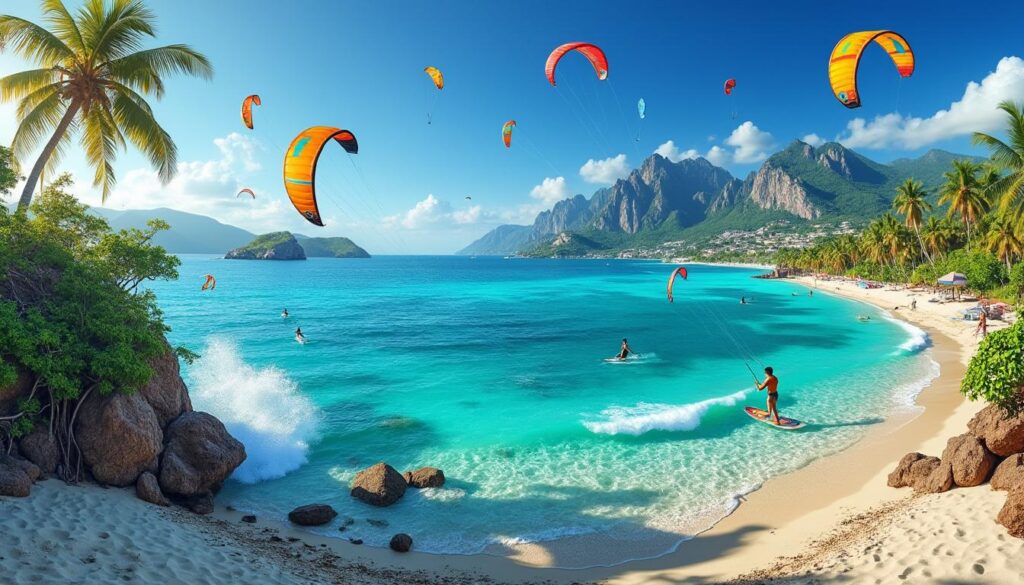
Strong wind, turquoise water, wide bays that seem designed for long reaches: Corsica is one of those islands where days are measured in knots of wind, pastures of clouds and tides of light. Those looking for kitesurf in Corsica don’t find just a few nice beaches, but a true circuit of spots ranging from north to south, venturi channels, flat lagoons and reefs that build proper waves when the Mistral or Sirocco comes in. The island sits between Sardinia, Tuscany and the French Riviera, and this position creates an almost continuous wind machine, perfect if you want to plan a kite trip with a reduced margin of error.
Between Piantarella, Figari, La Tonnara, Santa Manza, Algajola and lesser-known beaches like Ghjunchidu or Ostriconi, each bay has a distinct character: flat water for freestyle, messy chop to train legs and timing, shorebreaks to respect, seabeds mixed sand and rock. Knowing these differences takes you from an “impromptu outing” to a “planned session” where you choose the spot based on direction, intensity and skill level. The game in Corsica is exactly this: understanding where to move as the wind changes, a bit like you do in Salento between the Adriatic and Ionian or in major Mediterranean hubs like Paros and the Cyclades.
In short
- South Corsica = venturi and consistency: between Figari, Piantarella and La Tonnara the wind often works 1 day out of 2 in season.
- North rockier with more waves: Algajola, Calvi and Ostriconi give waves and more “oceanic” conditions when Mistral or Levante comes in.
- Best kite period: from May to October for water and temperatures, with peak reliability between May–July.
- Different levels, different spots: lagoons and enclosed bays for kitesurf for beginners, reefs and shorebreak for those who want to push.
- Weather and safety: serious forecasting, attention to storm warnings and rocky coasts, absolute respect for the wind.
Kitesurf Corsica: understanding wind and seasons before choosing a spot
Before talking about beaches, in Corsica you must talk about wind. The island takes the Mistral from the northwest, the Sirocco from the southeast, the Levante from the east and a series of local thermals that activate with summer heat. Between Bonifacio and Sardinia a strong venturi effect forms: the air is compressed in the strait and accelerates, giving that “fan on” feeling when everything else looks softer.
For those planning kitesurf holidays, this means that from May to July you have good chances of finding 15–25 knots with remarkable regularity, especially in the south. It’s no coincidence that many local schools focus everything on this period: warmer water, long days, fewer unstable depressions. August remains windy, but tourist pressure rises and you need to manage water space and launch areas better.
Those looking for the best kitesurf spot in Italy in terms of consistent wind often put Corsica on the same map as Salento, Sardinia and western Sicily. The difference lies in the mix: jagged coast, many small bays, seabeds that change even within a few hundred meters. The experienced kiter of kitesurf in Italy loves this puzzle, because they can “read” the conditions and often find themselves in the right spot while others pick the wrong coast.
The most meticulous use tools like Windfinder or GFS models: forecasts calculated four times a day, with resolution around 13 km and 6-hour steps up to 10 days. For spots like Ghjunchidu/Giunchiddu, these maps are gold: you look at the arrow’s direction, interpret intensity in knots, check for any weather warnings and then decide if it’s a day for a pulled 9m or a relaxed 12m. Knowing that knots can be easily converted into km/h, m/s or mph helps those coming from other countries who don’t think in nautical units.
A practical example: Luca, an intermediate rider used to the Adriatic kitesurf, checks forecasts for Figari. He sees 18–22 knots NW with a tendency to increase in the afternoon. He might underestimate the venturi effect and bring only a 12m, but someone who knows the area advises a 9m as the main sail. Result: a perfect session while others struggle. In Corsica the wind is not negotiated, it’s anticipated.
The takeaway is simple: those who learn to read wind and season in Corsica make a mental leap useful everywhere, from Ionian kitesurf to farther trips like Dakhla in the Atlantic. Interpreting the charts becomes part of the pre-session ritual, as important as inflating the kite properly.
Kitesurf Corsica: the best spots in the south between Piantarella, Figari and La Tonnara
The south of Corsica is the island’s kite beating heart. Between Bonifacio, Figari and Sartène there’s a concentration of bays that respond well to multiple wind directions. Those used to kitesurf Salento with two seas find a similar dynamic: if one coast isn’t working, often the neighboring one lights up. The goal is to know the personality of each Corsica kitesurf spot to understand where to fit your next session.
Piantarella is perhaps the most mentioned name when talking about kitesurf Corsica. The lagoon, colored by very white sand and partly protected by the island of Piana, offers water that’s generally flat or only slightly rippled. For those who want to train freestyle or first jumps with soft landings, it’s a playground. But it’s not just aesthetics: with west and northwest winds the area works regularly, and waterstarts become easier thanks to the lack of waves that push you off course.
Figari plays a different tune. Here the wind often comes reinforced between the hills, creating days of 20–30 knots where decisiveness and the right gear are needed. It’s a spot many also associate with windsurf and wingfoil, precisely because the chop and wind strength force cleaner, more focused riding. A local kitesurf school can help you understand exit and return lines to avoid gusts that are too messy close to shore.
La Tonnara is famous among those who love Mediterranean waves. With the Mistral working for days, the bay can build swells up to 2–3 meters, with orderly sets perfect for practicing surf-kite, committed bottom turns and cutbacks on the lips. Here the line between fun and risk is all about respect: powerful shorebreak, currents and seabeds to study before jumping in. It’s not an ideal spot for kitesurf for beginners, but it becomes an advanced school for those who want to go beyond “back-and-forth edging”.
Moving towards Santa Manza, you find hybrid conditions: calmer days, less radical water, perfect for those who have already mastered the waterstart but want to extend reaches, work on upwind and downwind runs. Many riders coming from kitesurf Taranto or other Ionian areas appreciate this kind of “intermediate” spot, where you feel the wind’s force but without too much violence.
To summarize the functional differences between some southern spots, here’s a useful overview:
| South Corsica area | Type of water | Ideal wind | Recommended level | Key strengths |
|---|---|---|---|---|
| Piantarella | Flat / light chop | NW–W, summer thermals | From guided beginner to advanced | Turquoise lagoon, ideal for freestyle and technical progression |
| Figari | Medium-strong chop | NW strengthened by venturi | Intermediate–advanced | Powerful and consistent wind, great training for kite control |
| La Tonnara | Waves 1–3 m depending on the day | Sustained Mistral | Advanced | Wave riding, jumps on the lips, wilder atmosphere |
| Santa Manza | Moderate chop | Various summer directions | Intermediate | Long reaches, good mix of safety and adrenaline |
Those coming from other iconic destinations like Tarifa, Paros or the Greek islands discover that these Corsican spots hold up well in comparison. They don’t have the “industrial” fame of some camps, but for those seeking quality and variety in kitesurf in Italy, southern Corsica is an important piece of the Mediterranean puzzle. It’s the place where you really understand how much wind, when it finds the right mountains, can transform a calm bay into a powerful gym.
Kitesurf Corsica in the north: Algajola, Calvi, Ostriconi and the wilder beaches
Moving to Balagne, between Calvi and Saint-Florent, Corsica changes face. The bays open to the west and northwest, the mountains form an amphitheater and when the Mistral or Levante comes in, the energy on the water becomes more “oceanic”. Those from the Adriatic kitesurf, used to shorter, closer waves, learn here to handle longer swells and faces of water that allow real surfing.
Algajola is the first name to note. A long sandy beach with transparent water that stirs when the Mistral gains strength. There aren’t kite schools operating steadily year-round, so it’s a spot mainly for independent riders with good beach launch management. The beauty is precisely this sense of freedom: you arrive, look at the set of waves, choose the right kite size, put your harness on and find yourself surfing walls of water that build with surprising regularity for the Mediterranean.
When the wind pushes too much from the east along the coast, many riders move toward Calvi bay. Here the wind tends to be more organized and the sea slightly more sheltered, ideal if you want to keep the session going without being wrecked by chaotic chop. The mix of ancient urban landscape, citadel, mountains behind and colorful kites on the bay creates a scene that sticks in your head, especially at sunset.
Further north, between Île-Rousse and Saint-Florent, Ostriconi beach is a well-kept secret among surfers and kiters. When the wind aligns, the waves run along the bay in an almost untouched environment: dunes, very few buildings, strong light. Here it’s essential to have good current reading and not to overestimate yourself. Those coming from tamer spots discover that a less urbanized Mediterranean can be surprisingly demanding.
Not far away, the beach of Ghjunchidu/Ghjunchitu has become a reference point for windfoil and wingfoil, but also for those who want to use the kite on less extreme days. Regular wind, more manageable waves, plenty of maneuvering space. It’s the classic place where two friends of different levels can both have fun: one works on more aggressive jumps outside, the other focuses on up-and-down runs nearshore and speed control.
To orient yourself among these scenarios, a simple mental checklist can help when choosing where to go in northern Corsica:
- Wind direction: strong Mistral? Think Algajola or Ostriconi; more moderate Levante? Consider Calvi.
- Personal level: if you’re still consolidating waterstart and upwind, prefer more sheltered bays and reduced waves.
- Logistics: parking, distance from accommodation, beach space for safe launch and landing.
- Crowding and mix of sports: windsurf, wave surfing, wingfoil: more disciplines together require more attention on the water.
At the same time, those who love discovering new horizons often alternate Corsica with other destinations of a different character, such as Tarifa and its constant wind. This direct comparison helps to better understand what makes each spot special and to build an experience bag that makes you react better to any condition. In northern Corsica you learn to trust your legs and your instinct on the waves, without filters.
When to go to Corsica for kitesurfing: months, wind and reading forecasts
The classic question: “What is the best period to do kitesurf in Corsica?”. In practice, you can find kiteable days almost year-round, but if we talk about the balance between wind, water temperature and logistics, the main block runs from May to October. Each month, however, has a different personality, and understanding it prevents you from arriving with wrong expectations.
From May to July the wind in the south, especially in the Figari–Bonifacio area, works very well thanks to the mix of Mistral and thermals. People often talk about 1 day out of 2 or 1 out of 3 with rideable conditions for intermediate kiters: 15–25 knots, medium sea, water that begins to warm. It’s the preferred period for those who want to combine a kitesurf course and rapid progression, because wind consistency shortens learning times compared to more capricious spots.
August is a double month: on one hand the water is warmer and the light seems endless, on the other tourist pressure increases. This means you may find yourself sharing beach and water with bathers, kayaks, SUP and boats. Here respecting dedicated areas and local ordinances is not a detail but the real dividing line between a good day and a risky situation. Those coming from less crowded spots must mentally prepare for tighter spaces.
September and early October are often a gift: the island empties a bit, the sea remains warm, and autumn perturbations start to move the sea with more significant waves. For those who love wave riding or want to test technique and endurance, it’s a period to mark in red. In addition, flights and ferries tend to be more accessible, making the trip logistics overall simpler.
Off-season, between November and April, Corsica becomes more challenging but fascinating for those seeking “raw” conditions: fewer people, colder sea, wind tied to more intense weather systems. Here thicker wetsuits are needed, experience in reading incoming fronts and even greater respect for local weather warnings. Many meteorological institutes issue severe weather alerts with color codes indicating the expected intensity of the event: learning to interpret them and not underestimate them is part of mature kite culture.
An often underestimated aspect is the reading of multi-day forecasts. Models like GFS updated four times a day provide a general trace up to 10 days, but real accuracy for a single spot improves as you get within 24–48 hours. The alert rider always crosses multiple sources: global models, local wind observations, webcams, nautical bulletins. And learns to read the arrow direction not only as a number of knots, but as an interaction with the coastline’s morphology.
If you’re used to organizing kite trips to distant destinations like Zanzibar, Fuerteventura or Bali, you already know the key is flexibility: the perfect itinerary is the one that allows you to move a few bays when conditions require. In Corsica this is even more true, because distances are short but microclimates can change significantly within a few kilometers. Those who adapt do more sessions in fewer days, and come home with that good kind of tiredness that only kite gives.
Watching some recent videos of the spots helps visualize wave, beach space and typical wind directions, so when you arrive on site you already have a clear mental map.
Equipment, safety and comparison with other kitesurf spots in Italy and the Mediterranean
Choosing equipment in Corsica is not a detail, especially if you want to maximize the island’s potential without stress. For an intermediate rider weighing around 75–80 kg, a classic quiver can include an all-around twin-tip board, perhaps a larger one if you’re still consolidating the waterstart, and two main kites like 9m and 12m. On sustained Mistral days, the 7m can become your best friend, especially at Figari or La Tonnara.
Many riders choose to travel with inflatable boards when they’re in multi-spot mode: they weigh less, fold into a backpack and solve the special luggage problem. For those arriving in Corsica by ferry and car, bringing a rigid quiver is often easier. A board of around 6 kg is manageable both on the shoulder to the beach and during car transfers between bays.
The neoprene chapter is more important than it seems. Even if the sun beats down, wind and evaporation can chill you fast. A good-quality shorty is often the ideal compromise between thermal protection and freedom of movement from May to early October. In shoulder months or off-season, a full suit 3/2 or 4/3 mm becomes necessary, especially in the north or on cloudy days. Adding a lycra top protects from UV rays and harness chafe, while windproof jackets and waterproof vests come in handy during breaks between sessions.
On safety, Corsica does not forgive improvisation. Open sea, rocks emerging in some areas, significant currents when waves work and long distances to cover if something goes wrong offshore. Carrying small night signaling devices, like lightweight glow sticks, can make a difference in a recovery after sunset or with reduced visibility. And of course leash, safety knife and a phone in a waterproof pouch are details a responsible rider does not forget.
If you compare Corsica with other Mediterranean hubs followed by Salento Kiter, you notice some constants and differences. Compared to kitesurf Lecce and Salento, Corsica offers fewer long linear beaches and more bays tucked between rocks, with a strong landscape component but also more elements to watch during launch and landing. Compared with spots like Corfu, Sharm or the Greek islands, Corsica is less “packaged” and wilder: fewer large industrial camps, more schools with local imprint.
Another interesting comparison is with big ocean hubs like Cape Verde or Fuerteventura. There the ocean rules with long swells and significant tides; in Corsica you remain in a Mediterranean context, but with a variability of conditions that trains you a lot to change technical register: from flat lagoon to wave spot in a few kilometers. Those who truly love to learn, not just collect postcards, find enormous value in this variety.
Ultimately, the key in Corsica is the same one you need at any major stage of your kite journey: know the wind, respect the spot, prepare your gear wisely. Whether you’re still learning to tack upwind or seeking your first powerful kiteloop on the waves, the island offers the right context if you arrive ready to read what’s happening around you.
A short visual recap on safety procedures and choosing the ideal quiver can turn a simple outing into a session where you feel in control of the situation, not a guest at the mercy of events.
What is the best period to kitesurf in Corsica?
For most riders the most balanced period runs from May to October. Between May and July the wind in the south of the island, especially between Figari, Piantarella and La Tonnara, is particularly regular thanks to the mix of Mistral and thermals. August offers warm water but more crowding, while September and early October combine still-warm sea and more interesting waves, with less tourist pressure.
Is Corsica suitable for kitesurfing for beginners?
Yes, but only by choosing the right spots and formats. The more sheltered lagoons and bays with flat water, like some areas of Piantarella or zones run by local schools, are suitable for those learning waterstart, kite control and first upwind legs. It’s essential to rely on a qualified kitesurf school, respect launch zones and avoid exposed wave spots like La Tonnara or Ostriconi until you have good control in all points of sail.
What equipment is needed for a kite trip in Corsica?
For a rider around 75–80 kg it’s advisable to bring at least two kites (for example 9m and 12m), an all-round twin-tip board and, if possible, a larger board for light wind or learning phases. In summer a good-quality shorty is often sufficient, while in shoulder seasons a full wetsuit 3/2 or 4/3 mm is better. Don’t forget a comfortable harness, leash, safety knife, repair kit and a communication or signaling system for offshore emergencies.
Should you check wind forecasts before every session?
Absolutely yes. Corsica is exposed to Mistral, Sirocco, Levante and local thermals, so wind strength and direction can change within hours or between bays. Models like GFS, updated four times a day, offer forecasts up to 10 days, but spot decisions should be made on the 24–48 hour windows and confirmed with local observations. Weather or strong wind warnings issued by meteorological agencies must always be taken seriously.
How does Corsica compare to other kitesurf spots in Italy?
Corsica is not Italy but, for those kitesurfing in Italy, it naturally falls among Mediterranean reference destinations alongside Salento, Sardinia and Sicily. Compared to areas like kitesurf Salento or kitesurf Taranto it offers fewer long continuous beaches and more bays nestled among rocks, with marked venturi effects in the south and longer waves in the north. It’s an ideal destination for those with some experience who want to grow by learning to better read wind, seabeds and spot logistics.