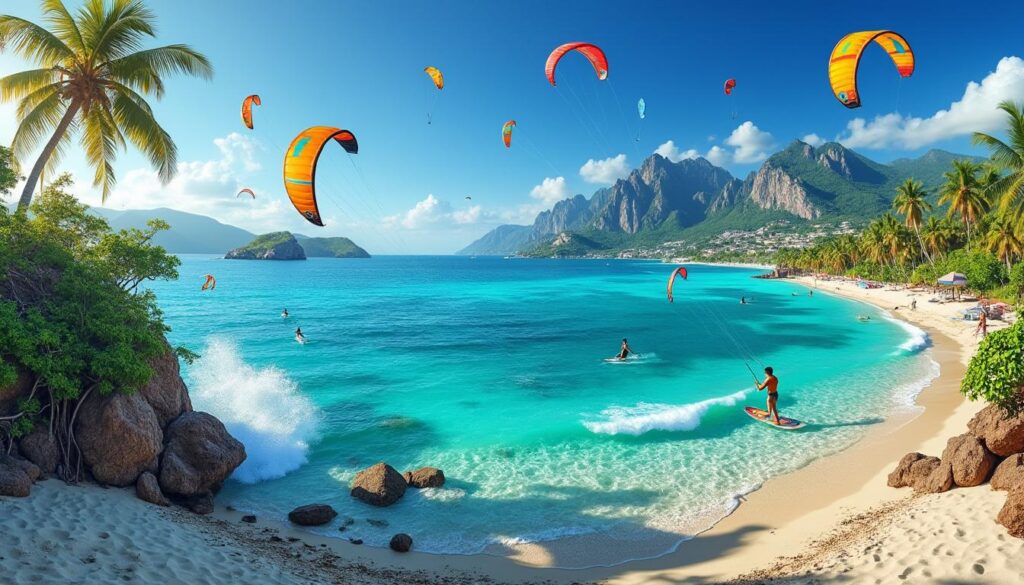
On the Island of Wind, time is measured in knots, tides and rising tides. Fuerteventura lives on constant trade winds, lagoons that appear and disappear, reefs that wake up with the right swell. Those looking for lively, direct, unfiltered kitesurfing will find a natural training ground here where the wind sets the rhythm of the days. From the fine sand of Sotavento to the dunes of Corralejo, each spot has a distinct personality: flat water for pulling endless tacks, clean waves for those who love to surf with the kite, lagoons perfect for learning without stress. No glossy postcards: just water, wind and the urge to get in the water as soon as the sail starts to pull.
For those already familiar with kitesurfing in Italy – from the mistral in kitesurf Salento to the storms of kitesurf on the Adriatic and Ionian – Fuerteventura is the natural next step. Conditions remain rideable almost all year, the spots are relatively close to each other and the atmosphere is that of an international community of riders crossing paths among vans, kites drying in the sun and makeshift fin racks. The island also works particularly well for those traveling with companions or children: while you ride, they can enjoy beaches, walks and small ocean-view villages. The idea is simple: pick the right wind, the right spot and turn each day into a session tailored to your level.
In short
- Fuerteventura is one of Europe’s kite capitals: constant trade winds, mild climate and spots for every level.
- The south of the island (Sotavento, Costa Calma) offers lagoons ideal for beginner kitesurfing and freestyle.
- The north (Corralejo, El Cotillo, Majanicho) is more variable: waves, reefs and beach breaks for intermediate and advanced riders.
- The windiest season runs from June to August, but you can ride year-round by choosing spots and times wisely.
- Kitesurf schools are widespread and often include rescue service: essential with side-off winds.
- A suitable wetsuit is needed: the Atlantic is cool, even if the sun deceives; better not to underestimate the water temperature.
Kitesurf Fuerteventura: the Island of Wind as an all-year playground
Anyone who arrives in Fuerteventura with a board under their arm immediately feels that here the wind is not an “extra service”, but the true protagonist. The trade winds push steadily for much of the year, modulated by the Azores High, and turn the island into an almost automatic machine for producing sessions. In many Italian kitesurf guides you read about spots that are perfect only in certain months; here, instead, the goal is to understand how to exploit every period, not just summer.
This sailing sport, born at the end of the ’90s as a creative offshoot of surfing, is based on a simple idea: use a kite as the engine. The kite is controlled via a bar connected by thin lines in Dyneema or Spectra, usually between 22 and 27 meters. It is precisely the length of the lines that allows the sail to pick up cleaner wind above the turbulence close to the sea surface. In Fuerteventura, where the dominant direction is north-east, this combination often produces a steady pull, ideal for working on technique.
On the best days kitesurfing here becomes a powerful mix of surf, windsurf, wakeboard and snowboard. The sea can be flat as a lake in some lagoons, or rippled by long, substantial waves on exposed beaches. For those coming from kitesurf Salento, used to playing between kitesurf Ionio and kitesurf Adriatico, suddenly facing a serious Atlantic swell is a wake-up call. Mistakes cost more, but progression is huge.
The great thing about Fuerteventura is also the logistics: a narrow, long island where driving from north to south takes about two hours. That means that if one side is too onshore, you can move to find a more sheltered spot or a better wind angle. You don’t rely on buses or taxis to hop between spots: a rental car is an integral part of the plan, like choosing the right board volume.
An example is the story of Luca, an intermediate rider used to kitesurfing in Puglia who decides to spend a week in Fuerteventura. He books accommodation in Costa Calma, planning to stay based in Sotavento. After two days in the flat lagoon, thanks to tips from the locals, he moves north to Corralejo to test Flag Beach with waves and side-on wind. In a few days he goes from perfecting the water start to trying his first controlled jumps, precisely because he alternates different conditions without changing island or taking internal flights.
For those who see Fuerteventura as an alternative or complement to classic kite trip destinations – from Tarifa to Greece, and including the options described in guides like kitesurf destinations in Italy and the Mediterranean – the Canary island offers a rare mix of accessibility, wind consistency and variety of spaces. The wind here is not negotiated: it is studied and respected, and in return it gives sessions that stay in your head for a long time.
The key to reading Fuerteventura is to think of it as a large modular spot. Depending on season, swell and wind, you can build your ideal week: technical lagoon, waves, freeride, downwind. Every day can become a small different chapter in your relationship with the ocean.
Weather, wind and reading the island: how to choose sessions
Those who learned to learn kitesurf in Mediterranean contexts know the mistral, the sirocco, and lake thermals well. Here the protagonist is the north-east trade winds. In the summer season, from June to August, the pressure gradient linked to the Azores High intensifies and winds can comfortably exceed 20 knots, often with back-to-back days of full power. For many, it’s the ideal window to plan a kite trip focused on the central hours of the day.
In winter and spring the wind does not disappear, but it changes character. More unstable low-pressure systems can appear, with days of pause or different directions. This is when wave spots like El Cotillo or Majanicho come alive, fed by more substantial swell. Even autumn, often cited as a less windy season, still offers good chances of wind days, especially if you are flexible with timing and read local micro patterns well.
The trick is exactly this: don’t chase Instagram photos, but learn to read forecasts, charts and feedback from kite centers. Just like in kitesurf Lecce or kitesurf Taranto, where locals switch sides between Adriatic and Ionian in a few hours, in Fuerteventura the choice between north and south of the island can turn a flop day into a memorable session. Those who arrive prepared, with a minimum theoretical base and a good habit of checking weather models, get into the island’s rhythm right away.
Once you understand this dynamic, the picture becomes clear: Fuerteventura is a wind engine that runs almost always. It’s up to you to decide whether to use it to progress, explore new terrains or simply grind tacks until your legs hold out.
Video, forecasts and feedback from the locals are the three tools to combine each morning before deciding which spot to head to. In a few weeks you learn to predict for yourself where you’ll find the sea best suited to your level.
Southern spots of Fuerteventura: Sotavento and Costa Calma for lagoons and freestyle
The southern part of the island is what nearly everyone thinks of when talking about kitesurf Fuerteventura. Costa Calma and, above all, the very long Sotavento beach have become an international reference. It’s no coincidence that a world-class windsurf and kitesurf event takes place here every year: the wind gains speed thanks to the venturi effect created by the mountains behind and provides days full of kites in the air.
The prevailing wind is north-east, often with a side-off angle: it starts from the land and blows toward the sea, slightly tilted relative to the coastline. That means very clean water downwind, perfect for drawing long tacks, but also the need to manage distance from the beach carefully and rely on schools and their rescue means. Planning comes into play here: no improvisation, especially if your level is still being built.
One of the most characteristic aspects of Sotavento is the lagoon that forms at high tide. When the water rises and fills the natural basin, a relatively flat stretch of shallow water is born, without waves. It’s the perfect scenario for kitesurf courses, but also for freestylers from intermediate to advanced who want to work on unhooked tricks, rotations and controlled kiteloops, without the extra variable of chop.
To better understand how the southern spots position themselves in terms of level and conditions, a simple overview can help:
| South Fuerteventura area | Type of spot | Recommended level | Key characteristic |
|---|---|---|---|
| Sotavento – Lagoon | Flat lagoon with tide | Beginners – Freestylers | Shallow water, priority for lessons and tricks |
| Sotavento – Open sea | Chop and small waves | Intermediate – Advanced | Often side-off wind, powerful pull |
| Costa Calma | Soft beach break | Intermediate | Quieter sessions compared to Sotavento |
Take the case of Sara, who took a kitesurf course in Italy after reading a beginner kitesurf guide like the one on Salento Kiter dedicated to novices. In Fuerteventura she chooses a school in Sotavento and in three days in the lagoon she goes from being pulled by the kite to managing her first independent water starts. On the fourth day, with the instructor following, she goes out from the lagoon into the open sea and experiences what it means to hold a close-hauled line with side-off wind: that’s where she truly understands the value of the theory studied on land.
Those who love freestyle find in Sotavento a kind of playground: the combination of smooth water, consistent wind and wide spaces allows repeating the same trick dozens of times on the same run. It’s the ideal situation for those aiming to move from basic jumps to more complex rotations, backrolls, frontrolls and, for the most motivated, unhooking and bar passes. Falls are part of the game, but the lagoon limits many of the risks typical of choppier conditions.
Not to be underestimated, however, are the limits: the lagoon is not always full, it depends on the tides, and when it empties the open sea with its own rules remains. This requires respecting the schedules provided by the schools and continuously monitoring conditions, just as you do at the best kitesurf spots in Italy when working with tides and sudden wind changes.
Safety management and rescue with side-off wind
The south of Fuerteventura is a master in discipline. Side-off wind does not forgive, and going out without a plan is the best way to end up in an area where only a jet ski can bring you back to shore. The schools in the area usually offer a rescue service (often until late afternoon) both for students and for those renting equipment. Anyone entering the water with their own gear must know that every recovery can have a significant cost, and above all that beyond a certain hour it is not guaranteed.
For this reason the fundamental tips are always the same: don’t overestimate your level, don’t inflate the kite and go out in conditions beyond your control, study safety theory well on land and communicate clearly with the instructor. No serious school will let you enter the water in unsuitable conditions, but the rider’s final responsibility remains central, especially when you start going out without a coach.
In the end, the south of Fuerteventura teaches a principle valid in any spot, whether it’s a kitesurf spot in Puglia, Calabria, Tarifa or Zanzibar: the wind is not an enemy to challenge, but a force to understand and use. Those who internalize it return home with a much more solid technical and mental baggage.
Watching how the locals manage distance from the shore, angle of sail and return timings is one of the most valuable lessons you can take away from Sotavento.
Kitesurf in the north of Fuerteventura: Flag Beach, El Cotillo, Majanicho and Punta Blanca
Moving north, the island changes face. The dunes of Corralejo Natural Park, the small fishing villages and the wilder bays create the perfect environment for those seeking spots with fewer schools and more personality. Here kitesurf Fuerteventura north is a mosaic of beach breaks, reefs and lagoons that behave differently depending on wind and tide.
Flag Beach is probably the best-known name: a wide sandy beach in front of the Corralejo dunes. From spring to late summer the north-east wind often blows side-on around 20 knots, a combination ideal for freeride, first jumps and for those who want a middle ground between safety and adrenaline. The wave can vary from moderate chop to more structured sets, but in general it remains a manageable context for intermediate riders.
Not far away, El Burro – also called Glass Beach – offers conditions similar to Flag but in a more compact space. The circular stone structures along the beach, built to shelter bathers from the wind, tell how integral the trade wind is to the landscape. On lighter wind days the beach fills with beginner surfers, while when the kite really starts to work the combination of wave and side-on wind provides very fun sessions.
Heading west, El Cotillo makes it clear that the Atlantic has a louder voice here. A long white beach of about two kilometers, bigger waves and north-east wind that works well with mid or high tide. The position of the sandbanks changes the quality of the wave and access to the water, requiring a trained eye or local advice. For those coming from northern Italy kitesurf spots, used to lake chop, the jump is notable here: every water start must be thought out earlier, every tack carries more weight.
Finally Majanicho and Punta Blanca complete the northern picture. Majanicho is a fishing village with a reef that generally offers a wave within reach of advanced beginners and intermediates. The wind often comes in side-on and, with the right tide, the sets become a splendid training ground for wave surfing with a kite. Entering and exiting the reef requires wearing booties and planning movements well, but the reward is one of the purest sensations kitesurfing can give: riding a clean wave guided by the pull of the kite.
Punta Blanca, not far away, is an expanse of bright white sand surrounded by dunes and turquoise water. At high tide a lagoon wide enough to allow lessons and quieter sessions forms. It’s as if the north offers a small replica of the Sotavento lagoon, but in a wilder setting where the crowd is smaller and the pace slower.
For those who like to alternate different conditions within the same week, the north is an enormous resource. One day freeride and jumps at Flag Beach, the next day wave riding at El Cotillo, then a technical lagoon session at Punta Blanca. Exactly like alternating kitesurf Salento between Ionian and Adriatic, but concentrated within a few kilometers of coast.
Reading reefs, tides and waves: the technical leap
The north of Fuerteventura is the ideal environment for those who want to move from simply “floating” to truly controlling their session. Reading the tide means understanding whether the reef is covered enough to enter safely, whether the Punta Blanca lagoon has enough space or if it’s better to wait a few hours. Observing the position of the sandbanks at El Cotillo helps predict where the wave will close cleaner and where, instead, it will be more disorderly.
This observational ability is built in the field, but can be accelerated by comparing notes with locals and with other Mediterranean places where technique is central. Those who, for example, have explored spots with similar structure described in guides like kitesurf and surf in Tuscany, will recognize common dynamics related to reefs, currents and interaction between wind and swell. In all these situations, the leap in level doesn’t come from a new trick learned on YouTube, but from the ability to choose the right line in the water.
Practically, the north of Fuerteventura offers the chance to turn each outing into a small laboratory: try a different take-off, anticipate the bottom turn, use the kite’s pull better to stay high on the face of the wave. It’s training that then becomes extremely useful when returning to Italian spots, whether it’s the best kitesurf spot in Puglia, Calabria or Liguria.
The message is simple: if you’re looking for a place where kitesurfing really makes you grow, the north of Fuerteventura gives nothing away for free but rewards every effort with interest.
When to go to Fuerteventura for kitesurfing: seasons, wind and the right wetsuit
One of the most frequent questions for those planning a kitesurfing holiday is: “What is the best period for Fuerteventura?”. The short answer: the island works all year, but the type of session you can expect changes. From June to August the wind pushes hard, the trade winds are more regular and many spots, in particular Sotavento and Flag Beach, offer almost daily riding. It’s the ideal period if you want to maximize the number of sessions and work on freestyle, jumps and speed control.
Spring and winter open different scenarios. The wind can be less “clock-like”, but more important swells come into play, especially on the west and north sides. If you love wave riding, these months will interest you a lot: El Cotillo, Majanicho and other reefs start to show their best character. September and October are generally months with slightly lower wind probability, but still playable for those flexible on times and spots.
Alongside the choice of period, there’s a theme that those coming from warmer waters tend to underestimate: the temperature of the Atlantic. At the end of summer the water stabilizes around 22°C, while in winter it can drop to 18°C. These are not prohibitive temperatures, but combined with constant wind they can quickly strip heat from the body if you don’t use the right wetsuit.
Here’s a useful summary to orient yourself in choosing the wetsuit:
- Summer (June–September): you can often go out without a wetsuit in the central hours, but a neoprene top or a shorty is highly recommended, especially with strong wind.
- Spring: a 3/2 or even a 2/2 can be enough if the sun is out; on windier days it’s better to have the 3/2.
- Winter (December–March): a 3/2 of good quality is the minimum, many riders prefer a 4/3 to stay comfortable during long sessions.
Choosing the wrong wetsuit means cutting your session time in half or, worse, starting to lose sensitivity and clarity while you are still far from shore. Once you enter the water with the correct gear, the Atlantic wind becomes an ally rather than a stress factor.
Another seasonal aspect concerns crowd management in the water. In mid-summer iconic spots can fill up, especially during peak hours linked to courses. Off-season, on the other hand, you breathe a more relaxed atmosphere, with more space in the water and cleaner lines for those who want to try new maneuvers without worrying too much. It’s a matter of personal style: do you prefer the energy of August or the calm of January with more selective waves?
Pairing Fuerteventura with Italian spots: an ideal rider’s calendar
For a rider living in Italy, it makes sense to think of Fuerteventura not as an exception, but as part of an annual wind calendar. From March to October, among spots like kitesurf Puglia, kitesurf Calabria, Sardinia and the northern lakes, it’s possible to build a regular home session program. When temperatures drop and thermals weaken, the Canary island becomes the perfect base to avoid interrupting progression.
Many riders organize the year like this: full autumn between kitesurf Salento and other Mediterranean coasts, winter with one or two trips to Fuerteventura or other windy islands, spring back in Italy with tides and local winds, summer experienced between the Ionian Sea, Adriatic and a few international stops like Tarifa or Greece. It’s a strategy that allows you to arrive at each new season a bit stronger, without having to “start from zero” after months of stopping.
In the end, the main advantage of inserting Fuerteventura into your route is continuity: keeping the feel with the bar, sensitivity on the edges and confidence with the wind. And that, in kitesurfing, is worth almost more than any new trick.
Schools, courses and progression in Fuerteventura: from beginner to advanced
One of the island’s strengths is the density of kitesurf schools of good level, from north to south. Instructors are used to working with riders of every origin, from the total beginner who has never held a bar to the advanced kiter who wants specific coaching on kiteloop, handlepass or wave surfing with a kite. The constant presence of wind has allowed centers to develop well-tested teaching methods, based on short but frequent sessions and, when necessary, with jet-ski support.
Typical packages found on the island are similar to those at main European spots:
- Beginner Group Course: designed for those who have never tried kitesurfing; it starts from wind theory, safety, kite flying on land, up to the first body drags and water starts.
- Semi-private course: ideal if you’ve already had a few hours in the water and want to refresh or progress without the pressure of a large group.
- Private 1:1 lesson: maximum focus on specific goals; perfect to unlock fears, correct rooted mistakes or work on advanced tricks.
- Intermediate course: for those who can already do a few meters but don’t yet hold a close-hauled line; focus on directional control, restarts, basic transitions.
- Advanced course and supervised kitesurfing: dedicated to those who are autonomous and only seek supervision and targeted advice during the session.
A crucial detail is safety organization: many schools work with a maximum ratio of two students per instructor, each equipped with a recovery vehicle (often a jet ski). With side-off winds or demanding conditions, this makes the difference between a formative session and a potentially dangerous one. Recovery in case of breakdown or technical problem is generally guaranteed until a specific afternoon time; after that, no one will pick you up offshore.
The choice of school should consider some fixed points: that the instructor speaks a language you understand well; that the theoretical part is given the right importance; that they never pressure you to go out in conditions beyond your level. Lying about your level is the fastest way to turn a holiday into a series of jet-ski recoveries costing €50 per outing.
From theory to practice: typical mistakes and how to avoid them
Many of the problems seen every day on Fuerteventura’s beaches are the same already known at all Mediterranean spots. Those who learned quickly, perhaps in a protected beginner spot, tend to underestimate the power of the Atlantic. The most common mistakes:
- Overestimating your level: claiming autonomy when you’re still insecure about relaunching the kite, self-rescue and managing strong wind.
- Ignoring safety briefings: skipping the theoretical part because “you just want to get in the water”.
- Going out late: starting the session near sunset or beyond the rescue coverage time.
- Not adapting equipment: keeping the same kite size even when the wind increases significantly.
The solution is summed up in one word: progression. Be patient in the first days, work well on body drags and kite control, learn to read the wind from shore before hooking into the chicken loop. Those who build a solid base in Fuerteventura then return to Italian spots – whether Salento, Tuscany or Sicily – with completely different confidence.
In this sense, the island is not just a tourist destination, but a true chapter in a rider’s training. From kitesurf Puglia to the waves of El Cotillo, the common thread remains the same: understand the wind, respect it and use it to go always a little further.
When is the best period to kitesurf in Fuerteventura?
The windiest months are June, July and August, when the north-east trade winds blow strong and regular, ideal for those who want to do many sessions. However, Fuerteventura is practicable all year: in winter and spring more substantial swells arrive, perfect for wave riding, while autumn offers more variable conditions but still usable by choosing spots and times wisely.
Is Fuerteventura suitable for beginner kitesurfing?
Yes, especially in the southern area, with the Sotavento lagoon and schools that offer structured courses and rescue service. The lagoon with shallow, flat water is ideal for learning water starts and first departures safely. It is essential to rely on a serious school, follow the entire theoretical part and never go out alone with side-off wind until you are truly autonomous.
What wetsuit should I bring to kitesurf in Fuerteventura?
In summer a neoprene top or a shorty is often enough, although many riders use a 3/2 to protect from the wind. In spring a 3/2 is generally perfect, while from December to March a good quality 3/2 is recommended or, even better, a 4/3 if you plan long sessions. The Atlantic is cooler than the Mediterranean, so don’t underestimate the water temperature.
Do you need a car to move between Fuerteventura spots?
Practically yes. The island is long and narrow, and the main spots – especially between north and south – are up to two hours’ drive apart. Public transport is not designed for those moving with kites and boards, and taxis are not a convenient solution to change spots based on the wind. Renting a car is the most practical choice to make the most of the conditions.
Do schools always offer rescue service?
Almost all organized schools offer a rescue service with jet ski during lesson and rental hours, usually until a specific afternoon time. Those enrolled in a course or renting equipment are covered automatically; those going out with their own gear can often pay for a separate surveillance service. It is essential to check the times and not start the session when the rescue is about to end.