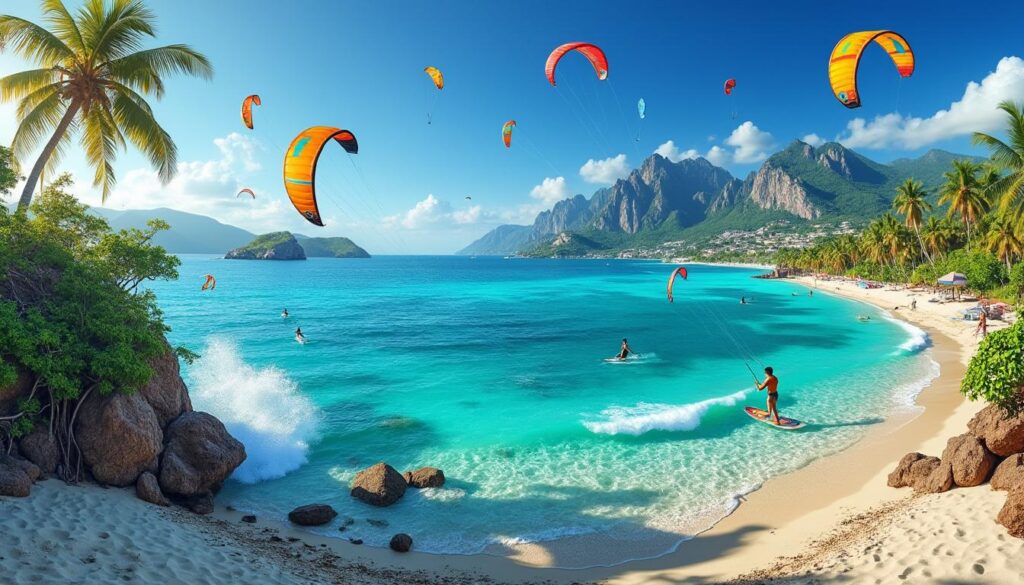
The wind coming from the northwest, the flat water of a shallow lagoon, the gusts that enter cleanly among the salt pans of Marsala, the waves that push onto Puzziteddu and the endless sandy bottom of Santa Maria del Focallo. Kitesurfing in Sicily is not a single postcard image but a mosaic of different spots, each with a precise character. Those looking for easy lagoons to learn find the Stagnone; those who love waves can head for the southwest coast; those who want convenient logistics and a lively city look to Catania and its Playa. The island, with its mild climate and constant winds, offers a very long season that goes well beyond the classic summer.
For those coming from other areas of kitesurf Italy – Garda, Sardinia, Lazio – Sicily is often the next step: a mix of wind, culture, cuisine and sea that pushes people to organize real kitesurf holidays. But to really make the most of it you need to understand how the local wind behaves, because the Maestrale doesn’t act like the Grecale, and a thermal on the Strait of Sicily doesn’t behave like one on Lake Garda. This is where the role of kitesurf schools in Sicily, structured courses and the advice of local riders comes into play, people who can read the sky even before the weather apps. This article puts things in order: best spots, where to find a serious kitesurf school, how to choose the right kitesurf course and when to target the island to have more on days than off days.
In short
- Key areas: Western Sicily (Stagnone, Capofeto, Puzziteddu) for lagoon and waves; Eastern Sicily (Catania, Santa Maria del Focallo, Ispica) for versatile spots and easy access.
- Best season: from February/March to November, with regular thermals in spring and autumn, wind often stronger in high summer.
- Kitesurf for beginners: Stagnone and Santa Maria del Focallo offer shallow water, sandy bottoms and plenty of space, ideal for learning kitesurfing safely.
- Schools and courses: IKO-certified instructors, one-to-one lessons, equipment rental and personalized packages are now the standard at the main Sicilian spots.
- Wind and choosing the spot: Maestrale, Scirocco and local thermals determine whether it’s worth moving between lagoon, beaches open to the channel’s virtual Adriatic or more sheltered Ionian-facing coasts.
Western Sicily kitesurf spots: Stagnone, Capofeto and Puzziteddu
When talking about the best kitesurf spot in Italy, the lagoon of the Stagnone di Marsala always enters the conversation. There the wind glides over flat water, the bottom stays shallow for hundreds of meters and the salt pans create a landscape that seems drawn for kite. For those looking for kitesurf for beginners, this spot is among the most forgiving: mistakes, wrong water starts, first low-speed tacks… everything happens in an environment that forgives. It’s the same reason why the Stagnone also attracts freestyle and big air riders from across Europe, who look for a “steel cable” on which to load their tricks.
The nice thing is that the Marsala and Mazara del Vallo area does not end with the lagoon. A little further south there is Capofeto, included in a nature reserve. Here the water remains relatively flat but the setting is wilder: low dunes, coastal vegetation, wide spaces. The wind often comes side or side-on, a perfect condition to work on safety. It’s a spot that appeals to those who want a less crowded environment than the Stagnone but still a high margin of safety, especially when moving out of the beginner phase and starting to tack regularly.
Going further southwest you reach Puzziteddu, the scene of many intense wave days. Here you don’t come looking for flat water, but to interact with the wave. Swells driven by Maestrale or Ponente build powerful lines that test timing and kite control. It’s one of those places where it’s worth arriving with a solid base: knowing how to hold a tack, control the depower, manage starts in marked chop. For those who started in a lagoon and want to move to wave, Puzziteddu almost becomes a rite of passage.
Those already familiar with spots like Punta Trettu in Sardinia will find familiarity with the style of Sicilian lagoon. To get an idea of how to think on these playing fields, it can be useful to take a look at the guides by Salento Kiter on lagoons like Punta Trettu or on kitesurf at the Stagnone di Marsala, where many concepts applicable to the nearby spots of Capofeto and Puzziteddu can be found.
A concrete example: imagine Marco, an intermediate rider who arrives from the Rome area. He is used to handling often gusty wind and shorebreak. At the Stagnone he finds himself on smooth water, with many people trying maneuvers safely. In the first two days he focuses on perfecting the toeside water start and on speed control in switch. When the forecast announces a stronger Maestrale, he decides to move to Puzziteddu to try the first wave lines. The same trip, but two spots with totally different identities that allow him to unlock different technical steps.
The common thread of this area is the long seasonality. From late winter to deep autumn synoptic winds and thermals alternate, which, exploiting the temperature difference between sea and land, often make it possible to organize an entire kite holiday with few completely flat days. It’s the reason many riders from the north choose western Sicily when thermals begin to fall at Garda or on the Adriatic.
Kitesurf for beginners in western Sicily: why the lagoon makes the difference
For those who want to learn kitesurfing, the Stagnone is a perfect laboratory. The shallow water allows you to stand to recover the board, adjust the bar, restart calmly. The risk of ending up in deep water or with waves that interfere with the start is minimal. This brings a huge psychological benefit: less fear, more ability to listen to the instructor and focus on technique. It’s very different from the first outings in open sea, where every mistake can end with long body drags toward the shore.
Local schools often work with a one-to-one or micro-group approach, so as to follow every movement step by step. It starts from kite control on land, moves to body drag and then to the first water starts. In a few days a motivated student already begins to tack independently along the lagoon. The key point is always the same: learning to read the wind and not just to “suffer” the power of the kite. Those who carry this mindset will struggle much less when changing spots.
For those who want to compare Sicily’s training style with other Italian contexts, resources like Salento Kiter’s article on the best orientations for kitesurf schools in Italy help to understand which standards to look for in a serious center: safety briefings, up-to-date equipment, mandatory helmet and impact vest, presence of a support boat when necessary.
In the end, what makes this part of Sicily a recurring destination is not just the salt pans landscape. It’s the combination of lagoon, nearby wave spots and a long season that allows building a coherent progression, from the timid sliding of the beginner to the first advanced maneuvers in flat water and on the wave.
Eastern Sicily kitesurf: Catania, Santa Maria del Focallo and Ispica
Moving to the eastern coast, the mood changes but the quality of kitesurf Sicily remains high. The Catania – Santa Maria del Focallo – Ispica axis offers spots that mix open sea, convenient logistics and endless sandy bottoms. At Catania Playa, the scene is urban: long beach, services, bars on the dunes, airport just minutes away. It’s the classic spot where you can land in the morning, rent equipment and do your first session already in the afternoon.
Further south, toward Santa Maria del Focallo and Ispica, the landscape opens up. A long tongue of sand, a bottom that slopes gently, wind often side-on: the perfect picture for those who are beginners but don’t necessarily want a lagoon. Here summer thermals and transitional synoptic winds in intermediate seasons come into play. When Maestrale filters through the channel or the Scirocco rises, the spot fills with colorful kites running parallel to the shore.
The schools in the area, like Sicily Kite School, have set up a formula that works well especially for those organizing kitesurf holidays with friends or as a couple. The kitesurf courses are designed for all levels: from complete beginners to advanced maneuvers, up to foil. The plus is the organization: possibility of transfers in a 9-seater van to the best spots of the day, lessons in Italian, English and French, and WhatsApp support to fit schedules, wind and availability without wasting time on endless phone calls.
A typical case is Laura, who arrives from Milan with a group of three friends. Two of them have never held a bar, she instead already has a few outings under her belt on Lake Garda. The school manages it with different packages: for beginners one-to-one lessons, with a dedicated instructor, helmet with radio and lots of work on kite control on the ground. For Laura, instead, an advanced package focused on constant upwind and first transitions. Thanks to the transfer logistics, the group moves together between Catania Playa and Santa Maria del Focallo depending on the wind, without having to worry about rental cars or parking.
Another strong point of eastern Sicily is the possibility to combine kite with discovering the island. Many schools offer guided excursions that combine morning sessions with visits to villages, archaeological sites or simply slow lunches in some hidden trattoria. For those who live kite not only as a sport but as part of a lifestyle, this alternation between wind and dry land makes the trip more complete.
Kitesurf holidays and services in Sicily: between transfers, rentals and personalized packages
An element that often makes the difference between a successful kite holiday and one wasted watching forecasts is the organization of services. In Sicily many operators have evolved at the pace of European riders, offering not only courses but also equipment rental of the latest generation. This allows traveling light, especially if you fly low-cost with limited luggage.
However, rental must be managed sensibly. Serious schools offer complete sets with kites updated to the current season, twin-tip boards in various sizes and, for experienced riders, foil and surfboard kits. Often a brief water check is required to assess the rider’s real level and recommend the kite and board suitable for the day’s conditions. It’s not a whim but a safety guarantee for everyone.
Kitesurf course packages are built on different steps, for example:
- Basic package: theory, safety, kite control on land, first body drags.
- Intermediate package: water start, first tacks, board recovery, relaunching the kite from the water.
- Advanced package: constant upwind, transitions, first controlled jumps, posture refinement.
Each block has an indicative number of hours, but the most serious schools leave room to adapt to real learning times, because not everyone reacts the same way to wind and water. Those used to other contexts like Malcesine or Garda spots can compare this structure with specific articles such as those dedicated to kitesurf on Lake Garda, but in Sicily the plus remains the water temperature and sandy bottoms.
The real strength of the eastern coast is this combination of easy open sea, well-kept services and schools that know every nuance of the local wind. Those landing here for the first time quickly notice that they are not simply “renting a kite”, but entering an environment where every session is built with care: wind direction, currents, tides, beach crowding. The holiday stops being a roll of the dice and becomes a reasoned sequence of sessions.
Best season for kitesurfing in Sicily: months, winds and strategies
Understanding what the best season for kitesurfing in Sicily is means looking at the calendar not only as a tourist but as a rider. In general terms, the island’s spots work well from February/March through November. In these months synoptic winds (Maestrale, Scirocco, Grecale) and local thermals alternate, which ignite when the sun heats the land enough compared to the sea.
Spring (March-May) is the time when many northern kiters escape the last cold days to seek warmer water. In Sicily the days grow longer, thermals begin to enter regularly especially in lagoons and exposed beaches. Temperatures are not yet the scorching ones of August, so sessions are less tiring. It’s an ideal period for those who want to take a kitesurf course without suffering from heat or overcrowding.
Summer (June-August) brings more stable flows but also more crowded beaches. The nice thing, however, is that the wind often strengthens, especially in the afternoon, thanks to stronger thermals. Those dreaming of freestyle moves or big jumps find the right window here. You just need to learn to coexist with swimmers, umbrellas and SUP boards, which is why some schools organize boat launches or outings at strategic times to avoid peak hours.
Autumn (September-October) perhaps offers the most loved combination by experienced riders: still warm sea, beaches that empty, more frequent perturbation winds that light up wave spots like Puzziteddu and similar areas. It’s also a golden period for the lagoon, which continues to work with conditions often more manageable than in full August: less confusion, more space to try new maneuvers.
To have a concise view of the key months, it’s useful to look at a table:
| Month | Probability of useful wind | Type of prevailing conditions | Recommended for |
|---|---|---|---|
| February – March | Medium | Synoptic winds, some perturbations | Motivated riders, waves and early season outings |
| April – May | High | Regular thermals + northwest winds | Kitesurf for beginners, basic courses and progression |
| June – August | High | Strong thermals, hot and long days | Freestyle, big air, kitesurf holidays in summer |
| September – October | Very high | Mixes of thermals and perturbations | Intermediates and advanced, lagoon + waves |
| November | Medium | More frequent perturbations | Experienced riders, wave spots, targeted trips |
An often underestimated aspect is choosing spots based not only on the month, but on the combination of wind direction and intensity with your own experience. For example, a beginner in April can do very well at the Stagnone with 15 knots of Maestrale, while the same day could be too demanding on an open beach with marked chop. Conversely, an advanced rider in September can consciously seek a serious swell at Puzziteddu while others prefer the calm of the lagoon.
Those who have learned to read thermals on inland basins like Garda – perhaps after studying content such as guides dedicated to kitesurf on Lake Garda – find in Sicily a larger playground but with similar mechanisms: observe the temperature difference between sea and land, understand what time the wind starts to turn, distinguish a thermal strengthening from a gust of a perturbation. This kind of sensitivity transforms a simple holiday into a real progression journey.
Salento wind, Sicilian wind: what really changes
Many riders already familiar with Salento wind wonder how different Sicilian wind is. In reality, the basic logic is similar: two seas, complex coastal geometries, possibilities to choose the most favorable side according to wind direction. In Salento you play between the Adriatic and the Ionian; in Sicily the comparison is between the Tyrrhenian, the Strait of Sicily and the Ionian. In both cases, the key is mobility: moving a few dozen kilometers can completely change the quality of the session.
Sicily, however, concentrates on a single island a variety of lagoons, open beaches and wave spots that allow training on multiple fronts in the same week. One day you work on water starts in shallow water, the next you study front-side waves, the next you freeride along an immense beach with side-on wind. Those who learn to move in this puzzle of conditions return home with a much more precise wind reading, usable then on any other Mediterranean spot.
The underlying message is clear: the best season to go to Sicily is not just a number on the calendar, but the sum of what you want to train, your level and your willingness to move between one side and the other. The more you know what to look for, the more the island will give you days to remember.
Kitesurf schools in Sicily: how to choose and what to expect
With the explosion of kitesurf sport in recent years, Sicily has seen the rise and growth of several schools. Not all, however, operate to the same standard. Choosing the right kitesurf school is essential especially for beginners or for those who want to unlock technical maneuvers safely. Some indicators immediately help understand if you are in the right place.
The first is the qualification of the instructors. International certifications (such as IKO) indicate that those who follow you have a structured method, know safety protocols and can balance theory and practice. The second concerns the student-to-instructor ratio: one-to-one formulas, 1 student – 1 instructor, are ideal for first steps and for working on specific aspects like kite relaunch, speed control or initial jumps. Groups are useful for motivation and sociality, but they should never be too crowded.
A good center to learn kitesurf in Sicily then offers:
- Up-to-date equipment every season, with kites of different sizes to adapt to weight and level.
- Helmets, impact vests and quick release systems explained and tested on land.
- Meteorological briefing at the start of the day, explaining wind direction, shore obstacles and any currents.
- A clear Plan B in case of sudden weather changes or unexpected crowding of the spot.
An example: Sicily Kite School between Catania and Santa Maria del Focallo organizes courses for all levels with qualified instructors, tailor-made packages and the possibility of IKO level certification at the end of the course. This means that, at the end of the course, the student can demonstrate their level anywhere in the world, facilitating equipment rental and access to other spots.
For those coming from other Italian contexts and wanting to compare different approaches, general guides to schools in the rest of the country – like those dedicated to spots such as Rome or Garda – help recognize common elements: clarity on prices, number of real hours in the water, presence of insurance, transparency on refund conditions in case of lack of wind.
Another positive sign is the willingness to say “no” when conditions are not suitable for your level. If an instructor recommends postponing the lesson because the wind is too strong or gusty, they are not doing it out of laziness but to avoid you associating kite with fear. It is better to wait a few hours and build confidence, rather than throwing yourself into the water improvisedly.
What to check before booking a kitesurf course in Sicily
Before booking a package, it’s worth doing a small checklist. You don’t need to be an expert, just ask the right questions to the school:
- How many students per instructor are usually in the water?
- What kind of radio do you use to communicate during the lesson?
- How do you handle insurance for damage and injuries?
- Is a support craft (RIB, boat) available at spots further from shore?
- What happens if there is no wind on the booked days? Are refunds or vouchers provided?
The answers to these questions say a lot about the team’s professionalism. A prepared school immediately shows precision in responding, provides practical details and does not try to minimize risks, but manages and explains them calmly. It’s the same attitude that differentiates a simple “beach with kites” from a true progression center.
For those dreaming of extending their path beyond Sicily, resources like the Salento Kiter articles on the meaning and history of kite, on schools in Italy or on spots like Garda, Sardinia and Rome allow building an overview of kitesurf Italy, in which Sicily is one of the most complete stops to vary conditions and grow technically.
In the end, the right school in Sicily is not only the one that gets you standing up faster, but the one that teaches you to “speak” with the wind, to read the clouds and to always respect the limits imposed by the sea. This is the basis on which you can then build years of calm and safe sessions.
Practical tips for organizing a kitesurf trip to Sicily
Once you have chosen spots, period and school, you still have to plan the trip practically. The first knot to untie is equipment: bring everything from home or rely on rental? Those who already have recent kites, board and harness often prefer to travel with their own quiver, especially if they have a configuration perfect for their weight and style. In this case it is advisable to check with the airline the conditions for sports equipment and book extra baggage in advance.
Those who are beginners or want to travel light can opt for local rental. In Sicily the most structured schools offer gear from recent seasons, often from the same brands used in the courses, therefore already tuned and tested on the spots’ conditions. The important thing is to inquire in advance about availability of sizes, especially if you have a non-standard weight or if you plan the trip in months of strong wind.
Another decisive aspect is mobility on the island. Many prefer to rent a car to move between spots, but several kite centers offer transfer in vans to and from spots and accommodations. For groups, this solution is often more convenient: no driving stress, parking or navigation, and someone who already knows every road that leads to the beaches. Advanced packages often also include the possibility of moving to more distant spots in case of particular forecasts.
Regarding accommodation, many schools collaborate with B&Bs, holiday homes or small resorts near the spots. This allows creating micro “kite camps” spontaneously, where sessions, dinners and analysis of videos shot in the water are shared. For those traveling alone, it is the easiest way to get in touch with other riders and find session partners.
Finally, physical preparation should not be underestimated. Kite doesn’t require bodybuilder muscles, but a minimum of endurance and joint mobility helps to enjoy more hours in the water and avoid trivial injuries. In the days before departure it makes sense to work on stretching, core stability and a few sessions of swimming or light running. Arriving in Sicily already a bit “switched on” means you can jump into the first sessions immediately without wasting time getting the body used to the effort.
Essential checklist for a kite trip to Sicily
To avoid forgetting anything, an essential list can make the difference. Here are some key items to always have with you, even if you rely on rental for kites and boards:
- Personal harness (if you are used to a specific model and size).
- Wetsuit appropriate for the season (shorty or 3/2 for high summer, 4/3 for spring and autumn).
- Booties in neoprene for spots with mixed bottoms or isolated rocks.
- Rash guard and cap to protect from the sun during breaks on land.
- Basic repair kit (patch for bladder, ripstop tape, reliable pump if possible).
- Travel insurance that covers water sports.
- Weather and wind apps already configured with the Sicilian spots you want to visit.
With this base, the trip turns from a gamble into a solid project. Each session becomes one more tile in your rider path, and Sicily stops being just a distant destination to become one of the epicenters of your personal wind atlas.
What is the best spot in Sicily for someone who wants to start kitesurfing?
For those looking for kitesurfing for beginners, the Stagnone di Marsala and Santa Maria del Focallo are two absolute references. The Stagnone offers a lagoon with flat water and a shallow bottom, perfect for learning water starts and board control safely. Santa Maria del Focallo, with its long sandy beach and often side-on wind, is ideal for those who want to debut directly in the open sea but without challenging waves or complex bottoms. In both cases, the presence of structured schools and certified instructors makes learning quicker and safer.
When is it best to go to Sicily to have more windy days?
The most productive window for kitesurfing in Sicily runs from April to October, with a peak between spring and autumn. April and May combine regular thermals and mild temperatures, ideal for basic courses and progression. June, July and August bring stronger thermals and long days, perfect for those seeking frequent sessions during summer holidays. September and October still offer warm water and less crowded beaches, with the arrival of perturbations that also activate wave spots. February, March and November can offer great days, but require more flexibility on travel dates.
Do you need to have your own equipment to kitesurf in Sicily?
It is not essential. Many schools in Sicily offer rental of up-to-date equipment, with kites and boards in various sizes to cover most wind conditions. Rental is particularly convenient for those flying with limited baggage or for beginners who have not yet bought a personal quiver. Bringing your own harness and, if possible, your own wetsuit is still a good idea, because they are the most personal comfort elements.
How long does it take to learn to kitesurf in Sicily?
With a structured kitesurf course and favorable weather conditions, most beginners manage to do their first independent tacks within 8–12 hours of actual lessons. This usually corresponds to 3–5 days of course, depending on intensity and wind. A realistic goal for a week in Sicily is to come away knowing how to control the kite, manage water starts, tack in both directions and return to the starting point or to a safety area indicated by the instructor. Further progression (constant upwind, transitions, jumps) requires more hours of practice but is easier to build after a good foundation.
Is Sicily also suitable for advanced riders?
Absolutely yes. Beyond the lagoons perfect for freestyle and technical training, Sicily offers wave spots like Puzziteddu and various open beaches where you can work on jumps, strapless maneuvers and navigation in more demanding conditions. The possibility of combining lagoon, open sea and waves in the same week makes the island very interesting even for those with years of experience. Advanced riders can choose periods with more perturbations (late summer, autumn) to make the most of swells and strong winds at selected spots.