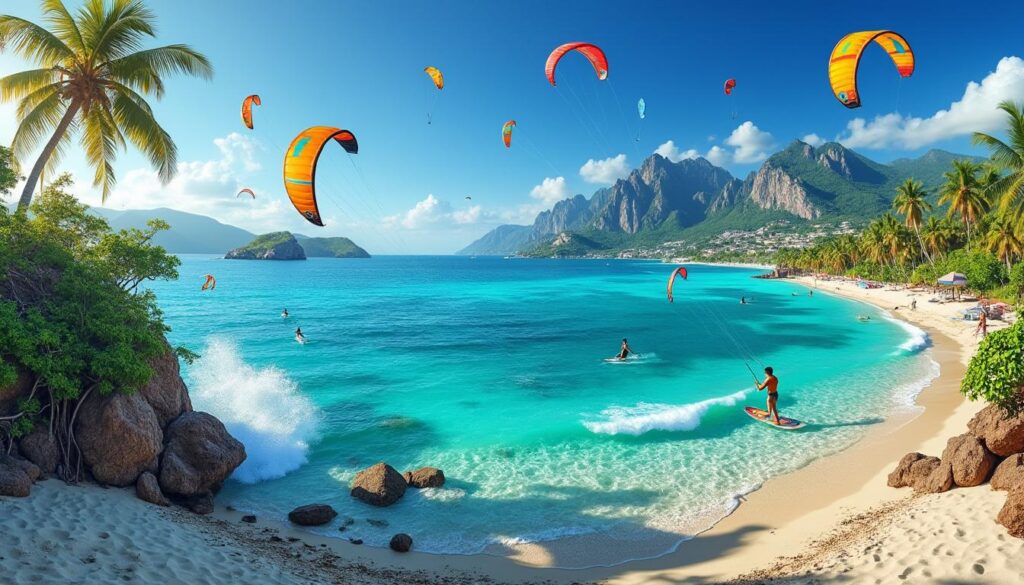
Sri Lanka and kitesurfing get along like wind and sail: an endless coastline, lagoons flat as mirrors, open ocean with surfable waves and two monsoons that mark the seasons. Those looking for an alternative to classic kitesurfing in Italy will find here a different playground, wilder, where you really ride according to the wind and not for postcard photos. The key areas revolve around Kalpitiya and its lagoons, but there are also remote islands, hours-long downwinders and, when the kite stays on the beach, national parks, historic sites and a cuisine that fills you up after any session. This picture allows you to plan solid kitesurf holidays, without being surprised by calm spells or spots chosen only via social media.
Those coming from Europe, perhaps already used to kitesurfing in Salento, the Adriatic or sessions between the Ionian and Tyrrhenian seas, find in Sri Lanka a curious mix: still-simple logistics, manageable prices, always warm water, but a variety of spots that recalls destinations like Dakhla, Zanzibar or the Red Sea. Within this scenario, the question is not “if” you will get on the water, but “where” and “how” we want to progress: learn the basics, push freestyle, launch into group downwinds or look for dirty but honest waves. Knowing the seasons, wind direction and features of the main spots is the key to not wasting precious travel days and turning Sri Lanka into a strong stop in your rider journey.
In short
- Two wind seasons: Southwest monsoon (May–October) strong and almost daily, Northeast monsoon (December–March) more thermal and afternoon-based.
- Main area: Kalpitiya peninsula, with flat lagoons for beginners and wave/outside spots for intermediate and advanced levels.
- Iconic spots: Kalpitiya Lagoon, Dream Spot, Vella Island, Ippantivu, Donkey Point, Kappaladi, Navy Point, plus the southern bays and Arugam Bay.
- Perfect for learning: shallow water, rescue boats at many schools, consistent wind: a “kitesurf course” here is doubly valuable in terms of progression.
- Epic downwinds: long lines in lagoon and ocean, suitable for intermediate and advanced riders who want to step up control.
- Off the water: safaris at Wilpattu, the ruins of Anuradhapura, boat trips through mangroves, dolphin and whale watching outings.
Kitesurf Sri Lanka: wind seasons and what to really expect
Before choosing a resort, kitesurf school or travel companions, you need to understand when the wind blows in Sri Lanka and how it changes from one spot to another. The island works around two main monsoons: the southwest and the northeast. Translated into rider language, that means two strong wind windows and very different conditions between summer and winter, a bit like the difference between kitesurfing in the Ionian and in the Adriatic in Salento when the coast exposure changes completely.
From May to October the southwest monsoon dominates. On the west coast, especially between Kalpitiya and Kappaladi, the wind often comes in strong, averaging between 20 and 25 knots with many days around 30 knots, especially at the start of the season, in May and June. The water stays warm, no thick wetsuit needed, and the “strong wind + flat lagoon” combination turns the lagoons into real rapid-progress gyms. Those coming from lighter Mediterranean spots, as mentioned in the focus on kitesurfing in Paros in the Mediterranean, find here a more extreme version: fewer compromises, more pull, more miles under the board.
From December to March the northeast monsoon takes over. The wind turns, becoming more thermal and often afternoon-driven, starting around midday and stabilizing between 14 and 18 knots in the lagoons. These are not storm numbers, but a good twin-tip or foil works great, while beginner kitesurf courses benefit in comfort: less impact, fewer uncontrolled edges, more time to focus on water starts, bar control and body dragging. January is usually the most solid month, followed by February; in March it’s always worth checking with schools if they are still operating, as some centers close when constant wind is absent.
Practically speaking, the choice of kite sizes depends a lot on the period. In summer you need small sizes: 7–9 meters for light or medium riders, maybe a 10 for safety if the wind that day is lighter. In winter the keywords are: 12–14 meters, especially if you want relaxed freeride and not spend the day pumping with the board. Many riders arriving already tuned to kitesurfing in Italy bring the classic 9–12 m combo and discover that here a 7 m is often more useful than anything else.
Also consider a detail often ignored: the wind cycle relative to the moon. In the summer season, around full moon days there can be 2–4 lighter days. On a long trip you absorb that well; on a short one-week trip it’s wise to monitor forecasts closely and maybe have a foil or a high-volume surfboard ready, so you don’t sit and watch other people fly their kites.
In summary: Sri Lanka gives up to 9 months of wind, with two distinct seasons. Those seeking power and adrenaline head straight to summer; those who prefer to learn safely or cruise smoothly look to winter. Choosing the period is the real first trick to enjoy this destination.
Kalpitiya Lagoon and surroundings: the heart of kitesurfing in Sri Lanka
The center of gravity of kitesurfing in Sri Lanka is the Kalpitiya peninsula. Here everything revolves around the large lagoon, the sandbanks that separate it from the ocean and a constellation of camps that literally live according to the wind. Unlike many tourist destinations that were born first for mass tourism and then adapted to kite, Kalpitiya grew almost the other way around: it was riders who pushed the development of kitesurf schools, accommodation and services.
The Kalpitiya Lagoon is the first spot to keep in mind. Flat water, shallow depth, at least in much of the area, and enough width to accommodate beginners, freeriders and a few freestylers pushing hooked and unhooked tricks. For those considering learning kitesurfing from scratch, this lagoon offers what is often missing in home waters: space, absence of shore break and the ability to walk to recover the board without getting hammered by every wave. Many schools have rescue boats dedicated, so mistakes become part of the game, not a real risk.
Around the lagoon there is a series of camps with different personalities. Some focus on the social side, with rooftop bars and fiery sunsets on the sand; others are more intimate, perfect for those who want to wake up, do some stretching, have a light breakfast and immediately get on the boat that crosses the lagoon. The facilities often also offer full packages, a classic formula for those seeking a true multi-day “kitesurf course” with accommodation included. A bit like what many European riders do in resorts in Fuerteventura or Dakhla, also described in the focus on kitesurfing in Dakhla, but with a completely different cultural context.
A few minutes by boat or jeep from the main lagoon are other key points. The Dream Spot is a long wild beach, with flat water and very little crowd. In summer the wind here often comes in cleaner than in the lagoon, with less turbulence; it’s the ideal place for those with solid basics who want to work on cleaner transitions, controlled jumps and first rotations without the traffic of school areas. The fine sand and wide spaces also help during breaks between sessions: kite laid down away from the water, no rush to protect gear from waves.
Further north, heading toward Puttalam Lagoon, the camp boats head to Vella Island and Ippantivu. Vella is a long narrow island that creates a completely flat and windward side, with wind often 5 knots stronger than Kalpitiya. This playground is for experienced riders: gusty but very powerful wind, offshore conditions and long reaches to the point your legs burn. Ippantivu, nicknamed “Mini-Vella”, offers a similar but more intimate scenario, set among mangroves and fishermen’s huts. In both cases, board and bar control are required: not kitesurfing for beginners, but an endless playground for those who already master edging and kite relaunches.
South of the lagoon lies Donkey Point, the ideal place for those wanting a taste of the true ocean. Access via a sandy track, kiting in open sea, wind often more stable than in the lagoon and a shore break to respect. Intermediates and experts mainly enter here, with twin-tip boards or surfboards, looking for waves to carve at a steady speed. The difference from the lagoon is clear: in the lagoon you work heavily on technique; at Donkey you learn to read the sea and adapt to currents and wave sets.
This Kalpitiya area allows building very different navigation days: morning in the lagoon to refine board handling, afternoon at Dream Spot or Donkey Point to test what you’ve just unlocked. It’s precisely this combination that makes the area one of the best kitesurf spots in Asia for those wanting to progress at a sustained pace.
Map of spots: from Kappaladi to Mannar, down to the south of the island
Leaving the Kalpitiya Lagoon bubble, Sri Lanka offers a series of spots that let you tailor your itinerary. An intermediate rider can alternate easy lagoons with wave spots, while an expert can push into the more remote areas of Adam’s Bridge and the east and south coasts. To navigate between flat water, waves and seasons, a summary of the main conditions can be useful.
| Sri Lanka Spot | Water type | Winter season (knots) | Summer season (knots) | Recommended level |
|---|---|---|---|---|
| Kalpitiya Lagoon | Flat, shallow water | 14–18 | 18–25 | Beginner–Intermediate |
| Dream Spot | Flat, ocean nearby | 14–18 | 20–25 | Intermediate |
| Vella Island | Extremely flat, offshore | 14–18 | 25–30 | Expert |
| Ippantivu | Flat lagoon, nature | 14–18 | 20–25 | Expert |
| Donkey Point | Ocean, waves | — | 20–25 | Intermediate–Expert |
| Kappaladi Lagoon | Flat, very shallow | — | 20–25 | Beginner |
| Navy Point | Flat, downwind | 14–18 | — | Intermediate–Expert |
| Mannar / Adam’s Bridge | Flat + chop, isolated | 14–18 | 20–25 | Intermediate–Expert |
| South (Ahangama, Weligama, Tangalle) | Waves, thermal | 12–18 | — | Expert |
| Arugam Bay | Waves, side-off | — | 14–25 | Expert |
A recurring name is Kappaladi Lagoon. Located about 20 km south of Kalpitiya, it is smaller but even more reassuring for those taking their first edges: water so shallow that schools don’t even use rescue boats, strong wind in summer and shore nearby everywhere. It’s the classic place where a beginner goes from “I can’t lift the kite” to “I’m doing my first upwind edges” in very few days, precisely because every mistake is absorbed by the context.
Moving north you reach Mannar and Adam’s Bridge, a strip of islets that ideally connects Sri Lanka to the Indian subcontinent. Here you enter the realm of the rider who loves isolation: very little infrastructure, simple villages, wind often present almost year-round and relatively flat water. It’s the kind of destination that attracts the same rider profile dreaming of kitesurfing in essential places like Cape Verde or certain Sharm reefs, also discussed in the article on kitesurfing in Sharm in the Red Sea. You don’t come here for nightlife, but for full days of water and wind, returning at sunset and a simple dinner.
The south of the island (Ahangama, Weligama, Tangalle) works on a different logic. From December to April you get sun, calm sea and more classic tourism. Wind is not guaranteed like in Kalpitiya, but on good days the thermal rises to 12–16 knots, sometimes even 20–25 depending on weather patterns. Kiting here blends with the surf world: line-ups with surfboards, guesthouses, fish restaurants, an atmosphere mixing travelers and locals.
On the east side, Arugam Bay is tied to surfing but, on windy days between May and September, offers kitesurf sessions among some of Asia’s most famous waves. The wind is often side-off, so it requires serious experience in handling relaunches, downwinds and returning to shore without panic. A rider already used to Mediterranean waves, like kitesurfing in Corsica or some Salento reefs, finds here a notable upgrade.
The overall picture is clear: Sri Lanka is not a single lagoon, but a network of spots connected by different seasons, with plug-and-play zones for those seeking safety and wild zones for those seeking pure adventure.
Learning kitesurfing in Sri Lanka: lagoons, schools and progression
Those thinking about kitesurfing for beginners often wonder if it’s worth traveling so far instead of starting at a classic kitesurf school in Italy, perhaps around Lecce, Taranto or other Puglia spots. The answer lies in conditions: Sri Lanka offers a mix of warm water, wave-free lagoons, huge space and many windy days, which makes every hour of course much more productive.
In the lagoons of Kalpitiya and Kappaladi, basic courses usually follow a clear sequence. First step: kite handling on land, learning to read the wind window, launch and land with assistance, walk while always maintaining control. The fact that there’s soft sand and open space helps reduce tension, so the mind and body can focus on what really matters: sensitivity on depower and the kite’s reactions to the slightest bar movement.
Second step: body dragging in the water. This is where the lagoons make the difference. Without shore waves throwing you off course, you can work better on angle to the wind and on the ability to find the board even if it drifts a few meters. A flat lagoon reduces physical and mental fatigue, a key element for those still afraid of deep water. Third step: first water start. In shallow water you can repeat the same movement dozens of times in quick succession, without those long pauses typical of wave-prone seas where you have to get out, walk, come back beyond the shore break.
Many schools offer 9–12 hour packages structured like this:
- 3–4 hours of practical theory on the beach (wind, safety, rigging equipment, first kite flight).
- 3–4 hours of body dragging and kite control in the water, with special attention to safety and board retrieval.
- 2–4 hours dedicated to water starts and first assisted edges, up to riding independently in both directions.
A motivated rider with good baseline fitness can start riding alone in a few days of full wind. The advantage over some Italian kitesurf contexts is precisely the continuity: day after day, same spot, same water, more or less the same wind. Fewer variables to manage, more focus on technique.
For those already intermediate, instructors often offer specific coaching: improving upwind sailing, learning toeside, landing basic jumps with soft landings, preparing the switch to surfboard or foil. The ability to use lagoon and ocean in the same area, especially in Kalpitiya, helps a lot: try a trick in flat, then transfer it to more complex contexts once the base is solid.
An important theme is choosing the kitesurf school. In Kalpitiya there are centers with local and international instructors, often certified (IKO or equivalent), who speak multiple languages. In the more organized camps classes are often limited to two students per instructor in the water, with helmet and impact vest always included. That means more direct feedback, more safety and less time wasted waiting for your turn.
The comparison many riders make is with other school destinations worldwide: Sri Lanka is often put on the same level as places like Zanzibar, Fuerteventura or Bali in terms of water quality and wind quantity, with the plus of a different culture and still relatively affordable prices for lessons and accommodation. For those who see kite as a long-term path, a first “kitesurf course” here can unlock such a solid foundation that it later allows managing even the most capricious home spots more calmly.
Downwinds, camps and rider life: how to organize your kite trip to Sri Lanka
Once you understand the season logic and choose the spot level, it’s time to build the trip smartly. Sri Lanka works great for those who simply want to park in a camp and kite every day, but it shines for those ready to alternate lagoon sessions, organized downwinds and a few exploration days by jeep or boat.
Downwinds are the heart of days for intermediate and advanced riders. In the summer season, one of the most popular starts at Dream Spot and reaches Ippantivu Island, crossing parts of Puttalam Lagoon. Duration about an hour of continuous sailing, with a support boat following and a clear initial briefing on signals, safety and how to behave in case of problems. It’s a powerful way to work on endurance, wind reading and managing position relative to the group.
Another classic, also in summer, starts at Kappaladi Lagoon and reaches Donkey Point or Kalpitiya Lagoon. Here you move from flat to ocean, meet some chop and, on the right days, a few decisive waves. It’s a typical route for riders who already have sea miles, perhaps used to itineraries along Mediterranean coasts, between kitesurfing in Corfu, Corsica and Italian spots. Those who tackle these downwinds return to shore tired but with a real leap in sea confidence.
In winter the focus shifts to other routes, like the downwind from Navy Point to Dream Spot, which combines lagoon stretches and ocean sections, always with the support of local boat drivers who know every sandbank and current variation. In all cases, the rule is clear: no departure without briefing, don’t improvise if your level isn’t sufficient to sail upwind and relaunch the kite safely.
Regarding camp choice, there are many options. Around Kalpitiya Lagoon there are facilities oriented to groups of friends, with wide common areas, long tables, music and rooftop bars, ideal for those who want to socialize after the session. Other camps aim for more intimate bungalows, perhaps overlooking the lagoon and gardens full of palms, suitable for couples or pairs of riders. In Kappaladi the facilities are more compact, right on the small lagoon, with water access practically at the bungalow door.
Key elements to evaluate are:
- Distance from the main spot: some camps are directly on the spot, others require short boat trips each morning.
- Presence of an in-house school: useful for lessons, rental or simply guaranteed rescue.
- Meal plan: many camps offer half board or full board, convenient where external restaurants are few.
- Extra activities: yoga, boat trips, organized safaris, useful on light wind days or leg-rest days.
From a logistics point of view, arrival is almost always via Colombo, with transfers organized by the camps to the Kalpitiya peninsula. Travel times vary with traffic, but generally it’s about 3–4 hours by road. Those wanting to explore more at the end of the trip can then head south or east by local trains and buses, adding a few days of surf or culture.
Compared to other distant destinations, like Hawaii or Bali, Sri Lanka remains an interesting compromise: often cheaper flights, moderate daily costs for accommodation and food, and a density of spots concentrated on a relatively narrow coast that maximizes hours on the water. It’s a destination that invites you to live the rider routine: wake up, eyes to the sky, wind check, light breakfast, “Grab the bar.” and off into the water until the light holds.
Beyond the kite: culture, nature and how to link Sri Lanka to Mediterranean spots
One of the most common questions when organizing a kitesurf trip is: “What if the wind drops?”. In Sri Lanka, especially in the Kalpitiya area, statistics are good, but some calm days occur. Instead of seeing it as a problem, it can become the opportunity to see the part of the island that you don’t perceive by staying only between lagoon and camp.
Just over an hour from Kalpitiya is Wilpattu National Park, one of the island’s largest and least crowded parks. Jeep safaris here let you see herds of deer, elephants, crocodiles and, with luck, leopards moving through clearings and forests. It’s not a “showcase” park, and precisely for that it retains a feeling of nature not yet tamed, somewhat reminiscent of wilder Mediterranean landscapes when you move away from the busiest coasts.
For history lovers, a day can be dedicated to Anuradhapura, the ancient capital of the Sinhalese kingdom. Imposing stupas, temple ruins, sacred trees and a spirituality you can feel in the air, very different from the chaotic atmospheres of modern cities. It’s a good way to remember that a kite trip can also be a way to rediscover other dimensions, not just wind and jumps.
Closer to the Kalpitiya coast, you can explore the Genge River by boat, entering the mangroves with the same slowness with which a rider controls their kite in light wind. Here the pace changes: no adrenaline, just calm water, birds, monkeys in the branches and the occasional crocodile. The contrast with 25-knot lagoon sessions is total, but precisely for this many riders appreciate these soft interludes.
Another classic activity, especially from December to April, is a boat trip to spot dolphins and whales off Kalpitiya. Pods of dolphins jumping together, fishing boats, morning light illuminating the ocean surface: an image that stays as much as a well-landed maneuver.
For those who see the kite as a thread connecting spots around the world, Sri Lanka fits well into a route that passes through the Mediterranean and the Atlantic. Riders who spend the summer between kitesurfing in Salento, Puglia spots and the Greek coasts, as also told in the focus on kitesurfing in Corfu, can use Europe’s colder months to move to Sri Lanka and keep their level high without losing board confidence. Likewise, those thinking of Atlantic routes like Cape Verde, Fuerteventura or Zanzibar find in Sri Lanka another stop with a different balance between lagoon, ocean and local culture.
The true strength of this destination is its ability to offer multiple dimensions in the same trip: technique in the lagoon, courage in the ocean, curiosity off the water. Every rider returns home with something more: not only tricks, but also stories, smells, faces. And it’s often this mix that, once back at home spots — whether a kitesurf session in Lecce pushed by tramontana or an afternoon scirocco in the Ionian — helps read the wind with different eyes.
What is the best time to kitesurf in Sri Lanka?
Sri Lanka offers two main wind seasons. From May to October the southwest monsoon blows, with strong and almost daily wind on the west coast (Kalpitiya, Kappaladi), ideal for intermediate and expert riders but also perfect for those wanting to learn in flat lagoons. From December to March the northeast monsoon arrives, with more thermal and afternoon wind between 14 and 18 knots, well suited for basic courses and relaxed freeride. January and February are generally the most reliable months of the winter.
Is Sri Lanka suitable for those who want to learn kitesurfing from scratch?
Yes, Sri Lanka is one of the most effective destinations for beginner kitesurfing. The lagoons of Kalpitiya and Kappaladi offer flat and often shallow water, lots of space and few waves. Many kitesurf schools work with small groups, rescue boats and structured 9–12 hour courses that take you from the first kite flight to the first autonomous edges in a few windy days. Warm water and no thick wetsuit reduce fatigue and fear, favoring faster progression.
What equipment is advisable to bring for a kite trip to Sri Lanka?
In summer, with the southwest monsoon, mainly small kites are needed: 7–9 m for light/medium riders and maybe a 10 m as a margin. In winter, with lighter thermal wind, it’s better to have a 12–14 m. A classic twin-tip freeride board covers most situations; those wanting to exploit the lightest days can bring a high-volume surfboard or a foil. Personal harness, helmet and impact vest are recommended. Local schools also offer rental for those who don’t want to travel heavily loaded.
Is it safe to travel and kitesurf in Sri Lanka?
Sri Lanka is generally considered a safe destination, with relatively low crime rates in kite camp areas and a very hospitable local population. As everywhere, it’s wise to use common sense with money and documents. On the water, safety depends on spot choice and your level: lagoons are very safe and served by rescue boats, while spots like Vella Island, Donkey Point or Arugam Bay require real experience. Relying on schools and local organizations further reduces risks.
What can you do on no-wind days in Kalpitiya?
On rare low-wind days, especially in summer around full moon, the Kalpitiya area offers several activities: jeep safaris in Wilpattu National Park to see elephants, leopards and other wildlife; day trips to the sacred city of Anuradhapura; boat excursions on the Genge River through the mangroves; offshore trips to spot dolphins and whales between December and April. Many camps also organize yoga, stretching and small trips to nearby fishing villages.