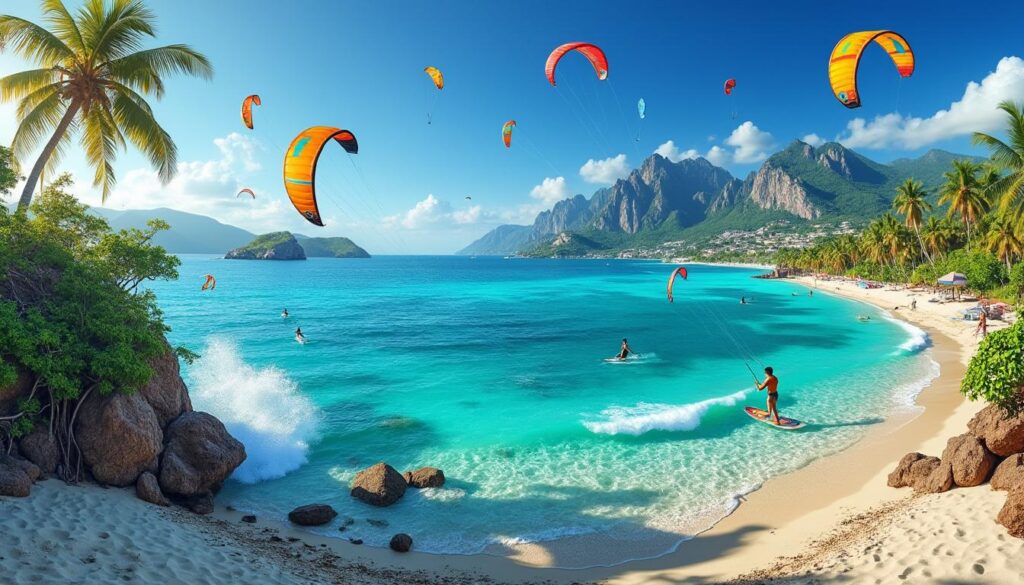
On Lago di Garda the wind gives no favors and in Malcesine you feel it full on. The Pelèr that comes in strong at dawn, the Ora that settles in regularly in the afternoon, the mountains that close the lake like a natural canyon: all of this pushes toward one thing, grabbing the bar and heading out on the water. Malcesine has become one of Italy’s kitesurfing epicenters because it combines reliable thermals, well-organized logistics, active clubs and an ingrained wind culture. First-time visitors are often taken aback: there are no long sandy beaches, but stones, tight spaces, strict rules and a lot of efficiency on the water.
Those used to kitesurfing in Salento, on the Adriatic or the Ionian coast, are struck by this lake more than a hundred meters deep, over fifty kilometers long, which behaves almost like an enclosed sea. In the area between Malcesine, Navene, Campione and Limone the thermal wind channels and cleans itself, often offering 12–18 knots with relatively flat water, perfect for progressing, edging and working on maneuvers. It’s not a fully “easy” beginner kitesurf spot: method, respect for the rules, support from local clubs and a good reading of the wind are required. But with the right tips it becomes one of the best kitesurf spots in Italy for those who want to grow safely.
- Malcesine is one of the windiest spots on Lago di Garda, thanks to the daily alternation between Pelèr and Ora.
- The main regulated kite areas are Navene and Campione, managed by local clubs with mandatory registration.
- Many kiters use the boat lift service to reach the most windward spot away from the shore.
- Beach space is limited and often rocky, so kite control and respect for the rules are essential.
- On average 8–10 months a year offer good wind probability, with a peak reliability between spring and late summer.
Malcesine Kitesurf: why Lago di Garda is a unique wind laboratory
Anyone looking for a place to truly learn to read the wind will find a complete training ground in Malcesine. Lago di Garda, wedged between the mountains and facing the Dolomites, works like a huge natural tunnel where air is sucked and pushed every day. To the north the basin narrows, pressure changes rapidly and two main thermals form: the Pelèr, from north to south at dawn, and the Ora, from south to north from early afternoon. This mechanism makes the area one of the historical references for windsurfing and increasingly for kitesurfing on Lago di Garda.
The lake exceeds fifty kilometers in length and almost seventeen kilometers in width at its maximum point, with an average depth over one hundred meters and a seabed that in some places reaches over three hundred meters. This enormous volume of water heats and cools more slowly than the land, generating thermal differences that feed local winds. We’re not talking about random gusts, but fairly recognizable cycles: those who study and observe them for a few days begin to sense the times, intensities and the areas where the wind channels best.
A character that helps visualize all this? Imagine Luca, an intermediate rider who usually goes between kitesurf Lecce and kitesurf Taranto. Used to Adriatic swells and Ionian waves, he arrives in Malcesine convinced a lake will be softer. Instead he finds a wall of mountains, a sheet of water that looks like the open sea and morning gusts that easily reach 25–30 knots with the Pelèr. His first reaction is surprise, the second is respect. With the support of a local kitesurf school and the lift service, however, he realizes that this environment, so different from Salento, forces him to improve edging technique, power control and relaunch management on flat water.
The key point is that Lago di Garda does not give infinite beach spaces. Unlike many kitesurf spots in Puglia, here there are stones, walls, nearby roads and organized lidos. For this reason clubs have emerged over the years that manage dedicated areas, piers, rescue RIBs and above all a system of shared rules. You don’t launch everywhere, you don’t inflate the kite anywhere, you don’t improvise a return in the first cove. This may seem strict, but it’s exactly what makes Malcesine a functional spot even on crowded days, with sailors, windsurfers, SUPs and tourist boats.
To understand how Malcesine compares to other Italian spots, it’s worth taking a look at an overview of the main winds and seasons. Without getting obsessively detailed, the logic is clear: on the Garda you seek consistency and frequency, in Salento you often deal with perturbations and direction shifts, in Sardinia you aim for a variety of swell and open sea.
| Zona | Tipo di vento principale | Intensità media (kt) | Periodo migliore | Caratteristiche per il kite |
|---|---|---|---|---|
| Malcesine – Lago di Garda | Termiche Pelèr / Ora | 12-25 (mattina più forte) | Primavera – fine estate | Acqua relativamente piatta, vento stabile, spazi ristretti in spiaggia |
| Salento – Ionio/Adriatico | Maestrale, Scirocco, termiche locali | 12-30 variabile | Tutto l’anno con picchi primavera/autunno | Ondina, mare formato, tanti spot liberi e scuole diffuse |
| Sardegna sud (es. Punta Trettu) | Maestrale, Scirocco | 14-28 | Primavera – autunno | Laguna piatta, spot tecnico ma perfetto per freestyle e kitesurf per principianti seguiti |
Those who want to deepen the national picture can take a look at the complete guide on kitesurf al Lago di Garda, which puts Malcesine in relation to the other key spots in the country. The bottom line is simple: understanding the local wind is the true key to turning a simple outing into a built session, the kind where you don’t endure the day but exploit every last knot.
Garda wind in Malcesine: Pelèr, Ora and how to choose your session
The heart of kitesurfing in Malcesine is managing the two thermal winds. The Pelèr is the master of the morning: it blows from north to south, often already in the early hours before dawn, and can easily climb above twenty knots, with peaks over thirty. Its intensity depends heavily on the nocturnal cooling of the mountains and the temperature difference between the air and the lake surface. When the sky is clear and the night was cool, prepare for a “full” morning, the kind when a 7 or 8 meter kite becomes the main sail.
The Ora, on the other hand, is a daytime wind that comes from south to north. It usually starts to be felt around noon, grows between 13:00 and 16:00 and can hold until sunset, especially in Malcesine where it often lasts longer than in other parts of the Garda. It is less nervous than the Pelèr, softer, with a typical range between 10 and 18 knots. For kitesurfing holidays it’s a gift: it allows you to plan afternoon outings, use mid-to-large kites and focus on maneuvers, foil or first rides on a twin tip.
To avoid being overwhelmed by all this theory, it’s worth looking at a typical day of a rider who approaches the lake with criteria. Let’s take Luca again: awake at 5:30, a look at the forecasts (which on the Garda are never perfect because the thermal component escapes statistics) and at the real-time wind profile. If the Pelèr is already rising and there are 18–20 knots, he prepares for a quick outing with a small kite, knowing he must return by around 9 at the latest, when local regulations often set the cutoff time for those launching from beaches not strictly kite-designated.
After a break, a light lunch and stretching, the real planned session is with the afternoon Ora. Here Luca changes kite, switches to an 11 or 12 meter, and chooses whether to use the lift service or exit from the club-managed area. The goal isn’t just racking up tacks, but working on transitions, controlled jumps and the timing with which he hooks the best gusts around mid-afternoon. The wind’s greater regularity compared to the morning allows him to focus on technique without the constant surprise of very strong gusts.
To avoid being caught unprepared, every kiter coming to Malcesine should be clear about at least this wind-reading scheme:
- Observe the sky at dawn: if the night was clear, the Pelèr can push hard; if the sky is hazy or overcast, the thermal may weaken.
- Check temperature differences between inland and the lake: the more marked they are, the stronger and more continuous the afternoon Ora will be.
- Listen to the locals: area clubs and kitesurf schools know the small microclimate variations between Malcesine, Navene and Campione very well.
- Don’t rely solely on apps: statistics do not always include the thermal contribution, so a forecasted 10 knots can easily become 16 in reality.
This approach applies everywhere, even when heading to kitesurf spots in Sardinia or the coasts near kitesurf Roma, but on the Garda it becomes almost mandatory. Misreading the wind means finding yourself overpowered among rocks and piers or underpowered in the middle of the lake asking for an unplanned rescue. Malcesine rewards those who arrive with respect and a desire to understand how the lake breathes, not those who only want two GoPro shots.
To complete their “wind education,” many riders alternate periods on the Garda with stages in the south. The guides on kitesurf Salento, spots and schools help build a broader picture: you move from the dense air of the lake to sea breezes, from the mountains to the scent of the Mediterranean scrub, always with the same underlying logic: understand what the wind intends to do before rigging the kite.
Kitesurf spots Malcesine and Navene: beaches, rules and lift service
Unlike many Italian coastlines, Lago di Garda has very precise rules on where kitesurfing can be practiced. Around Malcesine there are only certain areas where kitesurfing is authorized with clear management often linked to local clubs. For first-time visitors it is essential to understand this map, to avoid fines, arguments and above all risky situations for themselves and other lake users.
Let’s start with the most iconic area: Navene, about five kilometers north of Malcesine. Here a section of beach is dedicated to kitesurfing and managed by local sports associations, often called Kite Club Malcesine or similar. It’s a small area with a stony bottom, limited space to rig, where order and respect for the launch and return flows make the difference. The Ora from the south works very well here in the afternoon, with relatively flat water and steady wind especially a few hundred meters offshore.
Using the Navene area almost always requires club registration. The membership card includes access to services, briefings on the rules, possible storage spaces, water assistance and often also sports insurance. This structure may seem rigid to those coming from freer southern beaches, but it is exactly what allows many riders of different levels, plus leisure sailors, SUPs and relaxed tourists, to coexist. Here you don’t jump in the water “at random”; you follow a flow: rigging zone, launch area, exit channel, orderly return.
Besides Navene, the east shore around Malcesine offers other strategic points, especially with north wind. The Campagnola beach, about three kilometers north of the town center, works well in the morning with the Pelèr, but often in high season a mandatory return by 9:00 is required. The Retelino, one kilometer north near the ferry dock, requires always maintaining a distance of at least two hundred meters from the port area, in addition to the usual early return. To the south, the Assenza beach, in the municipality of Brenzone sul Garda opposite Trimelone Island, becomes a good alternative when the wind is too irregular at Campagnola.
Many riders choose, however, to minimize beach complications and take advantage of the famous lift service. Lago di Garda kitesurf schools organize boat outings aimed at autonomous kiters: you pay for a round-trip transfer and are taken to the center of the lake, in the most windward and obstacle-free zone. Here you unhook, rig the kite in the water with the help of the instructor or boat driver, and start tacking between Malcesine, Navene and the opposite shore.
The lift’s advantage is threefold. First, you avoid beach chaos, especially on summer days with little launch space. Second, you get straight where the wind is cleaner, without struggling to pass possible nearshore holes. Third, you remain under supervision: in case of problems, lost board, tangled line or sudden wind drop, the RIB returns, recovers the rider and brings them back safely. It’s not a full kitesurf course, because it’s aimed at those who already know how to handle launch, riding and return, but it’s a precious safety net.
This is also why the concept of kitesurf school is central on the Garda. Those who want to learn kitesurfing or improve often alternate lessons on the flat water here in Malcesine with stages in marine spots like Punta Trettu or Puglian beaches. Those seeking an overview of Italian realities can start from resources like the guide to kitesurf schools in Italy, which helps assess methods, certifications and spot types. Malcesine fully belongs to this circuit because it combines structured teaching and very instructional wind conditions, especially in afternoons with steady Ora.
Those who learn to move respectfully between Navene, Campione and the other authorized points then bring this approach to all other spots, from kitesurf Puglia to the rest of the Mediterranean. The implicit lesson is clear: a good rider is not only someone who jumps high, but someone who knows where they can go out, how to manage priorities and when it’s time to return before the wind changes face.
Best kitesurf spots on Lago di Garda: comparing Malcesine, Navene and Campione
To truly understand Malcesine’s value in the Italian kitesurf scene you need to compare it with the other Garda spots. The northern strip of the lake, on both shores, is where the thermal wind concentrates most, creating a sort of “corridor” that goes from Malcesine and Navene on the east shore to Campione and Limone on the west. Each of these towns has developed, over time, a slightly different wind culture and rider services, and the trick is to understand what you need most at the stage you’re at.
Malcesine and Navene are the organized heart for those focused on kite. Navene offers the regulated area, with clubs, signage and assistance. From here the afternoon Ora comes in clean, allowing work on freeride tricks, transitions and first controlled jumps in safety, thanks to generally not-too-choppy water. Malcesine town is instead the logistical reference: accommodations, campsites, rentals, shops and a lively evening scene that makes even less windy days more pleasant.
Campione, on the west shore, is the other recognized pole for kitesurfing on Lago di Garda. Here the landscape is even more vertical: the mountain seems to drop steeply into the water and shore space is limited but well managed by local clubs. Here too the Ora works strongly, often with a slight difference in intensity and direction compared to Malcesine due to orography. Campione is highly loved by freestylers and those seeking a “community” vibe concentrated in a few meters of lakeside, almost a wind village centered around the spot.
Other names that often come up in conversations are Limone sul Garda and Brenzone sul Garda. Limone, to the northwest, offers splendid outings but many launches are by boat due to extremely limited space. Brenzone, south of Malcesine, is mainly linked to morning Pelèr outings from spots like Assenza. Around all these centers there are also small secondary spots and zones reachable only by water, confirming how the Garda is more like a small inland sea dotted with micro-spots than a “simple lake” with a single beach.
From a progression standpoint, those looking for well-supported beginner kitesurfing find in Malcesine and Campione two excellent bases. Flat or slightly rippled water reduces effort in water starts and first rides, and the relatively stable Ora wind helps focus on kite posture and board control. Those more advanced can exploit the stronger morning winds, work on strapless jumps, foil or power tricks in safety thanks to the presence of support boats.
One often underestimated element is choosing the right twin tip board for the Garda. Here a slightly larger size can help a lot during the Ora, to get up earlier and stay afloat even when the wind drops a few knots. Not surprisingly many guides on how to choose the twin tip board for 2026 insist on this concept: adapt the board’s volume and surface to the spot type, rather than following only trends or generic advice.
Listing all these elements – wind, spaces, services, water type – allows building a small “mental map” of the Garda. Malcesine and Navene as the eastern hubs with a strong organizational component for kite, Campione as a west-side rider-oriented village-spot, Limone and Brenzone as satellites with more specific characteristics. The common thread remains the rigorous management of kite areas and the constant presence of thermal wind which, on the right days, turns the lake into a real aquatic playground framed by mountains.
Learn kitesurfing in Malcesine: levels, safety and smart progression
Those attracted to the lake but who haven’t yet done their first water start often wonder whether it makes sense to learn kitesurfing in Malcesine. The answer is yes, provided it’s done with the right structure behind it. Kitesurfing is accessible, dynamic and surprisingly within reach even for those without great athletic preparation. On average, with 5–6 structured lessons and a bit of assisted practice, many students reach a basic level of autonomy: they know how to rig safely, launch in both directions and return to the starting point in standard conditions.
In Malcesine this path is often organized in two phases. At first there is a lot of work on kite handling on land or in shallow water, using club spaces or, in some cases, boat outings in quieter zones. Objective: bar control, wind windows, relaunches, self-rescue. Only when the student shows stability and adequate reflexes do they move to the riding phase, often during the predictable afternoon Ora with medium wind. Here flat water is an ally, as it reduces wave-related surprises and allows focus on posture and coordination between kite pull and board pressure.
Chiara’s story is a good example. She lives in the city, tried windsurfing as a teen but nothing more. She decides to learn kitesurfing during a week of summer holidays at the Garda. She starts with a basic six-lesson kitesurf course, alternating theory and practice. In the first days she learns to handle the kite in light wind, do body drags and understand why depower is her best friend. From the third day, with the Ora around 14 knots, she starts attempting first water starts assisted by the trainer in the water.
At first she falls often, loses the board, gets tired quickly. But the lake gives her a precious thing: no waves to overwhelm her. She can stop, breathe, reorient the board and restart calmly. By the end of the week she is not yet a fully autonomous rider, but she manages to launch in both directions, travel a few dozen meters with control and, above all, return with logic, without being carried away by the wind line. The next step might be a weekend in a marine spot like Punta Trettu or an outing in the Ionian to test what she learned with a bit of chop.
To set up a smart progression path in Malcesine, and in kitesurfing across Italy, some points are fundamental:
- Choose a certified school: prepared instructors, radio helmets, support RIBs and respect for the rules make the path safer and faster.
- Start with medium wind: the Ora between 12 and 16 knots is ideal for first steps; avoid strong Pelèr until you have good control.
- Work on basic technique: body drag, kite relaunch, depower management and self-rescue are more important than early jumps.
- Connect lake and sea: alternating spots like Garda, Salento and Sardinia helps understand how to react to changing conditions.
Those who live kitesurfing as a lifestyle know the goal is not just “learning” but continuing to progress. The lake helps work on details: cleaner transitions, switch control, small backrolls. The sea then forces you to handle waves, currents and foam. Together they build a complete rider, able to move between kitesurf Lecce, kitesurf Taranto, Garda and beyond without changing mental approach: observe, understand, adapt.
Is kitesurfing in Malcesine suitable for absolute beginners?
Yes, in Malcesine you can start from zero, but only by entrusting yourself to a structured kitesurf school. The lake offers relatively flat water and predictable thermal wind, ideal for learning. However, the beaches are small and rocky, so launch and return management must be supervised by instructors with a support RIB. For absolute beginners it is not recommended to try independently without a course.
Is a permit or membership required to kitesurf in Malcesine and Navene?
In most kitesurf-dedicated areas in Navene and in regulated spots on the Garda, membership to a local club is required. The card allows use of the launch zone, access to services, sports insurance coverage and briefings on the rules. Launching from unauthorized beaches or ignoring restricted areas can lead to sanctions and, above all, create dangerous situations for other lake users.
What is the best period for kitesurfing in Malcesine?
The most reliable conditions for kitesurfing in Malcesine are generally found from spring to late summer, when the Pelèr and Ora thermals work more regularly. The Pelèr blows strongly in the early morning, while the Ora usually comes in from midday until sunset. The peak summer months can be very crowded, so it’s advisable to organize in advance with local clubs and schools, especially if you want to use the lift service.
What kite size is recommended for Lago di Garda?
The ideal size depends on the rider’s weight and the day, but many kiters on the Garda use kites between 7 and 9 meters with strong morning Pelèr and between 10 and 13 meters with the afternoon Ora. It’s useful to bring a small range of kites to adapt to intensity changes. For beginners, the instructor will indicate the safest size based on current conditions, avoiding over-rafting which can be particularly demanding on the lake.
Is the lift service mandatory or can I launch from the beach?
The lift service is not mandatory, but it is often the most practical and safe solution, especially on crowded days or for those unfamiliar with the spot. It allows you to reach the most windward areas in the center of the lake, reduces beach traffic and guarantees assistance in case of problems. Direct beach launch is possible only in authorized areas and strictly following the rules of the club that manages the spot.