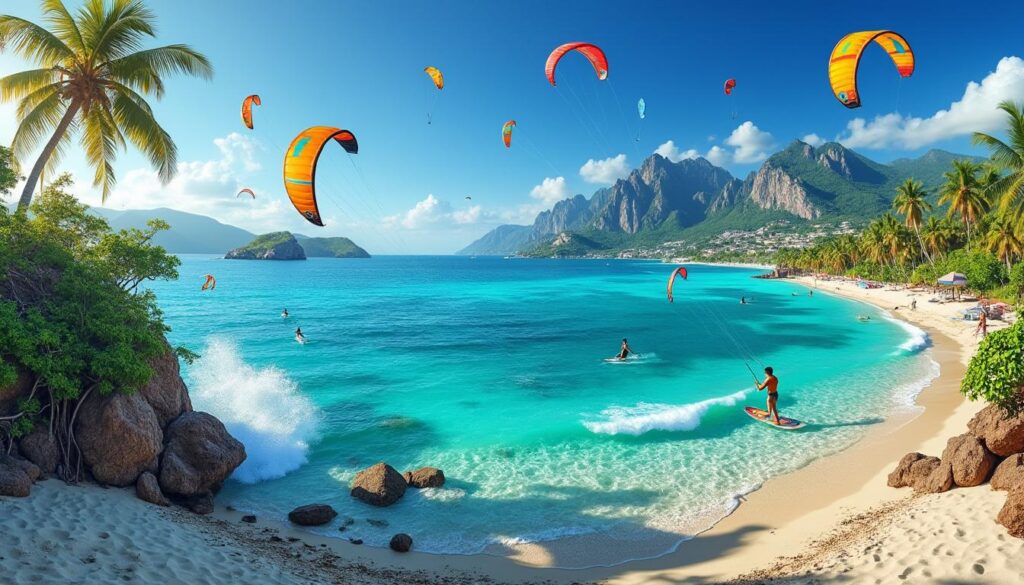
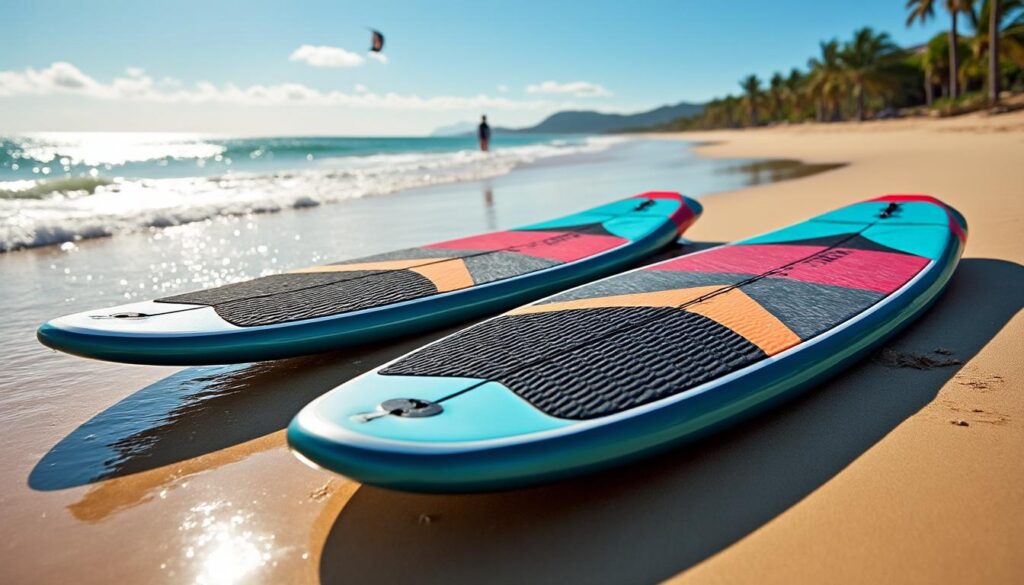
The wind picks up, the water ripples and the colorful sails begin to draw lines across the sky. In between, different boards, different styles, but the same obsession: pure glide. Surf kiting and kiteboarding are often confused, mixed up in seaside bar stories or under the school gazebos. In reality, behind these names lie different approaches to the sea and the wind, with sensations, technique and equipment that vary considerably from one discipline to another. Understanding clearly where kitesurfing on waves ends and where kiteboarding on flat water begins is the key to choosing the right course, the appropriate gear and, above all, the type of session you want to experience.
Many people get into kitesurfing in Italy after watching a viral big air video or a reel of perfect waves at sunset. But once you set foot in a kitesurf spot in Puglia, in Sardegna or at a lake, questions start: better waves or flat? Twin-tip or directional? Jumps or carving on the face? In a scenario like kitesurf in Salento, where in a few kilometers you pass from the Adriatic to the Ionian, choosing between surf kiting and kiteboarding is not just a matter of taste: it completely changes how you read the wind, enter the water and plan your kitesurf vacations. This guide puts the disciplines in order, compares equipment, costs, techniques and safety, with a very practical look at the reality of our Mediterranean spots.
In short
- Surf kiting = kite + directional surf-style board, focus on waves, smooth lines and reading the sea.
- Kiteboarding = kite + twin-tip (or a specific board), focus on jumps, freeride and maneuvers on flat water or chop.
- Kiteboarding has a faster learning curve in the initial steps; surf kiting requires more sensitivity on the waves.
- Kitesurfing on waves aims for the feeling of “surf with an engine”, kiteboarding emphasizes adrenaline, big air and versatility.
- For kitesurf for beginners, almost all kitesurf schools start with the twin-tip; the surf board comes later.
Surf Kiting and Kiteboarding: clear definitions to avoid confusion
Many novice riders arrive at a spot asking the difference between kitesurfing and kiteboarding. In many languages and regions of the world the terms are used interchangeably, but in the language of riders and schools in Italy it’s useful to make a practical distinction. When people talk about surf kiting they usually mean using the kite paired with a directional board similar to a surfboard, with the goal of riding the waves. The kite becomes the engine that takes you to the right spot, keeps you in speed, and helps you return to the lineup even with little swell.
Kiteboarding, on the other hand, is everything you do with a twin-tip: freeride, big air, wakestyle, freestyle, cruising. Here the central element is not the wave, but the wind and the water surface, which can be mirror-flat in a lagoon or messed up by chop and gusts. The bidirectional board allows you to change direction without switching feet, makes the water start easier and lets you focus on the bar, edging and jumps.
If you take a beginner — let’s call him Marco — who arrives in kitesurf Lecce for a long weekend, the school will almost always put a twin-tip under his feet. That way his first goal will be to stay upright, ride upwind and safely manage the kite’s traction. Only after a few dozen hours will it make sense to talk about surf kiting, change board type and think about bottom turn lines and cutbacks.
This does not mean that one discipline is “better” than the other. It means they answer different desires. Someone coming from classic surfing will find in surf kiting a natural evolution: the same reading of the wave, but more opportunities to get in the water thanks to the wind. Someone coming from snowboarding, skating or sailing usually falls in love immediately with the twin-tip: speed, edge control, jumps and the ability to exploit almost any wind condition.
To understand how we arrived at this distinction between kitesurf and kiteboarding, it’s worth taking a look at the history and meaning of the kite. A very useful deep dive is this article on meaning and history of kitesurf, which retraces the birth of the movement between France and Hawaii and explains why, at some point, boards and styles diversified so much.
The real key is simple: surf kiting and kiteboarding are two ways of using the same engine — the wind — with different goals. Knowing which attracts you more saves time, money and frustration from your first course onward.
Equipment compared: twin-tip, directional and kite setup
On the equipment side, the difference between surf kiting and kiteboarding is already evident on the beach. In kiteboarding twin-tips dominate: symmetrical boards with pads and straps, often equipped with channels and rockers designed to absorb chop and give pop out of turns. There are many categories: big air, freestyle, wakestyle, freeride, lightwind, beginner. A big air kiteboard is usually stiffer, with a fast profile and good edge hold to load jumps in strong wind; a freeride board is more flexible, forgiving of mistakes and kinder on the knees.
Within the twin-tip family you’ll find:
- Beginners / freeride: medium rocker, soft flex, easy planing, comfort on the chop.
- Big air: stiff boards, often reinforced with carbon or basalt, pronounced channels for grip.
- Freestyle / wakestyle: flatter profile for maximum pop, sometimes with grind base for rails and kickers.
- Lightwind: generous sizes and wide outline to get going with little wind.
In surf kiting directional boards are used: distinct nose and tail, surf-style fins, often strapless or with a strap only on the front/back foot depending on style. Concepts such as volume, rail, rocker and outline—borrowed directly from surf—come into play here. A board for small waves and medium wind will be wider with more volume; a board for steep waves and strong wind will be narrower, with sharp rails and a pronounced rocker.
The basic kite is the same — leading edge inflatable, bridles, four-line bar — but how you use it changes. In kiteboarding freeride you often look for a kite with good depower, easy relaunch from the water and powerful jumps. In surf kiting many prefer sails that are more stable, with a soft drift that allows you to descend the wave almost “without traction,” as if you were surfing without the kite.
Watching a mixed spot like a classic kitesurf on the Ionian, you’ll often see in the same bay a group of riders jumping on twin-tips near the shore break and a few wave riders waiting farther out for the right set, with the 6 or 7 inflated but the surfboard in hand. Two worlds coexisting, but with totally different equipment logic.
Costs, schools and learning kitesurf: what changes between the disciplines
One of the points that really makes the difference between surf kiting and kiteboarding is the wallet. To learn kitesurf safely you need to invest in a kitesurf course with a certified instructor and school equipment. On the surf side the list is short: board, leash, fins, wax, wetsuit if needed. On the kitesurf side the checklist grows: kite, bar, safety line, pump, harness, board, wetsuit, impact vest or buoyancy aid, helmet.
If you only look at personal equipment, a complete surfer’s setup can range between €1,000 and €2,000, especially if you aim for high-quality boards and wetsuits for many conditions. For a complete, good-quality kitesurf kit — meaning kite, bar, harness, twin-tip freeride, wetsuit and protection — it’s realistic to start from around €2,000, with prices rising for premium gear or a quiver with multiple kites. Surf kiting adds to that investment the directional surf board, which often costs as much as (or more than) a twin-tip.
For those coming to kitesurf for beginners, the smartest strategy is to rely on a kitesurf school and postpone buying gear. A good school in the kitesurf Taranto area or along the Adriatic provides everything: kites of various sizes, boards suitable for your weight, wetsuits and radios. The goal is to get you to a level where you can understand whether you prefer to focus on freeride, big air or if waves call you right away.
An interesting aspect is the difference in the learning curve. Kiteboarding freeride on a twin-tip is relatively quick at the start: if you are consistent and have steady wind, in a few days of intensive course you can reach your first independent riding. Surf kiting, instead, pays a double complexity: you must first be confident with the kite and then learn to manage a directional board, with foot switching, bottom turns and take-offs on the face.
Take the example of Sara, who decides to spend a week kitesurfing in Italy between the Adriatic and the Ionian. She spends the first three days getting comfortable on the twin-tip in a spot protected from the shore break, side-on wind, perfect conditions for beginners. By the end of the week she is already able to head upwind a bit and control speed. If she wanted to switch to surf kiting, she would need to add more hours dedicated solely to the surfboard, preferably in neat wave conditions and steady wind. Not impossible, but certainly more demanding.
Those with limited budgets who live far from the sea often choose kiteboarding freeride as a “base”: one board type, maybe two kites, and sessions on lakes, sea or windy spots even without swell. Those who spend more time in the water — for example people living near the best kitesurf spots in Italy with waves, like some stretches of Puglia, Sardegna and Toscana — can afford the luxury of a double quiver: twin-tip for strong wind and flat days, directional surf board for swells.
Comparative table: surf kiting vs kiteboarding for beginners
To keep the main differences between the disciplines in view, this table helps you understand which path might suit you best when you start planning your next course.
| Element | Surf Kiting (waves) | Kiteboarding (twin-tip) |
|---|---|---|
| Type of board | Directional surf-style, with fins and often strapless | Bidirectional twin-tip with pads and straps |
| Main focus | Riding and working the waves, smooth lines | Freeride, jumps, speed control, big air |
| Initial difficulty | Higher, requires good command of the kite and the board | More accessible to beginners, easier water start |
| Dependence on waves | High: manageable waves and suitable wind are needed | Low: just enough wind is sufficient, even on flat water |
| Progression over time | Slow but very technical, similar to surfing | Fast at first, then infinite variety of tricks |
| Ideal spots in Italy | Swells on the Tyrrhenian, Atlantic, some spots in Salento | Lagoons, lakes, windy coasts of the Adriatic and Ionian |
Looking at this table isn’t about choosing “the best,” but about understanding where you want to put your time, energy and money in the coming years of riding.
A comparative video like the one above can help you visualize live what on paper may seem only theory: body position, board steering, use of kite power change a lot between wave and flat.
Technique, riding style and sensations on the water
The deepest difference between surf kiting and kiteboarding is not just the board, but the sensations. In kiteboarding freeride the aim is often the control of power: you load the edge, feel the sail pull, release and you fly. Teo-side, backroll, frontroll, kiteloop: the body revolves around the bar, the board follows, water explodes in spray when you land. Everything revolves around the balance between kite traction and edge hold.
In surf kiting the focus shifts to the wave face. Here the kite is often more unloaded, parked high in the window or slightly drifted while you concentrate on the line: decisive bottom turn, transition on the shoulder, top turn with spray toward the lip. Classic surf maneuvers — cutback, foam climb, re-entry — become possible even on days with less powerful swell, thanks to the kite’s pull that keeps you planing.
There are overlaps between the two worlds. Many riders use a twin-tip even in small wave conditions, playing between chop and shore break with small jumps and aggressive carving. Likewise, several wave riders strapless use the kite for aerials off the wave with switch landings, blending surf style and air. But the basic logic remains distinct: in surf kiting the wave is queen, in kiteboarding the wind rules.
From a technical point of view, the physical demands change. Surf kiting forces you to work more with legs and hips to keep the rail in the face, manage the bottom in irregular water and absorb the jolts of the steeper sections. Kiteboarding, especially in big air and freestyle, stresses the knees and core heavily on take-off and landing, and requires good height management to avoid violent landings.
Another important nuance is tolerance for imperfect conditions. A rider who only does surf kiting suffers much more on days without swell or with messy waves and cross-wind. The freeride kiteboarder, by contrast, can have fun even with gusty wind and choppy water, starting a few meters further out. That is why many kitesurf Adriatic spots are used almost exclusively for twin-tip: shallow bottoms, short waves and side-on wind are a perfect playground for jumps and long reaches, less so for real wave work.
Those seeking a complete technical progression often alternate periods: winter dedicated to waves at a few selected spots, spring and summer more oriented toward kiteboarding freeride around the best windy spots. That way each session feeds a different part of your riding: kite control, rail sensitivity, turn timing. At the end of the season you find yourself with a much richer toolbox, no matter which board you have under your feet.
Typical mistake: trying to rush progress on the waves
One of the most common mistakes among those who discover kitesurf in Italy is falling in love with surf kiting videos and immediately throwing themselves onto the surfboard. Without a solid twin-tip base, however, the risk is fighting too many elements at once: kite, waves, current, foot switching. The result? Frustration, few waves caught, many falls and little real progress.
Many serious schools in Salento and across Italy insist on a clear path: first master the twin-tip, then introduce the directional board in easy conditions (flat water or small waves), finally tackle real waves. It’s an approach that saves time and energy, even if at the start the desire to grab the “cool” board is strong. Remember: waves won’t run away and the Salento wind, above all, must be understood and respected.
A good tutorial on the basics of kitesurfing on waves, like the one above, is the ideal complement after the first hours of real practice: see lines, timing and kite positioning, so you’re less lost at the next swell.
Spots, wind and Italian scenarios: where surf kiting and kiteboarding shine
If you live in or want to come for kitesurf vacations in Italy, the choice between surf kiting and kiteboarding is largely dictated by the spots. The beauty of our country is the variety: different seas, local winds, lakes, lagoons. There is literally a place suitable for every discipline.
On the Adriatic coast, from the Venetian shores down to kitesurf Adriatic in Salento, the classic profile is a gently sloping bottom, short chop and often side-on wind. Here kiteboarding on twin-tip is king: freeride, big air, first maneuvers. Spots like those around Lecce, with wide beaches and summer thermal wind, are perfect to start or to progress on tricks and jumps. Surf kiting comes into play only when real swells occur, less frequent but highly valued by wave riders.
On the Ionian side, the kitesurf Ionian offers different conditions: often flatter water with north-west winds, cleaner waves with scirocco or libeccio. On organized swell days, surf kiting finds its space here, especially on stretches with reefs or shoals that create more regular waves. When the wind strengthens but the wave drops, the twin-tip returns to the fore with long reaches in deep blue water.
Across the rest of Italy the map is equally varied. The lagoons of the north-east and the large alpine lakes are paradises for kiteboarding: flat water, regular thermal wind, huge opportunities for freeride and freestyle. The Tyrrhenian coast, the western Sardinia and some minor islands instead offer serious swells, ideal terrain for surf kiting in oceanic style when wind direction cooperates.
For those who want to build a real “kitesurf tour of Italy,” a good approach is to alternate specialized spots. Two or three stops in pure kiteboarding spots, maybe lagoons and lakes, to work on kite control and basic technique. Then a jump to the best wave spots — some in Puglia, others in Sardegna or Toscana — to spend a few days on surf kiting with instructors who know the sandbars and local shoals.
A fundamental tip: never choose a spot just based on Instagram photos. Better to cross-check information with serious weather forecasts, locals’ opinions and on-the-ground articles. Content like that from Salento Kiter exists precisely for this: to explain how the wind really behaves, which exposures work with which directions and which spots to avoid with big seas if you are a beginner.
How to choose the right spot based on the discipline
When you start planning a session or a kite holiday, it can be useful to always ask yourself three quick questions:
- What wind is forecast? If it’s moderate side-onshore, twin-tip freeride is often the safest choice.
- Will there be manageable waves? If yes, and if you already have a solid base, you could plan surf kiting sessions with a directional board.
- What is the group’s level? If there are novices in the group, it’s better to choose wide spots with shallow bottoms and little shore break, perfect for kiteboarding for beginners.
This small checklist prevents you from throwing yourself onto a messy beach break with side-off wind just to “do waves,” or from ending up in a flat lagoon with a surfboard in hand watching a sea without faces.
Safety, risks and well-being: what you need to know before entering the water
Surf kiting and kiteboarding share a fundamental point: they are sea sports where a misjudgment can cost you dearly. The kite adds a component of vertical and horizontal power that pure surfing does not have. Poor management can turn a simple gust into an uncontrolled flight toward the beach. That is why schools insist so much on procedures, signals and respecting the spot.
From a risk point of view, kiteboarding on a twin-tip has the advantage of a more “stable” position in the water, especially in the first months. Falls are frequent but often less violent, and the absence of big waves reduces the risk of sudden flips. However, the possibility to jump, loop the kite and chase more extreme maneuvers raises the danger level as you progress.
In surf kiting the wave dynamics also come into play: a lip closing over you, backwash currents, shoals that make the face break suddenly. Added to all this is the kite, which can remain in traction while you are being washed by one or more sets. It is precisely this combination that makes instinctive management of the quick release, depower and body position under the foam indispensable.
In terms of physical benefits, both disciplines are excellent for the heart, core strength and balance. Kiteboarding works a lot on abs, lower back, shoulders and legs, with long sessions that become a real cardio workout. Surf kiting adds a significant load to the lower joints, especially knees and ankles, when you really start to push the rail in bottom turns and cutbacks.
Mental benefits are similar: the sea has the same effect for everyone: it clears your head, forces you to be present, releases tension. Many riders say kiteboarding is a powerful antidote to stress: when you’re hooked in, nothing else exists but wind direction, the position of other kiters and managing your speed. Surf kiting, with its slow rhythm of waiting for the wave and then the explosion during the ride, delivers a nearly meditative form of concentration.
When choosing between the two disciplines, it also makes sense to consider possible injuries or weak spots in the body. Those who already have knee problems should lean toward boards with softer flex, schedule sessions in less chaotic seas and listen closely to their limits. In this sense, all-round twin-tip freeride boards, with medium flex and moderate rocker, represent a smart choice for most recreational riders.
Golden rule: respect the wind and the community
Whichever path you choose — surf kiting or kiteboarding — there is one rule that applies to all: the wind is non-negotiable, you learn to read it. This means checking forecasts beforehand, understanding local peculiarities (gusts, thermals, katabatic winds), talking to local riders and never forcing a session that “doesn’t feel right.”
The kite culture, even more than traditional surfing, is a strong and growing community. Even if numbers are still lower than surfing, the number of practitioners in Italy and the Mediterranean grows every season. Every beach has its unwritten codes: right of way, zones dedicated to schools, exit and entry corridors. Learning these rules is an integral part of your progress as a kiter, regardless of which board you have under your feet.
In the end, the sea makes no distinction between waves and flat: it rewards those who respect it, who listen to the wind and who know when it’s time to get back to shore. Surf kiting and kiteboarding are just two dialects of the same language, the one you learn every time you inflate the kite and put the board in the water.
Is it better to start with surf kiting or with kiteboarding on a twin-tip?
For most people it is much more effective to start with kiteboarding on a twin-tip. This board is bidirectional, forgives mistakes more and allows you to focus on kite management, water start and safety. Surf kiting with a directional board already requires a good command of the kite and introduces the complexity of waves and foot switching. Once you feel confident on a twin-tip – you can reach the downwind and ride upwind consistently – you can take a few specific lessons on waves with a school experienced in surf kitesurf in suitable spots.
Can I use the same equipment for both kiteboarding and surf kiting?
The kite (wing, bar, harness) can often be the same for both disciplines, although some wave riders prefer models with better drift and a softer behavior in the window. The real difference is the board: for kiteboarding you’ll use a twin-tip, while for surf kiting you’ll need a directional surf-style board, with different fins and often more volume. Many advanced riders keep both boards in the car and choose on the fly based on wind and waves. At the beginning, however, it’s advisable to invest first in a good freeride twin-tip setup and only later add the surfboard.
How long does it take to become independent in kiteboarding compared to classic surfing?
On average, with a good kitesurf course of 8–12 hours spread over several days and favorable weather conditions, a beginner can reach a first level of autonomy: launching, making controlled reaches, returning to the exit point safely. In classic surfing, reaching the point of catching truly surfed waves autonomously often requires many more hours in the sea spread over months, because you are entirely dependent on paddling, take-off timing and wave power. Surf kiting on waves, instead, only comes after consolidating solid kiteboarding basics.
Is kitesurfing more dangerous than surfing?
Both sports have specific risks, but the kite introduces the variable of aerial traction, which can generate more extreme situations if not handled properly. A sudden gust, incorrect use of the bar or launching from a crowded beach can quickly turn into serious accidents. On the other hand, surfing exposes you more to impacts with waves, the seabed and other boards. The key to reducing risks in kitesurfing is taking a course with certified instructors, learning safety procedures well (quick release, self-rescue), respecting the launch area and choosing conditions appropriate to your level.
Where to find spots in Italy suitable for both kiteboarding and surf kiting?
In Italy several regions offer conditions suitable for both disciplines. Puglia, particularly Salento, is a perfect example: on the Adriatic side you find spots ideal for kiteboarding with shallow bottoms and side-on wind, while on the Ionian side, with the right swell, cleaner waves appear for surf kiting. Sardegna, Sicilia and some areas of Toscana also offer similar combinations: lagoons or sheltered gulfs for twin-tips and more exposed stretches of coast to ride waves. Checking in with local communities, specialized schools and Italian kitesurf media helps you build an itinerary that considers both riding styles.