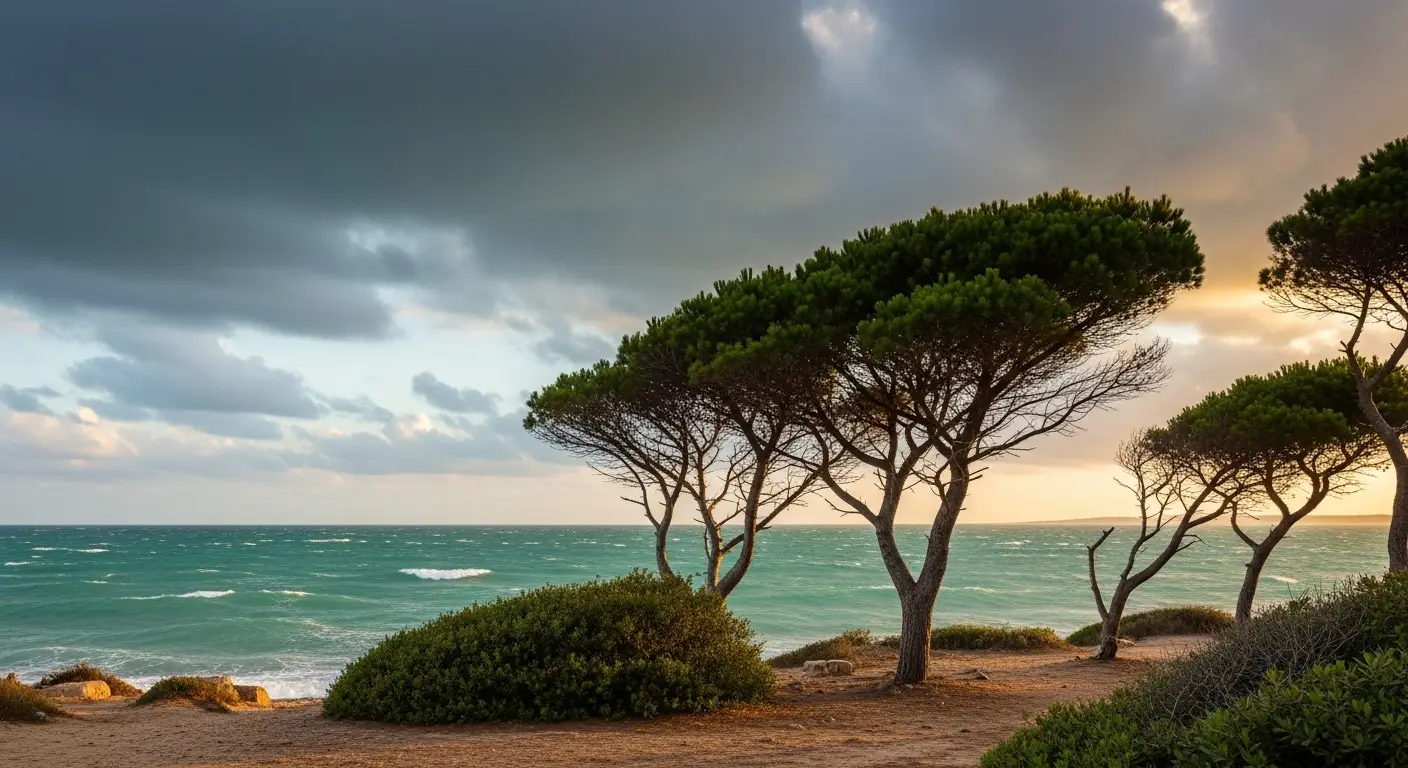
Taming the Invisible: Wind and Tides
The science of marine weather is the kitesurfer's first piece of equipment.
Understanding the Elements
Anticipation, the Key to Safety
Wind and tides are the two invisible forces that shape every kitesurfing session. Understanding how they work means turning uncertainty into advantage. In Salento, the diversity of coastlines (Adriatic, Ionian, Strait of Otranto) creates a natural laboratory where every wind tells a different story.
"Weather is not a matter of fate, it's technical data. The kitesurfer who knows how to read it turns every windy day into an opportunity, while others stay on the beach hoping for the best."
Reference
Beaufort Scale for Kitesurfing
From a light breeze to a fresh wind, each force level has its opportunities and limits.
Light Breeze
7-10 knots
Ideal for beginners with a large kite (14-17m²). Waves are small (0.2-0.5m). Perfect conditions for first waterstarts and controlled riding.
Moderate Breeze
11-15 knots
The sweet spot for most riders. Kites of 10-14m² depending on weight. Waves of 0.5-1m. Perfect for freeride, jumps and first tricks.
Fresh Breeze
17-21 knots
Sporty conditions. Kites of 8-11m². Waves of 1-2m. Intermediate and advanced riders find their sweet spot. Beware of gusts if you're less experienced.
Strong Breeze
22-27 knots
Reserved for experienced riders. Small kites (6-9m²). Waves of 2-3m. Conditions become demanding with powerful gusts and a well-formed sea state.
Force 7+ (28+ knots)
Extreme conditions reserved for experts. Waves 3-4m, reduced visibility due to spray. Most riders should stay on shore. Caution is never a weakness.
Know-How
Decoding Marine Bulletins
Three essential pieces of information to master in order to turn a weather bulletin into a session plan.
Average Wind vs Gusts
Average wind determines kite size. Gusts determine safety. A gust-to-average ratio above 1.5 indicates unstable wind. Golden rule: choose your kite for the gusts, not the average.
Ratio > 1.5 = unstableOffshore Direction: The Invisible Danger
An offshore wind (blowing from land to sea) is the #1 trap for kitesurfers. In case of trouble, it's impossible to get back to shore. In Salento, the Maestrale is offshore on the Adriatic coast and the Grecale on the Ionian coast.
Offshore = major dangerSwell Period
The period (in seconds) between two waves is as important as their height. A short swell (< 6s) creates choppy, disorganized water. A long swell (> 8s) produces clean, well-spaced waves, ideal for wave-riding.
> 8s = clean wavesInteractive Tool
Navigation Simulator
Enter the current conditions and your level to get a personalized safety analysis.
Safety analysis
Tides
Influence of Tides
In the Mediterranean, the tidal range is small but its influence on kitesurfing is very real.
Small Tidal Range, Big Impact
In the Mediterranean, the tidal range is small (20-40 cm) but enough to change conditions. At low tide, sandbars surface and create dangerous shallow areas. Some spots become unrideable.
Tidal Currents
Tidal currents are particularly noticeable in the straits and narrow bays of Salento. The current can reach 1.5 knots in certain passages, making body-dragging difficult or even impossible.
Venturi Effect
When wind funnels between two rocky headlands or into a bay, it accelerates through the Venturi effect. This phenomenon explains why certain spots like Porto Selvaggio consistently offer 3-5 knots more than the coastal average.
Synoptic Weather
Reading Isobars
Understanding atmospheric pressure maps to anticipate winds 3-5 days ahead.
Anticyclone
> 1013 hPa- High pressure, descending and stable air
- Calm weather, clear skies, light wind at the center
- Promotes thermal breezes in summer in Salento
- Wind rotates clockwise (Northern Hemisphere)
Depression
< 1013 hPa- Low pressure, rising and unstable air
- Strong wind, cloud cover, possible precipitation
- Generates the Tramontana and Scirocco in Salento
- Closely spaced isobars = stronger wind and gusts
Frequently Asked Questions
Wind & Tides FAQ
What is the minimum wind needed for kitesurfing?
How do you read a marine weather bulletin for kitesurfing?
Do Mediterranean tides affect kitesurfing?
What is the Venturi effect and how can you use it?
Beaufort Force 7: is it rideable for kitesurfing?
Need personalized advice?
Contact Us