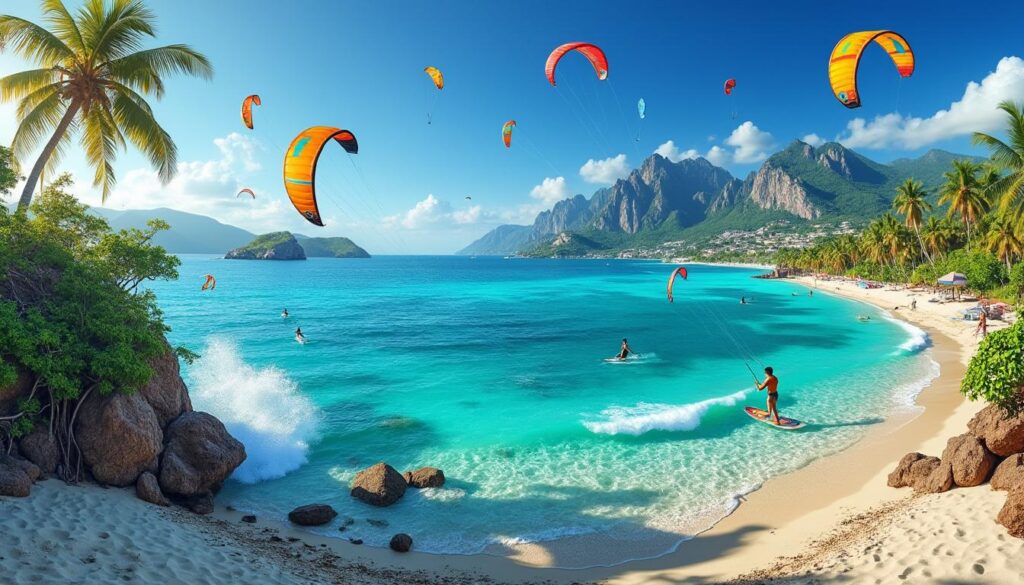
Porto Pollo is not just a stretch of coastline in northern Sardinia: it is one of those spots where the wind sets the pace of the day, the sails color the horizon and the sand sticks to you along with the desire to get back on the water. Those looking for a concrete place to do kitesurf in Italy, with reliable wind, turquoise water and a true board culture, will find a stable reference here. The double bay, the isthmus leading to the Isola dei Gabbiani and the strategic position on the Bocche di Bonifacio create a micro–world perfect for riders of all levels, from first body drags to hooked jumps in the middle of the lagoon.
In Sardinia many names circulate among those organizing kitesurf holidays: Stagnone, Punta Trettu, San Teodoro. But when talking about Porto Pollo kitesurf, a spot comes into play that combines open sea, sheltered gulfs, structured schools and services designed for those who live the beach from morning to night. Here the Maestrale wind finds a preferential lane between Corsica and Sardinia, the Ponente strengthens, and the seabed stays shallow for tens of meters. It’s the kind of place where you can learn from scratch with a serious kitesurf school, but also push your advanced riding without feeling limited. It’s not a postcard spot to watch from afar: it’s an arena to live with the bar in hand and your legs already ready for the water start.
- Porto Pollo is one of the most historic and windy spots of northern Sardinia, perfect for kite, windsurf and wing foil.
- The double bay formation and the isthmus towards the Isola dei Gabbiani offer flat water on one side and waves and chop on the other.
- The presence of a kitesurf school equipped with Duotone gear and certified instructors makes the spot ideal even for those looking for kitesurf for beginners.
- The Wind Bar and the beach services turn the session into a full day: riding, relaxation, socializing.
- For those exploring the kitesurf Italy circuit, Porto Pollo stands alongside spots like Stagnone, Punta Trettu and northern lakes like Garda.
Porto Pollo Kitesurf in Northern Sardinia: why it’s a legendary spot
Porto Pollo faces directly onto the Bocche di Bonifacio, the sea corridor that separates Sardinia from Corsica. This geographic detail is worth more than a thousand statistics: it means that every flow from west and east is channeled and often strengthened. For those looking for the best kitesurf spot in Italy with a good probability of wind, this is already a huge advantage. When the Maestrale comes in strong, the bay fills with sails, the chop grows and the water color shifts from pale turquoise to deep blue offshore.
The beach is long, though not very wide, made of light, fine sand that doesn’t stick everywhere like some Adriatic beaches. This sandy strip connects the mainland to the famous Isola dei Gabbiani, a small island linked by a sand isthmus that creates two bays with different characteristics. West side and east side are not just names: they are two scenarios with different conditions, allowing you to choose where to enter based on the wind and your technical level.
One of the reasons Porto Pollo is considered a reference in kitesurf in Sardinia is precisely this versatility. On one side you can find flatter, more sheltered water, perfect for first tacks, kitesurf lessons for beginners or for those working on their first controlled jumps. On the other side, when the wind picks up, short waves and chop appear, the ideal environment for those who want to train edging, control and advanced maneuvers. An intermediate rider can spend the morning in the calmer area reviewing fundamentals, and move in the afternoon where the wind strengthens to test a smaller kite.
The only real limit of the spot shouldn’t be hidden: its popularity. During peak season the beach fills up, the kites are many and strict right-of-way management is necessary. But this “crowded” side also brings an advantage: a strong shared kite culture. regulars know well the wind directions, launching zones, areas reserved for windsurf and sailing. Just observe a few minutes from the shore to understand which trajectories to follow, where to avoid hovering with the kite and how to set your tacks safely.
For those touring Italy in search of the best spots, Porto Pollo fits into a broader network that includes places like Stagnone in Sicily, detailed here as well: kitesurf Stagnone Marsala guide. But while the Stagnone offers almost exclusively flat conditions and shallow water, Porto Pollo brings a more “oceanic” mix to the table: strong winds, open sea, still-wild nature around the spot, with Mediterranean scrub vegetation reaching almost the beach.
Those who love the history of our sport breathe a familiar energy in this place. Windsurf arrived here decades ago, turning the gulf into a constant training ground for generations of riders. When kite started to spread in Italy and kitesurf as a sport began to win new practitioners, Porto Pollo absorbed this new discipline naturally, becoming one of the most structured centers in the Mediterranean for all wind-surfing boards: kite, wind, wing and even small sailing courses for children who start young.
The result is a “legendary” spot not because of marketing, but because it has seen seasons pass, gear changes, generations of riders and will remain a fixed point for those planning a true kitesurf holiday in Sardinia. The wind decides the details, but the overall consistency of conditions is what makes Porto Pollo a pillar on the kitesurf map in Europe.
Wind, sea and seasons: reading the Porto Pollo spot
Understanding Porto Pollo means first of all understanding its wind. Western flows, like Ponente and Maestrale, are the real protagonists. When they blow from the west, they enter the bay decisively and often gain a few knots thanks to the funnel effect created by the Bocche di Bonifacio. This makes the area very appealing to those looking for sessions of 20–25 knots stable, perfect both for freeride and for some more aggressive maneuvers with twin-tip or small surf boards.
The Levante instead arrives less often and with less intensity. On some days it may seem almost absent in the main part of the spot, while it is perceived more clearly in surrounding areas. For this reason local riders tend to plan mainly based on west forecasts. Spring and early autumn are often the best phase to combine consistent wind, still-pleasant water and a less crowded beach. Summer remains beautiful, but requires a bit more patience to manage coexistence with bathers, schools and other riders.
The water alternates stretches of flat with areas of chop. Especially when the wind exceeds 20 knots, the surface starts to ripple and those small “steps” form that are perfect to begin jumps. A beginner who has just completed a water start finds themselves in an environment where the sea supports their progression: enough chop to make them understand the importance of edge control, but not so chaotic as to become unmanageable. The sandy and shallow seabed near the shore helps a lot in handling falls, without hidden rocks ready to ruin your wetsuit.
Those who already know the dynamics of Salento wind or the Adriatic kitesurf will notice clear differences. In Salento, for example, you play a lot with the thermal and the sea change between the Ionian and Adriatic. In Porto Pollo, instead, the protagonist is the channel between Corsica and Sardinia, which doesn’t forgive distractions: if you underestimate the wind strength when it rises, you end up planing with too large a kite and little margin of control. For this reason more experienced riders insist on controlling kite size and constantly reading the horizon.
The key to really reading Porto Pollo is simple: observe flags, sails in the water and the wave line for at least ten minutes before rigging your gear. Understanding the actual direction, noting if the wind tends to grow in the afternoon and analyzing where local schools launch gives you an immediate picture. In such a lively spot, copying the choices of experienced riders is often the quickest way to nail your session.
The Wind Porto Pollo school: kite, windsurf and wing foil courses for all levels
At the center of Porto Pollo beach there is an operation that really makes a difference: a center specialized in kite, windsurf and wing foil courses that has been working for years with a team of certified instructors. We’re not talking about an improvised setup with two sails and a radio, but a real sports base that offers kitesurf courses, wind lessons, wing foil programs and full support for those setting foot on the spot for the first time.
The school uses modern equipment, largely signed Duotone, one of the most respected brands worldwide in kitesurf. For the student this means wing and kite with clear wind ranges, easy relaunch in the water, reliable bars, comfortable harnesses, boards with volumes suitable for the first departures. It’s not a minor detail: anyone about to learn kitesurf needs gear that forgives mistakes, with effective depower and a structure that helps with relaunches after the first inevitable crashes.
Courses are organized in different formulas: private lessons, group packages and specific paths for kitesurf for beginners or for those already at an intermediate level who want to work on jumps, transitions and riding in switch. The teaching approach is step by step. First you build kite control on land, then move to body drag, then the water start and finally the first tacks. The real difference lies in the instructor’s ability to read the wind and sea in real time, moving the student to the point in the bay most suitable for the learning phase.
A concrete example? Take Luca, 32, who arrives in Porto Pollo after a few hours of lessons on the kitesurf on Lake Garda. In Garda he learned the theory, some attempts at kite control and little else, due to unpredictable weather. In Sardinia, placed in a structured course at Porto Pollo, in three–four sessions with constant wind he manages to complete a water start on both sides and the first 50–70 meter tacks. It’s not “magic”, but the combined effect of steady wind, readable sea and a teaching progression designed to exploit local conditions.
The same logic applies to windsurf and wing foil. The school offers paths for those who have never stood on a board, with small sails and stable big boards, and advanced courses for those who can already tack and want to close freestyle maneuvers. Wing foil, a young but now established sport on the scene, finds ideal ground in Porto Pollo: regular winds, space, the possibility to choose between flatter or slightly choppier water. Instructors who follow wing and wind have solid backgrounds also in winter sports (skiing, snowboarding), so they know body dynamics, balance and technical progressions well.
Another advantage is the atmosphere. In the center you don’t breathe a resort vibe of all show and little substance. Here those who teach have spent countless hours in the water, often in tough conditions, and bring practical experience to the beach. When they explain why a more compact stance on the legs is better, or why it’s best not to load the bar too much in gusts, they don’t do it because they read it in a manual, but because they lived it in real sessions, often also in other Mediterranean spots.
For those evaluating different areas for a course in Italy, it may make sense to compare options. Some choose the north, with schools on Garda as in this overview: kitesurf schools in Italy, others move to the islands to have more wind guarantees. Porto Pollo carves out a particular position: it combines high technical standards, open sea, serious wind and a natural setting that makes you want to stay on the beach even when you are dead tired.
This mix of up-to-date equipment, certified instructors, deep knowledge of the spot and the ability to adapt each lesson to the day’s weather makes the school a true hub of the Isola dei Gabbiani. For those arriving with a clear goal of progressing, excuses quickly run out here: there’s wind, there’s support, it’s up to you to take the bar in your hands.
Types of courses and progression: from the first body drag to jumps
The core of the Porto Pollo school’s educational offer lies in the clarity of the paths. Private lessons are ideal for those who want full attention: dedicated instructor, radio, kite calibrated to weight and level. In the group format, designed for friends or couples, the advantage is sharing time and costs, observing others’ mistakes and learning from them too. In both cases the progression follows well-defined blocks, with concrete objectives for each session: static kite control, managing gusts, starts, then stable tacks and finally direction changes.
For those already autonomous, there are advanced packages focused on basic jumps, transitions, toeside riding or small surfboard management. Here the work becomes finer: working on edge engagement, the timing between edge release and kite pull, body position in the air. Porto Pollo, with its regular chop and the possibility to find small natural kicks, is an excellent training ground to start lifting off the water in a controlled way, without flying randomly downwind.
Along the same logic, wing foil is taught starting from wing control on land, then on the big board, finally with the actual foil. The goal is not to “do everything at once”, but to give the student tools to understand the wind, wing inclination and weight management on the feet. In windsurf, progressions go from simply going back and forth within the protected channel, up to tacking with sustained wind or performing the first freestyle maneuvers on shorter boards.
Within the center, the day’s organization is designed to make the most of the windy hours. Morning is often dedicated to beginners, with softer wind and relatively calm sea. In the afternoon, when the wind strengthens, intermediate and advanced groups enter. Those who wish can combine two disciplines in the same holiday: a kitesurf course package and a few wing lessons to explore a different way of feeling the wind on your arms.
In short, the Porto Pollo school does not limit itself to “letting you try” water sports, but builds a real path. Someone who arrives never having held a bar can leave after a few days with the awareness of being able to manage a session safely. Someone who is already a rider and wants to raise the level finds instructors able to point out the details that block progression. It is this orientation to growth, more than the simple location, that makes the center a reference point.
Isola dei Gabbiani and the Porto Pollo isthmus: perfect geography for kite
One of the elements that makes Porto Pollo unique compared to other kitesurf Italy spots is its geography. The Isola dei Gabbiani (also called Isuledda) is connected to the mainland by a thin strip of sand. This strip creates two mirror bays, like a giant natural pool open to the open sea. On one side the wind enters more directly, on the other the water remains flatter and sheltered. It’s like having two spots in one, reachable barefoot in a few minutes.
The “wind” side is the playground for more experienced riders. When the Maestrale pumps, gusts funnel and the chop grows, challenging edge control. The “calm water” side becomes a sort of school park for those taking their first steps or for those wanting to train technical maneuvers without too many disturbances from rough seas. This configuration is a blessing for kitesurf schools: if conditions change, just move the group to the other side of the isthmus to find a more manageable context.
Practically speaking, the beach is long and sandy, but not infinite in width. Order is needed in the take-off and landing areas for kites. For this reason dedicated school zones and regulations exist that require going toward the far end of the beach, near the river mouth, to practice kite. It’s a healthy compromise: riders respect spaces and right-of-way, schools can work safely, and holidaymakers without boards can still enjoy the sand without kites dropping on their heads.
The Mediterranean scrub surrounding the bay is not just a pretty view. Low shrubs and the shape of the hills behind contribute to avoiding excessively strong turbulence on the beach. The wind still arrives steady, but less “dirty” compared to some beaches closed off by buildings. This is an aspect spot-hoppers often underestimate: wind quality does not depend only on strength, but also on obstacles and landform.
For those coming from Salento kitesurf, where long sandy beaches alternate with rocky stretches on the Adriatic and Ionian, the feeling at Porto Pollo is that of a more concentrated spot, where everything is within sight. In a few minutes you see where the schools are, where the windsurfers enter, where wing foils concentrate and in which “lane” it’s smarter to set your tacks. It’s a compactness that helps those who don’t like getting lost in large expanses without reference points.
The isthmus also offers a logistical advantage: those accompanying riders but not entering the water can change side of the bay and find different conditions of wind, sea and crowding. Families with children often prefer the more sheltered side, where the retreat is less challenging and the little ones can play on the shoreline while the adults alternate sessions and moments on land. Thus kite stops being an “isolated” activity of the individual and becomes part of a shared day.
Ultimately, the Isola dei Gabbiani and the Porto Pollo isthmus are not just a nice aerial photo to post at the end of the holiday. They are a geographic system that makes kitesurf more accessible, adjustable and safe, especially when the wind decides to raise its voice. And for those who place session quality at the top of the list, this combination is worth at least as much as the water colors.
Sea conditions and local regulations: what to know before going out
Before rigging the sail and running to the water, Porto Pollo requires a minimum of mental briefing. The spot is famous and therefore regulated. Kitesurf is allowed in specific areas, particularly toward the lower end of the beach, near the area where a small watercourse flows into the sea. Here schools have organized launching and landing spaces to avoid conflicts with bathers and with those practicing windsurf closer to the establishments.
The sea, as already said, mostly offers combinations of flat water and chop. Large ocean-style waves are not the norm, but on the toughest days, with a strong Maestrale pushing, more interesting sets form offshore. The seabed is generally sandy and regular near the shore, then gradually deepens. This aspect helps a lot those learning, who can afford some walks with the board under their arm without fear of finding protruding rocks or sudden depth drops.
In high season the spot is crowded. This means basic right-of-way concepts are not optional. Those going upwind must give space to those coming downwind, those jumping must check that there is no one downwind, those launching from the shore have priority over those returning from an overly long tack. It may seem repetitive, but in a gulf full of sails these rules make the difference between a smooth session and an afternoon of avoidable accidents.
A simple trick: if you are new to the spot, take a walk along the kite part of the beach, observe where schools launch students, see where the more experienced riders turn and study trajectories. Ten minutes of active observation are enough to understand where to position yourself, what angle to keep relative to the wind and which zones to avoid because they are too crowded or reserved for other disciplines.
From a safety point of view, Porto Pollo offers the presence of schools and support boats in the water during peak course hours. It’s not an invitation to take unnecessary risks, but it is reassuring to know that there is a watchful eye on the spot. Those who arrive with a mature mindset, respecting written and unwritten rules, discover a spot where it is possible to push your level without turning the session into Russian roulette.
Knowing the sea, wind and local rules does not only serve to “not make mistakes”: it mainly serves to enjoy Porto Pollo for what it is, without stress. Once these elements are clear, instinct can focus on what really matters: feeling the board plane, using gusts to your advantage and closing those moves that until now remained only ideas in your head.
Wind Bar and lifestyle: living Porto Pollo beyond the session
A true kite spot is not made only of knots of wind and meters of line. It is also made of what happens before and after the session. At Porto Pollo this role is played by the Wind Bar, a venue right on the beach that accompanies the days from breakfast until late evening. Here the sand reaches the tables, the wetsuit hung on the backpack is as normal as flip-flops, and the background noise is a mix of riders’ chatter and the sound of wind insisting on sails parked on the shore.
The menu is designed for those who live the day in the water: from morning coffee to sandwiches, burgers, flatbreads, pizzas, poké bowls, salads and hot and cold dishes. There is attention for those following vegetarian, vegan or gluten-free diets, and even simpler options for the little ones. This is not an aesthetic detail, but real support to the kitesurf lifestyle: being able to eat well a few steps from the exit zone allows you to better organize timing between gusts.
Between sessions, the Wind Bar also becomes the place where stories, tips and small tuning tricks for sails cross. A rider from Rome tells about the conditions of kitesurf near Rome, others compare Porto Pollo with northern lakes or Sicilian lagoons. In a few chats you discover spots you didn’t know, serious schools in other regions, different ways of managing technical progression. It’s the real-life version of what is often sought in a thousand social groups, but with the difference that in front of you are people just back from the water, not just avatars.
For those traveling in a group, the Wind Bar is a stable base. Some come back earlier, sit down with a beer to watch the horizon, others wait for the wind to drop a bit to make the last outing with a smaller kite. Children play in the sand between tables while adults keep an eye on the sea not to miss a new jump or an unusual maneuver. The kite becomes again what it essentially is: a powerful pretext to share quality time with people who speak the same wind language.
This convivial dimension is very similar to other historical hubs of kitesurf Italy, like some schools on the edge of the Ionian kitesurf in Salento or certain facilities on Lake Garda, described in detail here: guide to kitesurf on Lake Garda. In all these places, the boundary between “bar” and “kite base” is thin: you enter for a coffee, you leave with advice on which kite size to rig or with a useful contact for a future trip.
The evening part is not missing. When the sun sets behind the hills and the wind finally decides to ease, the beach changes rhythm. Boards and sails are moved further up on the sand, leaving space for barefoot walkers who enjoy the relative silence after hours of continuous rustle. The Wind Bar turns on the lights, the music gets a bit louder, and Porto Pollo becomes a small seaside village where the day is summed up: who landed a new trick, who finally nailed the switch start, who simply enjoyed the first tack without fear.
In this context, calling Porto Pollo the “Italian California” is not just a slogan. Certainly, the dimensions are not the same, but the idea of a place where you live outdoors, centered on the wind, with a community of riders who recognize and support each other, is very concrete. For those who seek not just a spot, but an atmosphere to breathe sea and kite from morning to night, the puzzle is complete here.
Services and comforts for a full day on the beach
One of the most practical but often overlooked aspects when choosing a kite spot is the quality of services. At Porto Pollo those arriving for the day find showers, water points, shaded areas and the ability to eat without having to move by car. This reduces the classic stress of “complex logistics” that ruins many days at less structured spots. You can arrive in the morning, set up your base on the sand, alternate sessions, breaks and social moments without moving every hour.
For those thinking of a longer stay in the area, the presence of structures near the spot – campsites, residences, small lodgings – means you can really live at the rhythm of the wind. Just check the forecast as soon as you wake up, have a quick breakfast at the bar and in a few minutes you’re in the water. This lifestyle, common also in other kite meccas like Punta Trettu in Sardinia or Stagnone in Sicily, here is expressed with a more “open sea” touch and less lagoon-like.
The family-friendly aspect deserves a separate note. Not everyone travels with groups of riders: many bring partners, children, friends who perhaps don’t want or cannot enter the water. Porto Pollo, with its sandy beach, gradual waters and on-site services, is also suitable for those who just want to enjoy the sea. This reduces the classic tension of the rider who feels they are “stealing time” from their companions. Here everyone finds their space, and the day runs smoothly.
In the end the real luxury is not just having strong wind or perfect sea, but being able to choose how to live your day without impossible schedules. Porto Pollo offers exactly this: a balanced mix between high-level technical conditions and human comfort, which makes it easier to say yes to one more session when the wind decides to gift you a few more gusts at sunset.
Porto Pollo in the panorama of kitesurf in Italy and the Mediterranean
Placing Porto Pollo on a wider map of kitesurf Italy helps to understand its true weight. In a country where kite has grown rapidly in recent years, spots have multiplied: northern lakes, Tyrrhenian coasts, Adriatic, Ionian, Sicilies and Sardinia. Each of these corners has a precise identity. Lakes like Garda or Como work a lot with thermal wind, lagoons like Stagnone or Punta Trettu offer flat water and shallow bottoms, while certain Tyrrhenian and Salento beaches present more significant waves.
Porto Pollo positions itself as a bridge between the “oceanic” world and the Mediterranean. You have open sea, the Bocche di Bonifacio channel, often strong wind, but at the same time sheltered bays and sandy bottoms. For a rider who wants to build their technical growth, it’s interesting to alternate periods in flat spots (like those described in kitesurf Punta Trettu guide) with sessions here, where reading chop, gusts and managing the edge becomes more demanding and formative.
Many enthusiasts build real itineraries: a few days in Porto Pollo, move to other Sardinian spots, then maybe a stop in Salento to discover the double sea Adriatic–Ionian, and finally a jump to Sicily between Stagnone and the southern waves. This way of traveling trains not only muscles, but also the brain: every spot has different rules, winds, communities. You learn to read the weather, to understand which schools deserve trust, to choose the right kite based on spot photos even before arriving.
From a kite culture perspective, in recent years Porto Pollo has become a crossroads where different lines meet: historic windsurfers who saw kite born, young wingfoilers who glide silently above the chop, families who planned a simple holiday in Sardinia and end up booking a kitesurf course “just to try”. This mix makes the beach lively, full of cues and concrete examples for those who want to progress.
Looking at the Mediterranean as a whole, Porto Pollo competes comfortably with some more distant destinations often idealized on social media. Of course, we are not talking about tropical spots, but a place easily reachable from Italy and Europe, with solid infrastructure and a serious sporting background. For those who cannot fly every winter to the Caribbean, having an “Italian California” a few hours’ travel away becomes a real advantage, not just a tourist slogan.
From a training point of view, those who combine a base of learning kitesurf in didactic spots like Stagnone, Trettu or certain corners of kitesurf Lecce and then pass through Porto Pollo, build a complete technique. First you work on confidence with the kite in 20–40 cm of flat water, then you come here to measure yourself with stronger wind and variable sea. This step-by-step path is what distinguishes those who can “do two tacks” from those who really know how to read the spot and adapt, a condition indispensable to have fun safely everywhere.
| Spot | Water type | Ideal level | Main strength |
|---|---|---|---|
| Porto Pollo (Northern Sardinia) | Chop, flat near shore, open sea | From guided beginner to advanced | Double bay, wind strengthened by the Bocche di Bonifacio |
| Stagnone (Sicily) | Flat lagoon, shallow water | Beginner–intermediate | Perfect for learning and stress-free freestyle |
| Punta Trettu (South-West Sardinia) | Flat, very shallow bottom | Beginner–freestyler | Super didactic and regular conditions |
| Lake Garda | Inland water, variable chop | Intermediate | Thermal morning/evening and mountain scenery |
| Salento (Ionian/Adriatic) | From flat to medium waves | Intermediate–advanced | Double sea, many wind-dependent alternatives |
Looking at this table, Porto Pollo’s role becomes clear: it is not an “easy” spot in an absolute sense, but it is extremely formative if approached with the right humility and with the support of a good kitesurf school. It is a central piece in the Mediterranean kitesurf mosaic, the one that forces you to truly dialog with the wind without abandoning you alone in extreme conditions.
For those who feel it’s time to make a step up and don’t want to limit themselves to watching pro rider videos online, planning a few days in Porto Pollo, perhaps linking it with other Sardinian spots and the rest of Italy, is a concrete choice. The wind is there, the facilities are there, the schools are used to working with those starting from zero and with those who already have years of kite behind them. The rest, as always, depends on how ready you are to really take the wind on your face.
How to choose Porto Pollo compared to other Italian spots
Choosing the right spot is never accidental. It depends on your level, how much time you have, how much you want to push out of your comfort zone. Porto Pollo is a sensible choice if you seek strong wind, open sea, an environment where multiple disciplines coexist (kite, wind, wing) and a logistical base that allows you to live full beach days. If, instead, you are looking for an ultra-didactic place with mirror-flat water and shallow bottom everywhere, perhaps it’s better to start from lagoons like Punta Trettu or Stagnone and come here in a second phase.
For those living in the central–north, it may make sense to build a gradual path by first passing through lakes, like Garda or Como, and then tackling more open spots. Many schools, like those described in content dedicated to kitesurf Garda, prepare well for kite handling, even if with thermal wind and fresh water. The next step, on open sea and more “serious” wind at Porto Pollo, is the proving ground that transforms an occasional practitioner into an aware rider.
In the end the question to ask is only one: how ready are you to stop watching the kite only on Instagram and start using it for real in conditions that make you grow? If the answer is “enough”, Porto Pollo is one of those places that deserve to move from the dream list to the concrete plans list.
What is the best period to kitesurf in Porto Pollo?
Porto Pollo offers wind for much of the year, but the most interesting periods for kitesurfing are generally from late spring to autumn. Between May and June, and then between September and October, the Maestrale often comes in with good intensity, the beach is less crowded than in August and temperatures remain pleasant both in the water and on land. High summer still provides many windy days, but requires greater attention due to crowding in the water and on the shore.
Is Porto Pollo suitable for beginners who want to learn kitesurf?
Yes, provided you rely on a structured kitesurf school. The double bay configuration, with areas of flatter water and sandy bottom, is very favorable for learning. Instructors know how to choose the best times and areas to work with those who are taking their first steps, avoiding phases of overly strong wind or the most crowded zones. A beginner should never enter here alone: the wind can strengthen rapidly and expert guidance is needed to learn safely.
What equipment is needed for a kite holiday in Porto Pollo?
For a week in Porto Pollo it is useful to have a quiver with at least two sizes of kite, for example a medium and a small kite if your weight is average, so as to cover days of moderate and strong wind. A twin–tip freeride board works for most riders; those who like a small surf board can bring it to take advantage of chop and small waves when the Maestrale rises. Wetsuit choice depends on the season: in summer often a shorty or a long–john is enough; in spring and autumn a light 4/3 or 5/3 is better. If you don’t want to bring everything, beach schools offer rental with up-to-date equipment.
How does the coexistence between kitesurf, windsurf and wing foil work in Porto Pollo?
The beach is organized into areas: some stretches are historically dedicated to windsurf, others to kitesurf, and wing foil often fits into zones with more space and less crowding. Schools clearly indicate where it is possible to launch and land the kite and where it is better not to go out to avoid interference with other disciplines. Respecting these indications and right-of-way in the water is fundamental to maintain a safe and calm atmosphere among all riders, especially on windy days with many people at the spot.
Is it necessary to book kitesurf courses in Porto Pollo in advance?
Booking in advance is strongly recommended, especially in the most requested months such as July, August and spring and autumn weekends. Schools work with limited-size groups to ensure safety and quality of teaching, so available spots fill up quickly. Booking ahead also allows you to agree on the type of course most suitable for your level and to clarify any doubts about equipment, accommodation and logistics before arriving at the beach.