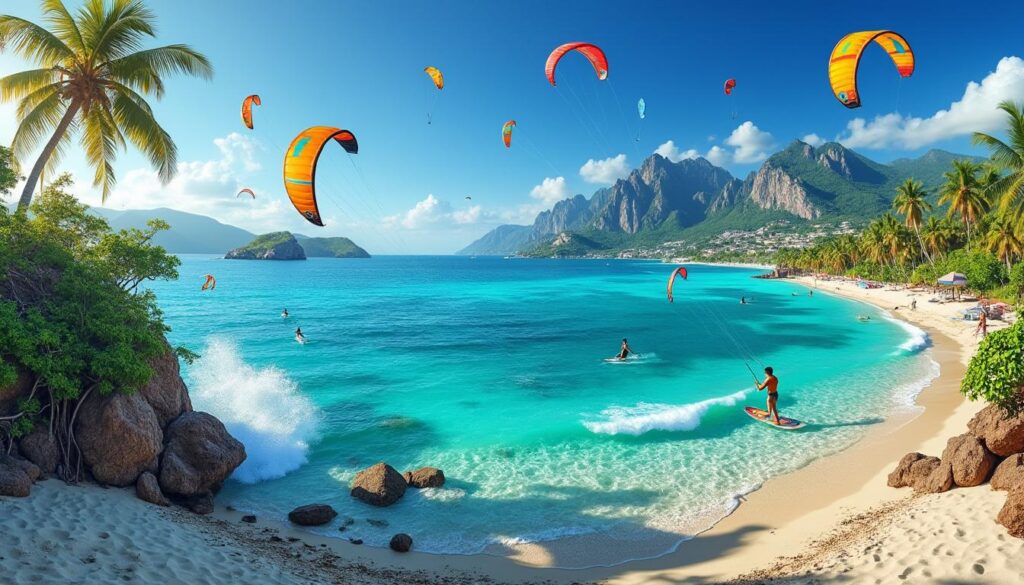
Between Agrigento and Ragusa, the south of Sicily is a stretch of coast where wind, light and sea meet directly, without filters. Here the sirocco burns the skin, the mistral clears the air and every bay can turn into the best kitesurf spot in Italy for a day. Those who come just to “enjoy the sea” often don’t see the potential, but anyone who dreams of hooking the chicken loop and launching into a water start immediately understands that this area is a true open-air laboratory. Dunes, deep beaches, currents to study, submerged reefs to respect: South Sicily is not a tamed playground, it’s a real training ground.
Those who want to learn kitesurfing or raise their level from simple upwind legs to unhooked tricks will find a complete path between Agrigento and Ragusa. Days with almost flat water ideal for the first tacks, afternoons with choppy chop perfect to work on board and kite control, downwind sunsets with gentler thermal winds. Local schools are structuring themselves better and better, following what happens in other hot zones of kitesurfing in Italy like kitesurf Salento or the better-known kitesurf spot in Puglia. Those who arrive prepared, with the right setup and a minimum wind culture, can put together sessions here that are worth an entire season.
- Wind: a mix of mistral, sirocco and thermals, with spots suitable both for flat water and medium-small waves.
- Spots: long coast between Agrigento and Ragusa, with wide beaches, wild stretches and some equipped areas.
- Level: from beginner kitesurfing to advanced riders, if you choose the spot well according to conditions.
- Seasons: spring and autumn for more consistent wind, summer for thermals and warm water.
- Style: freeride, first jumps, mellow waves and an excellent playground for those who want to progress safely.
Kitesurf South Sicily: reading the wind between Agrigento and Ragusa
To truly understand kitesurf South Sicily it’s not enough to look at a map with the names of the spots. Between Agrigento and Ragusa the protagonist is the wind, and the way it bounces off the hills, flows through the tuff canyons, accelerates over the coastal plains. Those who arrive thinking to find the same dynamics as the kitesurf Adriatic or the kitesurf Ionian are taken aback: here the gradients are different, the thermals work in a rougher way and the sirocco can switch from friend to foe in half a day.
Imagine Luca, an intermediate rider who took his first tacks around kitesurf Lecce and kitesurf Taranto, used to Salento winds that often shift but remain readable. He lands in South Sicily convinced that opening Windy is enough to find paradise. On the first day he launches with a 12-meter in a bay near Agrigento with a forecast of 18 knots from the mistral. On the beach it feels like a solid 20, but as soon as he gets out past the shore break, the wind drops and then spikes in gusts. Result: a few nervous legs, then an early return. The problem isn’t the spot but the wind reading.
The mistral, along this coast, tends to channel between the inland valleys. In some bays it arrives clean side-on, in others it’s distorted and creates turbulence that can be complicated for a beginner. The sirocco, instead, often brings a rough sea and humid air: the perceived power is different compared to the same intensity measured in knots in a drier context like many kitesurf spots in Puglia. For this reason, when preparing a kitesurf holiday session here, you need a double reading: that of the weather apps and that of the territory.
A trick many local riders use is to always compare two or three weather models and then check the actual direction on the beach at least half an hour before rigging. If you see the wind tending to turn side-off along the shore but remaining onshore a few hundred meters out, it’s not the right day for kitesurfing for beginners. Better to leave the water to more experienced riders, or move a few kilometers to a more open bay.
Another key aspect: summer thermals. On stable high-pressure days, South Sicily behaves similarly to certain stretches of the Salento. The morning is almost calm, the afternoon starts to breathe a breeze that, helped by the temperature difference between sea and land, can reach 15–18 knots, often side-on. Perfect for downsizing the kite, working on clean water starts and building confidence in bar handling.
For those coming from elsewhere and planning a kitesurf course, the advice is always the same: talk to a local kitesurf school, ask which directions work best on that specific stretch of coast and organize your day according to the wind tides, not just the holiday calendar. The wind here is not negotiated, it’s observed, studied and then ridden.
In the end, the key to South Sicily wind is this: whoever learns to read it between Agrigento and Ragusa returns home one gear higher at any other spot in the Mediterranean.
Mistral, sirocco and thermals: how to choose kite size
Many riders pick the wrong kite not because they don’t know the basic rule of knots, but because they don’t take into account wind quality. A sirocco loaded with sand and humidity at 20 knots often pulls more than a dry mistral at the same intensity. Also, the chop created by a crosswind increases the feeling of power on the board.
To avoid gross mistakes, a practical rule on this coast is to start with half a square meter smaller than what you would use in a spot with very laminar wind, especially if you are still learning kitesurfing. If you normally use a 12 at 20 knots, here consider a 10 straight away, at least for the first days. Better a few softer legs with a safety margin than an outing spent fighting the sail.
To give you a complete picture of gear choice, it can help to also look at how modern harnesses are designed: articles like this guide on Mystic harnesses for kitesurfing explain well why good lumbar support can make the difference when the wind hits and the gusts don’t forgive.
Main kitesurf spots between Agrigento and Ragusa: a concrete overview
Once you understand the logic of the wind, the next step is to choose the right spot between Agrigento and Ragusa. This is where the mix of beach, seabed, access and services comes into play. Some bays are perfect for those starting out, with ample launch areas and sandy bottoms. Others are more technical, perhaps with a more marked shore break or lateral currents that require good board control.
To orient yourself, a concise chart that puts together recommended level, ideal wind and the type of sea you can expect can be useful. It doesn’t replace a chat with a local, but it gives you an immediate idea of where you might want to point the van based on your ideal day.
| Area | Recommended level | Ideal wind | Type of sea |
|---|---|---|---|
| Agrigento coastline (general area) | Intermediate | Mistral side/side-on | Medium chop, small waves over sandy bottom |
| Between Gela and Scoglitti | Beginner–Intermediate | Summer thermals, mistral | Often flatter sea, wide beaches |
| Ragusa coast (Marina & surroundings) | Intermediate–Advanced | Sirocco, mistral | Medium-small waves, more energetic shore break |
The coastal area of Agrigento offers long stretches of sandy beach, often with not immediate access but precisely for this reason less crowded compared to more urbanized contexts. Those who already have good board control and water relaunch skills find here a good compromise between space and wind power. For kitesurfing for beginners, instead, it’s better to choose softer wind days, perhaps with afternoon thermals.
Between Gela and Scoglitti, the profile of the coast becomes slightly more regular, with wide beaches that in some ways recall certain zones of the kitesurf Adriatic. Here, with the right conditions, you can find spots ideal for the first rides in safety, always accompanied by an instructor. A well-organized kitesurf school can exploit these stretches of coast to create a practice area with lots of shallow water and easier exits.
Approaching Ragusa, the scene changes again. Some bays handle the sirocco very well, offering small fun waves to surf with a directional board. Those coming from surf or SUP can find the perfect mix here between wave culture and the pull of the kite. If you want to understand the differences between the various disciplines, content like this analysis between SUP and kitesurf helps choose the right toy based on the type of sea you find.
One important thing to understand is that there is no single “perfect Instagram spot” valid for everything. Each stretch of coast can be your best friend or your nightmare, depending on how the wind and waves turn. A mature rider knows how to change plans: if your plan A in Ragusa doesn’t work, plan B might be to move towards Agrigento or to the intermediate stretch, following the wind direction like a compass.
Those who learn to think this way, without fixating on a single place, bring home not only a great session, but a mentality of a true Mediterranean rider.
Comparison with other kitesurf spots in Italy
Comparing South Sicily with other iconic zones like kitesurf Salento, Lake Garda or the spots of the Lazio coast helps to understand the character of this area. If you take a look, for example, at the guide on kitesurfing on the Ostia coastline, you see how the urban context and services greatly influence the session there. Here between Agrigento and Ragusa, instead, it’s the wild dimension that sets the pace: fewer beach bars, more dunes and open spaces.
Compared to many kitesurf spots in Puglia, South Sicily tends to have slightly more disorderly wave motion when the sirocco is working, but it also offers more possibilities to find sheltered bays by playing with the coast’s orientation. It’s a place where freeride still has a raw flavor, perfect for those who want to disconnect from routine and focus on wind, board and sea.
Learn kitesurfing in South Sicily: paths for beginners and false myths
Those who hear about strong wind and wild coasts might think that kitesurf South Sicily is not suitable for complete beginners. In reality, if managed sensibly, this stretch between Agrigento and Ragusa can become an excellent gym for those who want to learn kitesurfing without ending up in an overcrowded spot. The fundamental condition is simple: choose days, times and spots carefully, guided by a serious kitesurf school.
Let’s take Luca again, the intermediate rider, and imagine instead his sister Sara, who has never worn a harness. They arrive together in South Sicily. Luca dreams of his first kiteloop, Sara just wants to manage a few meters of water start without panic. The school that welcomes them certainly wouldn’t send them to the same bay at the same time. While Luca is directed to a spot with 20 knots stable and good chop to jump, Sara begins her path in a more sheltered lagoon or in a stretch of sea with shallow water, moderate-sized kites and gentler thermal wind.
Three false myths worth debunking come into play here:
- “You always need strong wind to learn”: for the first lessons on bar control, body drag and getting started, 12–15 knots of clean wind are often ideal. Too much wind creates more mental tension than real progress.
- “Beginners must go out only when the sea is flat like a pool”: a slight chop quickly accustoms you to the reality of kitesurfing in Italy, where perfectly flat seas are not the norm. The important thing is to stay away from heavy shore breaks.
- “Watching a couple of videos is enough to go it alone”: one of the most dangerous things seen on the beach is the beginner attempting a self-launch with no support. A structured kitesurf course cuts months of blind attempts.
Serious schools in the area often work with small groups or semi-private lessons, alternating moments of wind and safety theory with progressive practical sessions. Those coming from northern Italy who already had a first taste on a lake or in spots like kitesurf Lake Maggiore find here the chance to consolidate the basics in salt water, with a scenario that changes day by day and forces you to stay clear-headed.
For a true kitesurf for beginners, the ideal path in South Sicily is structured like this: first days focused on kite control on land, body drag and relaunch management, then gradual steps towards first water starts with light wind, to reach the first real planing runs once safety has been internalized. Forcing stages only fills the head with fear.
Those who want to speed up the process can combine classic lessons with a kitesurf camp in Italy, where for a few days the only thought is wind, sea and physical recovery. You sleep near the spot, eat light, and talk only about gusts, sails and tricks. South Sicily lends itself well to this kind of total immersion, precisely because off the water the environment remains authentic and doesn’t distract with a thousand artificial attractions.
In the end, those who choose to learn kitesurfing between Agrigento and Ragusa don’t just come back with one more technical skill, but with a greater ability to read the sea. And that is worth gold at any Mediterranean spot.
Typical mistakes beginners make in South Sicily
Beginners’ mistakes are always the same, but here the context amplifies them. The most common is underestimating lateral currents: even with a sea that seems calm, a steady flow can carry the rider far from the starting point. For this reason, in the first sessions it is essential to always have an instructor in the water or a support craft within reach.
Another mistake is overestimating used equipment, perhaps borrowed from a friend. A too-old kite, without updated safety systems, in gusty wind risks turning a practice day into a story nobody wants to tell. Better a few days with modern gear, maybe tried through a kitesurf school, than weeks with an improvised setup.
Once these obstacles are overcome, South Sicily becomes a perfect playground for those who really want to move from “curious” to conscious rider status.
Equipment and set-up for South Sicily wind
Facing the South Sicily wind with the wrong equipment is like entering the water with a board without fins: technically you can do it, but you make your life extremely complicated. Between Agrigento and Ragusa the wind can go from light to nasty within a couple of hours, and the sea can transform from almost flat to disordered chop with half-meter waves. Having a versatile quiver is not a pro indulgence, it’s simply a form of respect for the sea.
For a medium-weight rider, a smart setup for this area often includes three kite sizes (for example 7–9–12) and two boards: an all-round twin-tip for freeride and, for those who like to experiment, a directional or a hydrofoil. The hydrofoil kitesurf, in particular, opens the door to sessions with lighter winds and relatively flat seas, completely redesigning days that would otherwise be labeled “no wind days.” To get an idea of how accessible foil is today, articles like the guides on how to learn hydrofoil kitesurf show that it is no longer an elite discipline.
The harness deserves a special mention: gusts here can be abrupt, and a poorly adjusted or uncomfortable support ruins posture over time and shortens sessions. Investing in a good model, studying technical reviews and comparing materials, is an act of care for your back. The same goes for the wetsuit: even though South Sicily is famous for warm water, a quality 3/2 or shorty makes a difference when the wind drops and you stay in the water longer than expected.
Those who often travel between kitesurf Salento, kitesurf spots in Puglia and South Sicily quickly learn to assemble and disassemble the quiver flexibly. There is no universal perfect kite: there is the right kite for that stretch of coast, at that hour, with that wind direction. Thinking this way means entering the sea with your brain on, not just with the desire to plane.
Board, kites and foil: how to choose based on the spot
In South Sicily the choice of board is fundamental. A twin-tip with a bit more surface helps when the wind is light or the sea is very rough, while a shorter, stiffer board responds better on strong wind days and tight waves. For those coming from related disciplines like wing foil or surf towed by the kite, it’s interesting to compare the different feelings: the reading of gusts changes completely. For those undecided between disciplines, guides like this comparison between wing foil and kitesurf clarify the pros and cons of each setup.
Regarding kites, it’s worth knowing at least broadly the philosophy of the main brands. Some models are more forgiving and tolerant of mistakes, ideal for kitesurfing beginners; others are nervous and precise, designed for those who already have total control and seek performance in jumps and kiteloops. Technical reviews and material tests, like those dedicated to historic kitesurf brands in Italy, help avoid buying blindly and choose the kite that will truly make you progress in this type of wind.
The key point is simple: don’t chase fashion, but a setup that speaks the same language as the wind between Agrigento and Ragusa.
Organize your kitesurf holidays between Agrigento and Ragusa
Arriving in South Sicily with your board under your arm and no precise plan can seem romantic, but it rarely leads to the best sessions. Between Agrigento and Ragusa, organizing your kitesurf holidays with a minimum method lets you make the most of every wind day. You don’t need a rigid tour-operator program, just a clear mental grid: when to travel, where to sleep, how to move between spots and whom to ask for updated info.
The ideal season to balance sea and wind often runs from late spring to early autumn, with interesting peaks also outside the classic periods if you’re not afraid of a slightly thicker wetsuit. Those coming from areas like kitesurf Lecce or Taranto will recognize similar dynamics: spring and autumn with more serious wind, summer with more thermals but also more people in the water and on the beach.
A smart approach is to structure the holiday in “wind windows”: 2–3 days based on a main weather forecast and a well-defined plan B within a maximum radius of an hour and a half by car. That way, if the predicted mistral weakens or shifts too much, you can change zone without wasting the day. The advantage of the coast between Agrigento and Ragusa is precisely this: many different spots relatively close to each other, with orientations that respond differently to the same conditions.
As for accommodation, choosing a base not too far from at least two or three strategic points allows you to stay flexible. Many riders opt for B&Bs or simple apartments, with space to lay out kites and wash the wetsuit. No extravagant resorts are needed: here the real luxury is coming out of the water at sunset, tired, with salty skin and the board still warm from the sun.
What to bring and how to plan your days
An essential checklist for your sessions between Agrigento and Ragusa includes:
- Two or three kites covering from 10 to 25 knots real, preferring versatile freeride models.
- An all-round twin-tip and, if you like to experiment, a wave board or a foil.
- Comfortable harness, spare bar or at least a repair kit for lines and depower.
- Wetsuit suitable for the season, UV rash guard, booties if you expect mixed bottoms.
- Safety kit: kite knife, impact vest if you are working on more aggressive tricks.
Typical days are built around wind peaks: quieter mornings dedicated to spot checks, stretching, small gear interventions; afternoons on the water, choosing whether to aim for relaxed freeride or more intense sessions. In the evening, instead of locking yourself in noisy places, listen to the sea: often it’s there that you really understand how much you learned that day.
Those who return every year to South Sicily, as happens for other Italian zones that have become “home” for many riders, end up treating Agrigento and Ragusa as a natural extension of their home spot. The wind changes, but the internal dynamic is always the same: observe, prepare, go out, respect.
What is the best time to kitesurf between Agrigento and Ragusa?
The most interesting seasons for kitesurfing in South Sicily generally run from late April to early June and from September to early November. In these months the wind is more frequent and consistent, with mistral and sirocco working well. In summer afternoon thermals often kick in, great for freeride and for beginners’ first steps, but beaches can be busier during central hours.
Is the area suitable for kitesurfing for beginners?
Yes, but only by carefully choosing spots and conditions. Some stretches between Gela, Scoglitti and some more sheltered bays toward Ragusa offer relatively shallow water and gentler wind, ideal for those starting out. It is essential, however, to rely on a local kitesurf school that knows the currents, obstacles and typical wind shifts of the area, rather than improvising alone.
What equipment is recommended for the wind in South Sicily?
For a medium-weight rider a quiver with 2–3 kites (around 7–9–12 m²), an all-round twin-tip and, for those wanting to expand possibilities, a wave board or a hydrofoil are recommended. A good harness, a wetsuit appropriate for the season and a complete safety kit (kite knife, reliable leash, possibly an impact vest) are essential, given that gusts can be sudden.
Is a car needed to get between the spots of Agrigento and Ragusa?
Having a car or van is almost essential. The spots are distributed along many kilometers of coast and often there are no convenient public connections to move with boards and kites. Having your own vehicle allows you to quickly change bays if the wind shifts, increasing the chances of finding the right spot at the right time.
Is it possible to kitesurf in South Sicily all year round?
You can theoretically go out all year round, but session frequency varies. In winter the wind can be very strong and the sea more challenging, suitable mainly for experienced riders well equipped with thick wetsuits. Spring and autumn remain the most balanced periods to combine reliable wind, manageable temperatures and ideal conditions both for those who want to progress and those seeking more technical sessions.