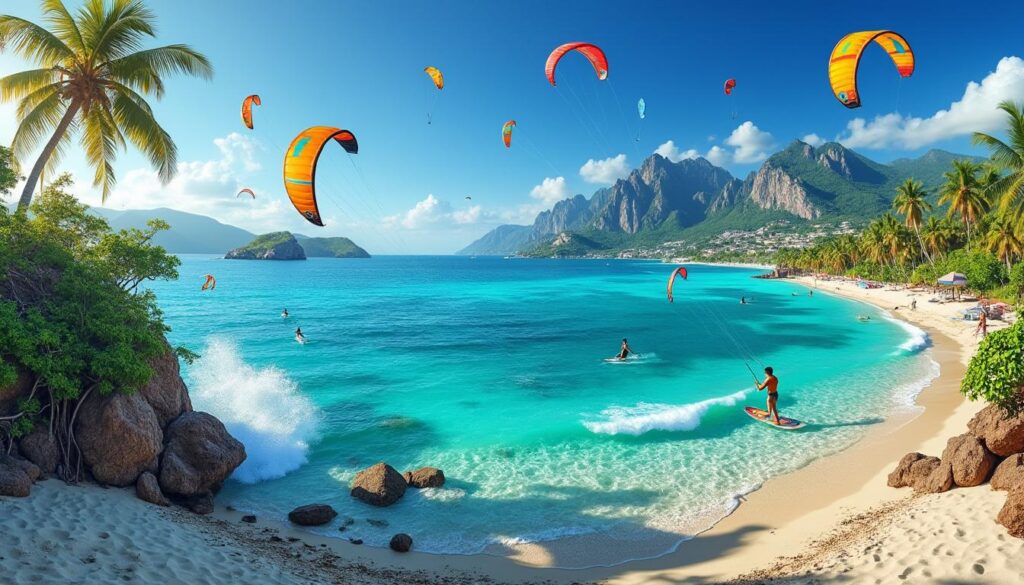
The wind comes in strong through the Strait of Gibraltar, the kites color the sky over the Atlantic, and on the beach languages, accents and different styles cross paths. Tarifa is considered by many the European capital of kitesurf, not so much because it offers the easiest conditions, but because here the kite is a true way of life. Between Levante pushing hard offshore and Poniente softer and cooler, those who come to Tarifa do it for one reason: to feel the kite tearing at the arms, to pump the adrenaline and return to shore with legs that tremble but a smile from ear to ear.
This little white town at the southern tip of Spain has become a reference point for those looking for powerful sessions, an international community and days that swing between online work, tapas and sunsets on the beach. It is not a “easy” place like some lakes or sheltered bays: the wind often arrives above 30 knots, the water temperature almost always requires a wetsuit, and in midsummer the crowd can become the real obstacle to your progression. But precisely for this reason Tarifa filters people out: those who stay, the wind teaches them to really understand it.
For a rider who already knows kitesurf Italy, from the kitesurf spots in Puglia to the northern lakes, Tarifa is the natural next step. Here you learn to handle the kite in variable conditions, to choose the right spot depending on Levante and Poniente, and to build a routine where each day is decided by watching the gusts, not the clock. Beginners who arrive leave transformed; intermediates begin to dream of maneuvers that once seemed out of reach. In this guide, Tarifa is put under the microscope with the practical eye of someone who lives every session as a real training: no glossy brochures, just wind, sand and smart choices.
In short
- Tarifa is the European capital of kite: wind almost all year round, international community, rider and digital nomad lifestyle.
- Levante and Poniente are the two key winds: the first strong and often offshore, the second more manageable and stable, perfect for progressing.
- It’s not a super easy spot for beginners, but those who learn here can truly kite anywhere, from the Adriatic to the Ionian.
- Different spots for different levels: from Valdevaqueros and Los Lances for everyone up to Balneario for those already pro.
- Tarifa is perfect for long stays: coworking, healthy living, lively nights and many activities when the wind drops.
Kitesurf Tarifa: why this “wind mecca” is different from all other spots
Tarifa is not just another spot to hang the kite in the sky. It is one of the few places in Europe where the wind blows practically all year and where, within a week, you can find yourself doing a session with 12 knots on a 12-meter kite and, two days later, holding the bar tight under gusts over 35 knots of Levante. This variability is exactly what makes Tarifa a perfect laboratory for those who really want to grow in kitesurf, beyond the perfect photos on social media.
The atmosphere is typical of border towns: a mix of Mediterranean cultures, Moroccan influences an hour away by ferry, surf vibes and an undercurrent of digital nomads who set their day according to the bulletin. Bars with tables full of laptops in the morning, the same faces more tanned in the evening, with sand still stuck to their feet. In this picture, kitesurf is not the “plus” of the holiday: it is the main reason people come, and everything else revolves around the sessions.
Looking at Tarifa with the eyes of someone who already knows kitesurf Salento, kitesurf Adriatic or kitesurf Ionian, the difference is clear: here you don’t have two seas like in Puglia to escape a weather system, but a single large Atlantic playground that changes face depending on wind direction. No one promises flat water every day, but every change of conditions pushes you to improve board control, bar sensitivity and wave reading.
Those who arrive thinking they will find the “perfect spot” are taken aback: between summer crowds, the almost constant need for a wetsuit and long stretches of beach to reach by car, Tarifa requires organization. But the local energy makes up for everything. On the beach you meet people who quit the office in Milan, French families with kids learning to body drag, German riders who work remotely in the morning and test new foils at sunset. People talk about work, but always between gusts.
A typical example: take Marco, an intermediate rider who usually rides at an kitesurf spot in Puglia and feels comfortable with a steady 18 knots. Arriving in Tarifa in May, he discovers in two weeks what it really means to “control the kite”: one day strong gusty Levante where he has to learn to reduce power with small bar movements; the next, lighter Poniente with annoying chop that forces him to work on his knees and board handling. He returns home with a technical baggage that in a too “easy” spot would have taken months to build.
For those planning itinerant kitesurf holidays, Tarifa fits well with other hubs of kitesurf Italy. An ideal summer can alternate Adriatic storms with days in Tarifa to train control in strong wind, then return to Salento or Calabria more rested but with completely different confidence. The key is understanding that Tarifa is not the place for three days of postcard photos and off you go: it gives its best when seasons change, crowds thin out and the wind remains the protagonist.
The point is simple: if you’re looking for a place that makes you grow as a rider and at the same time offers a beach life, flexible work and nights full of music, Tarifa plays in its own league.
Pros and cons of kitesurfing in Tarifa: how to choose if it’s really for you
Every spot has its character, and Tarifa’s does not forgive improvisation. The advantages are obvious: relaxed, surf-style atmosphere, restaurants and bars for every taste, prices still reasonable outside the high season, and above all a variety of spots that allows you to almost always find something to ride. Between Valdevaqueros, Los Lances, Rio Jara and nearby spots, you can go from flat water to waves, from light wind to 40-knot conditions, often within the same weekend.
There is also the other side of the coin. To really move between spots you need a car: the stretches of coast are wide, parking is not always close to the kite area, and loading-unloading gear becomes part of the routine. In peak summer, from July to early September, space in the water shrinks to a minimum: boards speeding everywhere, beginners in the middle of routes, and that constant “traffic” feeling that requires eyes always open. Also, unless you are here in the warmest months, a wetsuit is practically mandatory: spring, autumn and winter require a good 4/3, and those who don’t like the cold often head straight to the Ionian or southern Ionian.
Summing up honestly as a rider:
- Perfect if you want to grow technically, like strong wind and are willing to organize logistics.
- Less suitable if you’re looking for a calm, warm and super easy spot for your very first water starts in August.
Understanding this before booking saves you disappointment and allows you to use Tarifa for what it really is: a progression accelerator, not a “soft” playground.
Winds, seasons and wetsuit choice: reading Tarifa like an experienced rider
The heart of kitesurf Tarifa is the wind. Without understanding the difference between Levante and Poniente, you risk arriving at the spot with the wrong sail or, worse, with a level not adequate for the conditions. Here the wind is not a technical detail, it’s the rule that makes you decide whether to go out, where and with what setup.
The most “productive” period runs, on average, from spring to early autumn. From April to October you have the highest probability of finding sessions with usable wind, although some weeks can alternate full-power days with flat calm breaks. Pay attention though to the late June–early September window: the wind is there, but so is half of Europe in the water. If you want to learn, it’s better to aim for May–June or September–October, when conditions remain great but space increases.
Water temperatures are another often underestimated point. Tarifa’s coast, facing the Atlantic, is cooler compared to the Mediterranean. In spring, autumn and winter most riders choose a 4/3 full wetsuit, some even a 5/4 for colder Poniente days. In summer you can go down to a shorty or even a lycra on some warm days, but many still prefer a light 3/2 to protect from the wind, which dries and cools you in a few minutes. Those used to the warmth of the Ionian or the Tyrrhenian often end up surprised.
Kite sizes require a smart strategy. With Levante you can find yourself in a range from 15 to over 40 knots: having a 7 and a 9 in your bag is almost mandatory for an average rider, while a 5 becomes the secret weapon on the most extreme days. With Poniente, you more often work between 10 and 25 knots; in this case, a 10–12 covers most sessions for someone weighing between 70 and 80 kg. Bringing “every size” is not paranoia: here it really makes the difference between watching from shore and laughing in the water.
If you’re wondering how much the sea can change, the answer is: a lot. Some days you find almost flat water, perfect for freestyle and for testing a kitesurfing foil (if you want to dive deeper into the technique, also check this guide on kitesurfing foil and technique), other days the broken chop forces you to work on absorption and edging. During winter, swells turn some spots into playgrounds for wave lovers, with sections that recall top days on the kitesurf Ionian or the Tyrrhenian Calabria.
To pick the good days, many riders use a combination of weather apps and direct observation. Local wind meters are not always perfect: position, wind direction and nearby obstacles can show fewer knots than the real ones out on the spot. The trick is simple: on the first days, get into the habit of comparing what you see on the phone with what you feel holding the kite. In short time you build your mental “database” and start recognizing when an 18-knot forecast actually hides a full 25 at sea.
In the end, those who leave Tarifa with a real leap in quality are not those who got the most gusts, but those who learned to read the wind before even inflating the kite.
Quick table: seasons, wind and recommended gear in Tarifa
To help you plan better, here’s a concise overview of the most frequent conditions in Tarifa during the year and the typical gear used by intermediate riders.
| Period | Prevailing wind | Typical knot range | Type of wetsuit | Recommended kites (70–80 kg) |
|---|---|---|---|---|
| March – May | Mix of Levante / Poniente | 15 – 30+ | 4/3 full | 7 m², 9 m², 12 m² |
| June – Early September | Mainly Poniente | 12 – 25 | Shorty / 3/2 | 9 m², 10–12 m² |
| September – November | Strong return of Levante | 18 – 35+ | 4/3 full | 5–7 m², 9 m² |
| December – February | Variable, often choppy sea | 15 – 30 | 4/3 or 5/4 | 7 m², 9 m², 12 m² |
This table does not replace daily weather forecasts, but it gives you a clear idea of what to pack if you’re planning a longer stay in Tarifa, especially if you’re coming from milder Mediterranean environments like Salento or Tuscany.
The best kitesurf spots in Tarifa: from Valdevaqueros to Balneario, how to really orient yourself
One of the things that makes Tarifa unique is the density of spots along a few kilometers of coast. It’s not enough to know “I’m going to Tarifa”: you must understand where to get in the water depending on the wind, your level and the crowd. Those who choose the spot well find themselves surfing relaxed; those who get it wrong spend the session coming back on foot against the wind.
Valdevaqueros is the name you will hear most often. Imagine a large sandy bay, framed by dunes and green hills, with beach bars blasting soft music and tables full of kiters watching the kites in the air. With Levante, the water tends to be calmer and a turquoise almost Caribbean, but the wind can become extremely gusty near the shore. In practice: the first meters are a struggle to get out of the disturbed zone, then outside you find cleaner, more reliable wind. For this reason, those already comfortable with launching and sailing upwind have fun; those just beyond beginner level must stay very focused.
A few kilometers away, Los Lances and Rio Jara offer endless stretches of sand and conditions suitable for almost all levels, especially with Poniente. Schools love these areas precisely because they allow beginners to make a few body drag mistakes without immediately finding themselves in the middle of the crowd. In some seasons, an internal lagoon forms near Rio Jara, creating a flat water mirror perfect for trying basic tricks or improving edge control. Here though be aware of local rules and summer limitations, often in place to separate kiters, swimmers and windsurfing.
For those looking for waves or more challenging conditions, spots like Arte Vida or Bolonia come into play depending on wind direction and swells. Bolonia, with its backdrop of Roman ruins and the big dune, is a spot that works with both Levante and Poniente, although in summer temporary bans are often present. In winter it can offer water faces ideal for those who love to jump on the wave and play with bottom-turn timing. Arte Vida, on the other hand, is a more technical choice: rocks near the shore, current and waves that already require good board handling.
Balneario deserves a separate discussion: the “in-town” spot in front of Tarifa. The rule here is clear: high level or you stay watching. The water is deep immediately, the wind accelerates between buildings and there are no rescue boats: those who enter know how to handle the kite and safety well. It’s not the place to “try” a new trick for the first time, but rather where to show it when it’s already solid.
To choose each day where to go, many riders adopt a simple but effective routine:
- Check wind direction and intensity on 2–3 different apps.
- Check webcams and wind meters of the main areas (Valdevaqueros, Los Lances).
- Talk to those returning from a morning session to understand how the wind is working.
It’s a method that, with very little practice, allows you to turn all of Tarifa’s coast into a single “menu” from which to choose the right spot for your level, instead of suffering the wind at random.
Alternative spots around Tarifa: when moving makes the difference
Not every day is “perfect Tarifa”. Sometimes Levante gets so strong that it makes certain spots excessive for most riders, other times Poniente is present but light, and then it’s worth moving a few dozen kilometers. This is where secondary spots come into play, often less crowded and with slightly softer conditions.
Palmones, near the Bay of Algeciras, is one of these. When Levante is really hard in Tarifa, in Palmones it arrives more filtered. For this reason it is widely used by schools to continue courses on days when most riders in town would stay ashore. The water is more protected, the upwind less demanding, and a beginner who has already made the first launches can enjoy full sessions instead of fighting to keep the kite in the air.
Other spots like Getares, Los Caños de Meca or Sotogrande also work with strong Levante but require experience and attention to currents and shore break. In summer, many of these have kitesurf restrictions to protect swimmers: respecting signage and regulations is essential to avoid conflicts with locals and authorities. The advantage is that in low season they often offer cleaner sea and less crowded waters than central Tarifa.
This “mobile” approach to spot choice is exactly the same reasoning a rider applies in Italy when deciding whether to go kitesurfing in kitesurf Lecce, kitesurf Taranto or move to the Tyrrhenian coast. Those who learn this way of thinking in Tarifa – not getting fixated on a single spot, but following the best wind – return home much more flexible even when choosing between the Adriatic and Ionian, or between Tuscany and northern Italy.
In the end, Tarifa teaches you one simple thing: you can’t control the wind, but you can decide how to move to be in the right place at the right time.
Learning kitesurf in Tarifa: what to expect between courses, rescues and real progression
Many hear about Tarifa and immediately think of beginner courses at attractive prices. It’s true: compared to various European kitesurf holiday destinations, lessons here can be competitive. But there’s an important truth: Tarifa is not the easiest spot to learn kitesurf from scratch, especially in high season or on strong Levante days.
For those looking for kitesurf for beginners, the best period is between spring and autumn, outside the peak crowd weeks. Courses usually start with basic theory on wind, kite setup, safety and first body drag sessions in the water. On Poniente days, the wind is often more stable and manageable, ideal for first water starts. This is where instructors’ experience comes in: they know when to change spot, when to switch from a larger to a smaller kite and when it’s better to postpone the session because the wind is simply out of scale for a novice.
An element not to be underestimated is the boat rescue system present in several spots with Levante. Offshore wind easily carries kiters out to sea, especially those still learning upwind. Many schools include a “rescue card” in the package or sell it separately: essentially, if you’re dragged too far out, a boat intervenes and brings you back. It’s not an excuse to launch recklessly, but an intelligent safety net in an environment that can become demanding quickly.
For intermediate riders, Tarifa is instead a pure accelerator of progression. One well-managed week here equals a month of sporadic outings in a calm Mediterranean spot. It’s the place where you can work on:
- power control in gusts;
- smooth transitions in strong wind;
- first jumps with controlled landings;
- beginning foil work, when conditions allow.
Many Tarifa schools now have an approach similar to the best Italian realities. If you’re starting your path, it’s worth comparing programs with those dedicated to the kitesurf course in Italy, for example following resources like the complete beginner’s guide to kitesurf. Arriving in Tarifa with a solid theoretical base and a few hours of practice in easier spots – be it a kitesurf spot in Puglia, the Ionian Calabria or the Tuscan coast – allows you to make the most of the local wind’s power without having to manage everything from zero.
One aspect often appreciated by students is the international dimension of the schools: instructors who speak English, French, Italian and German, mixed groups, exchange of tips and contacts. You meet people you might see later on the kitesurf Adriatic or another Mediterranean spot, creating that network of riders that updates you on wind, swell and gear news. Tarifa thus becomes not only a place where you learn, but a hub in your personal kite map.
In the end, the real question is: is Tarifa the ideal starting point? It depends. If strong wind scares you, better to start in a milder spot, like many kitesurf Salento or Tuscan spots, and then come here to consolidate. If instead you feel ready to measure yourself against a dynamic environment, with the help of a good school Tarifa can become the step that forever changes your relationship with the kite.
Mistake no.1 beginners make in Tarifa: choosing the wrong period and spot
Many newbies arrive here in mid-August, book three days of lessons and think they will go out independently at the end of the weekend. Reality is different. Between heat, full beaches, changing wind and limited space in school areas, days become a race against time. The result? Few hours of quality water time and lots of frustration.
If you really want to make the most of Tarifa to learn, organize your stay around these three principles:
- avoid the high peak season if you’re a beginner;
- be flexible on lesson dates based on the wind, not fixed only to the calendar;
- rely on a school that moves you between spots instead of staying anchored to the same stretch of beach.
With these three simple rules, Tarifa stops being “too much” and becomes your advanced training ground, ready to launch you toward increasingly technical spots, in Spain as in Italy.
Living Tarifa between kitesurf, nightlife and remote work: the lifestyle that attracts riders from all over Europe
Once you pack away the kite and wash the wetsuit, Tarifa does not switch off. This is where the town differs from many other European spots: out of the water, there is a full life made of food, music, coworking and activities that match a windy day. For those thinking of a long stay, perhaps as a remote worker, the overall package becomes a very strong draw.
The old town, with its white alleys and inner courtyards, is full of bars that alternate serious breakfasts – cappuccinos, bowls, protein dishes – and evenings based on craft beers, local wine and tapas to share at the table. Cafés and restaurants along the road to the beach quickly become reference points: the place where you have breakfast after the morning session, where you stop for lunch with a half-dry wetsuit, the place where you end up losing track of time watching a pro kitesurf video shot right at Balneario.
For those who work online, Tarifa offers a growing network of coworking and shared spaces. Facilities born specifically for those who alternate calls and sessions, with stable connections, phone booths and flexible formulas by the hour or day. There are even colivings, shared houses where you find yourself sharing living rooms and kitchens with entrepreneurs, creatives and athletes who build their week between Wi‑Fi and wind forecasts. It’s an environment that closely resembles some emerging realities in the kitesurf Northern Italy, but with an extra gear: here the wind is the daily conductor.
When the wind drops, Tarifa never leaves you short on options. Surfing Atlantic leftovers, dawn or sunset rooftop yoga, climbing, mountain bike trails around the town, whale watching in the Strait in the right seasons. For those wanting to maintain good athletic levels, there are gyms with functional training, crossfit and specific shoulder and core work, perfect to prevent kite injuries.
A typical list of “no wind” activities for a week in Tarifa might include:
- surf lessons at one of the nearby spots with swell;
- a regenerating yoga session after several days of strong wind;
- a day trip to Vejer de la Frontera or Cadiz;
- fast ferry to Tangier and return in the evening, with feet already ready for the sand the next day;
- tapas night in the center and a final walk on the walls with a view of Morocco’s lights.
It’s a rhythm that alternates like a good session: intense phases in the water, recovery moments, space for the mind. For many Italian riders used to weekend touch-and-go trips to a lake or some kitesurf spot in Puglia, Tarifa represents the first truly “kite-centric” life experience: you stop fitting the kite between commitments, and start organizing commitments around the wind.
Budget, accommodation and daily logistics: Tarifa beyond the beach
Living in Tarifa for a few weeks or months also means dealing with budget, lodging and transport. Compared to many European metropolises or super touristy locations, costs can still be reasonable, especially in low and mid season. Apartments are found between the center and slightly outer areas, often with the possibility of a small garage or storage to leave kite gear ready to go.
For those who move frequently between spots, a car is almost mandatory. Renting directly from Malaga or Gibraltar airport remains the most convenient solution, watching out for rates that in recent years have fluctuated considerably. Some prefer to combine buses and car sharing, but the truth is that with boards, kites and harness, the flexibility of a car makes days much easier.
On the shopping front, the town offers supermarkets of various sizes, small organic shops and even bakeries dedicated to specific needs like gluten free. A classic routine for many riders is to do a big grocery shop on arrival, then top up with fresh fruit and vegetables during the week. This way you can alternate home-cooked dinners with fish and tapas outings, without draining the budget in the first three days.
In short, Tarifa is best lived when you stop treating it as just an “escape” and start treating it for what it is: a place where you can set up a real rider life, with everything you need to train, work and breathe wind even away from the water.
Tarifa and the comparison with kitesurf Italy: how to integrate this “mecca” into your kite travels
Those who know kitesurf Italy well and have traveled between Puglia, Calabria, Tuscany and the north know that our country’s strength is variety: different seas, different coast orientations, microclimates that allow you to find wind almost always by moving a few hours. Tarifa adds a different tile to this personal geography: it’s not “another spot”, it’s a whole chapter dedicated to strong wind, an international community and a remote-work lifestyle.
Think of an ideal season for an Italian rider. Spring in Salento, with Salento wind channeling between the Adriatic and Ionian and the first serious thermals; early summer with a mission to a different Italian kite destination, maybe trying Tuscany or Sicily; then a block of two–three weeks between late September and October in Tarifa, when Levante starts to make itself heard again but the beaches begin to empty. You return home with a technical baggage that will be noticeable in every future outing at your home spot.
From the gear and technique point of view, Tarifa “forces” you to take stock. If you’ve invested in recent years in gear for softer spots – big kites, voluminous boards, light wetsuits – here you quickly see where you have gaps. Maybe you realize you’re missing a 7 to handle the more blown-out days, or that a slightly smaller board would give more control in Atlantic chop. It’s the same kind of reflection many make after testing their setup moving from open sea to a lagoon, or after competing in events like the Italian kitesurf championship.
Tarifa also becomes a mental proving ground. After a few days of strong wind, you understand where your realistic limits are, how much margin you still have in terms of fear management and safety. It’s a test that, once passed, makes many conditions that once seemed “too much” feel lighter. Returning then to your usual spots – be it a kitesurf spot in Puglia, the Calabrian coast or Lake Garda – with this inner confidence completely changes the way you enter the water.
The most interesting thing is that the relationship between Tarifa and Italy is not one-way. Many Spanish and northern European riders begin to look with interest at our spots, especially kitesurf Salento and the Ionian and Adriatic coasts, precisely because they offer complementary conditions: warmer seas, variety of waves and flat water a few kilometers away, generous summer thermal wind, and a kite culture that has grown a lot in recent years. For those who move between these worlds, Tarifa is the “strong gym”, Italy the “complete playground”.
In the end, a modern rider’s real strength is not choosing one spot and staying there forever, but knowing how to combine different places into a single wind story. In this story, Tarifa occupies the role of the European capital of kite: a place to return periodically to measure your skills again, update your level and leave with even more hunger for water.
When is the best time to kitesurf in Tarifa?
The most effective period for kitesurfing in Tarifa generally runs from April to October. In these months you find the best combination of Levante and Poniente, with a high probability of usable wind almost every week. If you’re a beginner, it’s advisable to avoid the peak crowd between late June and early September and aim for May–June or September–October, when there’s more space in the water and schools can manage lessons better.
Is Tarifa suitable for beginners who want to learn kitesurfing?
Tarifa can work for motivated beginners, but it’s not the easiest spot to start. The wind can be strong and gusty, especially with Levante, and in high season the crowd makes everything more complex. Ideally, arrive with a minimum theoretical base or a few hours of practice in milder spots, like many spots in Puglia or Tuscany, and choose less crowded periods. Relying on a good school that can change spot according to conditions is fundamental.
What equipment is needed to kitesurf in Tarifa?
To make the most of Tarifa it’s useful to have several kite sizes, especially if you expect a wide wind range: for a rider around 70–80 kg, a 7, a 9 and a 12 m² cover most situations between strong Levante and lighter Poniente. As for wetsuits, a 4/3 full is recommended for spring, autumn and winter, while in summer you can go down to a shorty or a light 3/2. Consider also purchasing a rescue card if you plan to go out often with offshore Levante.
Is a car necessary to move between Tarifa spots?
A car is not mandatory, but it makes the experience much easier. Most spots are spread along several kilometers of coast, and transporting full gear on buses or car shares can become complicated, especially in high season. With a rental car you can choose the best spot each day based on the wind and move quickly if conditions change.
How can I combine a trip to Tarifa with the best kitesurf spots in Italy?
A great strategy is to use Tarifa as an “intense” stop within a broader season. You can train in spring or early summer in Italy, exploring spots like Salento, Calabria, Tuscany or northern Italy, then plan two–three weeks in Tarifa between late September and October to work on strong wind and variable conditions. Resources like guides dedicated to kitesurf in Italy help you create an itinerary that combines the best of both worlds: Mediterranean variety and Atlantic power.