Those who want a complete view of technique, body positions and progressive maneuvers can deepen with the guide on technique and maneuvers in kitesurfing foil, where each phase is linked to concrete exercises to try in the next session.
When you can fly for 100 meters in control, with regular tacks on both tacks, it’s the sign that it’s time to think about the next chapter: choosing spots and conditions that enhance your new way of being on the water.
Spots for hydrofoil kitesurf in Italy and Salento: where and when to fly
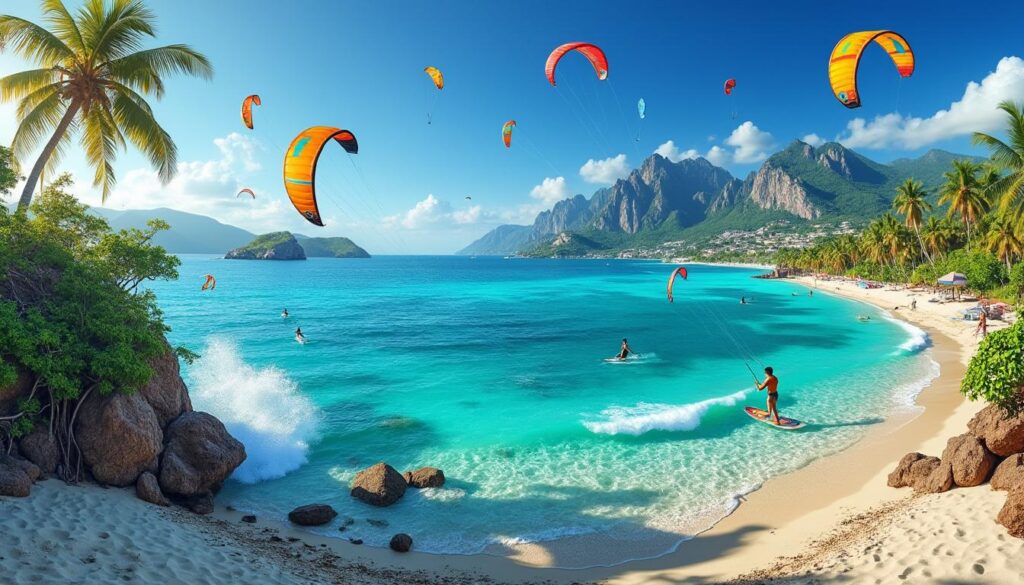
The hydrofoil changes the way you read a kitesurf Italy map. If before your eye only ran to icons of waves and strong winds, now sheltered gulfs, lagoons and stretches of coast where the thermal works precisely begin to shine. Salento, with its double face kitesurf Adriatic and kitesurf Ionian, is one of the clearest examples of this revolution.
On the Ionian side, in the warm months, the afternoon thermal often gives 10–15 stable knots and almost flat sea: pure gold for the foil. When twin-tip riders start complaining because “the 9 no longer holds”, those with a hydrofoil pump the lines, go out with the 12 freeride and enjoy two hours of total silence a few centimeters from the water. On the Adriatic side, instead, medium Mistral days with long waves open the foil-wave scenario, where you no longer just look for speed but the right line to surf soft swells far from the shore.
Salento, Puglia and the best foil-friendly spots
Among kitesurf Puglia spots, some lend themselves naturally to hydrofoil. Areas with sandy bottoms that slope regularly, without sudden shoals, are perfect to stay relaxed even when the mast works high. In some stretches of coast near kitesurf Lecce, the combination of turquoise water, clean side-on wind and downwind space makes it simple to set long tacks in total safety.
On the kitesurf Taranto side, several sheltered bays offer excellent conditions when the north wind channels and the sea stays orderly. These are spots where the foil becomes almost a touring board: you go out, sail for kilometers without stress, stop offshore to look at the coastline profile and then return working on clean points of sail. On these days, the boundary between a technical session and a “flying stroll” is very thin.
But Salento is not the only promised land. In Liguria and Tuscany there are bays where the afternoon thermal pushes little but well, ideal for those who want to combine sea and city. In Sardinia, some lagoons sheltered from the open sea are perfect laboratories for those taking their first steps with a short mast. And in the North, lakes with morning and evening thermal winds have become reference points for a whole generation of foilers.
Spot selection: practical criteria for foil riders
Regardless of the region, a foil-friendly spot usually has some common characteristics:
- Sufficient depth: the water must exceed the length of your mast with a safety margin to avoid bottom touches while flying.
- Clean seabed: sand or uniform mud are the foil’s best friends; isolated rocks and reef outcrops are alarm bells.
- Regular wind: violent gusts and sudden holes make it difficult to maintain flight; clean thermals or well-established synoptic winds are better.
- Downwind space: you always need a wide corridor free of obstacles (buoys, rocks, bathers, anchored boats).
For those who also dream of trips abroad or to other parts of the Mediterranean, it makes sense to check reports on destinations like kitesurf in Cape Verde, where hydrofoil coexists with wave and twin-tip in one of the most famous oceanic playgrounds among Italian riders.
Good planning of spots makes the foil what it should be: an amplifier of freedom, not an additional source of logistical stress and unnecessary risks.
Wind, safety and advanced progression in kitefoil
The foil gives freedom, but only to those who treat wind and safety with absolute respect. Being able to go out with 10 knots does not mean “always and anyway”, especially when you begin to sail far from the coast. The ideal range for most riders in hydrofoil kitesurf lies between 10 and 18 knots: below 7–8 knots the kite struggles to stay aloft, above 20 knots every bar mistake turns into a lash.
The wind direction relative to the coast is the first variable to check. On-shore and side-on are the foilist’s best allies: in case of problems, board and rider tend to return naturally toward the shore. Pure side can be fine with a good downwind space margin. Side-off and offshore, however, are conditions to avoid without boat support, because drifting offshore on a foil is surprisingly rapid.
Apparent wind, speed and kite management
One of the surprises of kitefoil is the high average speed. Even with moderate wind, the combination of sliding on the wing and little board resistance generates a strong apparent wind. It’s the same sensation as when you pedal fast on a bike on a calm day and still feel air in your face: the foil reproduces this phenomenon on the water.
In practice, a 15-knot gust that seems harmless from the beach, on the water at 25 km/h on a foil, can turn into a significant power hit if the sail is too large or poorly depowered. For this reason many riders prefer to enter light, with a kite 2–3 meters smaller than they would use on a twin-tip in the same wind, and work with the depower almost always engaged. When in doubt, on the foil it is almost always better to be slightly underpowered than overpowered.
Right-of-way rules and safety space in hydrofoil
All the classic kitesurf rules remain valid: starboard tack has priority, kite high for the windward rider, low for the leeward rider, pay attention to windsurfers’ and sailing boats’ trajectories. With the foil, however, it is wise to add an extra margin, because a rider in flight has more sudden direction changes and covers more meters in less time.
Keep at least two line lengths distance from other kites, avoid aggressive maneuvers near the shore and clearly signal any long downwind runs as part of a spot etiquette that makes everyone more relaxed, not just foilers. On very crowded days, perhaps in high summer, it may make sense to focus on technical exercises away from the main group or move the session to early morning or sunset.
From basics to advanced riding: how to keep growing
Once you have conquered stable flight on both tacks, the most fun phase of hydrofoil kitesurf begins: infinite progression. Typical steps are:
- Speed control: learn to lower the board to slow down, using body and depower instead of pulling only the bar.
- Foiled jibes: first with the board touching the water again, then in continuous flight, working on smooth torso and shoulder rotation.
- Carving and waves: use the foil as a surfboard, following swell or even just long chop, especially on kitesurf Ionian days with soft waves.
- Tricks and freestyle: for those with a solid base, 360s, downloop carving and creative strapless maneuvers begin.
Many riders choose to organize periods of kitesurf holiday in foil-friendly spots – from Salento to the major islands – alternating twin-tip, surfboard and hydrofoil in the same week. It’s one of the most effective ways to keep the body active, avoid overuse injuries in a single discipline and experience the wind in all its shades, without lost days.
The common thread always remains the same: learn to read the wind precisely. Once the foil becomes natural under your feet, the sea – Adriatic, Ionian or any other coast – stops being just a backdrop and finally becomes your full playground.
How long does it take to learn hydrofoil kitesurf if I already know how to use a twin-tip?
If you sail confidently on a twin-tip – steady upwind, water start without thinking and good kite control even in gusts – many riders begin to make their first controlled flights in 3–5 sessions guided by an instructor. To reach long tacks in flight on both tacks, with a relaxed feeling and control, generally between 8 and 15 outings are needed, depending on consistency, wind conditions and the quality of the equipment used.
Is hydrofoil kitesurf suitable for absolute beginners?
No. The foil is not intended for those who have never kitesurfed. First you must learn to manage the kite, safety rules, body drag, the water start and basic navigation with a twin-tip. Only when these elements become automatic does it make sense to add the complexity of the mast and flying above the water, to avoid risky situations and unnecessary frustration.
What kite size should I use for foil compared to twin-tip?
In general, with the foil you can use a sail 2–3 meters smaller than you would use on a twin-tip in the same wind conditions, or keep the same size but sail with less power thanks to large depower. Much depends on your weight, the kite model and the size of the foil wing. When learning, it is always better to enter the water slightly underpowered rather than too powered.
Are helmet and impact vest really necessary for kitefoil?
Yes, they are strongly recommended. In kitefoil falls occur near a rigid mast and a board with marked edges, so helmet and impact vest significantly reduce the risk of head and torso injuries. In several Italian spots, especially in specialized schools, instructors do not accept students in foil courses without these two basic protections.
Can I use the hydrofoil with rough sea and waves?
Yes, but it is an advanced step. Learning with relatively flat water and regular wind makes it much easier to control the foil’s pitch. Once you find stability and confidence, moving to long, orderly waves – like certain Mistral days on the Adriatic side or swell on the Ionian – transforms the foil into a true surfboard, with powerful sensations. To start, however, it is better to stay on calm spots and manageable conditions.
Those who want a complete view of technique, body positions and progressive maneuvers can deepen with the guide on technique and maneuvers in kitesurfing foil, where each phase is linked to concrete exercises to try in the next session.
When you can fly for 100 meters in control, with regular tacks on both tacks, it’s the sign that it’s time to think about the next chapter: choosing spots and conditions that enhance your new way of being on the water.
Spots for hydrofoil kitesurf in Italy and Salento: where and when to fly
The hydrofoil changes the way you read a kitesurf Italy map. If before your eye only ran to icons of waves and strong winds, now sheltered gulfs, lagoons and stretches of coast where the thermal works precisely begin to shine. Salento, with its double face kitesurf Adriatic and kitesurf Ionian, is one of the clearest examples of this revolution.
On the Ionian side, in the warm months, the afternoon thermal often gives 10–15 stable knots and almost flat sea: pure gold for the foil. When twin-tip riders start complaining because “the 9 no longer holds”, those with a hydrofoil pump the lines, go out with the 12 freeride and enjoy two hours of total silence a few centimeters from the water. On the Adriatic side, instead, medium Mistral days with long waves open the foil-wave scenario, where you no longer just look for speed but the right line to surf soft swells far from the shore.
Salento, Puglia and the best foil-friendly spots
Among kitesurf Puglia spots, some lend themselves naturally to hydrofoil. Areas with sandy bottoms that slope regularly, without sudden shoals, are perfect to stay relaxed even when the mast works high. In some stretches of coast near kitesurf Lecce, the combination of turquoise water, clean side-on wind and downwind space makes it simple to set long tacks in total safety.
On the kitesurf Taranto side, several sheltered bays offer excellent conditions when the north wind channels and the sea stays orderly. These are spots where the foil becomes almost a touring board: you go out, sail for kilometers without stress, stop offshore to look at the coastline profile and then return working on clean points of sail. On these days, the boundary between a technical session and a “flying stroll” is very thin.
But Salento is not the only promised land. In Liguria and Tuscany there are bays where the afternoon thermal pushes little but well, ideal for those who want to combine sea and city. In Sardinia, some lagoons sheltered from the open sea are perfect laboratories for those taking their first steps with a short mast. And in the North, lakes with morning and evening thermal winds have become reference points for a whole generation of foilers.
Spot selection: practical criteria for foil riders
Regardless of the region, a foil-friendly spot usually has some common characteristics:
- Sufficient depth: the water must exceed the length of your mast with a safety margin to avoid bottom touches while flying.
- Clean seabed: sand or uniform mud are the foil’s best friends; isolated rocks and reef outcrops are alarm bells.
- Regular wind: violent gusts and sudden holes make it difficult to maintain flight; clean thermals or well-established synoptic winds are better.
- Downwind space: you always need a wide corridor free of obstacles (buoys, rocks, bathers, anchored boats).
For those who also dream of trips abroad or to other parts of the Mediterranean, it makes sense to check reports on destinations like kitesurf in Cape Verde, where hydrofoil coexists with wave and twin-tip in one of the most famous oceanic playgrounds among Italian riders.
Good planning of spots makes the foil what it should be: an amplifier of freedom, not an additional source of logistical stress and unnecessary risks.
Wind, safety and advanced progression in kitefoil
The foil gives freedom, but only to those who treat wind and safety with absolute respect. Being able to go out with 10 knots does not mean “always and anyway”, especially when you begin to sail far from the coast. The ideal range for most riders in hydrofoil kitesurf lies between 10 and 18 knots: below 7–8 knots the kite struggles to stay aloft, above 20 knots every bar mistake turns into a lash.
The wind direction relative to the coast is the first variable to check. On-shore and side-on are the foilist’s best allies: in case of problems, board and rider tend to return naturally toward the shore. Pure side can be fine with a good downwind space margin. Side-off and offshore, however, are conditions to avoid without boat support, because drifting offshore on a foil is surprisingly rapid.
Apparent wind, speed and kite management
One of the surprises of kitefoil is the high average speed. Even with moderate wind, the combination of sliding on the wing and little board resistance generates a strong apparent wind. It’s the same sensation as when you pedal fast on a bike on a calm day and still feel air in your face: the foil reproduces this phenomenon on the water.
In practice, a 15-knot gust that seems harmless from the beach, on the water at 25 km/h on a foil, can turn into a significant power hit if the sail is too large or poorly depowered. For this reason many riders prefer to enter light, with a kite 2–3 meters smaller than they would use on a twin-tip in the same wind, and work with the depower almost always engaged. When in doubt, on the foil it is almost always better to be slightly underpowered than overpowered.
Right-of-way rules and safety space in hydrofoil
All the classic kitesurf rules remain valid: starboard tack has priority, kite high for the windward rider, low for the leeward rider, pay attention to windsurfers’ and sailing boats’ trajectories. With the foil, however, it is wise to add an extra margin, because a rider in flight has more sudden direction changes and covers more meters in less time.
Keep at least two line lengths distance from other kites, avoid aggressive maneuvers near the shore and clearly signal any long downwind runs as part of a spot etiquette that makes everyone more relaxed, not just foilers. On very crowded days, perhaps in high summer, it may make sense to focus on technical exercises away from the main group or move the session to early morning or sunset.
From basics to advanced riding: how to keep growing
Once you have conquered stable flight on both tacks, the most fun phase of hydrofoil kitesurf begins: infinite progression. Typical steps are:
- Speed control: learn to lower the board to slow down, using body and depower instead of pulling only the bar.
- Foiled jibes: first with the board touching the water again, then in continuous flight, working on smooth torso and shoulder rotation.
- Carving and waves: use the foil as a surfboard, following swell or even just long chop, especially on kitesurf Ionian days with soft waves.
- Tricks and freestyle: for those with a solid base, 360s, downloop carving and creative strapless maneuvers begin.
Many riders choose to organize periods of kitesurf holiday in foil-friendly spots – from Salento to the major islands – alternating twin-tip, surfboard and hydrofoil in the same week. It’s one of the most effective ways to keep the body active, avoid overuse injuries in a single discipline and experience the wind in all its shades, without lost days.
The common thread always remains the same: learn to read the wind precisely. Once the foil becomes natural under your feet, the sea – Adriatic, Ionian or any other coast – stops being just a backdrop and finally becomes your full playground.
How long does it take to learn hydrofoil kitesurf if I already know how to use a twin-tip?
If you sail confidently on a twin-tip – steady upwind, water start without thinking and good kite control even in gusts – many riders begin to make their first controlled flights in 3–5 sessions guided by an instructor. To reach long tacks in flight on both tacks, with a relaxed feeling and control, generally between 8 and 15 outings are needed, depending on consistency, wind conditions and the quality of the equipment used.
Is hydrofoil kitesurf suitable for absolute beginners?
No. The foil is not intended for those who have never kitesurfed. First you must learn to manage the kite, safety rules, body drag, the water start and basic navigation with a twin-tip. Only when these elements become automatic does it make sense to add the complexity of the mast and flying above the water, to avoid risky situations and unnecessary frustration.
What kite size should I use for foil compared to twin-tip?
In general, with the foil you can use a sail 2–3 meters smaller than you would use on a twin-tip in the same wind conditions, or keep the same size but sail with less power thanks to large depower. Much depends on your weight, the kite model and the size of the foil wing. When learning, it is always better to enter the water slightly underpowered rather than too powered.
Are helmet and impact vest really necessary for kitefoil?
Yes, they are strongly recommended. In kitefoil falls occur near a rigid mast and a board with marked edges, so helmet and impact vest significantly reduce the risk of head and torso injuries. In several Italian spots, especially in specialized schools, instructors do not accept students in foil courses without these two basic protections.
Can I use the hydrofoil with rough sea and waves?
Yes, but it is an advanced step. Learning with relatively flat water and regular wind makes it much easier to control the foil’s pitch. Once you find stability and confidence, moving to long, orderly waves – like certain Mistral days on the Adriatic side or swell on the Ionian – transforms the foil into a true surfboard, with powerful sensations. To start, however, it is better to stay on calm spots and manageable conditions.
Those who want a complete view of technique, body positions and progressive maneuvers can deepen with the guide on technique and maneuvers in kitesurfing foil, where each phase is linked to concrete exercises to try in the next session.
When you can fly for 100 meters in control, with regular tacks on both tacks, it’s the sign that it’s time to think about the next chapter: choosing spots and conditions that enhance your new way of being on the water.
Spots for hydrofoil kitesurf in Italy and Salento: where and when to fly
The hydrofoil changes the way you read a kitesurf Italy map. If before your eye only ran to icons of waves and strong winds, now sheltered gulfs, lagoons and stretches of coast where the thermal works precisely begin to shine. Salento, with its double face kitesurf Adriatic and kitesurf Ionian, is one of the clearest examples of this revolution.
On the Ionian side, in the warm months, the afternoon thermal often gives 10–15 stable knots and almost flat sea: pure gold for the foil. When twin-tip riders start complaining because “the 9 no longer holds”, those with a hydrofoil pump the lines, go out with the 12 freeride and enjoy two hours of total silence a few centimeters from the water. On the Adriatic side, instead, medium Mistral days with long waves open the foil-wave scenario, where you no longer just look for speed but the right line to surf soft swells far from the shore.
Salento, Puglia and the best foil-friendly spots
Among kitesurf Puglia spots, some lend themselves naturally to hydrofoil. Areas with sandy bottoms that slope regularly, without sudden shoals, are perfect to stay relaxed even when the mast works high. In some stretches of coast near kitesurf Lecce, the combination of turquoise water, clean side-on wind and downwind space makes it simple to set long tacks in total safety.
On the kitesurf Taranto side, several sheltered bays offer excellent conditions when the north wind channels and the sea stays orderly. These are spots where the foil becomes almost a touring board: you go out, sail for kilometers without stress, stop offshore to look at the coastline profile and then return working on clean points of sail. On these days, the boundary between a technical session and a “flying stroll” is very thin.
But Salento is not the only promised land. In Liguria and Tuscany there are bays where the afternoon thermal pushes little but well, ideal for those who want to combine sea and city. In Sardinia, some lagoons sheltered from the open sea are perfect laboratories for those taking their first steps with a short mast. And in the North, lakes with morning and evening thermal winds have become reference points for a whole generation of foilers.
Spot selection: practical criteria for foil riders
Regardless of the region, a foil-friendly spot usually has some common characteristics:
- Sufficient depth: the water must exceed the length of your mast with a safety margin to avoid bottom touches while flying.
- Clean seabed: sand or uniform mud are the foil’s best friends; isolated rocks and reef outcrops are alarm bells.
- Regular wind: violent gusts and sudden holes make it difficult to maintain flight; clean thermals or well-established synoptic winds are better.
- Downwind space: you always need a wide corridor free of obstacles (buoys, rocks, bathers, anchored boats).
For those who also dream of trips abroad or to other parts of the Mediterranean, it makes sense to check reports on destinations like kitesurf in Cape Verde, where hydrofoil coexists with wave and twin-tip in one of the most famous oceanic playgrounds among Italian riders.
Good planning of spots makes the foil what it should be: an amplifier of freedom, not an additional source of logistical stress and unnecessary risks.
Wind, safety and advanced progression in kitefoil
The foil gives freedom, but only to those who treat wind and safety with absolute respect. Being able to go out with 10 knots does not mean “always and anyway”, especially when you begin to sail far from the coast. The ideal range for most riders in hydrofoil kitesurf lies between 10 and 18 knots: below 7–8 knots the kite struggles to stay aloft, above 20 knots every bar mistake turns into a lash.
The wind direction relative to the coast is the first variable to check. On-shore and side-on are the foilist’s best allies: in case of problems, board and rider tend to return naturally toward the shore. Pure side can be fine with a good downwind space margin. Side-off and offshore, however, are conditions to avoid without boat support, because drifting offshore on a foil is surprisingly rapid.
Apparent wind, speed and kite management
One of the surprises of kitefoil is the high average speed. Even with moderate wind, the combination of sliding on the wing and little board resistance generates a strong apparent wind. It’s the same sensation as when you pedal fast on a bike on a calm day and still feel air in your face: the foil reproduces this phenomenon on the water.
In practice, a 15-knot gust that seems harmless from the beach, on the water at 25 km/h on a foil, can turn into a significant power hit if the sail is too large or poorly depowered. For this reason many riders prefer to enter light, with a kite 2–3 meters smaller than they would use on a twin-tip in the same wind, and work with the depower almost always engaged. When in doubt, on the foil it is almost always better to be slightly underpowered than overpowered.
Right-of-way rules and safety space in hydrofoil
All the classic kitesurf rules remain valid: starboard tack has priority, kite high for the windward rider, low for the leeward rider, pay attention to windsurfers’ and sailing boats’ trajectories. With the foil, however, it is wise to add an extra margin, because a rider in flight has more sudden direction changes and covers more meters in less time.
Keep at least two line lengths distance from other kites, avoid aggressive maneuvers near the shore and clearly signal any long downwind runs as part of a spot etiquette that makes everyone more relaxed, not just foilers. On very crowded days, perhaps in high summer, it may make sense to focus on technical exercises away from the main group or move the session to early morning or sunset.
From basics to advanced riding: how to keep growing
Once you have conquered stable flight on both tacks, the most fun phase of hydrofoil kitesurf begins: infinite progression. Typical steps are:
- Speed control: learn to lower the board to slow down, using body and depower instead of pulling only the bar.
- Foiled jibes: first with the board touching the water again, then in continuous flight, working on smooth torso and shoulder rotation.
- Carving and waves: use the foil as a surfboard, following swell or even just long chop, especially on kitesurf Ionian days with soft waves.
- Tricks and freestyle: for those with a solid base, 360s, downloop carving and creative strapless maneuvers begin.
Many riders choose to organize periods of kitesurf holiday in foil-friendly spots – from Salento to the major islands – alternating twin-tip, surfboard and hydrofoil in the same week. It’s one of the most effective ways to keep the body active, avoid overuse injuries in a single discipline and experience the wind in all its shades, without lost days.
The common thread always remains the same: learn to read the wind precisely. Once the foil becomes natural under your feet, the sea – Adriatic, Ionian or any other coast – stops being just a backdrop and finally becomes your full playground.
How long does it take to learn hydrofoil kitesurf if I already know how to use a twin-tip?
If you sail confidently on a twin-tip – steady upwind, water start without thinking and good kite control even in gusts – many riders begin to make their first controlled flights in 3–5 sessions guided by an instructor. To reach long tacks in flight on both tacks, with a relaxed feeling and control, generally between 8 and 15 outings are needed, depending on consistency, wind conditions and the quality of the equipment used.
Is hydrofoil kitesurf suitable for absolute beginners?
No. The foil is not intended for those who have never kitesurfed. First you must learn to manage the kite, safety rules, body drag, the water start and basic navigation with a twin-tip. Only when these elements become automatic does it make sense to add the complexity of the mast and flying above the water, to avoid risky situations and unnecessary frustration.
What kite size should I use for foil compared to twin-tip?
In general, with the foil you can use a sail 2–3 meters smaller than you would use on a twin-tip in the same wind conditions, or keep the same size but sail with less power thanks to large depower. Much depends on your weight, the kite model and the size of the foil wing. When learning, it is always better to enter the water slightly underpowered rather than too powered.
Are helmet and impact vest really necessary for kitefoil?
Yes, they are strongly recommended. In kitefoil falls occur near a rigid mast and a board with marked edges, so helmet and impact vest significantly reduce the risk of head and torso injuries. In several Italian spots, especially in specialized schools, instructors do not accept students in foil courses without these two basic protections.
Can I use the hydrofoil with rough sea and waves?
Yes, but it is an advanced step. Learning with relatively flat water and regular wind makes it much easier to control the foil’s pitch. Once you find stability and confidence, moving to long, orderly waves – like certain Mistral days on the Adriatic side or swell on the Ionian – transforms the foil into a true surfboard, with powerful sensations. To start, however, it is better to stay on calm spots and manageable conditions.
- Protected spot: choose bays with side/side-on wind, relatively flat water and a sandy bottom at least as deep as your mast.
- Short, focused sessions: better 45 minutes concentrated with breaks for debrief than three hours of chaotic attempts.
- Video feedback: being filmed from the beach or a dinghy helps see posture errors you don’t perceive in the water.
- Minimal but clear theory: understanding lift, pitch and apparent wind before entering accelerates everything.
Those who want a complete view of technique, body positions and progressive maneuvers can deepen with the guide on technique and maneuvers in kitesurfing foil, where each phase is linked to concrete exercises to try in the next session.
When you can fly for 100 meters in control, with regular tacks on both tacks, it’s the sign that it’s time to think about the next chapter: choosing spots and conditions that enhance your new way of being on the water.
Spots for hydrofoil kitesurf in Italy and Salento: where and when to fly
The hydrofoil changes the way you read a kitesurf Italy map. If before your eye only ran to icons of waves and strong winds, now sheltered gulfs, lagoons and stretches of coast where the thermal works precisely begin to shine. Salento, with its double face kitesurf Adriatic and kitesurf Ionian, is one of the clearest examples of this revolution.
On the Ionian side, in the warm months, the afternoon thermal often gives 10–15 stable knots and almost flat sea: pure gold for the foil. When twin-tip riders start complaining because “the 9 no longer holds”, those with a hydrofoil pump the lines, go out with the 12 freeride and enjoy two hours of total silence a few centimeters from the water. On the Adriatic side, instead, medium Mistral days with long waves open the foil-wave scenario, where you no longer just look for speed but the right line to surf soft swells far from the shore.
Salento, Puglia and the best foil-friendly spots
Among kitesurf Puglia spots, some lend themselves naturally to hydrofoil. Areas with sandy bottoms that slope regularly, without sudden shoals, are perfect to stay relaxed even when the mast works high. In some stretches of coast near kitesurf Lecce, the combination of turquoise water, clean side-on wind and downwind space makes it simple to set long tacks in total safety.
On the kitesurf Taranto side, several sheltered bays offer excellent conditions when the north wind channels and the sea stays orderly. These are spots where the foil becomes almost a touring board: you go out, sail for kilometers without stress, stop offshore to look at the coastline profile and then return working on clean points of sail. On these days, the boundary between a technical session and a “flying stroll” is very thin.
But Salento is not the only promised land. In Liguria and Tuscany there are bays where the afternoon thermal pushes little but well, ideal for those who want to combine sea and city. In Sardinia, some lagoons sheltered from the open sea are perfect laboratories for those taking their first steps with a short mast. And in the North, lakes with morning and evening thermal winds have become reference points for a whole generation of foilers.
Spot selection: practical criteria for foil riders
Regardless of the region, a foil-friendly spot usually has some common characteristics:
- Sufficient depth: the water must exceed the length of your mast with a safety margin to avoid bottom touches while flying.
- Clean seabed: sand or uniform mud are the foil’s best friends; isolated rocks and reef outcrops are alarm bells.
- Regular wind: violent gusts and sudden holes make it difficult to maintain flight; clean thermals or well-established synoptic winds are better.
- Downwind space: you always need a wide corridor free of obstacles (buoys, rocks, bathers, anchored boats).
For those who also dream of trips abroad or to other parts of the Mediterranean, it makes sense to check reports on destinations like kitesurf in Cape Verde, where hydrofoil coexists with wave and twin-tip in one of the most famous oceanic playgrounds among Italian riders.
Good planning of spots makes the foil what it should be: an amplifier of freedom, not an additional source of logistical stress and unnecessary risks.
Wind, safety and advanced progression in kitefoil
The foil gives freedom, but only to those who treat wind and safety with absolute respect. Being able to go out with 10 knots does not mean “always and anyway”, especially when you begin to sail far from the coast. The ideal range for most riders in hydrofoil kitesurf lies between 10 and 18 knots: below 7–8 knots the kite struggles to stay aloft, above 20 knots every bar mistake turns into a lash.
The wind direction relative to the coast is the first variable to check. On-shore and side-on are the foilist’s best allies: in case of problems, board and rider tend to return naturally toward the shore. Pure side can be fine with a good downwind space margin. Side-off and offshore, however, are conditions to avoid without boat support, because drifting offshore on a foil is surprisingly rapid.
Apparent wind, speed and kite management
One of the surprises of kitefoil is the high average speed. Even with moderate wind, the combination of sliding on the wing and little board resistance generates a strong apparent wind. It’s the same sensation as when you pedal fast on a bike on a calm day and still feel air in your face: the foil reproduces this phenomenon on the water.
In practice, a 15-knot gust that seems harmless from the beach, on the water at 25 km/h on a foil, can turn into a significant power hit if the sail is too large or poorly depowered. For this reason many riders prefer to enter light, with a kite 2–3 meters smaller than they would use on a twin-tip in the same wind, and work with the depower almost always engaged. When in doubt, on the foil it is almost always better to be slightly underpowered than overpowered.
Right-of-way rules and safety space in hydrofoil
All the classic kitesurf rules remain valid: starboard tack has priority, kite high for the windward rider, low for the leeward rider, pay attention to windsurfers’ and sailing boats’ trajectories. With the foil, however, it is wise to add an extra margin, because a rider in flight has more sudden direction changes and covers more meters in less time.
Keep at least two line lengths distance from other kites, avoid aggressive maneuvers near the shore and clearly signal any long downwind runs as part of a spot etiquette that makes everyone more relaxed, not just foilers. On very crowded days, perhaps in high summer, it may make sense to focus on technical exercises away from the main group or move the session to early morning or sunset.
From basics to advanced riding: how to keep growing
Once you have conquered stable flight on both tacks, the most fun phase of hydrofoil kitesurf begins: infinite progression. Typical steps are:
- Speed control: learn to lower the board to slow down, using body and depower instead of pulling only the bar.
- Foiled jibes: first with the board touching the water again, then in continuous flight, working on smooth torso and shoulder rotation.
- Carving and waves: use the foil as a surfboard, following swell or even just long chop, especially on kitesurf Ionian days with soft waves.
- Tricks and freestyle: for those with a solid base, 360s, downloop carving and creative strapless maneuvers begin.
Many riders choose to organize periods of kitesurf holiday in foil-friendly spots – from Salento to the major islands – alternating twin-tip, surfboard and hydrofoil in the same week. It’s one of the most effective ways to keep the body active, avoid overuse injuries in a single discipline and experience the wind in all its shades, without lost days.
The common thread always remains the same: learn to read the wind precisely. Once the foil becomes natural under your feet, the sea – Adriatic, Ionian or any other coast – stops being just a backdrop and finally becomes your full playground.
How long does it take to learn hydrofoil kitesurf if I already know how to use a twin-tip?
If you sail confidently on a twin-tip – steady upwind, water start without thinking and good kite control even in gusts – many riders begin to make their first controlled flights in 3–5 sessions guided by an instructor. To reach long tacks in flight on both tacks, with a relaxed feeling and control, generally between 8 and 15 outings are needed, depending on consistency, wind conditions and the quality of the equipment used.
Is hydrofoil kitesurf suitable for absolute beginners?
No. The foil is not intended for those who have never kitesurfed. First you must learn to manage the kite, safety rules, body drag, the water start and basic navigation with a twin-tip. Only when these elements become automatic does it make sense to add the complexity of the mast and flying above the water, to avoid risky situations and unnecessary frustration.
What kite size should I use for foil compared to twin-tip?
In general, with the foil you can use a sail 2–3 meters smaller than you would use on a twin-tip in the same wind conditions, or keep the same size but sail with less power thanks to large depower. Much depends on your weight, the kite model and the size of the foil wing. When learning, it is always better to enter the water slightly underpowered rather than too powered.
Are helmet and impact vest really necessary for kitefoil?
Yes, they are strongly recommended. In kitefoil falls occur near a rigid mast and a board with marked edges, so helmet and impact vest significantly reduce the risk of head and torso injuries. In several Italian spots, especially in specialized schools, instructors do not accept students in foil courses without these two basic protections.
Can I use the hydrofoil with rough sea and waves?
Yes, but it is an advanced step. Learning with relatively flat water and regular wind makes it much easier to control the foil’s pitch. Once you find stability and confidence, moving to long, orderly waves – like certain Mistral days on the Adriatic side or swell on the Ionian – transforms the foil into a true surfboard, with powerful sensations. To start, however, it is better to stay on calm spots and manageable conditions.
- Protected spot: choose bays with side/side-on wind, relatively flat water and a sandy bottom at least as deep as your mast.
- Short, focused sessions: better 45 minutes concentrated with breaks for debrief than three hours of chaotic attempts.
- Video feedback: being filmed from the beach or a dinghy helps see posture errors you don’t perceive in the water.
- Minimal but clear theory: understanding lift, pitch and apparent wind before entering accelerates everything.
Those who want a complete view of technique, body positions and progressive maneuvers can deepen with the guide on technique and maneuvers in kitesurfing foil, where each phase is linked to concrete exercises to try in the next session.
When you can fly for 100 meters in control, with regular tacks on both tacks, it’s the sign that it’s time to think about the next chapter: choosing spots and conditions that enhance your new way of being on the water.
Spots for hydrofoil kitesurf in Italy and Salento: where and when to fly
The hydrofoil changes the way you read a kitesurf Italy map. If before your eye only ran to icons of waves and strong winds, now sheltered gulfs, lagoons and stretches of coast where the thermal works precisely begin to shine. Salento, with its double face kitesurf Adriatic and kitesurf Ionian, is one of the clearest examples of this revolution.
On the Ionian side, in the warm months, the afternoon thermal often gives 10–15 stable knots and almost flat sea: pure gold for the foil. When twin-tip riders start complaining because “the 9 no longer holds”, those with a hydrofoil pump the lines, go out with the 12 freeride and enjoy two hours of total silence a few centimeters from the water. On the Adriatic side, instead, medium Mistral days with long waves open the foil-wave scenario, where you no longer just look for speed but the right line to surf soft swells far from the shore.
Salento, Puglia and the best foil-friendly spots
Among kitesurf Puglia spots, some lend themselves naturally to hydrofoil. Areas with sandy bottoms that slope regularly, without sudden shoals, are perfect to stay relaxed even when the mast works high. In some stretches of coast near kitesurf Lecce, the combination of turquoise water, clean side-on wind and downwind space makes it simple to set long tacks in total safety.
On the kitesurf Taranto side, several sheltered bays offer excellent conditions when the north wind channels and the sea stays orderly. These are spots where the foil becomes almost a touring board: you go out, sail for kilometers without stress, stop offshore to look at the coastline profile and then return working on clean points of sail. On these days, the boundary between a technical session and a “flying stroll” is very thin.
But Salento is not the only promised land. In Liguria and Tuscany there are bays where the afternoon thermal pushes little but well, ideal for those who want to combine sea and city. In Sardinia, some lagoons sheltered from the open sea are perfect laboratories for those taking their first steps with a short mast. And in the North, lakes with morning and evening thermal winds have become reference points for a whole generation of foilers.
Spot selection: practical criteria for foil riders
Regardless of the region, a foil-friendly spot usually has some common characteristics:
- Sufficient depth: the water must exceed the length of your mast with a safety margin to avoid bottom touches while flying.
- Clean seabed: sand or uniform mud are the foil’s best friends; isolated rocks and reef outcrops are alarm bells.
- Regular wind: violent gusts and sudden holes make it difficult to maintain flight; clean thermals or well-established synoptic winds are better.
- Downwind space: you always need a wide corridor free of obstacles (buoys, rocks, bathers, anchored boats).
For those who also dream of trips abroad or to other parts of the Mediterranean, it makes sense to check reports on destinations like kitesurf in Cape Verde, where hydrofoil coexists with wave and twin-tip in one of the most famous oceanic playgrounds among Italian riders.
Good planning of spots makes the foil what it should be: an amplifier of freedom, not an additional source of logistical stress and unnecessary risks.
Wind, safety and advanced progression in kitefoil
The foil gives freedom, but only to those who treat wind and safety with absolute respect. Being able to go out with 10 knots does not mean “always and anyway”, especially when you begin to sail far from the coast. The ideal range for most riders in hydrofoil kitesurf lies between 10 and 18 knots: below 7–8 knots the kite struggles to stay aloft, above 20 knots every bar mistake turns into a lash.
The wind direction relative to the coast is the first variable to check. On-shore and side-on are the foilist’s best allies: in case of problems, board and rider tend to return naturally toward the shore. Pure side can be fine with a good downwind space margin. Side-off and offshore, however, are conditions to avoid without boat support, because drifting offshore on a foil is surprisingly rapid.
Apparent wind, speed and kite management
One of the surprises of kitefoil is the high average speed. Even with moderate wind, the combination of sliding on the wing and little board resistance generates a strong apparent wind. It’s the same sensation as when you pedal fast on a bike on a calm day and still feel air in your face: the foil reproduces this phenomenon on the water.
In practice, a 15-knot gust that seems harmless from the beach, on the water at 25 km/h on a foil, can turn into a significant power hit if the sail is too large or poorly depowered. For this reason many riders prefer to enter light, with a kite 2–3 meters smaller than they would use on a twin-tip in the same wind, and work with the depower almost always engaged. When in doubt, on the foil it is almost always better to be slightly underpowered than overpowered.
Right-of-way rules and safety space in hydrofoil
All the classic kitesurf rules remain valid: starboard tack has priority, kite high for the windward rider, low for the leeward rider, pay attention to windsurfers’ and sailing boats’ trajectories. With the foil, however, it is wise to add an extra margin, because a rider in flight has more sudden direction changes and covers more meters in less time.
Keep at least two line lengths distance from other kites, avoid aggressive maneuvers near the shore and clearly signal any long downwind runs as part of a spot etiquette that makes everyone more relaxed, not just foilers. On very crowded days, perhaps in high summer, it may make sense to focus on technical exercises away from the main group or move the session to early morning or sunset.
From basics to advanced riding: how to keep growing
Once you have conquered stable flight on both tacks, the most fun phase of hydrofoil kitesurf begins: infinite progression. Typical steps are:
- Speed control: learn to lower the board to slow down, using body and depower instead of pulling only the bar.
- Foiled jibes: first with the board touching the water again, then in continuous flight, working on smooth torso and shoulder rotation.
- Carving and waves: use the foil as a surfboard, following swell or even just long chop, especially on kitesurf Ionian days with soft waves.
- Tricks and freestyle: for those with a solid base, 360s, downloop carving and creative strapless maneuvers begin.
Many riders choose to organize periods of kitesurf holiday in foil-friendly spots – from Salento to the major islands – alternating twin-tip, surfboard and hydrofoil in the same week. It’s one of the most effective ways to keep the body active, avoid overuse injuries in a single discipline and experience the wind in all its shades, without lost days.
The common thread always remains the same: learn to read the wind precisely. Once the foil becomes natural under your feet, the sea – Adriatic, Ionian or any other coast – stops being just a backdrop and finally becomes your full playground.
How long does it take to learn hydrofoil kitesurf if I already know how to use a twin-tip?
If you sail confidently on a twin-tip – steady upwind, water start without thinking and good kite control even in gusts – many riders begin to make their first controlled flights in 3–5 sessions guided by an instructor. To reach long tacks in flight on both tacks, with a relaxed feeling and control, generally between 8 and 15 outings are needed, depending on consistency, wind conditions and the quality of the equipment used.
Is hydrofoil kitesurf suitable for absolute beginners?
No. The foil is not intended for those who have never kitesurfed. First you must learn to manage the kite, safety rules, body drag, the water start and basic navigation with a twin-tip. Only when these elements become automatic does it make sense to add the complexity of the mast and flying above the water, to avoid risky situations and unnecessary frustration.
What kite size should I use for foil compared to twin-tip?
In general, with the foil you can use a sail 2–3 meters smaller than you would use on a twin-tip in the same wind conditions, or keep the same size but sail with less power thanks to large depower. Much depends on your weight, the kite model and the size of the foil wing. When learning, it is always better to enter the water slightly underpowered rather than too powered.
Are helmet and impact vest really necessary for kitefoil?
Yes, they are strongly recommended. In kitefoil falls occur near a rigid mast and a board with marked edges, so helmet and impact vest significantly reduce the risk of head and torso injuries. In several Italian spots, especially in specialized schools, instructors do not accept students in foil courses without these two basic protections.
Can I use the hydrofoil with rough sea and waves?
Yes, but it is an advanced step. Learning with relatively flat water and regular wind makes it much easier to control the foil’s pitch. Once you find stability and confidence, moving to long, orderly waves – like certain Mistral days on the Adriatic side or swell on the Ionian – transforms the foil into a true surfboard, with powerful sensations. To start, however, it is better to stay on calm spots and manageable conditions.
Hydrofoil Kitesurf: how the “flight” above the water really works
To understand hydrofoil kitesurf you have to imagine a small airplane immersed in the water under the board. The mast connects the board to a large front wing and a rear stabilizer. When you start moving, the water flows over the airfoil profile, the pressure above and below the wing changes and an upward force is generated: lift. It’s the same principle that makes your kite take off in the air, only here the “sky” is below the sea surface.
As soon as lift exceeds the weight of rider + board, the board rises out of the water and drag collapses. It’s here that the foil turns a borderline day into a full session. Imagine a rider at a kitesurf Puglia spot, Ionian side, 12 knots of thermal wind, sea almost flat. With a freeride twin-tip he struggles to plane and every chop slows him down. With an entry-level foil and an 11 m² freeride kite, a few meters of acceleration are enough: the board rises, the sound of the chop disappears, apparent wind increases and everything becomes smooth.
The angle at which the wing meets the water flow – the angle of attack – is the main lever you have under your feet. If you load the heel too much and lift the nose, the wing takes an exaggerated angle, lift explodes and the foil “rearing up” catapults you forward: the famous porpoising. If instead you keep the board too flat, the thrust is insufficient and you stay glued to the surface. The game, when you learn, is to find that point where the board flies low, stable, and lets you focus entirely on kite management.
Two key variables then come into play: mast length and wing aspect ratio. A mast of 60–75 cm is perfect to start: less leverage, falls from a lower height, softer reactions. Masts of 85–95 cm are the weapon of advanced riders who want extreme upwind angles, deep carving and greater margin when the sea chops up. On the wing, a low aspect ratio (so a shorter, wider wing) provides stability at low speed, easy takeoff and plenty of control: it’s the ideal choice for a first foil. Long, narrow wings with a high aspect ratio slice like blades and are perfect for racing, but demand clean technique.
In kitefoil, the kite also changes role compared to the twin-tip. Freeride sails with large depower are often used, kept less powered and worked in a way to create a mix between power and apparent wind. The more the foil accelerates, the more you feel the wind in your face, even if the anemometer doesn’t move: this allows you to stay on the water with 10–14 knots when many others pack up. In the classic Salento wind afternoons, when the thermal rises slowly, the foil allows you to start the session hours earlier and finish much later.
For those who want to deepen the theory and the analogies between kite aerodynamics and foil hydrodynamics, a useful read is the analysis dedicated to flying on the water with the kitefoil, where all this theory is linked to real cases in kitesurf Italy spots.
Understanding these mechanisms is not just to “look cool” on the beach: it’s the basis for choosing a set-up consistent with your level and the spot conditions, the central theme of the next section.
Hydrofoil kitesurf and light wind: why it changes every session
One of the reasons the foil has exploded in kitesurf Italy is its ability to make enjoyable the wind that was previously snubbed. In lagoons, lakes and sheltered bays, the 10–15 knots of “clean” wind are often more frequent than the postcard 25-knot days. With the twin-tip, these days are a lottery; with the foil they become a constant playground, perfect for those who live in cities and want predictable after-work sessions.
A concrete example? Luca, 40, an intermediate rider who works in Milan and commutes to the northern lakes on weekends. With the classic twin-tip setup he went out once every three attempts: either too little wind, or unmanageable gusts. After a kitesurf course specific to foil and a targeted gear change, today he manages to take advantage of days he previously considered “wasted”, reduces weather stress and accumulates priceless hours on the water to improve technique and confidence with the wind.
In short, the hydrofoil is not a racing gadget, but a concrete tool to transform your relationship with wind and your usual spots. Those who understand it rarely go back.
Hydrofoil kitesurf equipment: board, mast, kite and setup to learn
In the world of kitesurfing foil, the wrong equipment can slow you down for months. You don’t need the most expensive foil on the market, but a harmonious set that speaks the same language as your level. The most common mistake? Copying exactly the setup of someone who races or does Big Air, thinking “if they use it, it will be good for me too”. The result is usually a string of falls and a board put up for sale after a few outings.
To avoid this, it’s better to think in blocks: board, foil (mast + wings), kite and safety accessories. See them separately, but think of them together; it’s the best way to build a kit that will accompany you from the first plane to controlled flight.
Hydrofoil board for kitesurf: volume, dimensions and straps
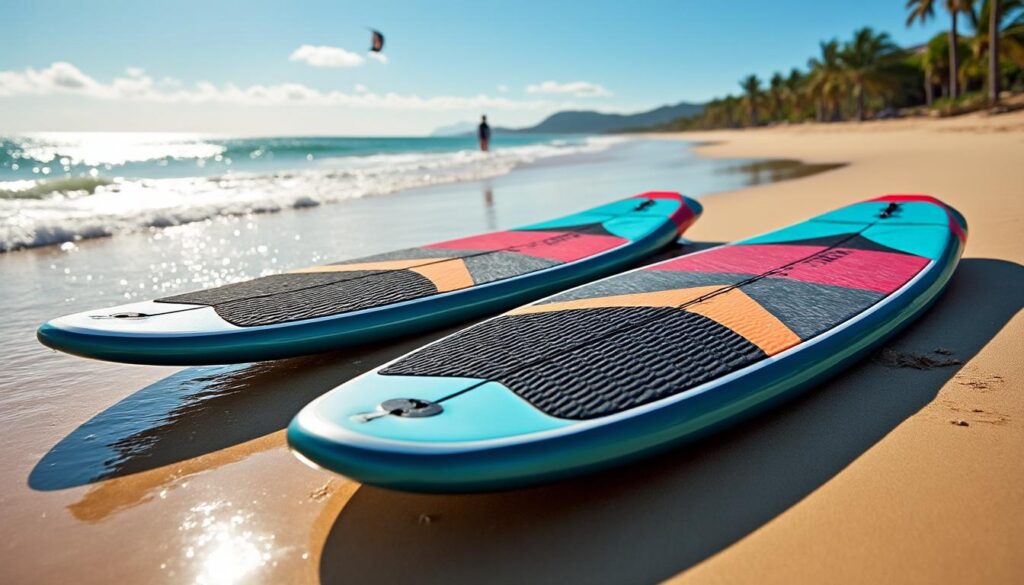
The right board to start hydrofoil kitesurf is the one that forgives mistakes. A voluminous shape, wide nose, soft rails and a length around 120–140 cm allow you to stay balanced even when stationary, while you sort the kite and foot position. Volume helps a lot in the water start phase: less time fighting in the water, more energy to concentrate on foil control.
There are also hybrid surf/foil boards with mast mounts and lines similar to a small surfboard. They are beloved by those who alternate foil and wave in the same kitesurf Puglia spot, switching from finless mode to surf the waves to a full foil setup on light-wind days. Straps? For the first approach many riders use one or two soft front straps, just to find the foot position without locking it too much. Full strapless is an extra challenge, better postponed until you feel the foil as an extension of your body.
Mast, front wing and stabilizer: the heart of the hydrofoil
The foil unit is the set of mast, fuselage, front wing and stabilizer. For those approaching the kitefoil, a typical configuration is: aluminum mast of 60–75 cm, front wing 1200–1500 cm² with a thick profile, medium-large rear stabilizer. This combination makes takeoff progressive, forgives small weight errors and reduces the tendency to porpoise.
To clarify ideas, here is a summary of typical choices for those who want to learn:
| Component | Recommended configuration | Main advantages |
|---|---|---|
| Mast | 60–75 cm, aluminum material | Softer falls, gentle response, ideal for spots with shallow bottoms |
| Front wing | 1200–1500 cm², thick profile, low aspect ratio | Lift at low speed, easy takeoff, maximum stability |
| Stabilizer | Medium-large surface | Pitch control, reduction of porpoising |
| Board | Voluminous, wide nose, 120–140 cm | Simplified water start, helps in the learning phase |
| Strap | 1–2 optional front straps | Help find the stance without fully locking the foot |
When the level grows, it makes sense to move to smaller, faster wings, longer masts and more compact boards, especially if you aim for long distance or advanced freeride in the kitesurf Adriatic with a slightly choppy sea.
Kite for hydrofoil: freeride, foil kite or one-strut?
For kitesurf foil you don’t need an extreme sail. A good inflatable freeride, hybrid or one-strut kite, with large depower and easy relaunch, remains the smartest choice for most riders. With wind between 10 and 18 knots many use a single size (10–12 m²), taking advantage of the apparent wind generated by the foil speed to cover a wide range.
Leading edge inflatable foil kites are unbeatable in efficiency and low end, and dominate Formula Kite competitions. But they require attention in handling, especially in the water and during relaunches. For those new to foil in kitesurf Italy, starting with an inflatable SLE/hybrid kite you already know reduces the variables to manage.
If you are considering a complete quiver change, the article dedicated to foil boards and setups for kitesurf can help you compare boards, wings and kites concretely, with an eye on budget and resale value in the used market.
Safety accessories: helmet, impact vest and details that make the difference
With the foil, every fall happens near a rigid mast and sharp edges. Helmets and impact vests are not an aesthetic optional, but a form of respect for yourself and for those who go in the water with you. In many kitesurf Salento spots, instructors do not accept students without these two basic protections, and the trend is spreading throughout Italy.
Other important details: a bar with clearly distinct colors between right and left to reduce errors on restarts, a wetsuit appropriate to the season (in the South a 3/2 is often enough, but in winter a 4/3 or 5/4 is a guarantee), a kite leash in perfect condition and lines checked regularly. When you spend more time away from shore, these particulars will become your invisible safety net.
Once the setup is fine-tuned, the next step is learning to use it intelligently: this is where the learning path dedicated to hydrofoil comes into play.
How to learn hydrofoil kitesurf: method, exercises and mistakes to avoid
Hydrofoil is not an “extra mode” of kitesurf: it’s a discipline with its own rules. Those who approach it as if it were just a different board often burn out in the first three outings. The smartest way to start is to rely on a kitesurf school with instructors experienced in foil, not just in twin-tip, and follow a gradual path. The keyword is progression, not immediate spectacle.
First question to ask: is your twin-tip level really solid? To start with a foil you need to be able to hold your upwind course, manage the kite even in gusts, do water starts “automatically” and know basic safety maneuvers, like self-rescue. If you still find yourself always downwind of the beach or being pulled by the kite without control, it’s wiser to postpone foil and consolidate the fundamentals.
Typical progression in a hydrofoil kitesurf course
A kitesurf course dedicated to hydrofoil, especially in kitesurf Lecce and kitesurf Taranto centers, often follows a very clear step ladder:
- Briefing on land: foil anatomy, dangerous zones around the mast, correct falling and board recovery methods.
- First towed trials (if available): the instructor tows you with a dinghy or jet ski to let you feel the foil lift without having to think about the kite.
- Water start with the kite: board still resting on the water, kite high, focus on a smooth departure trying not to surface the entire mast immediately.
- First “take-offs” from the sea: short flights of a few meters, low board, pitch control without seeking maximum height.
- Continuous flight: longer tacks with the foil in the air, work on direction, speed and depower management.
- First maneuvers: foiled tack transitions, then jibes and tacks in flight when the base is truly stable.
There is no fixed number of hours: some riders begin flying in 3–4 sessions, others need 8–10 outings to feel relaxed. Consistency is the real accelerator: three days in a row in a kitesurf holiday spot with steady wind are worth more than twenty scattered outings in complicated conditions.
The most common mistakes of those starting hydrofoil kitesurf
Those who switch to foil almost always repeat the same mistakes, out of habit or instinct. Knowing them beforehand allows you to avoid at least half:
The first is loading the back foot too much, a typical twin-tip reflex. On a foil, however, it means increasing the wing angle beyond measure and making the board take off uncontrollably. The solution is to move the weight more to the center, almost neutral, and let speed generate the rise. Another classic: holding the bar fully sheeted in. Seeking security in power is a mistake; with the hydrofoil you work with a less powered sail, kite high and fine depower control.
Another trap is fixing your gaze on your feet or the mast. The moment you look down, your body loses alignment and balance vanishes. The habit to build is therefore to always look forward, read the chop, pick a reference on the horizon, as when you surf a wave of the Ionian. Finally, many choose the wrong spot: gusty side-off wind, strong current, irregular seabed and perhaps some hidden rocks are not the ideal set for first outings.
Practical strategies to accelerate learning
To reduce frustration and “bad” falls, some simple strategies work well:
- Protected spot: choose bays with side/side-on wind, relatively flat water and a sandy bottom at least as deep as your mast.
- Short, focused sessions: better 45 minutes concentrated with breaks for debrief than three hours of chaotic attempts.
- Video feedback: being filmed from the beach or a dinghy helps see posture errors you don’t perceive in the water.
- Minimal but clear theory: understanding lift, pitch and apparent wind before entering accelerates everything.
Those who want a complete view of technique, body positions and progressive maneuvers can deepen with the guide on technique and maneuvers in kitesurfing foil, where each phase is linked to concrete exercises to try in the next session.
When you can fly for 100 meters in control, with regular tacks on both tacks, it’s the sign that it’s time to think about the next chapter: choosing spots and conditions that enhance your new way of being on the water.
Spots for hydrofoil kitesurf in Italy and Salento: where and when to fly
The hydrofoil changes the way you read a kitesurf Italy map. If before your eye only ran to icons of waves and strong winds, now sheltered gulfs, lagoons and stretches of coast where the thermal works precisely begin to shine. Salento, with its double face kitesurf Adriatic and kitesurf Ionian, is one of the clearest examples of this revolution.
On the Ionian side, in the warm months, the afternoon thermal often gives 10–15 stable knots and almost flat sea: pure gold for the foil. When twin-tip riders start complaining because “the 9 no longer holds”, those with a hydrofoil pump the lines, go out with the 12 freeride and enjoy two hours of total silence a few centimeters from the water. On the Adriatic side, instead, medium Mistral days with long waves open the foil-wave scenario, where you no longer just look for speed but the right line to surf soft swells far from the shore.
Salento, Puglia and the best foil-friendly spots
Among kitesurf Puglia spots, some lend themselves naturally to hydrofoil. Areas with sandy bottoms that slope regularly, without sudden shoals, are perfect to stay relaxed even when the mast works high. In some stretches of coast near kitesurf Lecce, the combination of turquoise water, clean side-on wind and downwind space makes it simple to set long tacks in total safety.
On the kitesurf Taranto side, several sheltered bays offer excellent conditions when the north wind channels and the sea stays orderly. These are spots where the foil becomes almost a touring board: you go out, sail for kilometers without stress, stop offshore to look at the coastline profile and then return working on clean points of sail. On these days, the boundary between a technical session and a “flying stroll” is very thin.
But Salento is not the only promised land. In Liguria and Tuscany there are bays where the afternoon thermal pushes little but well, ideal for those who want to combine sea and city. In Sardinia, some lagoons sheltered from the open sea are perfect laboratories for those taking their first steps with a short mast. And in the North, lakes with morning and evening thermal winds have become reference points for a whole generation of foilers.
Spot selection: practical criteria for foil riders
Regardless of the region, a foil-friendly spot usually has some common characteristics:
- Sufficient depth: the water must exceed the length of your mast with a safety margin to avoid bottom touches while flying.
- Clean seabed: sand or uniform mud are the foil’s best friends; isolated rocks and reef outcrops are alarm bells.
- Regular wind: violent gusts and sudden holes make it difficult to maintain flight; clean thermals or well-established synoptic winds are better.
- Downwind space: you always need a wide corridor free of obstacles (buoys, rocks, bathers, anchored boats).
For those who also dream of trips abroad or to other parts of the Mediterranean, it makes sense to check reports on destinations like kitesurf in Cape Verde, where hydrofoil coexists with wave and twin-tip in one of the most famous oceanic playgrounds among Italian riders.
Good planning of spots makes the foil what it should be: an amplifier of freedom, not an additional source of logistical stress and unnecessary risks.
Wind, safety and advanced progression in kitefoil
The foil gives freedom, but only to those who treat wind and safety with absolute respect. Being able to go out with 10 knots does not mean “always and anyway”, especially when you begin to sail far from the coast. The ideal range for most riders in hydrofoil kitesurf lies between 10 and 18 knots: below 7–8 knots the kite struggles to stay aloft, above 20 knots every bar mistake turns into a lash.
The wind direction relative to the coast is the first variable to check. On-shore and side-on are the foilist’s best allies: in case of problems, board and rider tend to return naturally toward the shore. Pure side can be fine with a good downwind space margin. Side-off and offshore, however, are conditions to avoid without boat support, because drifting offshore on a foil is surprisingly rapid.
Apparent wind, speed and kite management
One of the surprises of kitefoil is the high average speed. Even with moderate wind, the combination of sliding on the wing and little board resistance generates a strong apparent wind. It’s the same sensation as when you pedal fast on a bike on a calm day and still feel air in your face: the foil reproduces this phenomenon on the water.
In practice, a 15-knot gust that seems harmless from the beach, on the water at 25 km/h on a foil, can turn into a significant power hit if the sail is too large or poorly depowered. For this reason many riders prefer to enter light, with a kite 2–3 meters smaller than they would use on a twin-tip in the same wind, and work with the depower almost always engaged. When in doubt, on the foil it is almost always better to be slightly underpowered than overpowered.
Right-of-way rules and safety space in hydrofoil
All the classic kitesurf rules remain valid: starboard tack has priority, kite high for the windward rider, low for the leeward rider, pay attention to windsurfers’ and sailing boats’ trajectories. With the foil, however, it is wise to add an extra margin, because a rider in flight has more sudden direction changes and covers more meters in less time.
Keep at least two line lengths distance from other kites, avoid aggressive maneuvers near the shore and clearly signal any long downwind runs as part of a spot etiquette that makes everyone more relaxed, not just foilers. On very crowded days, perhaps in high summer, it may make sense to focus on technical exercises away from the main group or move the session to early morning or sunset.
From basics to advanced riding: how to keep growing
Once you have conquered stable flight on both tacks, the most fun phase of hydrofoil kitesurf begins: infinite progression. Typical steps are:
- Speed control: learn to lower the board to slow down, using body and depower instead of pulling only the bar.
- Foiled jibes: first with the board touching the water again, then in continuous flight, working on smooth torso and shoulder rotation.
- Carving and waves: use the foil as a surfboard, following swell or even just long chop, especially on kitesurf Ionian days with soft waves.
- Tricks and freestyle: for those with a solid base, 360s, downloop carving and creative strapless maneuvers begin.
Many riders choose to organize periods of kitesurf holiday in foil-friendly spots – from Salento to the major islands – alternating twin-tip, surfboard and hydrofoil in the same week. It’s one of the most effective ways to keep the body active, avoid overuse injuries in a single discipline and experience the wind in all its shades, without lost days.
The common thread always remains the same: learn to read the wind precisely. Once the foil becomes natural under your feet, the sea – Adriatic, Ionian or any other coast – stops being just a backdrop and finally becomes your full playground.
How long does it take to learn hydrofoil kitesurf if I already know how to use a twin-tip?
If you sail confidently on a twin-tip – steady upwind, water start without thinking and good kite control even in gusts – many riders begin to make their first controlled flights in 3–5 sessions guided by an instructor. To reach long tacks in flight on both tacks, with a relaxed feeling and control, generally between 8 and 15 outings are needed, depending on consistency, wind conditions and the quality of the equipment used.
Is hydrofoil kitesurf suitable for absolute beginners?
No. The foil is not intended for those who have never kitesurfed. First you must learn to manage the kite, safety rules, body drag, the water start and basic navigation with a twin-tip. Only when these elements become automatic does it make sense to add the complexity of the mast and flying above the water, to avoid risky situations and unnecessary frustration.
What kite size should I use for foil compared to twin-tip?
In general, with the foil you can use a sail 2–3 meters smaller than you would use on a twin-tip in the same wind conditions, or keep the same size but sail with less power thanks to large depower. Much depends on your weight, the kite model and the size of the foil wing. When learning, it is always better to enter the water slightly underpowered rather than too powered.
Are helmet and impact vest really necessary for kitefoil?
Yes, they are strongly recommended. In kitefoil falls occur near a rigid mast and a board with marked edges, so helmet and impact vest significantly reduce the risk of head and torso injuries. In several Italian spots, especially in specialized schools, instructors do not accept students in foil courses without these two basic protections.
Can I use the hydrofoil with rough sea and waves?
Yes, but it is an advanced step. Learning with relatively flat water and regular wind makes it much easier to control the foil’s pitch. Once you find stability and confidence, moving to long, orderly waves – like certain Mistral days on the Adriatic side or swell on the Ionian – transforms the foil into a true surfboard, with powerful sensations. To start, however, it is better to stay on calm spots and manageable conditions.
- Fly with little wind: the foil comes into play already from 10–12 knots, when many twin-tips stay ashore.
- Dedicated equipment: voluminous boards, shorter masts and large front wings make foil kitesurf for beginners much more manageable.
- Strategic spots: sheltered gulfs, regular seabeds and side/side-on wind are the basis for learning safely.
- Guided progression: a kitesurf course specifically for foil cuts learning time and limits heavy falls.
- Italy and Salento: between kitesurf Adriatic, kitesurf Ionian, Puglia, Lecce and Taranto, the hydrofoil finds one of the best playgrounds in all of Europe.
Hydrofoil Kitesurf: how the “flight” above the water really works
To understand hydrofoil kitesurf you have to imagine a small airplane immersed in the water under the board. The mast connects the board to a large front wing and a rear stabilizer. When you start moving, the water flows over the airfoil profile, the pressure above and below the wing changes and an upward force is generated: lift. It’s the same principle that makes your kite take off in the air, only here the “sky” is below the sea surface.
As soon as lift exceeds the weight of rider + board, the board rises out of the water and drag collapses. It’s here that the foil turns a borderline day into a full session. Imagine a rider at a kitesurf Puglia spot, Ionian side, 12 knots of thermal wind, sea almost flat. With a freeride twin-tip he struggles to plane and every chop slows him down. With an entry-level foil and an 11 m² freeride kite, a few meters of acceleration are enough: the board rises, the sound of the chop disappears, apparent wind increases and everything becomes smooth.
The angle at which the wing meets the water flow – the angle of attack – is the main lever you have under your feet. If you load the heel too much and lift the nose, the wing takes an exaggerated angle, lift explodes and the foil “rearing up” catapults you forward: the famous porpoising. If instead you keep the board too flat, the thrust is insufficient and you stay glued to the surface. The game, when you learn, is to find that point where the board flies low, stable, and lets you focus entirely on kite management.
Two key variables then come into play: mast length and wing aspect ratio. A mast of 60–75 cm is perfect to start: less leverage, falls from a lower height, softer reactions. Masts of 85–95 cm are the weapon of advanced riders who want extreme upwind angles, deep carving and greater margin when the sea chops up. On the wing, a low aspect ratio (so a shorter, wider wing) provides stability at low speed, easy takeoff and plenty of control: it’s the ideal choice for a first foil. Long, narrow wings with a high aspect ratio slice like blades and are perfect for racing, but demand clean technique.
In kitefoil, the kite also changes role compared to the twin-tip. Freeride sails with large depower are often used, kept less powered and worked in a way to create a mix between power and apparent wind. The more the foil accelerates, the more you feel the wind in your face, even if the anemometer doesn’t move: this allows you to stay on the water with 10–14 knots when many others pack up. In the classic Salento wind afternoons, when the thermal rises slowly, the foil allows you to start the session hours earlier and finish much later.
For those who want to deepen the theory and the analogies between kite aerodynamics and foil hydrodynamics, a useful read is the analysis dedicated to flying on the water with the kitefoil, where all this theory is linked to real cases in kitesurf Italy spots.
Understanding these mechanisms is not just to “look cool” on the beach: it’s the basis for choosing a set-up consistent with your level and the spot conditions, the central theme of the next section.
Hydrofoil kitesurf and light wind: why it changes every session
One of the reasons the foil has exploded in kitesurf Italy is its ability to make enjoyable the wind that was previously snubbed. In lagoons, lakes and sheltered bays, the 10–15 knots of “clean” wind are often more frequent than the postcard 25-knot days. With the twin-tip, these days are a lottery; with the foil they become a constant playground, perfect for those who live in cities and want predictable after-work sessions.
A concrete example? Luca, 40, an intermediate rider who works in Milan and commutes to the northern lakes on weekends. With the classic twin-tip setup he went out once every three attempts: either too little wind, or unmanageable gusts. After a kitesurf course specific to foil and a targeted gear change, today he manages to take advantage of days he previously considered “wasted”, reduces weather stress and accumulates priceless hours on the water to improve technique and confidence with the wind.
In short, the hydrofoil is not a racing gadget, but a concrete tool to transform your relationship with wind and your usual spots. Those who understand it rarely go back.
Hydrofoil kitesurf equipment: board, mast, kite and setup to learn
In the world of kitesurfing foil, the wrong equipment can slow you down for months. You don’t need the most expensive foil on the market, but a harmonious set that speaks the same language as your level. The most common mistake? Copying exactly the setup of someone who races or does Big Air, thinking “if they use it, it will be good for me too”. The result is usually a string of falls and a board put up for sale after a few outings.
To avoid this, it’s better to think in blocks: board, foil (mast + wings), kite and safety accessories. See them separately, but think of them together; it’s the best way to build a kit that will accompany you from the first plane to controlled flight.
Hydrofoil board for kitesurf: volume, dimensions and straps
The right board to start hydrofoil kitesurf is the one that forgives mistakes. A voluminous shape, wide nose, soft rails and a length around 120–140 cm allow you to stay balanced even when stationary, while you sort the kite and foot position. Volume helps a lot in the water start phase: less time fighting in the water, more energy to concentrate on foil control.
There are also hybrid surf/foil boards with mast mounts and lines similar to a small surfboard. They are beloved by those who alternate foil and wave in the same kitesurf Puglia spot, switching from finless mode to surf the waves to a full foil setup on light-wind days. Straps? For the first approach many riders use one or two soft front straps, just to find the foot position without locking it too much. Full strapless is an extra challenge, better postponed until you feel the foil as an extension of your body.
Mast, front wing and stabilizer: the heart of the hydrofoil
The foil unit is the set of mast, fuselage, front wing and stabilizer. For those approaching the kitefoil, a typical configuration is: aluminum mast of 60–75 cm, front wing 1200–1500 cm² with a thick profile, medium-large rear stabilizer. This combination makes takeoff progressive, forgives small weight errors and reduces the tendency to porpoise.
To clarify ideas, here is a summary of typical choices for those who want to learn:
| Component | Recommended configuration | Main advantages |
|---|---|---|
| Mast | 60–75 cm, aluminum material | Softer falls, gentle response, ideal for spots with shallow bottoms |
| Front wing | 1200–1500 cm², thick profile, low aspect ratio | Lift at low speed, easy takeoff, maximum stability |
| Stabilizer | Medium-large surface | Pitch control, reduction of porpoising |
| Board | Voluminous, wide nose, 120–140 cm | Simplified water start, helps in the learning phase |
| Strap | 1–2 optional front straps | Help find the stance without fully locking the foot |
When the level grows, it makes sense to move to smaller, faster wings, longer masts and more compact boards, especially if you aim for long distance or advanced freeride in the kitesurf Adriatic with a slightly choppy sea.
Kite for hydrofoil: freeride, foil kite or one-strut?
For kitesurf foil you don’t need an extreme sail. A good inflatable freeride, hybrid or one-strut kite, with large depower and easy relaunch, remains the smartest choice for most riders. With wind between 10 and 18 knots many use a single size (10–12 m²), taking advantage of the apparent wind generated by the foil speed to cover a wide range.
Leading edge inflatable foil kites are unbeatable in efficiency and low end, and dominate Formula Kite competitions. But they require attention in handling, especially in the water and during relaunches. For those new to foil in kitesurf Italy, starting with an inflatable SLE/hybrid kite you already know reduces the variables to manage.
If you are considering a complete quiver change, the article dedicated to foil boards and setups for kitesurf can help you compare boards, wings and kites concretely, with an eye on budget and resale value in the used market.
Safety accessories: helmet, impact vest and details that make the difference
With the foil, every fall happens near a rigid mast and sharp edges. Helmets and impact vests are not an aesthetic optional, but a form of respect for yourself and for those who go in the water with you. In many kitesurf Salento spots, instructors do not accept students without these two basic protections, and the trend is spreading throughout Italy.
Other important details: a bar with clearly distinct colors between right and left to reduce errors on restarts, a wetsuit appropriate to the season (in the South a 3/2 is often enough, but in winter a 4/3 or 5/4 is a guarantee), a kite leash in perfect condition and lines checked regularly. When you spend more time away from shore, these particulars will become your invisible safety net.
Once the setup is fine-tuned, the next step is learning to use it intelligently: this is where the learning path dedicated to hydrofoil comes into play.
How to learn hydrofoil kitesurf: method, exercises and mistakes to avoid
Hydrofoil is not an “extra mode” of kitesurf: it’s a discipline with its own rules. Those who approach it as if it were just a different board often burn out in the first three outings. The smartest way to start is to rely on a kitesurf school with instructors experienced in foil, not just in twin-tip, and follow a gradual path. The keyword is progression, not immediate spectacle.
First question to ask: is your twin-tip level really solid? To start with a foil you need to be able to hold your upwind course, manage the kite even in gusts, do water starts “automatically” and know basic safety maneuvers, like self-rescue. If you still find yourself always downwind of the beach or being pulled by the kite without control, it’s wiser to postpone foil and consolidate the fundamentals.
Typical progression in a hydrofoil kitesurf course
A kitesurf course dedicated to hydrofoil, especially in kitesurf Lecce and kitesurf Taranto centers, often follows a very clear step ladder:
- Briefing on land: foil anatomy, dangerous zones around the mast, correct falling and board recovery methods.
- First towed trials (if available): the instructor tows you with a dinghy or jet ski to let you feel the foil lift without having to think about the kite.
- Water start with the kite: board still resting on the water, kite high, focus on a smooth departure trying not to surface the entire mast immediately.
- First “take-offs” from the sea: short flights of a few meters, low board, pitch control without seeking maximum height.
- Continuous flight: longer tacks with the foil in the air, work on direction, speed and depower management.
- First maneuvers: foiled tack transitions, then jibes and tacks in flight when the base is truly stable.
There is no fixed number of hours: some riders begin flying in 3–4 sessions, others need 8–10 outings to feel relaxed. Consistency is the real accelerator: three days in a row in a kitesurf holiday spot with steady wind are worth more than twenty scattered outings in complicated conditions.
The most common mistakes of those starting hydrofoil kitesurf
Those who switch to foil almost always repeat the same mistakes, out of habit or instinct. Knowing them beforehand allows you to avoid at least half:
The first is loading the back foot too much, a typical twin-tip reflex. On a foil, however, it means increasing the wing angle beyond measure and making the board take off uncontrollably. The solution is to move the weight more to the center, almost neutral, and let speed generate the rise. Another classic: holding the bar fully sheeted in. Seeking security in power is a mistake; with the hydrofoil you work with a less powered sail, kite high and fine depower control.
Another trap is fixing your gaze on your feet or the mast. The moment you look down, your body loses alignment and balance vanishes. The habit to build is therefore to always look forward, read the chop, pick a reference on the horizon, as when you surf a wave of the Ionian. Finally, many choose the wrong spot: gusty side-off wind, strong current, irregular seabed and perhaps some hidden rocks are not the ideal set for first outings.
Practical strategies to accelerate learning
To reduce frustration and “bad” falls, some simple strategies work well:
- Protected spot: choose bays with side/side-on wind, relatively flat water and a sandy bottom at least as deep as your mast.
- Short, focused sessions: better 45 minutes concentrated with breaks for debrief than three hours of chaotic attempts.
- Video feedback: being filmed from the beach or a dinghy helps see posture errors you don’t perceive in the water.
- Minimal but clear theory: understanding lift, pitch and apparent wind before entering accelerates everything.
Those who want a complete view of technique, body positions and progressive maneuvers can deepen with the guide on technique and maneuvers in kitesurfing foil, where each phase is linked to concrete exercises to try in the next session.
When you can fly for 100 meters in control, with regular tacks on both tacks, it’s the sign that it’s time to think about the next chapter: choosing spots and conditions that enhance your new way of being on the water.
Spots for hydrofoil kitesurf in Italy and Salento: where and when to fly
The hydrofoil changes the way you read a kitesurf Italy map. If before your eye only ran to icons of waves and strong winds, now sheltered gulfs, lagoons and stretches of coast where the thermal works precisely begin to shine. Salento, with its double face kitesurf Adriatic and kitesurf Ionian, is one of the clearest examples of this revolution.
On the Ionian side, in the warm months, the afternoon thermal often gives 10–15 stable knots and almost flat sea: pure gold for the foil. When twin-tip riders start complaining because “the 9 no longer holds”, those with a hydrofoil pump the lines, go out with the 12 freeride and enjoy two hours of total silence a few centimeters from the water. On the Adriatic side, instead, medium Mistral days with long waves open the foil-wave scenario, where you no longer just look for speed but the right line to surf soft swells far from the shore.
Salento, Puglia and the best foil-friendly spots
Among kitesurf Puglia spots, some lend themselves naturally to hydrofoil. Areas with sandy bottoms that slope regularly, without sudden shoals, are perfect to stay relaxed even when the mast works high. In some stretches of coast near kitesurf Lecce, the combination of turquoise water, clean side-on wind and downwind space makes it simple to set long tacks in total safety.
On the kitesurf Taranto side, several sheltered bays offer excellent conditions when the north wind channels and the sea stays orderly. These are spots where the foil becomes almost a touring board: you go out, sail for kilometers without stress, stop offshore to look at the coastline profile and then return working on clean points of sail. On these days, the boundary between a technical session and a “flying stroll” is very thin.
But Salento is not the only promised land. In Liguria and Tuscany there are bays where the afternoon thermal pushes little but well, ideal for those who want to combine sea and city. In Sardinia, some lagoons sheltered from the open sea are perfect laboratories for those taking their first steps with a short mast. And in the North, lakes with morning and evening thermal winds have become reference points for a whole generation of foilers.
Spot selection: practical criteria for foil riders
Regardless of the region, a foil-friendly spot usually has some common characteristics:
- Sufficient depth: the water must exceed the length of your mast with a safety margin to avoid bottom touches while flying.
- Clean seabed: sand or uniform mud are the foil’s best friends; isolated rocks and reef outcrops are alarm bells.
- Regular wind: violent gusts and sudden holes make it difficult to maintain flight; clean thermals or well-established synoptic winds are better.
- Downwind space: you always need a wide corridor free of obstacles (buoys, rocks, bathers, anchored boats).
For those who also dream of trips abroad or to other parts of the Mediterranean, it makes sense to check reports on destinations like kitesurf in Cape Verde, where hydrofoil coexists with wave and twin-tip in one of the most famous oceanic playgrounds among Italian riders.
Good planning of spots makes the foil what it should be: an amplifier of freedom, not an additional source of logistical stress and unnecessary risks.
Wind, safety and advanced progression in kitefoil
The foil gives freedom, but only to those who treat wind and safety with absolute respect. Being able to go out with 10 knots does not mean “always and anyway”, especially when you begin to sail far from the coast. The ideal range for most riders in hydrofoil kitesurf lies between 10 and 18 knots: below 7–8 knots the kite struggles to stay aloft, above 20 knots every bar mistake turns into a lash.
The wind direction relative to the coast is the first variable to check. On-shore and side-on are the foilist’s best allies: in case of problems, board and rider tend to return naturally toward the shore. Pure side can be fine with a good downwind space margin. Side-off and offshore, however, are conditions to avoid without boat support, because drifting offshore on a foil is surprisingly rapid.
Apparent wind, speed and kite management
One of the surprises of kitefoil is the high average speed. Even with moderate wind, the combination of sliding on the wing and little board resistance generates a strong apparent wind. It’s the same sensation as when you pedal fast on a bike on a calm day and still feel air in your face: the foil reproduces this phenomenon on the water.
In practice, a 15-knot gust that seems harmless from the beach, on the water at 25 km/h on a foil, can turn into a significant power hit if the sail is too large or poorly depowered. For this reason many riders prefer to enter light, with a kite 2–3 meters smaller than they would use on a twin-tip in the same wind, and work with the depower almost always engaged. When in doubt, on the foil it is almost always better to be slightly underpowered than overpowered.
Right-of-way rules and safety space in hydrofoil
All the classic kitesurf rules remain valid: starboard tack has priority, kite high for the windward rider, low for the leeward rider, pay attention to windsurfers’ and sailing boats’ trajectories. With the foil, however, it is wise to add an extra margin, because a rider in flight has more sudden direction changes and covers more meters in less time.
Keep at least two line lengths distance from other kites, avoid aggressive maneuvers near the shore and clearly signal any long downwind runs as part of a spot etiquette that makes everyone more relaxed, not just foilers. On very crowded days, perhaps in high summer, it may make sense to focus on technical exercises away from the main group or move the session to early morning or sunset.
From basics to advanced riding: how to keep growing
Once you have conquered stable flight on both tacks, the most fun phase of hydrofoil kitesurf begins: infinite progression. Typical steps are:
- Speed control: learn to lower the board to slow down, using body and depower instead of pulling only the bar.
- Foiled jibes: first with the board touching the water again, then in continuous flight, working on smooth torso and shoulder rotation.
- Carving and waves: use the foil as a surfboard, following swell or even just long chop, especially on kitesurf Ionian days with soft waves.
- Tricks and freestyle: for those with a solid base, 360s, downloop carving and creative strapless maneuvers begin.
Many riders choose to organize periods of kitesurf holiday in foil-friendly spots – from Salento to the major islands – alternating twin-tip, surfboard and hydrofoil in the same week. It’s one of the most effective ways to keep the body active, avoid overuse injuries in a single discipline and experience the wind in all its shades, without lost days.
The common thread always remains the same: learn to read the wind precisely. Once the foil becomes natural under your feet, the sea – Adriatic, Ionian or any other coast – stops being just a backdrop and finally becomes your full playground.
How long does it take to learn hydrofoil kitesurf if I already know how to use a twin-tip?
If you sail confidently on a twin-tip – steady upwind, water start without thinking and good kite control even in gusts – many riders begin to make their first controlled flights in 3–5 sessions guided by an instructor. To reach long tacks in flight on both tacks, with a relaxed feeling and control, generally between 8 and 15 outings are needed, depending on consistency, wind conditions and the quality of the equipment used.
Is hydrofoil kitesurf suitable for absolute beginners?
No. The foil is not intended for those who have never kitesurfed. First you must learn to manage the kite, safety rules, body drag, the water start and basic navigation with a twin-tip. Only when these elements become automatic does it make sense to add the complexity of the mast and flying above the water, to avoid risky situations and unnecessary frustration.
What kite size should I use for foil compared to twin-tip?
In general, with the foil you can use a sail 2–3 meters smaller than you would use on a twin-tip in the same wind conditions, or keep the same size but sail with less power thanks to large depower. Much depends on your weight, the kite model and the size of the foil wing. When learning, it is always better to enter the water slightly underpowered rather than too powered.
Are helmet and impact vest really necessary for kitefoil?
Yes, they are strongly recommended. In kitefoil falls occur near a rigid mast and a board with marked edges, so helmet and impact vest significantly reduce the risk of head and torso injuries. In several Italian spots, especially in specialized schools, instructors do not accept students in foil courses without these two basic protections.
Can I use the hydrofoil with rough sea and waves?
Yes, but it is an advanced step. Learning with relatively flat water and regular wind makes it much easier to control the foil’s pitch. Once you find stability and confidence, moving to long, orderly waves – like certain Mistral days on the Adriatic side or swell on the Ionian – transforms the foil into a true surfboard, with powerful sensations. To start, however, it is better to stay on calm spots and manageable conditions.
The first flight in hydrofoil kitesurf is that moment when the water stops making noise and the wind becomes the only sound in your head. The board lifts off the sea, the mast works beneath the surface and suddenly kitesurfing is no longer just jumping and gliding: it’s sliding above the Adriatic and the Ionian like on an invisible track. Those coming from twin-tip or surf immediately feel a new world opening up, especially on light-wind days when, until yesterday, you would sit on the beach watching the anemometer. With the foil, those “dead” hours become the best of the day.
Understanding how a kitefoil works, however, means going beyond social-media curiosity. Under your feet there isn’t a longer fin, but a real inverted airplane that turns every knot of wind into lift. Technique is needed, of course, but above all an intelligent path: choosing the right equipment, selecting suitable spots, respecting safety rules and relying on a kitesurf school that really knows foil. Whether your goal is to extend sessions in kitesurf Salento, explore the thermal lakes of the North or prepare a kitesurf holiday trip in the Mediterranean, the hydrofoil is today the number-one ally to multiply days on the water and learn to read the wind with a new sensitivity.
- Fly with little wind: the foil comes into play already from 10–12 knots, when many twin-tips stay ashore.
- Dedicated equipment: voluminous boards, shorter masts and large front wings make foil kitesurf for beginners much more manageable.
- Strategic spots: sheltered gulfs, regular seabeds and side/side-on wind are the basis for learning safely.
- Guided progression: a kitesurf course specifically for foil cuts learning time and limits heavy falls.
- Italy and Salento: between kitesurf Adriatic, kitesurf Ionian, Puglia, Lecce and Taranto, the hydrofoil finds one of the best playgrounds in all of Europe.
Hydrofoil Kitesurf: how the “flight” above the water really works
To understand hydrofoil kitesurf you have to imagine a small airplane immersed in the water under the board. The mast connects the board to a large front wing and a rear stabilizer. When you start moving, the water flows over the airfoil profile, the pressure above and below the wing changes and an upward force is generated: lift. It’s the same principle that makes your kite take off in the air, only here the “sky” is below the sea surface.
As soon as lift exceeds the weight of rider + board, the board rises out of the water and drag collapses. It’s here that the foil turns a borderline day into a full session. Imagine a rider at a kitesurf Puglia spot, Ionian side, 12 knots of thermal wind, sea almost flat. With a freeride twin-tip he struggles to plane and every chop slows him down. With an entry-level foil and an 11 m² freeride kite, a few meters of acceleration are enough: the board rises, the sound of the chop disappears, apparent wind increases and everything becomes smooth.
The angle at which the wing meets the water flow – the angle of attack – is the main lever you have under your feet. If you load the heel too much and lift the nose, the wing takes an exaggerated angle, lift explodes and the foil “rearing up” catapults you forward: the famous porpoising. If instead you keep the board too flat, the thrust is insufficient and you stay glued to the surface. The game, when you learn, is to find that point where the board flies low, stable, and lets you focus entirely on kite management.
Two key variables then come into play: mast length and wing aspect ratio. A mast of 60–75 cm is perfect to start: less leverage, falls from a lower height, softer reactions. Masts of 85–95 cm are the weapon of advanced riders who want extreme upwind angles, deep carving and greater margin when the sea chops up. On the wing, a low aspect ratio (so a shorter, wider wing) provides stability at low speed, easy takeoff and plenty of control: it’s the ideal choice for a first foil. Long, narrow wings with a high aspect ratio slice like blades and are perfect for racing, but demand clean technique.
In kitefoil, the kite also changes role compared to the twin-tip. Freeride sails with large depower are often used, kept less powered and worked in a way to create a mix between power and apparent wind. The more the foil accelerates, the more you feel the wind in your face, even if the anemometer doesn’t move: this allows you to stay on the water with 10–14 knots when many others pack up. In the classic Salento wind afternoons, when the thermal rises slowly, the foil allows you to start the session hours earlier and finish much later.
For those who want to deepen the theory and the analogies between kite aerodynamics and foil hydrodynamics, a useful read is the analysis dedicated to flying on the water with the kitefoil, where all this theory is linked to real cases in kitesurf Italy spots.
Understanding these mechanisms is not just to “look cool” on the beach: it’s the basis for choosing a set-up consistent with your level and the spot conditions, the central theme of the next section.
Hydrofoil kitesurf and light wind: why it changes every session
One of the reasons the foil has exploded in kitesurf Italy is its ability to make enjoyable the wind that was previously snubbed. In lagoons, lakes and sheltered bays, the 10–15 knots of “clean” wind are often more frequent than the postcard 25-knot days. With the twin-tip, these days are a lottery; with the foil they become a constant playground, perfect for those who live in cities and want predictable after-work sessions.
A concrete example? Luca, 40, an intermediate rider who works in Milan and commutes to the northern lakes on weekends. With the classic twin-tip setup he went out once every three attempts: either too little wind, or unmanageable gusts. After a kitesurf course specific to foil and a targeted gear change, today he manages to take advantage of days he previously considered “wasted”, reduces weather stress and accumulates priceless hours on the water to improve technique and confidence with the wind.
In short, the hydrofoil is not a racing gadget, but a concrete tool to transform your relationship with wind and your usual spots. Those who understand it rarely go back.
Hydrofoil kitesurf equipment: board, mast, kite and setup to learn
In the world of kitesurfing foil, the wrong equipment can slow you down for months. You don’t need the most expensive foil on the market, but a harmonious set that speaks the same language as your level. The most common mistake? Copying exactly the setup of someone who races or does Big Air, thinking “if they use it, it will be good for me too”. The result is usually a string of falls and a board put up for sale after a few outings.
To avoid this, it’s better to think in blocks: board, foil (mast + wings), kite and safety accessories. See them separately, but think of them together; it’s the best way to build a kit that will accompany you from the first plane to controlled flight.
Hydrofoil board for kitesurf: volume, dimensions and straps
The right board to start hydrofoil kitesurf is the one that forgives mistakes. A voluminous shape, wide nose, soft rails and a length around 120–140 cm allow you to stay balanced even when stationary, while you sort the kite and foot position. Volume helps a lot in the water start phase: less time fighting in the water, more energy to concentrate on foil control.
There are also hybrid surf/foil boards with mast mounts and lines similar to a small surfboard. They are beloved by those who alternate foil and wave in the same kitesurf Puglia spot, switching from finless mode to surf the waves to a full foil setup on light-wind days. Straps? For the first approach many riders use one or two soft front straps, just to find the foot position without locking it too much. Full strapless is an extra challenge, better postponed until you feel the foil as an extension of your body.
Mast, front wing and stabilizer: the heart of the hydrofoil
The foil unit is the set of mast, fuselage, front wing and stabilizer. For those approaching the kitefoil, a typical configuration is: aluminum mast of 60–75 cm, front wing 1200–1500 cm² with a thick profile, medium-large rear stabilizer. This combination makes takeoff progressive, forgives small weight errors and reduces the tendency to porpoise.
To clarify ideas, here is a summary of typical choices for those who want to learn:
| Component | Recommended configuration | Main advantages |
|---|---|---|
| Mast | 60–75 cm, aluminum material | Softer falls, gentle response, ideal for spots with shallow bottoms |
| Front wing | 1200–1500 cm², thick profile, low aspect ratio | Lift at low speed, easy takeoff, maximum stability |
| Stabilizer | Medium-large surface | Pitch control, reduction of porpoising |
| Board | Voluminous, wide nose, 120–140 cm | Simplified water start, helps in the learning phase |
| Strap | 1–2 optional front straps | Help find the stance without fully locking the foot |
When the level grows, it makes sense to move to smaller, faster wings, longer masts and more compact boards, especially if you aim for long distance or advanced freeride in the kitesurf Adriatic with a slightly choppy sea.
Kite for hydrofoil: freeride, foil kite or one-strut?
For kitesurf foil you don’t need an extreme sail. A good inflatable freeride, hybrid or one-strut kite, with large depower and easy relaunch, remains the smartest choice for most riders. With wind between 10 and 18 knots many use a single size (10–12 m²), taking advantage of the apparent wind generated by the foil speed to cover a wide range.
Leading edge inflatable foil kites are unbeatable in efficiency and low end, and dominate Formula Kite competitions. But they require attention in handling, especially in the water and during relaunches. For those new to foil in kitesurf Italy, starting with an inflatable SLE/hybrid kite you already know reduces the variables to manage.
If you are considering a complete quiver change, the article dedicated to foil boards and setups for kitesurf can help you compare boards, wings and kites concretely, with an eye on budget and resale value in the used market.
Safety accessories: helmet, impact vest and details that make the difference
With the foil, every fall happens near a rigid mast and sharp edges. Helmets and impact vests are not an aesthetic optional, but a form of respect for yourself and for those who go in the water with you. In many kitesurf Salento spots, instructors do not accept students without these two basic protections, and the trend is spreading throughout Italy.
Other important details: a bar with clearly distinct colors between right and left to reduce errors on restarts, a wetsuit appropriate to the season (in the South a 3/2 is often enough, but in winter a 4/3 or 5/4 is a guarantee), a kite leash in perfect condition and lines checked regularly. When you spend more time away from shore, these particulars will become your invisible safety net.
Once the setup is fine-tuned, the next step is learning to use it intelligently: this is where the learning path dedicated to hydrofoil comes into play.
How to learn hydrofoil kitesurf: method, exercises and mistakes to avoid
Hydrofoil is not an “extra mode” of kitesurf: it’s a discipline with its own rules. Those who approach it as if it were just a different board often burn out in the first three outings. The smartest way to start is to rely on a kitesurf school with instructors experienced in foil, not just in twin-tip, and follow a gradual path. The keyword is progression, not immediate spectacle.
First question to ask: is your twin-tip level really solid? To start with a foil you need to be able to hold your upwind course, manage the kite even in gusts, do water starts “automatically” and know basic safety maneuvers, like self-rescue. If you still find yourself always downwind of the beach or being pulled by the kite without control, it’s wiser to postpone foil and consolidate the fundamentals.
Typical progression in a hydrofoil kitesurf course
A kitesurf course dedicated to hydrofoil, especially in kitesurf Lecce and kitesurf Taranto centers, often follows a very clear step ladder:
- Briefing on land: foil anatomy, dangerous zones around the mast, correct falling and board recovery methods.
- First towed trials (if available): the instructor tows you with a dinghy or jet ski to let you feel the foil lift without having to think about the kite.
- Water start with the kite: board still resting on the water, kite high, focus on a smooth departure trying not to surface the entire mast immediately.
- First “take-offs” from the sea: short flights of a few meters, low board, pitch control without seeking maximum height.
- Continuous flight: longer tacks with the foil in the air, work on direction, speed and depower management.
- First maneuvers: foiled tack transitions, then jibes and tacks in flight when the base is truly stable.
There is no fixed number of hours: some riders begin flying in 3–4 sessions, others need 8–10 outings to feel relaxed. Consistency is the real accelerator: three days in a row in a kitesurf holiday spot with steady wind are worth more than twenty scattered outings in complicated conditions.
The most common mistakes of those starting hydrofoil kitesurf
Those who switch to foil almost always repeat the same mistakes, out of habit or instinct. Knowing them beforehand allows you to avoid at least half:
The first is loading the back foot too much, a typical twin-tip reflex. On a foil, however, it means increasing the wing angle beyond measure and making the board take off uncontrollably. The solution is to move the weight more to the center, almost neutral, and let speed generate the rise. Another classic: holding the bar fully sheeted in. Seeking security in power is a mistake; with the hydrofoil you work with a less powered sail, kite high and fine depower control.
Another trap is fixing your gaze on your feet or the mast. The moment you look down, your body loses alignment and balance vanishes. The habit to build is therefore to always look forward, read the chop, pick a reference on the horizon, as when you surf a wave of the Ionian. Finally, many choose the wrong spot: gusty side-off wind, strong current, irregular seabed and perhaps some hidden rocks are not the ideal set for first outings.
Practical strategies to accelerate learning
To reduce frustration and “bad” falls, some simple strategies work well:
- Protected spot: choose bays with side/side-on wind, relatively flat water and a sandy bottom at least as deep as your mast.
- Short, focused sessions: better 45 minutes concentrated with breaks for debrief than three hours of chaotic attempts.
- Video feedback: being filmed from the beach or a dinghy helps see posture errors you don’t perceive in the water.
- Minimal but clear theory: understanding lift, pitch and apparent wind before entering accelerates everything.
Those who want a complete view of technique, body positions and progressive maneuvers can deepen with the guide on technique and maneuvers in kitesurfing foil, where each phase is linked to concrete exercises to try in the next session.
When you can fly for 100 meters in control, with regular tacks on both tacks, it’s the sign that it’s time to think about the next chapter: choosing spots and conditions that enhance your new way of being on the water.
Spots for hydrofoil kitesurf in Italy and Salento: where and when to fly
The hydrofoil changes the way you read a kitesurf Italy map. If before your eye only ran to icons of waves and strong winds, now sheltered gulfs, lagoons and stretches of coast where the thermal works precisely begin to shine. Salento, with its double face kitesurf Adriatic and kitesurf Ionian, is one of the clearest examples of this revolution.
On the Ionian side, in the warm months, the afternoon thermal often gives 10–15 stable knots and almost flat sea: pure gold for the foil. When twin-tip riders start complaining because “the 9 no longer holds”, those with a hydrofoil pump the lines, go out with the 12 freeride and enjoy two hours of total silence a few centimeters from the water. On the Adriatic side, instead, medium Mistral days with long waves open the foil-wave scenario, where you no longer just look for speed but the right line to surf soft swells far from the shore.
Salento, Puglia and the best foil-friendly spots
Among kitesurf Puglia spots, some lend themselves naturally to hydrofoil. Areas with sandy bottoms that slope regularly, without sudden shoals, are perfect to stay relaxed even when the mast works high. In some stretches of coast near kitesurf Lecce, the combination of turquoise water, clean side-on wind and downwind space makes it simple to set long tacks in total safety.
On the kitesurf Taranto side, several sheltered bays offer excellent conditions when the north wind channels and the sea stays orderly. These are spots where the foil becomes almost a touring board: you go out, sail for kilometers without stress, stop offshore to look at the coastline profile and then return working on clean points of sail. On these days, the boundary between a technical session and a “flying stroll” is very thin.
But Salento is not the only promised land. In Liguria and Tuscany there are bays where the afternoon thermal pushes little but well, ideal for those who want to combine sea and city. In Sardinia, some lagoons sheltered from the open sea are perfect laboratories for those taking their first steps with a short mast. And in the North, lakes with morning and evening thermal winds have become reference points for a whole generation of foilers.
Spot selection: practical criteria for foil riders
Regardless of the region, a foil-friendly spot usually has some common characteristics:
- Sufficient depth: the water must exceed the length of your mast with a safety margin to avoid bottom touches while flying.
- Clean seabed: sand or uniform mud are the foil’s best friends; isolated rocks and reef outcrops are alarm bells.
- Regular wind: violent gusts and sudden holes make it difficult to maintain flight; clean thermals or well-established synoptic winds are better.
- Downwind space: you always need a wide corridor free of obstacles (buoys, rocks, bathers, anchored boats).
For those who also dream of trips abroad or to other parts of the Mediterranean, it makes sense to check reports on destinations like kitesurf in Cape Verde, where hydrofoil coexists with wave and twin-tip in one of the most famous oceanic playgrounds among Italian riders.
Good planning of spots makes the foil what it should be: an amplifier of freedom, not an additional source of logistical stress and unnecessary risks.
Wind, safety and advanced progression in kitefoil
The foil gives freedom, but only to those who treat wind and safety with absolute respect. Being able to go out with 10 knots does not mean “always and anyway”, especially when you begin to sail far from the coast. The ideal range for most riders in hydrofoil kitesurf lies between 10 and 18 knots: below 7–8 knots the kite struggles to stay aloft, above 20 knots every bar mistake turns into a lash.
The wind direction relative to the coast is the first variable to check. On-shore and side-on are the foilist’s best allies: in case of problems, board and rider tend to return naturally toward the shore. Pure side can be fine with a good downwind space margin. Side-off and offshore, however, are conditions to avoid without boat support, because drifting offshore on a foil is surprisingly rapid.
Apparent wind, speed and kite management
One of the surprises of kitefoil is the high average speed. Even with moderate wind, the combination of sliding on the wing and little board resistance generates a strong apparent wind. It’s the same sensation as when you pedal fast on a bike on a calm day and still feel air in your face: the foil reproduces this phenomenon on the water.
In practice, a 15-knot gust that seems harmless from the beach, on the water at 25 km/h on a foil, can turn into a significant power hit if the sail is too large or poorly depowered. For this reason many riders prefer to enter light, with a kite 2–3 meters smaller than they would use on a twin-tip in the same wind, and work with the depower almost always engaged. When in doubt, on the foil it is almost always better to be slightly underpowered than overpowered.
Right-of-way rules and safety space in hydrofoil
All the classic kitesurf rules remain valid: starboard tack has priority, kite high for the windward rider, low for the leeward rider, pay attention to windsurfers’ and sailing boats’ trajectories. With the foil, however, it is wise to add an extra margin, because a rider in flight has more sudden direction changes and covers more meters in less time.
Keep at least two line lengths distance from other kites, avoid aggressive maneuvers near the shore and clearly signal any long downwind runs as part of a spot etiquette that makes everyone more relaxed, not just foilers. On very crowded days, perhaps in high summer, it may make sense to focus on technical exercises away from the main group or move the session to early morning or sunset.
From basics to advanced riding: how to keep growing
Once you have conquered stable flight on both tacks, the most fun phase of hydrofoil kitesurf begins: infinite progression. Typical steps are:
- Speed control: learn to lower the board to slow down, using body and depower instead of pulling only the bar.
- Foiled jibes: first with the board touching the water again, then in continuous flight, working on smooth torso and shoulder rotation.
- Carving and waves: use the foil as a surfboard, following swell or even just long chop, especially on kitesurf Ionian days with soft waves.
- Tricks and freestyle: for those with a solid base, 360s, downloop carving and creative strapless maneuvers begin.
Many riders choose to organize periods of kitesurf holiday in foil-friendly spots – from Salento to the major islands – alternating twin-tip, surfboard and hydrofoil in the same week. It’s one of the most effective ways to keep the body active, avoid overuse injuries in a single discipline and experience the wind in all its shades, without lost days.
The common thread always remains the same: learn to read the wind precisely. Once the foil becomes natural under your feet, the sea – Adriatic, Ionian or any other coast – stops being just a backdrop and finally becomes your full playground.
How long does it take to learn hydrofoil kitesurf if I already know how to use a twin-tip?
If you sail confidently on a twin-tip – steady upwind, water start without thinking and good kite control even in gusts – many riders begin to make their first controlled flights in 3–5 sessions guided by an instructor. To reach long tacks in flight on both tacks, with a relaxed feeling and control, generally between 8 and 15 outings are needed, depending on consistency, wind conditions and the quality of the equipment used.
Is hydrofoil kitesurf suitable for absolute beginners?
No. The foil is not intended for those who have never kitesurfed. First you must learn to manage the kite, safety rules, body drag, the water start and basic navigation with a twin-tip. Only when these elements become automatic does it make sense to add the complexity of the mast and flying above the water, to avoid risky situations and unnecessary frustration.
What kite size should I use for foil compared to twin-tip?
In general, with the foil you can use a sail 2–3 meters smaller than you would use on a twin-tip in the same wind conditions, or keep the same size but sail with less power thanks to large depower. Much depends on your weight, the kite model and the size of the foil wing. When learning, it is always better to enter the water slightly underpowered rather than too powered.
Are helmet and impact vest really necessary for kitefoil?
Yes, they are strongly recommended. In kitefoil falls occur near a rigid mast and a board with marked edges, so helmet and impact vest significantly reduce the risk of head and torso injuries. In several Italian spots, especially in specialized schools, instructors do not accept students in foil courses without these two basic protections.
Can I use the hydrofoil with rough sea and waves?
Yes, but it is an advanced step. Learning with relatively flat water and regular wind makes it much easier to control the foil’s pitch. Once you find stability and confidence, moving to long, orderly waves – like certain Mistral days on the Adriatic side or swell on the Ionian – transforms the foil into a true surfboard, with powerful sensations. To start, however, it is better to stay on calm spots and manageable conditions.