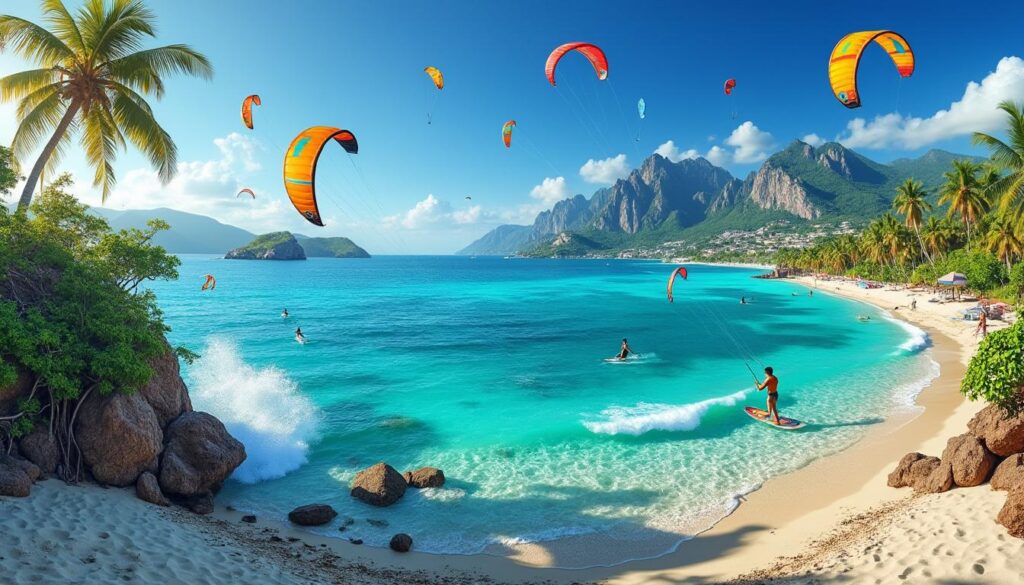
The wind pushes, the waves rise, the kite draws arcs in the sky and the board cuts the water. In this guide to kitesurfing in the waves the focus is not the perfect social photo, but understanding what you really need to get in the water with a clear mind, choose the right spot and manage the power without being caught off guard. From the Adriatic to the Ionian, passing through the best spots for kitesurf in Italy, wave riding is a discipline of its own: it requires reading the waves, timing, respect for the wind and a technique that comes from many hours in the water, not from two videos watched quickly.
Here we talk about discipline, technique and spots in a direct language, like a chat on the beach after the session. We start from what distinguishes kitesurfing in the waves from classic freeride, move on to choosing equipment, the first carvings on a clean wave and the best lines to take advantage of the vento Salento in Puglia. Whether you are thinking about a kitesurf course to start from zero or want to move from a twin tip to a directional board, you will find practical advice, mistakes to avoid and concrete references to spots, in Italy and the Mediterranean.
In short
- Kitesurfing in the waves = directional board, fine kite control and reading the set of waves, not just jumps.
- The right spot does half the job: sandy bottom, side / side-on wind and clear exit channels.
- In kitesurf Salento you can choose between the Adriatic kitesurf and the Ionian kitesurf depending on the day’s wind.
- For beginner kitesurfers in the waves you first need a solid freeride foundation on flat water.
- A good kitesurf school teaches you not only how to start, but how to read waves, currents and the line-up.
Kitesurfing in the waves: meaning, discipline and mindset
When we talk about kitesurfing in the waves, many imagine only spray and radical bottom turns. In reality this discipline is above all a change of mindset compared to freeride. You are no longer “going back and forth”, you are looking for the right section of the wave, the perfect timing to turn the board and the smoothest way to return to the line-up without getting in anyone’s way. Every choice becomes strategic: where to start, which side to keep the kite on, how quickly to head upwind.
The “sail” component remains central: the kite continues to be your engine, but in the waves it stops being the absolute protagonist. You often keep it high, almost neutral, while it is the wall of water beneath you that pushes you. This means you must learn to trust the wave, not only the pull. Essentially, stop “fighting” the sea and start using it to your advantage, as classic surfers do.
Imagine Luca, a solid intermediate on a twin tip who spends a week of kitesurf holidays in Puglia. On the flat water of the Ionian he feels at home: long edges, simple jumps, tacking without worries. Then a Scirocco arrives, clean waves break on the Adriatic side and a local hands him a directional board. He rides the first three waves just to stay upright; on the fourth he realises he can drop down the face, push on the rail and leave the kite high, almost still. There he discovers what “giving back in the waves” really means.
In terms of disciplines, wave riding occupies a precise place in the mosaic of kitesurf in Italy. If freestyle aims at unhooked tricks and airs, wave seeks clean lines and control on the face of the wave. International strapless and wave competitions reward precisely this: wave choice, variety of maneuvers, style in the turns, not pure jump height. That’s why many seasoned riders, after years of big air, end up falling in love with the directional board: less physical impact and more reading of the ocean.
On the Italian coasts, conditions are not oceanic, but Maestrale or Scirocco storms often provide workable waves more frequently than you might think. On the Adriatic kitesurf, with side-on wind and the right period, you can find smooth walls ideal for first bottom turns. On the Ionian kitesurf, after a long Scirocco swell, regular sets arrive that seem made for three well-drawn turns before the wave closes out.
The disciplinary side concerns not only technique and equipment, but also how to behave in the water with others. In wave riding surfers without kites, SUPs, bodyboarders and long-time locals coexist. Here the priority is not “who has more rights because they have a kite”, but who is already standing on the wave, who is taking off more inside the peak, who has the cleanest line. Without this respect, the line-up quickly becomes chaos.
That’s why anyone who truly wants to dedicate themselves to kitesurfing in the waves must be prepared to learn not only a new style, but a new ethic. Observe, ask questions, listen to the locals, enter the water with humility. Only then does the session become fluid and the wind, the waves and the other riders move as a single system. When you start to feel this harmony, you understand that wave kite is not just “another way to do kite”, but a complete language with its own rules.
Basic technique for kitesurfing in the waves: from freeride to the first bottom turn
To approach kitesurfing in the waves calmly you need a solid freeride base. If you still often lose the board, fail to complete turns or panic with gusts, it’s better to consolidate these skills on flat water first. Once the fundamentals are stable, you can begin to change approach and board, aiming for a directional or strapless setup.
The transition is not only about gear, but about technique. With the twin tip you are used to loading the edge on heels and toes; with the directional you must manage nose and tail as in surf, pushing hard on the back foot in turns and keeping weight forward when you want to accelerate. The kite must no longer pull you constantly: you often keep it higher, move it little and let the wave move you.
Body position and kite management in the waves
In the waves, the classic mistake of those coming from freeride is to “drive” everything with the bar. Pull, release, up and down continuously. This makes the movement nervous and makes you lose feeling with the board. The goal is the opposite: minimal bar movements, large body and board movements. The bar remains relatively neutral, the kite hovers high between 11 and 1 o’clock, while you focus on the rail.
To find the right position, think of three points:
- Shoulders facing along the wall of the wave, not toward the kite.
- Back foot well loaded on the tail in turns, to make the board turn without sliding.
- Gaze always a little ahead on the line you want to trace, not on your feet.
These three details completely change how the board enters the wave. If you look down or at the kite, you will end up braking and losing the best section.
Bottom turn, top turn and timing with the wave
Two maneuvers lie at the heart of wave riding: bottom turn and top turn. The bottom is the arc at the base of the wave, when you descend along the face and prepare to climb back up. The top is the movement at the top of the wave, where you can do a snap, cut-back or a simple smooth turn to return toward the critical part.
In the bottom turn, move from descent to action in three steps:
- Descend along the wave with weight slightly forward, kite high and the board almost in line with the face.
- When you reach the lowest part, load the back foot, tilt the board toward the wave and turn shoulders and head.
- Coordinate a small kite movement (for example from 11 to 1) to have a touch of pull while you climb.
In the top turn, the goal is to change direction without completely losing speed. Here depower comes into play: if you keep the kite too powered, it will drag you off the face of the wave; if you ease it at the right moment, you can feel the push only from the water. The trick is to “breathe” with the bar: a slight push when you’re at the top, a micro-pull while you descend.
Transitions, jibe and first strapless moves
When you start using directional boards, the jibe (standing turn) becomes fundamental. You can no longer simply do a heel-to-toe switch like with a twin tip: you must rotate the body, change foot position and keep the kite stable while the nose changes direction. At first it is normal to take a few dips, but once the movement clicks, wave riding becomes much smoother.
For those choosing strapless, there is the added challenge of not losing the board during changes of direction or in jumps. Working on light placements, micro-bounces and ankle sensitivity is essential. Here technique merges with instinct: the straps don’t hold you, you must feel the board as an extension of your body.
To get a clear overview of the technical steps from the first ride to wave riding, it can be useful to pair sessions with targeted teaching materials or videos: a good mix of practice, slow-motion images and instructor feedback accelerates the learning curve a lot. What matters is always remembering that every maneuver in the waves starts from a correct reading of the set, not from the desire to impress those watching from the beach.
Equipment for kitesurfing in the waves: board, kite and ideal setup
The choice of equipment for kitesurfing in the waves is different from that for simple freeride. A board that seems perfect on flat water can become unmanageable in chop and waves, while a kite that is too “nervous” will force you into constant adjustments when you actually need calm and predictability. That’s why, before jumping into the sea with the first directional found in the shop, it’s worth understanding which elements really make the difference.
The key triangle is simple: board – kite – setup. The goal is to find a balance that allows easy starts, good control in bottom and top turns, quick water relaunches and the ability to handle lulls and gusts typical of Mediterranean spots. A good basic rule is not to extremize: better an accessible wave board and a versatile freeride/wave kite than a radical race set-up designed for pros.
Directional and strapless boards for the waves
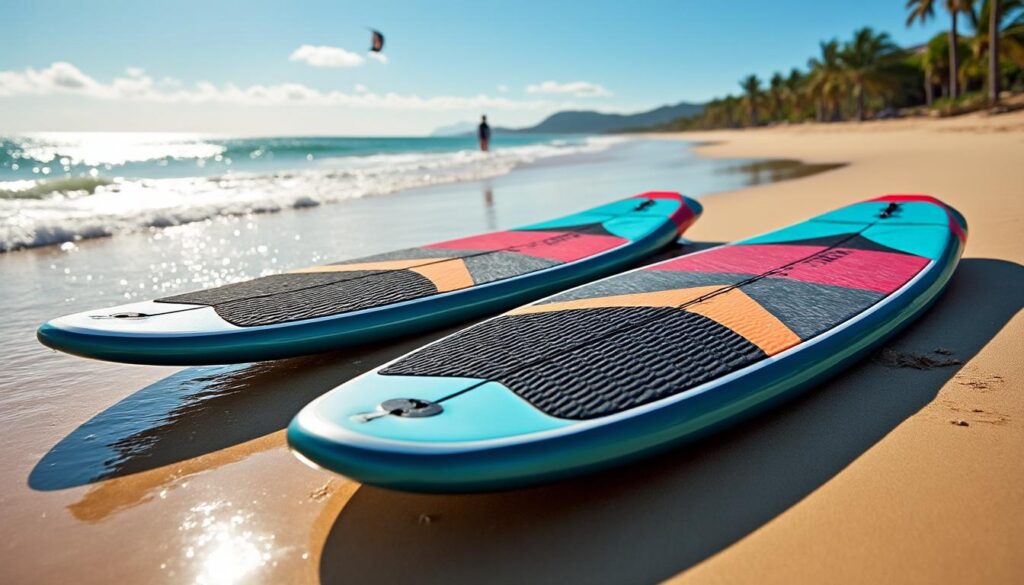
In waves the protagonist is almost always the directional board. The main differences compared to a twin tip are asymmetric nose and tail, volume distributed to facilitate takeoffs and exits from steep sections and rails designed to hold the line in turns. The most common sizes range from 5’2 to 5’10 depending on the rider’s weight and style.
For those coming from beginner kitesurfing or intermediate levels, a board with a bit more volume and soft lines helps a lot. No one forbids you from using straps at the beginning: they give security and keep the board glued to the feet during the first jibes and bottom turns. Over time, if you fall in love with pure wave, you can switch to strapless, perhaps starting on days with small waves and steady wind.
Type of kite for wave riding
In wave riding, the keyword is drift, the ability of the kite to remain stable and predictable while you advance driven by the wave with little pull. Freeride models oriented toward wave often have more open profiles, bridles designed for good depower and a progressive response to inputs.
To get an idea, look at the difference between a classic C-kite designed for unhooked freestyle and a modern delta/wave. The first demands constant bar input, pulls hard in the window and punishes position errors. The latter soaks up gusts, stays controllable even when it drops downwind and allows you to focus more on the board than the sail.
At spots like kitesurf Lecce or kitesurf Taranto, where conditions can change from flat to formed sea in a few hours, having a quiver of 2–3 well-chosen wave/freeride wings covers most situations. To understand which sizes to start with based on the typical wind of your area, it can be helpful to read focused resources like this piece on the minimum wind for kitesurf, which helps connect weight, size and real knots on the spot.
Setup, fins, leash and accessories
In wave riding, details like fins and a leash matter more than they might seem. A board mounted in thruster (three fins) often offers the best compromise between hold in turns and manoeuvrability; the quad (four fins) can give more speed along the wave but requires more sensitivity to avoid sliding. The board leash, banned in freeride with twin tips, becomes mandatory here to avoid losing the directional in the frequent wipeouts in the wave zone.
On the bar, an easily reachable trim is essential: in the waves you often move from moments of full wind between sets to slightly softer moments closer to shore. Being able to adjust power in seconds means avoiding unnecessary broaches when a bigger wave surprises you.
To get a clear view of the differences between freeride and wave gear, a quick overview can help:
| Elemento | Setup freeride | Setup wave consigliato |
|---|---|---|
| Tavola | Twin tip 135–140 cm | Direzionale 5’4–5’8 con volume medio |
| Straps | 2 straps simmetriche | Strapless o 2/3 straps regolabili |
| Kite | Freeride/all-round | Wave/freeride con buon drift e depower |
| Pinne | Standard twin tip | Thruster o quad specifico wave |
| Leash | Solo leash di sicurezza al kite | Leash tavola + leash di sicurezza al kite |
Once you find the setup that makes you feel confident, the feeling is clear: in the waves the gear disappears and only the line you want to draw on the face of the wave remains. When that happens, you understand that every minute spent thinking about boards, kites and fins was an investment, not a gear-nerd fixation.
Spots, wind and waves: Salento, Puglia and the best wave locations in Italy
Talking about kitesurfing in the waves in Italy means, first of all, knowing the wind. Every coast has its character, its ideal directions, the days when it really “switches on.” The advantage of kitesurf Salento is precisely the ability to choose between Adriatic kitesurf and Ionian kitesurf almost every day, depending on Maestrale, Tramontana or Scirocco. A short drive and the session changes completely.
Anyone organizing a week of kitesurf holidays in Puglia understands immediately: the priority is not the most photographed beach, but exposure to the wind. A day that is messy onshore on the Adriatic side can become a clean side-shore on the Ionian side, and vice versa. That’s why local riders move “in search of wind” more than in search of postcard locations.
Salento: two seas to always choose the best spot
In the heel of Italy, the vento Salento plays with the geography. Tramontana and Maestrale often come in clean on the Adriatic side, generating chop and waves that grow as the hours pass. Scirocco and Levante, on the other hand, work better on the Ionian, often with longer swell and regular waves. Knowing where to go based on direction is what separates a good session from a day spent watching others have fun.
For those who want a practical overview of the community, groups and local scene mentality, resources like the article on kitesurf community in Italy help understand how to move between spots, courses and trusted contacts. The beauty of Salento is that kite is not just a sport, but a network of friends who warn each other when “the right wind” arrives.
Other wave spots in Italy and the Mediterranean
The best kitesurf spot in Italy for waves is not just one. It depends on season, swell and wind. Some guidelines, however, exist. The west coast of Sardinia is famous for powerful storms and often steady wind, ideal for those already familiar with significant waves. Sicily, with areas like the Stagnone for flat water and other spots exposed to the open sea, allows you to alternate flat-water technique days with formed-sea days.
Less “publicised” shores such as some bays in the Tyrrhenian or Ionian Calabria are also entering the wave riding map, thanks to the growth in riders and local schools. Outside Italy, the Mediterranean offers interesting wave destinations in Greece, Spain, the Atlantic coast of Morocco and beyond: those wanting to broaden their horizon can find concrete ideas in guides like those dedicated to kitesurf destinations in Europe, useful for planning an entire season chasing waves.
Safety and reading the spot in the waves
If flat water forgives many mistakes, the waves do not. Before rigging the kite, always take time to read the spot. Where do the main waves break? Are there exit channels with less foam? What is the direction of the current? Is the wind really side/side-on or does it tend to push you toward the rocks? These questions are not theory, they are the basis for not finding yourself trapped in a nasty shore break with the sail pinned down.
A good habit is to watch the local surfers: where do they start? What trajectory do they follow to return to the line-up? If you are new to a place, asking for two pointers on the beach is a sign of intelligence, not inexperience. Often three sentences from a rider who knows that stretch of coast are enough to save you from a bad adventure.
In the colder months, when the Mediterranean lights up with storms, many riders choose to move to warmer destinations to continue working on the wave. In these cases, specific guides on winter kitesurf and warm destinations help plan a season without long stops and to take to the water, under different skies, the techniques practiced at home.
In the end, every wave spot is a unique combination of wind, bottom and line-up. Understanding this combination, listening to those who have been riding it for years and adapting your own style is the only way to turn the waves from a random obstacle into a playmate. When you start to recognise a good set from afar and move naturally between channels and currents, the Mediterranean becomes one big playground.
Learning to kitesurf in the waves: path, typical mistakes and practical tips
Reaching wave riding without skipping steps is the smartest choice you can make. No one is born ready to face a set of waves with a kite and a directional. It takes time, patience and a planned path. First consolidate beginner kitesurfing on flat water, then add chop, finally enter real waves. In this journey, a serious kitesurf school makes the difference between steady progression and an endless series of “feel-based” sessions with few real improvements.
A good structured kitesurf course, after basics of safety and initial rides, can already include some elements preparatory to wave: kite management without looking at it, clean changes of direction, work on speed control and trajectories. When these pieces are stable, introducing small waves becomes natural, not a leap into the void.
The most common mistakes of those entering the waves
Those who move from flat to wave carry automatisms that worked before but become counterproductive. The three most frequent mistakes are:
- Kite too low: in the waves the kite should be kept higher to avoid falling into the foam and to have a safety margin if the wave throws you forward.
- Excess speed: arriving at the wave like on a highway, without modulating power and line, often causes you to miss the turn timing.
- Not looking at the right section: fixating on the part of the wave closest to you and losing sight of where it will close or open up.
Correcting these patterns requires awareness. Every time something doesn’t work, try asking yourself: where was my kite? Where was I looking? How much was I loaded on the board? In a short time you will start recognising your tendencies and reversing the negative ones.
How to structure the first sessions in the waves
An effective approach is to dedicate specific sessions to only one aspect at a time. For example, a whole day just to work on keeping the kite high and stable while you pass over the white water. Another focused on smooth bottom turns, without the expectation of doing top turns immediately. This way the body can memorise clear patterns, instead of being bombarded by a thousand simultaneous demands.
Structuring sessions this way also helps manage mental energy better. Waves require much more concentration than flat water: incoming sets, currents, other riders, upwind obstacles. If you turn every outing into a total exam, frustration will come quickly. If instead you decide what you want to work on before entering the water, every small improvement becomes a concrete win.
Costs, courses and continuity of practice
Many riders underestimate the impact that a couple of hours of targeted coaching can have on wave progression. An external eye immediately sees position errors, timing mistakes and bad habits. To understand how to choose between single lessons, packages and rentals, articles like those on kitesurf lesson rates help define a realistic budget and choose formulas that allow continuous practice, not just “the course once in a lifetime”.
Continuity is perhaps the most often underestimated factor. Better three consecutive weekends with choppy sea than a single annual week-long trip. Waves, like wind, are learned through repeated exposure. Every session leaves a trace in muscle memory and in your ability to read the water. Skipping months only to expect to pick up where you left off is the best way to never truly feel comfortable.
In the end, learning kitesurfing in the waves is like learning a new language. At first you struggle to follow the flow, then you start recognising recurring structures, and finally you find yourself “thinking” directly in wave: you see the set coming, position yourself without even thinking too much, turn the board and end up shouting alone on the face of the wave. That’s when you understand that yes, it was worth it.
Watching instructional videos and then repeating the exercises in the water, with clear objectives, makes progression faster and above all more conscious.
Physical, mental and lifestyle benefits of kitesurfing in the waves
Kitesurfing in the waves is not just a technical variant of kite: it is a different way of being at sea. Wave sessions tire the body in a particular way and at the same time clear the mind like few other activities. The continual alternation between waiting for the set, paddling with the directional board, managing the kite and pure surfing creates a rhythm that resembles a long active meditation.
Physically, the waves work the legs, core and stabilisers a lot. Every small variation in bottom and the wall of water forces continuous micro-adjustments. It’s an intense but intelligent workout: you don’t end up making static efforts, but fluid movements hidden in the glide. In addition, the cardio component increases compared to freeride, because between waves you often have to get back to the line-up, handle currents, walk upwind if the kite takes you downwind.
The mental benefit is perhaps the most powerful part. In the waves you cannot “switch off your brain”: if you do, the next set will catch you off guard. You must remain present, read the horizon, feel the wind on your skin and understand how it combines with the tide and swell. This total presence leaves little room for useless thoughts. Many riders say that wave sessions were decisive in managing periods of work or personal stress: the sea takes, breaks down and then returns everything in a simpler form.
On the lifestyle level, wave riding changes how you spend holidays and weekends. You no longer choose a destination just because “there’s wind”, but because there are waves of a certain type, a community with a mindset similar to yours, schools or instructors who speak the same “sea language”. The Mediterranean offers a rare mix of culture, food, lively towns and kite spots: between storms you can truly build a lifestyle that alternates work, sessions and rest naturally.
Videos and stories from Italian and Mediterranean riders show how kitesurfing in the waves is no longer a niche, but a living part of sea culture, shared among those who get up at dawn, already look at flags and waves, and know that the day will be built around a single thing: taking the bar at the right moment.
How advanced do you need to be to start kitesurfing in the waves?
To enter the waves safely it is recommended to already have a solid intermediate level in freeride: secure starts, consistent upwind, controlled direction changes and good kite handling without looking at it. If you often lose the board or still feel insecure with gusty wind, it is better to consolidate these aspects on flat water before tackling wave riding.
What type of board is best to start in the waves?
To start kitesurfing in the waves a directional wave board with a bit of volume and soft lines, set up in thruster, is ideal. You can use straps at the beginning to feel more stable and switch to strapless later. Avoid shapes that are too radical or too small: they make the learning curve unnecessarily steep.
Is it dangerous to do kitesurfing in the waves as a beginner?
Entering waves directly as an absolute beginner is not recommended: waves add complexity and risks (shore break, currents, crowded line-ups) that require solid control of kite and board. Much safer is to take a course in a flat-water spot, become independent and only then, with the help of instructors or experienced riders, gradually approach the waves.
What wind conditions are ideal for wave riding in Italy?
Ideal conditions for kitesurfing in the waves in Italy are side or side-on wind between 15 and 25 knots, orderly waves and a preferably sandy bottom. In Salento, for example, Maestrale and Tramontana work well on the Adriatic, while Scirocco and Levante can offer great waves on the Ionian. It is always important to check currents, incoming swells and upwind obstacles before entering the water.
Do you need specific insurance for kitesurfing in the waves?
Having kite-specific insurance is highly recommended, especially if you practice in wave spots shared with surfers and other sea users. There are policies designed for kite that cover liability and injuries, useful both in Italy and abroad. Checking available coverages in advance allows you to face sessions with greater peace of mind.