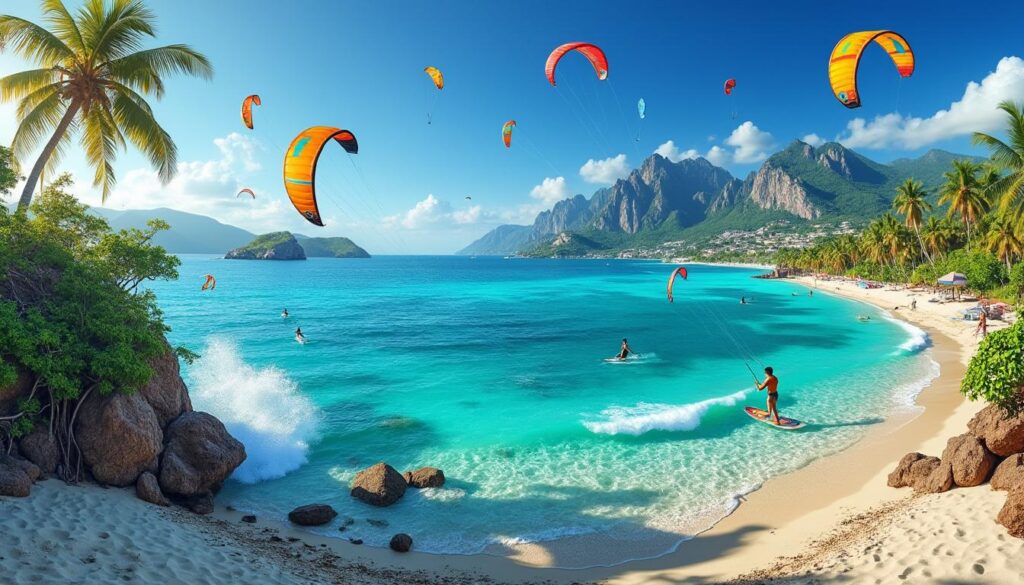
The wind blows, the kite rises and on the beach there is a child who watches the water with bright eyes. More and more families ask themselves at what age you can start kitesurfing and how to do it safely, between specialized schools, kids equipment and suitable spots. Kitesurfing is no longer just for adults: in Italy, from Garda to Salento, to Sardinia and Sicily, programs designed specifically for the little ones are emerging, with trained instructors and clear protocols. The issue is not only chronological age, but weight, swimming ability, maturity and the quality of the chosen school.
Kitesurfing for children, if approached seriously, is a path that teaches wind control, respect for the sea and autonomy. The difference between a happy memory and a bad experience lies in the details: shallow water or deep seabed, light or gusty wind, a chaotic group or tailored lessons. Choosing a kitesurf spot in Puglia or another Italian spot, understanding if your child is ready, assessing costs, timing and the role of parents: all this is part of the game. The goal? To make the child experience kitesurfing as a serious game, having fun while learning, without force and without unnecessary risks.
In short
- Age and weight: generally kids kitesurfing starts around 7–9 years old, with a minimum weight of about 30 kg and good water skills.
- Being able to swim is mandatory: the child must feel safe in the water and know how to handle short stretches of freestyle swimming.
- Certified school: choosing a kitesurf school with instructors specifically trained for teaching children makes a difference.
- Weather conditions: light wind, a safe spot, shallow or flat water are essential in the early stages.
- Role of parents: support, patience and realistic expectations; it’s better to avoid acting as the instructor directly.
- Benefits: kitesurfing develops autonomy, self-confidence, coordination and the ability to read wind and environment.
Kitesurfing for kids: right age, minimum weight and requirements to start
When we talk about kitesurfing for children, the first question is always the same: “At what age can they start?”. In Italy, many schools indicate as a guideline 7–9 years, but the raw number tells only part of the story. An 8-year-old who weighs 32 kg, swims without fear and listens attentively can be more ready than a twelve-year-old who is not comfortable in the water. For this reason, serious centers always evaluate four parameters: age, minimum weight around 30 kg, water skills and maturity.
Weight is not a random detail: a body that is too light, carried by the wind via the kite, has less inertia and is moved easily. To learn safely, you need the right balance between kite power, rider weight and technical control. That’s why many instructors prefer to wait until the child reaches that 30–35 kg range before moving on to in-water phases with the board, perhaps starting with simple kite flying exercises on land, with reduced equipment and very soft wind.
Another non-negotiable requirement: swimming. The child must be able to swim freely, without armbands and without panicking if they swallow some water or suddenly find themselves without support. It’s not about entering a freestyle competition, but about being able to sustain a short distance and stay clear-headed even in an unexpected situation, such as a fall while wearing a life jacket.
Head count matters too. In kids kitesurfing, the ability to follow instructions, distinguish left from right, not touch equipment without permission and respect timing is fundamental. A concrete example? Luca, 9 years old, on his first day of course immediately falls in love with the kite, but tends to get distracted. The instructor works in short blocks, with frequent breaks, alternating explanations and play. That way, Luca learns to concentrate at key moments without experiencing the lesson as a constant scolding.
To have an overview, it’s useful to compare the most common guidelines used by kitesurf schools in Italy:
| Parameter | Recommended value | Why it matters |
|---|---|---|
| Indicative starting age | 7–9 years | Age at which coordination and attention allow managing the basics of the kite. |
| Minimum weight | ≈ 30 kg | Greater stability relative to the kite’s pull, safer handling. |
| Swimming ability | Swim without aids | Handling falls, short distances and contact with water. |
| Maturity | Listening and rule-following | Indispensable for following instructions and safety protocols. |
In this framework, kitesurfing for beginners is not taboo for the little ones, but a path to be built calmly. The first sessions can take place on land, with trainer kites and bar-control games, without rushing to get on the board right away. The key is to transform initial curiosity into a healthy progression in which each step is consolidated.
Those who choose kitesurfing holidays with the family should also carefully consider the time of year: milder months, long days, not freezing water and moderate wind help the child have a serene first contact with the sea. In short, the real answer to “at what age?” is: when age, weight, swimming and mindset are aligned.
How to understand if your child is really ready for kitesurfing
Beyond the numbers, there are some signs that help understand if it’s the right time. Does the child often ask to try, watch sessions attentively, ask questions about the wind and equipment? When they go to the sea, do they enter the water willingly and not freeze if waves splash their face? These clues indicate a natural predisposition to the discipline.
It can be useful to start with small tests: an advanced swimming course, some outings on a SUP or bodyboard, games with mini kites on the beach. If they react well, listen, respect the gear and keep wanting to play despite the effort, then moving to a junior kitesurf course can be the natural next step. The wind waits, but it doesn’t run away: the child’s serenity is always the priority.
Safety first: kitesurf school, certified instructors and the role of parents
Once it’s clear that the child is ready, the next topic is safety. Here the choice of kitesurf school makes the difference between a structured path and unnecessary risk. For the little ones, it’s essential that instructors have a specific “Teaching to Children” training or equivalents: teaching kitesurfing to an adult is not the same as working with a child who can get tired, distracted or frightened suddenly.
The most attentive schools offer equipment dedicated to the stature and weight of kids: small harnesses, wetsuits suitable for the temperature, helmets, life jackets and reduced-size kites. In addition, they often use helmets with radios, so the instructor can speak directly to the child even when they are a few meters out in the water. This continuous communication lowers stress, corrects mistakes in real time and transmits calm.
Some schools, especially in spots like Punta Trettu in Sardinia or in kitesurf Salento, work with small groups or private lessons, precisely to maintain constant control of the situation. In a typical two-hour lesson, the first part is dedicated to equipment setup and safety reminders, the second to very progressive practical exercises, with breaks calibrated to the youngsters’ endurance.
A separate chapter concerns the role of parents. Even those who have been kiting for years tend to underestimate a fundamental aspect: being a parent and being an instructor are two different things. Children, especially during moments of frustration or fear, often respond better to an external adult perceived as a neutral guide. It’s a matter of emotional dynamics: with mom or dad, expectations, the desire not to disappoint and fear of being judged come into play.
For this reason, many schools suggest a clear model: leave technical teaching to the instructor and reserve the parent a role of logistical and emotional support. For example, learning to check weather conditions, recognize a gust, help prepare equipment on land and know how to behave in an emergency off the water. This creates a real team: instructor, child and parent all row in the same direction.
Another often underestimated point is managing expectations. Some dream their child will, after two lessons, already do a water start and long reaches. The reality of kitesurfing for beginners, especially for children, is much more gradual. In the first sessions the goal may be only to learn to control the kite, understand where the wind is coming from, try some controlled body drags in the water. And that is perfectly fine.
Families that live this path better are those who turn each step into a success: the first day the child keeps the kite steady in the wind window, the first time they feel pulled in the water, the moment they recognize a change in wind direction on their own. Kitesurfing teaches patience, and this patience starts with the adults.
Those who dream of taking their children on future kite trips, perhaps to iconic spots like Punta Trettu or the Atlantic islands, should build from the start a solid base of safety and trust. A child who feels heard, protected and not judged will want to return to the water, even after a fall or a failed exercise. And, in the long run, that is the real victory.
Structure of a kids kitesurf course: duration, costs and real progression
Understanding how a kitesurf course for children works helps parents navigate offers and promises. Generally, kids lessons last about 2 hours, but many schools allow shortening the session based on the child’s endurance. Two hours are the compromise between enough time to get into the flow and not overdoing mental and physical fatigue.
The most common formats are three: private lessons (one child, one instructor), paired lessons and small groups of three. One-to-one lessons have a higher hourly cost, often around 60 €/h, which can drop slightly after a certain number of hours (for example to 50 €/h from the seventh hour onwards). Paired lessons tend to halve the price per child, hovering around 30 €/h, while groups of three drop further, with prices around 25 €/h per student.
These costs almost always include all technical equipment: kite, bar, board, harness, wetsuit, helmet, life jacket. For the first land lessons, a swimsuit, sunscreen, sunglasses and a good water bottle are enough. This “all inclusive” formula allows the family to try kitesurfing without immediately investing in their own gear, a decision that makes more sense once some autonomy has been achieved.
The typical progression of a kids course develops in multiple phases. In the first part, the focus is on kite control on land: wind window, launching, landing, basic safety, quick release. Then you move to shallow water, where the child tries the first body drags always with close instructor support. Only when kite control is stable and water handling is natural is the board introduced and the first attempts at water start.
Many certified schools issue at the end an international certification (for example IKO) that certifies the level reached. It’s not just a piece of paper: it allows the child, as they grow, to access services like lifts or gear rental at other spots without starting from scratch. It’s like an identity card for the rider in training.
Talking about overall budget, it’s useful to consider that the biggest investment is always in the early stages: course, travel, possible accommodation near the school. Once the child becomes autonomous, costs drop drastically, especially if you opt for used kitesurf equipment that is well selected. Those who prefer new gear should budget, for a complete set, around 2,000–2,200 €, but with the advantage of better value retention and easier resale.
In Italian regions with a strong kite vocation, like kitesurf Lecce, kitesurf Taranto on the Ionian side or schools on Garda, kids programs are often organized modularly: 6–8 hour packages, intensive weekends, summer weeks. The idea is to allow the child to learn while maintaining some continuity, without letting too much time pass between lessons, so as not to lose practical and theoretical notions.
For planners, a useful tip is to set realistic goals for each lesson block. For example: “With the first 4 hours, we focus on basic kite control and safety. With the next ones, we work on body drag and first approaches to the board.” This avoids the frustration of expecting pro results after a few sessions and lets you enjoy every small achievement. In kitesurfing, especially with children, the true progression is the one that doesn’t skip steps.
Choosing the right spot: Salento, Puglia and other kids-friendly spots in Italy
To introduce a child to kitesurfing, the spot matters as much as the instructor. In Italy, some places are particularly suited to first experiences thanks to shallow water, sandy bottoms and fairly regular wind. In the South, kitesurf Salento offers the rare combination of two seas, the Adriatic and the Ionian, which allow chasing the wind by choosing the side best suited to the day’s conditions.
On the Ionian coasts, many bays with relatively flat water and gradual bottoms are perfect for the little ones to take their first steps, especially on light thermal wind days. On the Adriatic side, wider beaches allow comfortable set-ups and plenty of space on the shore for land exercises, kite flying in safety and emergency simulations. The Salento wind, variable but generous in the shoulder seasons, often offers light sessions ideal for kids.
Heading north, spots like Lake Garda offer another dimension: fresh water, morning thermal winds and organized tourist infrastructures. Here, schools tend to concentrate courses from April to October, when temperatures and wind favor those who want to learn. Well-managed Ora or Peler days, with support boats and lift systems, allow building a solid base before tackling more demanding seas.
Looking beyond Puglia, other Italian spots suitable for families with children include lagoons, enclosed bays and beaches with shallow, flat water. In Sardinia, for example, Punta Trettu has become a reference point for those seeking “flat” conditions and steady wind, often cited as one of the best kitesurf spots in Italy for learning. In family stories, the same words always return: waist-deep water, sandy bottom, manageable wind, support boats in the water.
Those who start the path in Italy and then dream of moving to international spots can find inspiration in destinations like Fuerteventura for kitesurfing or Tarifa. Before thinking about these scenarios, however, it’s strategic to make the most of what’s at home: learning to read a weather bulletin, recognize wind direction relative to the coast, understand the difference between chop, swell and flat water.
In coastal Italian regions, a culture of mutual respect between experienced kiters and beginners is also growing. In the best spots, areas dedicated to schools reduce the risk of collisions, separating learners from those performing advanced maneuvers. This is important not only for safety, but also for the atmosphere: a child who feels welcomed, not a nuisance, associates positive feelings with kitesurfing that will stay with them for a long time.
In perspective, choosing the right spot means saving time, energy and nerves for the whole family. The best kitesurf spot in Italy is not only the one most famous on Instagram, but the one where wind, water, the school and the context align with the main objective: making the child fall in love with the sea in a safe and gradual way.
Benefits of kitesurfing for children: autonomy, confidence and an active lifestyle
Beyond the technical part, kitesurfing for kids brings with it a huge load of psychological and physical benefits. It’s a complete sport in which the child learns to manage balance, coordination, controlled strength and concentration. It’s not just about “going fast” or “jumping high”, but understanding the relationship between body, wind and water. Every exercise becomes a small applied physics lab without the child noticing.
One of the most evident impacts is on self-confidence. Think of a girl who, after days of attempts, finally manages to lift herself on the board for a few meters. That feeling of almost flying over the water remains. It increases the perception of one’s abilities, reduces fear of making mistakes and reinforces the idea that with commitment and patience results come. In kitesurfing there is no “all at once”: you fall, you try again, you improve.
Then there is the aspect of autonomy. A mini rider learns to prepare part of the equipment, check their helmet, fasten the harness correctly, verify that the lines are not tangled. These small responsibilities, guided by the instructor and supervised by parents, train the ability to take care of oneself and one’s gear. The sea doesn’t like improvisation: this lesson remains valid even off the water.
From a social point of view, kitesurfing for children often opens the door to new friendships. In kids courses or summer camps, youngsters from different towns meet who share the same passion. They compare progress, encourage each other, celebrate the first reaches together. The wind, which for an adult can be simply a technical datum, for a child becomes a shared element, almost a secret language to decode as a group.
Another powerful aspect concerns the relationship with nature. Those who grow up reading the sea, watching clouds and listening to wind direction develop a spontaneous attention to the environment. They don’t throw plastic on the beach, respect marine life, understand the importance of weather forecasts not only for the session but for everyone’s safety. The sea is not a postcard backdrop, but a living ecosystem to know and respect.
In everyday life, this active lifestyle translates into fewer hours in front of screens and more movement. A weekend of kitesurfing holidays with the family means getting up early, packing a bag, reaching the spot, breathing sea salt for hours. For many children used to city life, it’s a positive revolution: they discover the pleasure of effort, wind on the skin, sand between their toes.
In the long term, kitesurfing can become a common thread that accompanies adolescence and adulthood. Some children start with courses in Italy, then grow up exploring spots like Tarifa, Porto Pollo or the Canaries, perhaps following itineraries told by dedicated media or articles such as those on the history and meaning of kitesurfing. Not everyone will become a pro, but many will carry with them a different way of being in the water and enjoying free time.
Ultimately, the real gift of kitesurfing to the little ones is not only the possibility of gliding on a board, but the chance to grow with a simple mantra: learn to read the wind, accept that not everything can be controlled, but that with respect, technique and listening you can live with the force of nature and use it to play, safely.
At what age can a child start kitesurfing?
Generally children can begin to approach kitesurfing between 7 and 9 years old, but age is not the only parameter. A minimum weight of around 30 kg, a good ability to swim without aids, the desire to learn and the ability to follow instructions also matter. The first phases can be carried out on land, with small kites and light wind, then gradually move to shallow water.
Is kitesurfing dangerous for children?
Like all wind and water sports, kitesurfing can be risky if practiced without rules. However, if the child is followed by a certified school, with instructors specialized in teaching the very young, appropriate equipment and safe spots, the level of safety increases enormously. The use of a helmet, life jacket, radio-helmet and shallow water makes the learning process much more controlled.
How much does a kitesurf course for children cost?
Costs vary depending on the school and the chosen formula. Indicatively, a private lesson can cost around 60 €/h, with reductions after several hours; paired lessons are around 30 €/h per child, while small groups (three students) can drop to about 25 €/h per child. Equipment is almost always included in the price. For the complete path consider multi-hour packages, often offered at discounted rates.
Can parents directly teach kitesurfing to their children?
Even if a parent is an experienced kiter, it is not advisable to teach their own children autonomously. Children respond better to an external instructor, used to managing emotional dynamics, safety and didactic progression specific to the age. The ideal role of the parent is support: choose the right school, follow the child, learn the basics of safety and keep realistic expectations about progression.
How long does it take for a child to become independent in kitesurfing?
The time required depends on age, lesson frequency, spot conditions and personal predisposition. On average, after a first 6–8 hour package a child can manage the kite safely and start the first body drags in the water. To reach water starts and short reaches require more sessions, preferably close together. The important thing is not to rush: a slow but solid progression is the basis for autonomous and safe practice.