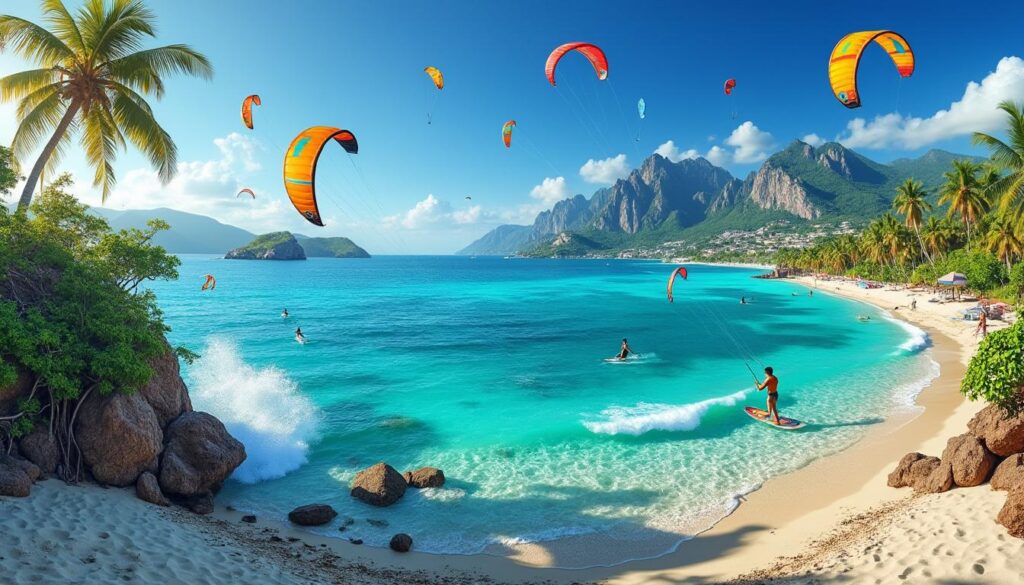
You’re looking at the sky, counting the knots at your favorite spot and always asking yourself the same question: which kitesurf kite should I use today? Choosing the right wing isn’t a technical detail, it’s what decides whether you’ll have a relaxed session full of progress, or a constant fight with the wind. With different shapes, sizes, wind ranges and skill levels, the risk of getting confused is high, especially if you’re starting out or switching seas, from the Adriatic kitesurf to the Ionian kitesurf. In Italy, and particularly at Puglia kitesurf spots, picking the wrong kite often means staying on the shore watching others ride.
Those approaching beginner kitesurfing often hear about HER, C-kite, foil kite, hybrids, delta. Names that sound technical but hide simple logic: stability versus responsiveness, safety versus extreme performance, smooth power versus brutal pull. Knowing these differences helps you read the wind better, understand what’s happening on the bar and choose a kite that truly fits your level, your weight and your goals. Whether you’re learning the water start at a Salento kitesurf spot or preparing your first strapless jumps at one of the best kitesurf spots in Italy, the kite is not an accessory: it’s your engine.
- Understanding kitesurf kite types (LEI, foil, C, delta, hybrids) is the first step to choosing well.
- Level, weight and the real wind at the spot should always guide the size choice.
- To learn kitesurfing safely, it’s better to use a stable kite with big depower and easy relaunch.
- To progress in freestyle or foil, you need more technical wings, with direct feedback and specific profiles.
- Complementary equipment such as a wetsuit, helmet and harness completely changes comfort on the water.
Types of kitesurf kites: LEI, foil, C, delta and hybrids explained simply
To choose the right wing for your level you must first recognize what you’re looking at when you see a kite in the sky. Inflatable LEI kites are the ones you see at most kitesurf spots in Italy: they have a rigid leading edge, pumped with air, and one or more bladders that give the kite its shape. This design makes the kite float in the water and, above all, very stable—ideal both for basic courses and for riders who enjoy relaxed freeride.
LEI kites are popular because they offer a good compromise between ease and performance. They have an intuitive water relaunch: if the kite falls, a small bar input and a few steps on the board will bring it back up. It’s one of the reasons why almost all kitesurf schools, from kitesurf Lecce to kitesurf Taranto, use LEI kites for their courses. For a rider doing their first tacks, knowing the kite will relaunch without drama is pure gold.
Moving on to foil kites, the structure changes completely. There is no inflatable leading edge here: the kite is made of many stitched cells that fill with air during flight. The result is an ultra-light wing, super efficient in light winds. When you see someone planing with 8–10 knots on a foil board, they almost always have a foil kite flying. This type of kite offers continuous, smooth lift, but demands educated hands: trim must be cared for, water relaunches are more delicate and the lines tend to be more complex.
C-kites are the old school of freestyle. They have a pronounced “C” shape, little or no front bridle, and a direct feel on the bar. The pull is brutal, the arc is narrower and the depower less generous. Riders doing very radical kitesurfing, with unhooked moves and old-school tricks, still prefer them for the precise control they provide. For a beginner, however, this aggressive responsiveness can be demanding, especially in gusts.
Delta kites and hybrids are children of design evolution. The delta shape is easily recognizable: a leading edge that tapers toward the tips and a wide, rounded trailing edge. This mix creates a kite that turns fast, stays stable and has generous depower. Perfect for those dreaming of wave riding and fun jumps without sacrificing safety. Hybrids mix C and delta elements (or foil and LEI) to create versatile kites with a wide wind range and a feel that’s neither too soft nor too nervous—ideal as an all-round kite for those who want to do a bit of everything.
Imagine Luca, a beginner at an Puglia kitesurf spot on the Ionian side. The wind is medium, around 18 knots. With a 12 m C-kite he would end up dragged and exhausted after a few legs. With an 11 m delta or a 12 m LEI freeride, instead, he would have controllable pull, easy relaunch and time to breathe between runs. The moral is clear: the kite’s design must speak the language of your level.
Once you understand the different models, it’s natural to ask how all this affects the practical choice, especially when the wind changes direction and intensity between the Adriatic and Ionian in the same day.
How to connect kite type, riding style and spot
Each kite type comes alive differently depending on the riding style. Relaxed freeride, made of long runs and some controlled jumps, pairs well with LEI freeride and hybrids. Those who love waves, especially on the Adriatic kitesurf when clean little waves arrive from the North-East, often choose delta or hybrid wings with stable drift and quick turning. For foil, instead, foil kites or lightweight LEI kites with a higher aspect ratio have become standard, as you can explore in guides dedicated to kitesurf with foil board.
If your goal is to learn kitesurfing, go out often and feel safe while managing water starts, body drags and first upwind legs, choose a kite with generous depower, intuitive relaunch and a wide wind range. Only when these parameters become routine does it make sense to think about more technical kites for freestyle or big air. Safety first, style later.
Choosing kite size: wind, weight and level
Once you’ve grasped the kite types, the next step is to understand which kite size to use depending on the wind and your weight. A common mistake for beginner kitesurfers is to accept a single “jolly” size recommendation without considering the actual spot. At classic Salento kitesurf spots, where the wind can change from 12 to 25 knots in a few hours as the sea changes, having only one kite often means losing half the good days.
A general rule: the heavier you are and the lighter the wind, the bigger your kite should be. Conversely, if you’re light or you often sail with a strong Mistral over 20 knots, you’ll need smaller sizes. But the number on the anemometer isn’t enough. Gusts, current, board type (twintip, small surfboard, foil) and especially your control on the bar must also be considered.
To give a concrete idea, look at this indicative chart for an average rider on a twintip in the Mediterranean:
| Rider weight | Light wind (10–14 knots) | Medium wind (15–20 knots) | Strong wind (21–28 knots) |
|---|---|---|---|
| 55–65 kg | 11–13 m² | 8–10 m² | 6–8 m² |
| 66–80 kg | 13–15 m² | 9–12 m² | 7–9 m² |
| 81–95 kg | 15–17 m² | 11–13 m² | 8–10 m² |
These ranges are just a starting point. For first kitesurf lessons, many instructors prefer to stay slightly below the “ideal” size, especially when the wind is irregular. Better to make a few fewer runs than to be overpowered, with the kite dragging you to shore while you fight instead of learning. In kitesurf holidays this choice makes even more sense: you don’t know the spot well, you don’t yet feel the local wind, so it’s logical to be conservative.
Take Chiara, 60 kg, doing her first outings at an Ionian kitesurf spot with thermal winds of 15–18 knots. With a 12 m freeride she could ride well, but to learn the first water starts often using a 9 or 10 m kite will make her feel lighter on the bar, with depower margin to handle gusts. Once her technique improves, that same 12 m kite will become her weapon to plane even in 13–14 knots.
Don’t forget that the board type affects performance almost as much as kite size. With a foil board, planing at 10 knots with a 9 m kite is a reality, while with a twintip you’ll often need a 13–15 m. If you’re curious how much the board changes the game, exploring specific content on kitefoil and flying over the water can open a world.
Wind range, safety and progression
Every kite has a manufacturer-declared wind range: it’s the interval of wind within which the kite performs well, provided the rider knows how to use it. For a beginner, however, it’s better to consider only the central part of that range. If a 12 m is rated for 12–25 knots, someone learning should realistically see it as good for 13–20 knots, leaving out the extremes that require responsiveness and experience to manage depower and trim.
The key is simple: select the kite that allows you to ride with the bar at half travel, neither fully pulled in nor fully depowered. If you always have the bar pulled all the way in and still aren’t planing, you need a bigger kite or more wind. If instead you ride with the bar pushed forward, gritting your teeth to avoid being blown away, it’s time to step down in size. Listening to these sensations is the fastest way to learn to choose the right equipment for yourself.
Kite for beginners: stability, relaunch and forgiveness
Beginners often want to know what the best kitesurf kite to start with is. The answer isn’t a single brand or model, but a set of characteristics. To learn kitesurfing safely you need wings with an intermediate profile, 3 or 4 struts, large depower and a bridle system that makes the kite stable in the window. This type of kite “forgives” bar errors and doesn’t turn every micro-movement into a violent pull.
In kitesurf courses kites are also chosen for their easy relaunch. A beginner will drop the kite many times. If every failed water start turns into 5 minutes of struggle to relaunch, frustration rises, the cold sets in sooner and learning slows. Modern school and freeride kites include profiles that tend to rotate and return to the edge of the window almost by themselves as soon as you pull a bit on one side of the bar.
Another crucial quality is stability at the center of the window. When you’re learning to manage your body and the board, there are moments when the kite is left “parked” almost overhead or at 11/13 o’clock. In these angles, a kite that’s too nervous can stall or fall if the beginner doesn’t moderate the bar. Kites designed for learners are more forgiving: they stay in the air, vibrate little and don’t require constant micro-adjustments.
A beginner choosing their first kite should look at these parameters:
- Wide and progressive depower, manageable by hands that aren’t yet steady.
- Simple water relaunch, with clean lines and no overly complex systems.
- Stability in flight, without unpredictable behavior in gusts.
- Wide wind range, so you can cover more windy days with less stress.
- Safety of the quick-release system, modern and easy to reset in the water.
Imagine Sara, on her third lesson at a kitesurf school in kitesurf Taranto. She’s working on her first body drags against the wind. With an aggressive freestyle kite, every bar mistake would drag her sideways, forcing the instructor to stop her constantly. With a school freeride kite, instead, the power comes in softer, relaunches are linear and confidence grows session after session. The right kite makes you forget the kite, so you can focus only on the maneuvers.
Another consideration for beginners concerns complementary equipment. A good wetsuit, an appropriate helmet and a harness that doesn’t crush your hips make the difference between lasting 40 minutes and enjoying two hours of continuous practice.
Comfort, wetsuit and protection: why they matter as much as the kite
Spending lots of time in the water requires a kitesurf wetsuit that keeps you warm, lets you move freely and doesn’t wear out after a few seasons of board abrasions. Those who think “the Mediterranean is warm anyway” quickly discover that after an hour of body dragging in strong wind the thermal sensation drops fast. For a complete guide on thicknesses, cuts and tips for choosing a wetsuit, a dedicated resource like the kitesurf wetsuit guide is useful.
Likewise, a kitesurf-specific helmet is not a stylistic whim. Between boards flying in strong wind, crashes during maneuvers and the possibility of hitting the bottom, protecting your head is a clear choice, not paranoia. New models have improved fit, water drainage systems and clean lines that don’t impede the neck. Completing the picture is the harness: waist or seat, soft or hard, the right model lets you keep the kite up longer without strange pains in your back and hips.
Advanced kites for freeride, foil and wave in kitesurf Italy
Once you’ve passed the beginner phase, the question changes: it’s no longer “how do I stay upright”, but “which kite helps me push my style?”. At the best kitesurf spots in Italy, especially in areas like Salento where flat Ionian conditions alternate with waves on the Adriatic kitesurf side, many advanced riders keep multiple kite models in their quiver to adapt to the day’s plan.
For advanced freeride, many choose performance hybrids or deltas. They still offer good depower, but with a more direct feel on the bar, very useful for higher jumps and rotations. You still need kites that relaunch well, but that are lively in the air and allow you to correct jump trajectory even mid-air. At this stage the rider starts playing with shorter or longer lines, trim adjustment and board choices with more or less rocker.
In wave riding, especially at spots exposed to swells that occasionally hit the Salento kitesurf coast, the kite becomes a “silent friend” that must disappear while you surf a face. Here come kites with excellent drift, meaning able to stay flying even when you ride in a direction similar to the wind, almost “toward” the kite. Pure wave kites turn quickly, have less forward pull and a depower that lets you dump power instantly to read the wave better.
Those who fall in love with the foil quickly discover that the kite perfect for a twintip is often too much on the foil. On a foil, very little power is enough to take off and then maintain flight. High aspect ratio foil kites or ultra-light LEI kites with great upwind efficiency shine here. Their job is to give you a steady but gentle push, without power spikes that catapult you out of the water.
Many riders who live between the Adriatic and the Ionian year-round organize their quiver based on local wind statistics. Regular thermals? More medium-small kites. Windy spots with strong Mistral? Go down in size. Areas dominated by light wind? Invest in foil kites or LEI foil-oriented models.
Building a smart quiver for different spots
For those who often visit kitesurf Lecce and surroundings, a typical quiver might be: 8 m and 10 m for windy Adriatic days and a 12–13 m for Ionian spots with softer wind. Those who add a foil can often reduce the maximum size, because they’ll start riding even with 10–11 knots. A well-thought set isn’t the biggest one, but the one that covers 70–80% of the real sessions you have throughout the year.
As you step up a level, the comparison between more technical harness models with greater lumbar support and lighter, ventilated helmets—designed for those who spend hours on the water—also comes into play. To dive deeper into choosing these details, there are specific contents on how to choose the best kitesurf harness and on helmets best suited for high-energy sessions.
Reading the Salento wind and adapting the kite to your spot
The common thread of all these choices remains the same: understanding the wind. The Salento wind has its unwritten rules. It often changes direction between morning and afternoon, runs through the channels between the hills, accelerates in certain gulfs and dies down in others. Those who learn to read it, combining forecasts, sky observation and knowledge of tides and currents, manage to choose the right kite already in the parking lot, without having to go back to the car three times.
To connect theory and practice, a useful tactic is this: when you arrive at the spot, look at the kite sizes riders of similar weight are using and observe how they perform on the water. If you see them constantly fully depowered and a bit struggling, go down in size compared to them. If you see them working the bar at maximum and having trouble planing, go up. When in doubt and especially if your level is intermediate, err always on the small side: a kite that’s a bit too small might make you work more with the board, but you’ll stay clear-headed and safe.
Studying the prevailing winds of the best kitesurf spots in Italy also lets you plan trips. If you know a certain bay typically has thermals between 14 and 18 knots, you can organize your quiver accordingly and leave useless sizes at home. Updated content on the best kitesurf spots helps read these trends, spot by spot.
In the end it all comes back to this: choosing the wrong kite makes you survive the session. Choosing the wing that matches your level, the wind and the spot lets you really progress. And you feel the difference from the first run.
What is the best kitesurf kite to start with for real safety?
To start, a LEI freeride or all-round kite with 3–4 struts, large depower and easy water relaunch is recommended. It should be stable, have a wide wind range and a modern quick-release safety system. Avoid pure C-kites and kites too focused on aggressive freestyle: they are designed for experienced riders and make learning more stressful and less safe.
How many kites are needed to cover a kitesurf spot in Puglia?
For many riders who regularly frequent the Salento kitesurf spots, a quiver of 2–3 well-chosen kites is sufficient. For example: 8 m and 11–12 m for someone weighing around 70 kg, or 9 m, 12 m and 15 m for someone heavier or who wants to make the most of light winds. If you add a foil to your gear, you can often reduce the maximum size because you’ll start planing with less wind.
How do I know if my kite is too big or too small?
If you always ride with the bar pushed forward, feel the kite pulling hard even when you don’t want it to and struggle to control speed, the kite is likely too big for the current wind. If instead you keep the bar pulled to the maximum, the board struggles to plane and you easily lose downwind ground, the kite is too small or the wind has dropped. The goal is to ride with the bar at half travel, with margin both to depower and to generate power.
For foil is a foil kite better or a traditional LEI?
Both solutions work but have different characteristics. Foil kites are more efficient in light winds, stay flying with very little apparent wind and facilitate long upwind legs and crossing angles. They require more care in handling and relaunch. Lightweight LEI kites with a medium-high aspect ratio are easier to use for those coming from twintip and offer a smoother transition to the world of foil. The ideal choice depends on your level and how often you sail in very light wind.
Do you need a different kite for Adriatic kitesurf and Ionian kitesurf?
It’s not mandatory to have different kites, but many riders who frequent both coasts adapt their quiver to local statistics. The Adriatic can offer more windy days with choppier seas, where medium-small sizes and kites with good depower stand out. The Ionian often provides softer thermals and flatter water, where slightly larger sizes or faster boards come into play. The same kite can work on both seas, but choosing sizes according to the typical wind of each coast will let you make the most of every session.