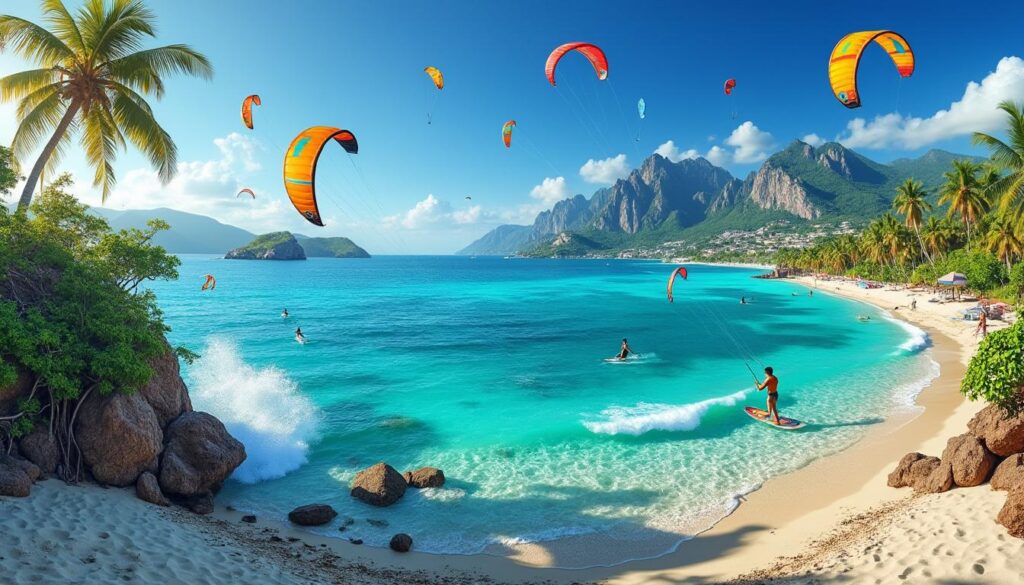
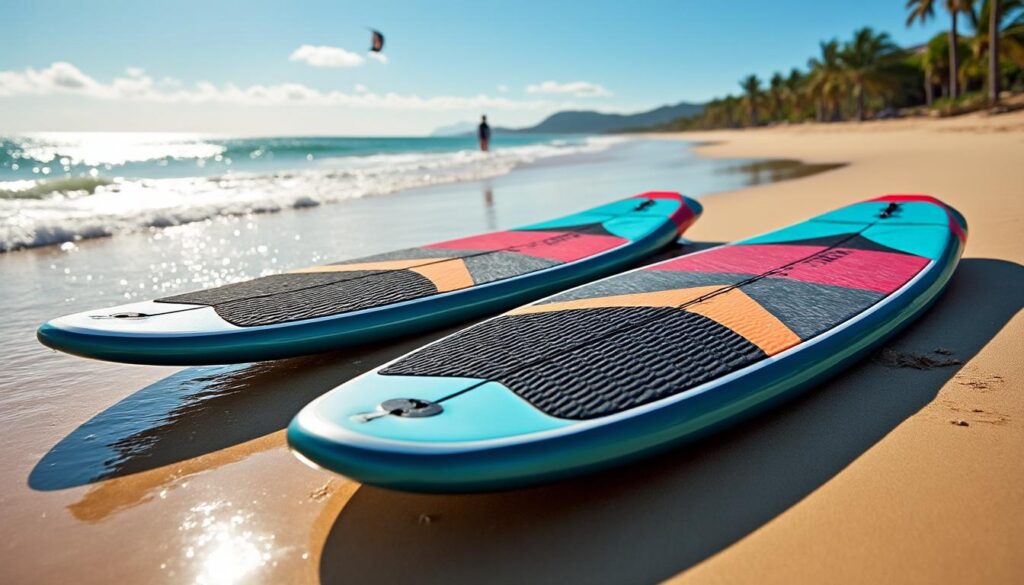
- Freestyle: hooked and unhooked tricks, rotations, handle passes. It requires relatively flat water and stable wind. It’s the scene that made many riders famous on social media.
- Wave: directional board, more depowered kite, work on the waves. Here the kite becomes a discreet tow and the real star is the wave face you are riding.
- Foil: hydrofoil that lifts you out of the water, silence under your feet, long windward legs. It’s the discipline closest to Formula Kite and the one that revolutionized the very concept of “sufficient” wind.
- Strapless freestyle: tricks on a surfboard without straps, jumps, rotations, board-off. Requires very high timing and control.
- Big Air: the objective is simple to understand and hard to achieve: higher, longer, more technical jumps, often in strong wind conditions.
This variety exists because materials allow it. Manufacturers offer wings specific for freeride, wave, foil, big air, light wind. Twin tip boards, surfboards, foil boards, directionals. The choice is not only a matter of style, but also of safety: using a stable freeride kite for kitesurfing for beginners is very different from attaching a C-kite for pure freestyle to someone still searching for balance on their first run.
Safety is precisely the thread that links the pioneering phase to today’s standards. If in the beginning everything relied on instinct, now the norm is to start with a kitesurf course with certified instructors, proper harness, helmet, buoyancy aid and a clear understanding of the rules of navigation. Knowing how to read the weather, recognize an approaching storm, understand how a gust forms is an integral part of a rider’s kit. It’s not optional.
| Historical phase | Material characteristics | Safety level | Typical rider profile |
|---|---|---|---|
| 1980s – experimentation | Rudimentary kites, no depower, water skis | Low, almost no redundancy | Pioneers and inventors |
| 1990s – Wipika & boom | Inflatable wings, first leashes and quick releases | Medium, risk still high | Windsurfers looking for novelty |
| 2000s – standardization | 4-line kites, twin tip, widespread safety systems | Higher, schools and structured courses | Global community of riders |
| 2010s–today – specialization | Foil, discipline-specific kites, advanced materials | High if adequate training is followed | From beginner to Olympic pro |
An aspect that always deserves attention is the weather. It’s not enough to look out the window: you need to know local patterns, wind direction, the relationship between spot and obstacles, offshore risks, afternoon thermals. For those who want to dig deeper, there are resources dedicated to kitesurf weather and wind management, where it’s explained how to turn numbers and arrows into real choices: go out or wait, change kite or return.
If you watch a rider today flying on a foil in Formula Kite or closing a mega loop in big air, remember that behind them are decades of evolution, falls, trials and small technical revolutions. The history of kitesurfing didn’t end with entry into the Olympics: it only opened a new chapter. The next step, as always, will start from a beach, a bit of wind and someone willing to let themselves be pulled even further.
How was modern kitesurfing born?
The roots of kitesurfing go back to experiments with traction kites and water skis in the 1980s, especially in Australia. The decisive leap came in the mid-1980s, when Bruno and Dominique Legaignoux developed the first inflatable Wipika wings that could be relaunched from the water. In the 1990s the scene moved to Maui, where windsurfers like Robby Naish and Pete Cabrinha began using these kites systematically. With the entry of specialized brands and the birth of the first schools, kitesurfing shifted from experiment to a true global water sport.
What is the difference between freeride kitesurfing and Olympic Formula Kite?
Freeride is the freer soul of kitesurfing: twin tip or small surfboard, the goal is fun, no prescribed course. You can alternate long reaches, some jumps, a bit of wave riding depending on the spot. Formula Kite, on the other hand, is a racing discipline: it uses a hydrofoil, specific wings and races on a buoyed course, with point rankings and rules similar to traditional Olympic sailing. In freeride you’re in command with the wind; in Formula Kite you must beat opponents and the clock.
Is a course necessary to start kitesurfing?
Yes, a course at a kitesurf school with qualified instructors is essential. Kitesurfing harnesses the power of wind and requires knowledge of safety, weather, quick-release systems and right-of-way rules. Learning on your own significantly increases risks for you and others in the water. A good course teaches kite handling on land, body drag, water start and first rides, focusing on accident prevention.
What equipment is used for Olympic kitesurfing?
At the Olympics, kitesurfing is represented by the Formula Kite class, which uses hydrofoil boards, rigid-profile wings and standardized bars. Athletes have a limited set of kites of various sizes, usually between 7 and 25 m², to cover a wind range from about 5 to 40 knots. All equipment must be homologated according to class rules so that results depend primarily on the rider’s skills rather than technological advantage.
How to choose the most suitable kitesurf discipline?
The choice depends on where you ride and what excites you most. If your spot is often flat and you love jumps, freestyle or big air are natural paths. If you have regular waves and enjoy surfing, wave and strapless are ideal. If you’re fascinated by speed and long windward legs, foil and perhaps a future in Formula Kite may suit you. Always start from basic freeride, build solid foundations and then experiment, guided by instructors who know your spot and its conditions well.
The wind that yanks your arms, the board beginning to plane and the wing pulling you upward: kitesurfing was born as a game for slightly crazy pioneers and today it is a highly technical Olympic discipline, regulated and timed to the second. In between, there’s a story made of experiments with kites, materials that tore, the first kitesurf courses on deserted beaches and then the global explosion with crowded spots, schools everywhere and live streams from Formula Kite races. Understanding how we got from the first tests with water skis and rudimentary kites to the Olympics also means understanding where this sport is heading and what you can expect if you decide to invest your time, energy and a few good gusts of wind.
Today kitesurfing is an entire family of disciplines: freestyle, wave, foil, big air, strapless. In Italy new kitesurf schools are born every year, brands update wings and boards and riders learn to read the wind like an everyday language. At the Olympics, however, only one “version” of kitesurf arrives: Formula Kite, the most technical and strategic side, where hydrofoils, rigid-profile wings and buoyed courses turn the session into a race. From the Maui boom in the ’90s to the Olympic debut, passing through the explosion of kitesurf Italy with spots like Salento, Stagnone and Garda, this evolution has also changed the way people learn, train and experience kitesurf holidays in the Mediterranean.
- Rebel origins: from 19th-century traction kites to the first improvised sessions in the 1980s.
- ’90s revolution: Wipika, Naish, Cabrinha, Flexifoil and the birth of modern kitesurfing as a sport.
- Different disciplines: freestyle, wave, foil, big air, strapless – there is no single way to use the kite.
- Formula Kite at the Olympics: fast hydrofoil, buoy courses, tactics from pure Olympic sailing.
- Italy in the spotlight: development of kitesurf Salento, Stagnone, Tarifa, Marseille and possible medals for Italian athletes.
History of kitesurfing: from early trials to the boom years
Imagine an Australian beach in the early ’80s. Few people, no logos in sight, just someone trying to get pulled by a kite with water skis on their feet. That’s where the first shadows of what we today call kitesurfing appear: no foil, no safety leash, just wind, lines and a lot of stubbornness. This “handmade” approach was the foundation of everything: those in the water had no manuals, they were writing the rules on the spot.
A few years later, in 1985, a French inventor, Bruno Legaignoux, began to think more structurally. The simple but brilliant idea: attach floats to a traction wing so that it stays on the surface after a crash and can be relaunched from the water. Thus the Wipika patent was born, which would forever change the sport. With those wings with bladders, inflatable, the kite stopped being just a toy for land and truly became a tool for sailing.
The real explosion, however, happens a few years later, when the action moves to Maui, Hawaii. Here a crew of windsurfers who are no longer satisfied with the traditional sail enters the scene: Manu Bertin, Flash Austin, Lou Wainman, Robby Naish, Pete Cabrinha and other names that today are almost legendary in the kite world. They use the first Wipika but also box kites like the Flexifoil Blade, non-relaunchable from the water. Every outing is a risk, but also a laboratory. The rule is simple: try, fall, change setup and try again.
Towards the end of the ’90s, around 1999, kitesurfing goes from being a game for a few obsessed people to becoming a recognized sport. Industry appears: Wipika, Naish Sails, Cabrinha, Peter Lynn, Mosquito, Challenger and other companies begin producing sails designed just for kites in the water, dedicated boards, bars with more advanced safety systems. This shift is crucial because it makes possible the opening of the first schools, the birth of the first structured beginner kitesurf courses and the first official competitions.
Many of today’s riders started precisely thanks to that phase. Beaches begin to fill up, the first videos circulate between VHS and DVD, surf and windsurf magazines dedicate pages to the new sport. It begins to be understood that it is not a passing fad but a discipline that can grow, with its rules, its spots, its champions. In Italy, the first real movements are seen on Garda, at Stagnone and on some beaches in Tuscany and Lazio, while the Salento wind begins to be talked about among the most curious.
The key insight of that period? Kitesurfing stops being an experiment and becomes a community. And a community, when it grows, pushes the whole system to evolve: materials, safety, training and, above all, mentality.
From play to system: how materials changed the story
At the beginning every kite was an unstable compromise between power and survival. Wings punctured, bars were rudimentary, leashes often non-existent. Over the years, however, work on materials, design and safety has made a huge difference. The concepts of depower, quick release, and 4- and 5-line systems have become standard, reducing risks and opening kitesurfing to a much wider audience.
Brands like Duotone, Slingshot, Naish, Cabrinha, Ozone and F-One built their identity precisely during these years of continuous drive. Those looking today for in-depth reviews of the latest models can get a clear idea of this evolution by reading, for example, the technical analyses on Duotone kites and other modern models, where it’s clear how far current products are from the rigid and somewhat brutal wings of the origins.
The result is visible to anyone who goes to the beach: today kitesurfing for beginners is possible, provided you go through a serious school, whereas in the ’90s it was almost only for those who accepted a very high level of risk. The leap is not only technological but cultural: the sport matures and starts to take itself seriously.
This progression, from creative madness to standardization, opened the door to the next phase: that of specialized disciplines and international regattas.
From the origins to Formula Kite: the evolution toward Olympic kitesurfing
When kitesurfing gains traction worldwide, it’s only a matter of time before someone asks: “But what if we turned this wind thrust into a real race?” The first competitions are almost gatherings, with flexible rules and a lot of experimental spirit. But with the increase in technical level and the spread of the kitefoil, kitesurf racing becomes a discipline in its own right.
The key shift is the introduction of the hydrofoil: a board with a winged fin that lifts you out of the water and makes you glide with almost no drag. Suddenly speeds increase, velocity jumps are impressive and the usable wind range expands enormously. That’s where the basis of Formula Kite is born, the class that today represents kitesurfing at the Olympics.
In the Formula Kite format, riders use rigid-profile wings, super-efficient kite foils and thin boards designed only to plane high and fast. Races take place on buoyed courses, with upwind, downwind and reaching legs. It’s a mix between the sensitivity of the kiter and the tactics of traditional sailing regattas: you must read the wind, choose the best line, manage speed and never botch the start.
An interesting aspect is the flexibility of the required conditions. Competitions are designed to run with winds ranging from about 5 to 40 knots. This is possible thanks to the use of kites of different sizes, typically between 7 m² and 25 m². More wind, smaller kite; light wind, larger kite. It’s not just a matter of strength, but above all of control and setup strategy.
Those who want to really understand how the hydrofoil works from a didactic perspective find many practical cues in specific guides, such as those dedicated to learning kitesurf foil safely, where each phase – from body drag to the first foil start – is broken down step by step.
Formula Kite at the Olympics: rules, tactics and race conditions
At the Olympics kitesurfing presents itself in the most “regulated” version possible: Formula Kite. Athletes race on a windward-leeward course marked by buoys, accumulating points across a series of races. Each regatta is a combination of a perfect start, choice of route and equipment management. A mistimed start, a delayed pump of the wing, a bad jibe and the ranking can change in seconds.
Races are held in a wide wind range, again between 5 and 40 knots, and each rider has a set of certified kites of different sizes. The rules define a limited number of wings you can use during the event to keep fairness and control costs. Both men and women compete in a similar format, with qualifying heats, intermediate phases and a final medal race that awards the medals.
From a television point of view, it’s powerful spectacle: kiters flying on foils, leaning on the leading edge of the wing, with speeds that easily surpass many Olympic sailing boats. For those coming from classic freeride, seeing such tight upwind angles and such fast tracks is almost science fiction.
This “regatta” structure also impacts how athletes train. It’s not enough to know how to jump high or do a good backroll: hours of work on the foil, starts, laylines and managing fatigue in close heats are required. It’s a different kitesurfing, but still born from the same passion for wind and sea.
The lesson for those on the other side of the bar is clear: kitesurfing can be played on many levels, from relaxed freeride to Olympic level. What changes is how far you want to push beyond your comfort zone.
Kitesurf and the Olympics: Paris 2024, Marseille and the global impact on the sport
When the IOC confirmed kitesurfing’s debut at the Paris 2024 Olympics, many riders had the same feeling: “Finally.” After years of steady growth, world tours, continental championships, the jump to the Olympic dimension was almost natural. Marseille was chosen as the racing venue, in the heart of the Mediterranean, with a refurbished port as the hub of Olympic sailing.
Marseille offers a mix kitesurfers know well: fairly reliable winds, little tide, manageable currents and a natural amphitheater that allows the public to watch the races up close. The racing basin, in front of the Corniche, was designed to bring spectators closer to the action. In the water, about 40 riders (20 men and 20 women) compete for medals that can change a career.
The Formula Kite race program was concentrated on the best wind window within the Olympic period. Opening series over several days, separate finals for men and women and a medal race that decides everything in a few heats: a daring buoy choice or an early start is enough to ruin an entire week. It’s a cruel but spectacular format that rewards those who read the wind almost instinctively.
Behind the scenes, the qualification system was designed to ensure global representation. Spots reserved for the host nation, slots assigned through the Sailing World Championships, continental quotas and a final regatta for those left out. Result: in the water there are not only the usual European names, but also riders from Asia, Latin America, Oceania, Africa, the Caribbean. Olympic kitesurfing thus becomes a worldwide showcase of different ways of reading the same wind.
For a sport used to living by social videos, wild spots and sessions without schedules, seeing riders with numbered bibs, framed by official cameras and inserted into Olympic statistics is a powerful symbolic step. It marks the point at which kitesurfing is no longer a “new trendy sport,” but a structured discipline with a history, rules and an institutional dimension.
Weather conditions, equipment and spectacle: what makes the Olympic race unique
One detail that strikes many enthusiasts is the relative simplicity of the conditions needed to start an Olympic kitesurf race. You don’t need a storm: 5 knots are enough for the most powerful foils to fly, up to 30–35 knots where natural selection really begins. Thanks to sets of kites in different sizes, athletes can adapt to almost any scenario. This is one of the reasons the IOC looked favorably at kitesurfing: high spectacle, great weather flexibility.
From the equipment side, the Olympic format requires certified and homologated materials: hydrofoil boards with class foils, specific Formula Kite rigid-profile wings, standard bars. The goal is to avoid results depending too much on the latest model, keeping the rider’s skill at the center. In reality, of course, every small detail counts: thicknesses, profiles, foil finishes, line adjustments. It’s a level where everything is pushed to the limit.
The public sees colorful wings zipping on the water’s edge, but behind them are years of development. Brands like Cabrinha, Duotone, Ozone and others have all invested in the foil and race segment, and technical advances then also reach freeride. Anyone looking at a 2026 freeride wing benefits from all the research done for Formula Kite. This exchange between competition and everyday use is one of the silent engines of kitesurf evolution.
In the end, the point is simple: the Olympic showcase amplifies everything. More visibility, more media attention, more young people deciding to look for a local kitesurf school to get started. The sea remains the same, but the view on this sport changes.
Italy, Formula Kite and a new generation of riders: from local beaches to the podium
The inclusion of kitesurfing in the Olympics found Italy ready. In recent years the country has built a dense network of spots, schools, events and top-level athletes. From the Stagnone of Marsala to Lake Garda, from kitesurf South Sicily to the Apulian coasts, anyone who wants to learn or push their level has only embarrassment of choice. In this context, it’s no surprise to see Italian riders among the favorites for medals.
In the men’s category, names like Riccardo Pianosi have shown they can consistently compete with the best in the world. Podium at the youth world championships, important results on the Formula Kite circuit, ability to manage foil and wings calmly even in the tightest races. On the women’s side, athletes like Maggie Eillen Pescetto have carried the Italian flag to the highest levels, showing that the national school has found the right key even in the foil discipline.
The echo of Sofia Tomasoni’s gold medal at the 2018 Youth Olympic Games is still strong. That victory made many boys and girls understand that kitesurfing is not just jumps and tricks for social media, but also a serious sporting path, with training, technical staff and long-term planning. Many athletes now chasing the Olympic pass cite that result as one of the moments that motivated them to pursue Formula Kite.
At an institutional level, the work of the Associazione Kitesurf Italiana and figures like Antonio Gaudini has helped give the sport structure, pushing for recognition, national competitions and instructor training. His words at the announcement of the Olympic debut still echo among riders: years of work to bring a “wind game” to the center of the world sporting scene.
But Italy’s real strength in kitesurfing lies in the mix of different spots and very active local communities. You have the Adriatic kitesurf with gentler thermal winds and wide beaches, the Ionian kitesurf with often more gusty conditions, the Salento kitesurf that exploits two seas and a thousand combinations of directions, not to mention the northern lakes and the volcanic spots of Sicily.
From local schools to kitecamps: how the Olympic boom changes training
With the Olympic horizon in sight, the way training is done has also changed. It’s no longer just about basic lessons for water start and first tacks, but about complete programs that take the rider from intermediate level to the first regattas. Many schools structure specific packages for those who want to enter the foil world, with modules on wind reading, race tactics and fatigue management.
An important piece are the kitecamps organized in strategic spots, where you can spend a week only between wind, lessons and video analysis. Those who want an idea of this approach can look at initiatives described on pages like kitecamps and camps in Italy dedicated to kitesurfing, where the “all day on the water” formula allows you to really focus on progression without interruptions.
For young people aiming at Formula Kite, the typical pathway goes through:
- Twin tip basics: learn fundamentals, safety, kite control.
- Transition to foil: first planing, balance management, effective upwind.
- Local regattas: familiarize with buoys, starts, right-of-way rules.
- International tour: youth world championships, European stages, Olympic qualifications.
Not everyone will reach Marseille or the next editions of the Games, but the chain effect is clear: more attention, more facilities, more technical culture even among those who just want to “have fun” safely in their own sessions.
The bottom-line message remains the same: if you learn the basics well, you have a sport in your hands that can take you wherever you want, from the local bay to the Olympic podium.
Kitesurfing today: disciplines, safety and how this story affects you up close
Looking at the arc from heavy fabric kites to foil racing wings, the history of kitesurfing seems a straight line toward performance. In reality, it’s a continuous branching. Today “kitesurf” is an umbrella that covers different worlds, all born of the same wind but with their own characters. Understanding them helps you choose where you want to be in this story.
The main disciplines are:
- Freestyle: hooked and unhooked tricks, rotations, handle passes. It requires relatively flat water and stable wind. It’s the scene that made many riders famous on social media.
- Wave: directional board, more depowered kite, work on the waves. Here the kite becomes a discreet tow and the real star is the wave face you are riding.
- Foil: hydrofoil that lifts you out of the water, silence under your feet, long windward legs. It’s the discipline closest to Formula Kite and the one that revolutionized the very concept of “sufficient” wind.
- Strapless freestyle: tricks on a surfboard without straps, jumps, rotations, board-off. Requires very high timing and control.
- Big Air: the objective is simple to understand and hard to achieve: higher, longer, more technical jumps, often in strong wind conditions.
This variety exists because materials allow it. Manufacturers offer wings specific for freeride, wave, foil, big air, light wind. Twin tip boards, surfboards, foil boards, directionals. The choice is not only a matter of style, but also of safety: using a stable freeride kite for kitesurfing for beginners is very different from attaching a C-kite for pure freestyle to someone still searching for balance on their first run.
Safety is precisely the thread that links the pioneering phase to today’s standards. If in the beginning everything relied on instinct, now the norm is to start with a kitesurf course with certified instructors, proper harness, helmet, buoyancy aid and a clear understanding of the rules of navigation. Knowing how to read the weather, recognize an approaching storm, understand how a gust forms is an integral part of a rider’s kit. It’s not optional.
| Historical phase | Material characteristics | Safety level | Typical rider profile |
|---|---|---|---|
| 1980s – experimentation | Rudimentary kites, no depower, water skis | Low, almost no redundancy | Pioneers and inventors |
| 1990s – Wipika & boom | Inflatable wings, first leashes and quick releases | Medium, risk still high | Windsurfers looking for novelty |
| 2000s – standardization | 4-line kites, twin tip, widespread safety systems | Higher, schools and structured courses | Global community of riders |
| 2010s–today – specialization | Foil, discipline-specific kites, advanced materials | High if adequate training is followed | From beginner to Olympic pro |
An aspect that always deserves attention is the weather. It’s not enough to look out the window: you need to know local patterns, wind direction, the relationship between spot and obstacles, offshore risks, afternoon thermals. For those who want to dig deeper, there are resources dedicated to kitesurf weather and wind management, where it’s explained how to turn numbers and arrows into real choices: go out or wait, change kite or return.
If you watch a rider today flying on a foil in Formula Kite or closing a mega loop in big air, remember that behind them are decades of evolution, falls, trials and small technical revolutions. The history of kitesurfing didn’t end with entry into the Olympics: it only opened a new chapter. The next step, as always, will start from a beach, a bit of wind and someone willing to let themselves be pulled even further.
How was modern kitesurfing born?
The roots of kitesurfing go back to experiments with traction kites and water skis in the 1980s, especially in Australia. The decisive leap came in the mid-1980s, when Bruno and Dominique Legaignoux developed the first inflatable Wipika wings that could be relaunched from the water. In the 1990s the scene moved to Maui, where windsurfers like Robby Naish and Pete Cabrinha began using these kites systematically. With the entry of specialized brands and the birth of the first schools, kitesurfing shifted from experiment to a true global water sport.
What is the difference between freeride kitesurfing and Olympic Formula Kite?
Freeride is the freer soul of kitesurfing: twin tip or small surfboard, the goal is fun, no prescribed course. You can alternate long reaches, some jumps, a bit of wave riding depending on the spot. Formula Kite, on the other hand, is a racing discipline: it uses a hydrofoil, specific wings and races on a buoyed course, with point rankings and rules similar to traditional Olympic sailing. In freeride you’re in command with the wind; in Formula Kite you must beat opponents and the clock.
Is a course necessary to start kitesurfing?
Yes, a course at a kitesurf school with qualified instructors is essential. Kitesurfing harnesses the power of wind and requires knowledge of safety, weather, quick-release systems and right-of-way rules. Learning on your own significantly increases risks for you and others in the water. A good course teaches kite handling on land, body drag, water start and first rides, focusing on accident prevention.
What equipment is used for Olympic kitesurfing?
At the Olympics, kitesurfing is represented by the Formula Kite class, which uses hydrofoil boards, rigid-profile wings and standardized bars. Athletes have a limited set of kites of various sizes, usually between 7 and 25 m², to cover a wind range from about 5 to 40 knots. All equipment must be homologated according to class rules so that results depend primarily on the rider’s skills rather than technological advantage.
How to choose the most suitable kitesurf discipline?
The choice depends on where you ride and what excites you most. If your spot is often flat and you love jumps, freestyle or big air are natural paths. If you have regular waves and enjoy surfing, wave and strapless are ideal. If you’re fascinated by speed and long windward legs, foil and perhaps a future in Formula Kite may suit you. Always start from basic freeride, build solid foundations and then experiment, guided by instructors who know your spot and its conditions well.