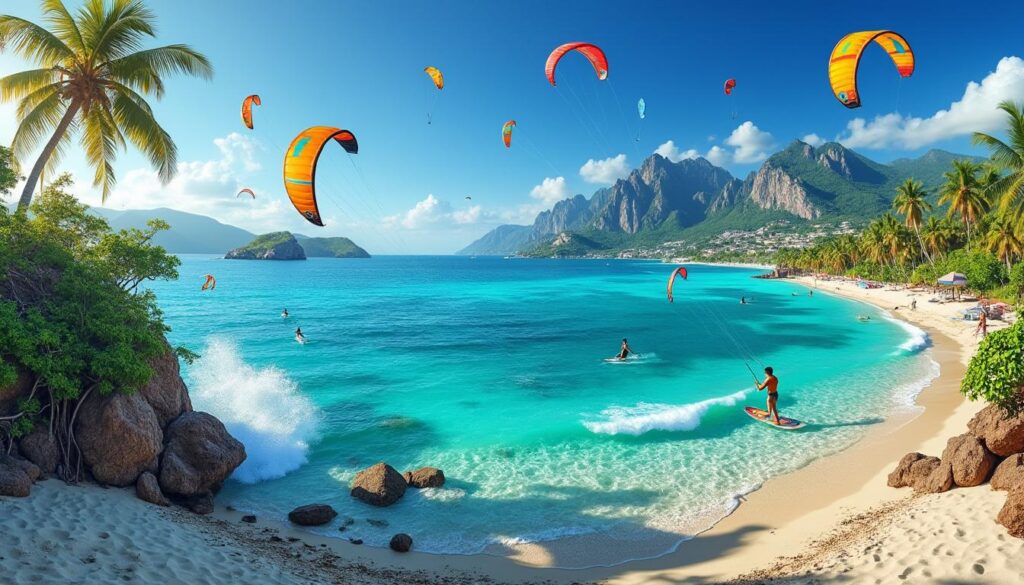
In Italy the wind never blows by chance. In summer the thermals arrive as punctual as an espresso at the counter; in spring and autumn the Mistral, Scirocco and Tramontana come in to draw on weather maps a true natural playground. Kitesurf holidays in Italy are not just weeks at the seaside: they are days marked by forecasts, last‑minute spot changes, sunsets with sand still on you and that mix of physical tiredness and lightness of mind that only a long session can give. Those planning 2026 already feel the acceleration when they look at the calendar: from north to south, among lakes, the Adriatic, the Ionian and the islands, the right places to inflate the kite and set off are plentiful.
Those who start searching “best kitesurf spot in Italy” on their smartphone often get lost among glossy photos and vague information. In reality, a good kite holiday starts from different questions: where does the thermal wind work almost every day? Where is the water shallow and safe for kitesurf for beginners? Which areas offer serious schools, structured courses and reliable equipment rental? And again: if the wind turns, where can you move in less than an hour without wasting the day? This is the concrete approach that turns a week at the beach into a sequence of consistent sessions, visible progress and a few new tricks landed. Italy, with its double face of Adriatic kitesurf and Ionian kitesurf, with windy lakes and flat lagoons, is perfect for building a tailored 2026 itinerary, from the novice to the advanced rider looking for technical spots and strong wind.
In short
- North Italy by kite: lakes like Garda and Como offer regular thermals, freshwater and very structured schools, ideal for learning kitesurf safely.
- Islands and large bays: Sardinia and Sicily have legendary spots between waves, flat lagoons and consistent winds that delight those planning real kitesurf vacations.
- Central regions and big cities: Rome and Naples allow you to combine culture and sea, with spots reachable in a day and schools run by experienced instructors.
- Puglia and kitesurf in Salento: double Adriatic/Ionian coast, Salento wind capricious but generous and one of the most interesting concentrations of spots in the Mediterranean.
- Gear and progression: choosing the right equipment, a good kitesurf school and planning the 2026 season according to your goals makes every session safer and more fun.
Kitesurf holidays in Italy: from Lake Garda to Lake Como
Those who think that kitesurf in Italy is only sea have yet to hear the song of the northern thermals. Lake Garda, with its roughly 370 km² of water, is a historical benchmark for those looking for organized wind, rescue boats and schools everywhere. Here the morning and afternoon thermals build almost schoollike days: early session, lunch break, second afternoon session. For a successful kite holiday in 2026 it is a certainty, especially for those traveling with family who want to alternate sessions, excursions and relaxation.
Along Garda’s shores many centers offer everything from a basic kitesurf course of 2–3 days up to advanced packages to learn jumps, transitions and switch control. You often start with body drag and kite handling from the shore, then dedicate the following days to the water start and the first independent upwind legs. A feature that beginners love is the constant presence of support boats: if you get the direction wrong or lose your board, no panic — the boat arrives and brings you back to the right spot.
Garda is also the realm of the tireless: after the “learn to kite” cycle many move on to foil and wing foil to take advantage even of lighter winds. In 2026 wing and foil are no longer niche: they are an integral part of the package at many schools, a way to stay on the water when others wait for the wind to rise. In a single week you can do your first twin‑tip rides, try some foil starts and close the days with group downwinds that feel like small crossings.
No less engaging is Lake Como, with totally different scenery but the same essence: reliable thermal winds and facilities ready to welcome those who want to learn. Dervio is one of the most popular bases: from there modular courses of 3, 5 or 6 hours depart, single lessons to test the feeling with the kite and advanced sessions for those who already ride but want to improve style and safety. The atmosphere is special: among mountains, villages and historic villas, the session takes on an almost theatrical flavor.
For many budding riders Como becomes “the lake where the spark ignited.” It is common to see students arrive timidly on the first day and, after a few hours with the bar in hand, start smiling automatically every time the kite lifts them onto the board. That bond between body and board, which on land seemed abstract, suddenly becomes natural. And it is precisely this change of perspective that makes a kite holiday different from a simple week at the beach: the feeling of having learned something new, of having a different relationship with the wind.
To organize a balanced trip between northern and central Italy it’s worth comparing the lake wind seasons with those of the coasts. Between April and September Garda and Como thermals are very reliable, ideal for concentrating basic courses and first outings. Later, when the sea water is warmer and synoptic flows regain strength, it makes more sense to move toward the large bays of the central‑south.
| Area | Best period | Recommended level | Type of water | Key strength |
|---|---|---|---|---|
| Lake Garda | April – September | Beginners / Intermediates | Freshwater, slightly rippled | Many schools, rescue boats, regular thermal wind |
| Lake Como (Dervio) | May – September | Beginners / Intermediates | Freshwater, moderate chop | Scenic landscape, modular courses, intimate environment |
| Central Italy coasts | March – November | All levels | Sea, waves or chop depending on the day | Combine culture, cities and sea |
For those planning kitesurf holidays in Italy now, starting from the lakes means building solid technical foundations and arriving at the sea with a few upwind legs already under your belt: the perfect combination to make 2026 a year of real progression.
Kitesurf holidays Sardinia and Sicily: open sea, lagoons and constant wind
When talking about spots that make riders from all over Europe dream, Sardinia and Sicily are always on the podium. In kitesurf holidays in Italy 2026 these two islands remain key destinations, especially for those who want to mix crystalline waters and serious wind. In Sardinia, the Porto Pollo area continues to be a natural magnet: two adjacent bays, turquoise water, often strong wind and a community of windsurfers and kiters that animates the beach from morning to the last breeze.
Porto Pollo is an excellent example of a “multi‑sport” spot: windsurf, kite, wing foil and even those starting to try directional foils from waves coexist here. The advantage of such an organized place is the presence of schools with diversified levels: from kitesurf for beginners starting with body drag in safety to advanced clinics for those who want to work on jumps, rotations and power control. With wind at the limit, many switch to wing foil, using the wing and foil board to glide fast even when a classic kite would require a too large size.
On the other side of Sardinia, the Costa Smeralda and the Olbia area offer ideal scenery for those who want to combine tourism and water. Wing foil schools have multiplied, with private lessons that start with a brief on‑land briefing and lead to the first foil glides in less than a holiday. The strong idea is always the same: use every wind condition with the most suitable tool, without watching the sea from the shore.
Moving to Sicily, the lagoon of the Stagnone di Marsala remains one of the smartest choices for those who want to learn kitesurf in Italy in total control. Flat water, shallow bottom, almost no waves: a paradise for those taking the first steps with the board and who need to fall a thousand times without stress. In such a space the instructor can focus on body position, board direction and power management without you having to fight the chop.
The lagoon extends for over 3,000 hectares and allows schools and students to always find a less crowded area, even in the busy periods of the season. While you train on the water start and first controlled upwind legs, salt pans, windmills and the islands of Mozia and Santa Maria appear in the background. It’s one of those places where learning doesn’t mean giving up the beauty of the landscape; on the contrary: the feeling of gliding on glass‑smooth water, surrounded by a nearly suspended landscape, remains as memorable as the first meters of planing.
An often underestimated aspect, especially by those organizing their first kitesurf holiday, is managing strong wind. Both in Sardinia and Sicily there can be days when the Mistral or Scirocco touch 30 knots. In these cases the support of an experienced kitesurf school is essential: choice of the right kite, explanations on where not to go out, management of beach safety. Precisely for this reason, besides choosing the destination, it’s worth thinking about the equipment too.
To get a clear idea of what’s really needed, a useful resource is this guide dedicated to complete kitesurf equipment, which helps understand which items are priorities, how to match board and kite size to your weight and the average conditions of the place where you’ll be riding. Going on the water prepared means avoiding basic mistakes and enjoying each outing more.
If the goal for 2026 is to combine holidays, wind and technical progression, an itinerary that includes at least one spot in Sardinia and one in Sicily covers practically all needs: from flat lagoons perfect for learning, to open bays where you understand what “keeping the kite powered” really means in significant conditions.
Kitesurf holidays in Italy between Rome and Naples: city, culture and powerful sessions
Not everyone wants to choose between city and sea. For many travelers, the ideal kitesurf holidays in Italy mix a morning at the museum and an afternoon on the water, a pizza downtown and a sunset with the board under your arm. This is where the areas of Rome and Naples come into play, with their spots near the city, perfect for those who want to breathe both culture and wind.
The Lazio coast, a short distance from the capital, hosts established spots like Anzio and the Ostia seafront. In Anzio you can take lessons with certified instructors and even with Italian champions who have accumulated years of experience in the field. For beginners the ideal formula is a personalized introductory lesson: focus on bar control, safety, wind windows and the first kite pulls in shallow water. Those already independent can instead find refinement sessions to improve direction changes, upwind and first aerial maneuvers.
Ostia, beyond being Rome’s classic “sea”, has in recent years seen a significant growth in wing foil and foil kite. Many schools offer both classic kitesurf courses and wing foil packages, with the same logic: take advantage even of lighter wind days and extend the usable season. For a rider planning their 2026 holiday, this versatility is gold: fewer days lost due to lack of strong wind and the chance to experiment with new disciplines.
Moving south, the Gulf of Naples offers landscapes that alone are worth the trip. In Monte di Procida, for example, lessons are run with a maximum of two students per instructor, so that every mistake is corrected at the outset. For those who want to delve into the details of the Campania area — recommended spots, schools, best periods — it can be useful to consult a dedicated guide like this on kitesurf Naples, spots and schools, which gathers a lot of practical information.
Going out in front of the Gulf with Vesuvius in the background is something that needs few adjectives. From a technical point of view, however, what matters is the quality of teaching. In the most serious schools, the first lessons always include basic theory, safety management and progressive practice: first ground simulations, then dragging in the water, finally the first attempts to stand up on the board. Every step is designed to reduce the margin of error and increase confidence with equipment and local conditions.
An advantage of the Rome and Naples areas is easy access: airports, high‑speed trains, frequent connections. For those who have only a week and want to combine cultural holiday and sessions, these regions are excellent candidates. You can spend a morning among the Imperial Fora and an afternoon tacking in the open sea, or visit Pompeii and then find yourself with the bar in hand a few hours later.
For intermediate riders, these spots are above all real wind gyms: currents, chop, small waves, occasional gusts. Conditions less “perfect” than a lagoon but closer to what you’ll encounter across the Mediterranean. Learning to read the sea, handle gusts and relaunch the kite in non‑ideal situations is an investment that pays off in every future holiday.
When planning a 2026 itinerary that includes Rome and Naples, it’s wise to fit in at least a couple of “buffer” days without fixed commitments, to be used to chase the best wind window: this is the smartest way to reconcile lively cities, history and effective sessions.
Kitesurf holidays Puglia and Salento: double Adriatic/Ionian coast
If there is a corner of Italy that best synthesizes what it means to “follow the wind”, it is Puglia, and in particular kitesurf in Salento. Here the peninsula is thin, squeezed between Adriatic kitesurf and Ionian kitesurf, and allows you to change sea in less than an hour by car. For kitesurf holidays in Italy aimed at maximum flexibility, this makes a huge difference: if one coast is flat and windless, often the other is working.
The Salento wind has character; it doesn’t like to be commanded. But when it comes in, it gives long planing days, turquoise or deep blue water and a light that enhances every color. The most famous spots alternate lagoons, open sea stretches, sandy beaches and areas with deeper bottoms. Those who want a precise overview of the main kitesurf spots in Puglia can deepen with a dedicated guide like this on best kitesurf spots in Puglia, useful for planning stages and movements.
One of Salento’s strengths is the variety of situations it can offer in the same week. It often happens to see riders who one day train on almost flat water on a calm Ionian and the next day face waves and chop on the Adriatic, under a decided Mistral. From the point of view of technical progression, this is pure gold: you learn to manage the board in ever‑different conditions, to read wings and clouds, to choose the right setup before even inflating the kite.
For those who want to learn kitesurf from scratch, the presence of local schools with instructors who know wind and seabeds by heart is essential. Lessons do not limit themselves to “pull the bar and go”, but include very concrete advice on where not to go out with certain directions, how to avoid lateral currents and where wave return can bother the first water starts. These are the kinds of details you don’t find on social media but that make the difference between a fun session and a frustrating day.
In 2026 many Salento schools offer complete paths that go from kitesurf for beginners up to advanced clinics, passing through foil and wing foil packages. The watchword is always the same: adapt to the wind. If the day is marginal for twin‑tip, you go out on foil. If the wind drops too much, you wait for the evening thermal and do shorter but intense sessions. You never force a condition that doesn’t convince you, especially when you are still learning.
Organizing a kite holiday in Puglia also means thinking about what happens off the water. Between outings there are white towns, historic villages, outdoor feasts and evenings in which sessions are discussed with sand still on your feet. For many riders the strongest memory of a Salento kitesurf holiday is not only the wind, but the combination of light, food, slow rhythm and sudden car dashes to “catch the right wind hole”.
For this balance to really work, it’s useful to arrive prepared also on the linguistic and technical level. Help comes from practical resources like the glossary of kitesurf terms in Italian, which helps quickly understand what the instructor means when talking about wind window, de‑power, trim, edging. Less time asking for explanations, more energy to dedicate to the board.
In a landscape like Italy’s, Salento remains one of the places where kite is lived as an everyday culture, not as an exotic parenthesis. Planning your kitesurf holidays in Italy 2026 here means choosing a place where the wind is not a guest, but a demanding neighbor to be respected and listened to.
Equipment, schools and progression: turning kitesurf holidays into real growth
A successful kite holiday depends not only on the chosen spot, but on how you get to the water: fitness level, knowledge of basic theory, quality of equipment, choice of kitesurf school and personal goals. Looking ahead to 2026, more and more riders set up kitesurf holidays as mini progression camps, with a clear focus: learn from point A to point B, rather than “hoping to improve” between a beer and a sunset.
For an absolute beginner, the ideal path starts with a structured kitesurf course: at least 6–8 hours divided over several days, alternating theory, on‑land practice and water outings. First you learn to handle the kite safely, then you move on to body drag and finally the board. Each phase makes sense: skipping steps out of impatience often translates into fear or bad habits that are hard to correct later.
Many show up for the first course with equipment bought in a hurry, perhaps used, and sometimes unsuitable for their weight or the chosen spot. To avoid costly mistakes, it’s useful to research in advance what is really needed. In this sense, guides like the one dedicated to windsurf and kitesurf: essential equipment help navigate among boards, sails, bars, harnesses and wetsuits, distinguishing what is fundamental from what can wait.
For those already autonomous and wanting to raise the bar, kitesurf holidays in Italy 2026 are the perfect opportunity to add new elements: first jumps, basic rotations, switch transitions, introduction to foil. Many schools now offer specific “from twin‑tip to foil” packages, where in a few days you learn the basics of controlling a foil board at contained speeds, using flatter spots and moderate winds.
An intelligent approach to progression on holiday could follow this simple priority list:
- Safety first: learn self‑rescue, kite relaunching from the water and de‑power management.
- Speed control: know how to accelerate and slow down with edging and body position.
- Beating upwind: maintain course and consistently climb upwind.
- Clean transitions: change direction without falling every time.
- Introduction to maneuvers: small controlled jumps or first strapless/foil moves.
Each point has direct repercussions on session quality. A rider who knows how to climb upwind and manage speed tires less, stays closer to the spot, and has more margin to try something new without worrying about ending too far downwind. This kind of technical solidity is built better on holiday, when you have consecutive days on the water, compared to occasional weekend outings of a few hours.
To help especially beginners start off on the right foot, specific resources like the kitesurf guide for beginners collect many frequent doubts: how many hours are needed to stay upright, how to choose the right school, which conditions to avoid at the beginning, how to manage fear and respect for the sea. Read first, ask the instructor for confirmations later: this combination saves time, energy and a few too many knocks.
After all, the real difference between a simple holiday and a kite holiday is all here: using the wind not only to glide on the water, but to push a little beyond your limits, in a clear and safe way. Every well‑built session becomes a small brick in your rider story, and 2026 can be the year this story truly begins to take shape.
What is the best period to organize kitesurf holidays in Italy?
In most of Italy the most reliable window runs from March to October, with differences between lakes and sea. The northern lakes (Garda, Como) work very well from April to September thanks to thermal winds, ideal for basic courses and first outings. The Tyrrhenian and Adriatic coasts see good conditions from March already, while Puglia, Sardinia and Sicily often offer the best combinations between May–June and September–October, when it is still warm but beaches are less crowded.
For learning kitesurf is it better the lake or the sea?
Both options work, but for beginners what matters most is relatively flat water, free space and well‑organized schools. Lakes like Garda and Como offer predictable thermal wind and a great presence of support boats. Sea spots like the Stagnone or some bays of Salento guarantee shallow and flat water. The ideal choice also depends on how convenient it is for you to get there and the type of holiday you want: more ‘sporty’ on the lakes, more combined sea‑tourism on the coasts.
How many hours of course are needed to start going independently?
On average between 6 and 10 hours of structured course are needed to reach the first independent upwind legs, but the number varies a lot from person to person. Some manage the first water starts already on the second day, others need more time to feel safe. The important thing is not to fixate on the number of hours but to master the basics: kite control, self‑rescue, board start and the ability to return to the starting point.
Do you need your own equipment to take a kitesurf course on holiday?
No, for the first phases it is almost always better to use the material provided by the kitesurf school. This way you can try different sizes and models without having to invest immediately in a complete kit. Only after the course, when you have a clear idea of the conditions you will ride most often and your level, does it make sense to consider purchasing personal equipment, possibly with the instructors’ support.
Is kitesurf suitable also for those who are not particularly fit?
Yes, kitesurf does not require extreme physical strength, but a good minimum of mobility and endurance. The main load is transferred through the harness, not the arms. It is still advisable to arrive on holiday with some preparation: walks, light swimming or core exercises help better withstand the first sessions, which are often intense because of the amount of new things to learn. Once the initial phase is overcome, fatigue decreases and technique prevails.