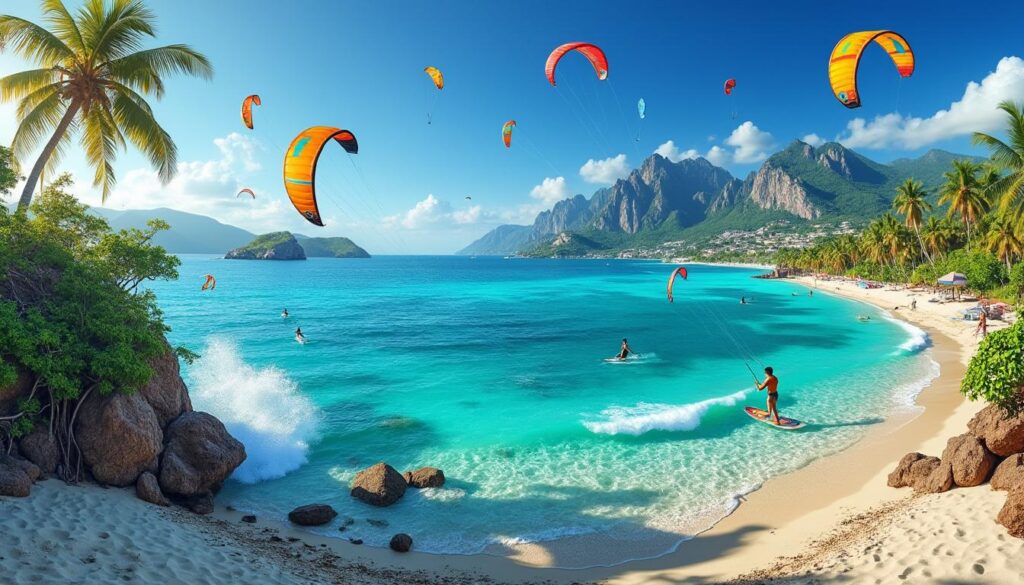
Constant wind, turquoise lagoons, a soft bottom underfoot and schools ready to get you up on the kite from day one: kitesurf in Zanzibar is not just an exotic getaway, it’s a true playground for those who want to learn, progress or pile up hours of riding on flat water. Between Paje, Kiwengwa and the outer reefs, the spice island of the Indian Ocean offers conditions dreamed of in Europe in the dead of winter. Those coming from the kitesurf in Italy scene are often surprised by the combination of regular winds, warm sea and well-organized spots with IKO schools, water rescue and modern equipment.
Understanding, however, where to go, when to book your kitesurf holidays and how to choose the right kitesurf school makes all the difference between a week spent waiting for the wind and a series of solid sessions, with real progress on the water start, basic jumps or the first foil. Zanzibar has two main wind seasons, each with its own character, and spots that change with the tide. This means that those who arrive prepared, with the appropriate kite sizes and a minimum of planning, make the most of every day. Those who improvise, on the other hand, risk picking the wrong period or beach.
- Best period for beginners: mid June–mid October and late December–mid March.
- Iconic spot: Paje Beach, with a side-onshore wind and a flat lagoon perfect for learning.
- Average wind: about 16 knots, often increasing in the afternoon.
- Typical gear: 12–9 m kites, water above 24°C, wetsuit often optional.
- Outer reef: waves from 1 to 3.5 meters for wave and guided downwinders.
Kitesurf Zanzibar: know spots and lagoons before grabbing the bar
Zanzibar is not a single spot but an archipelago of possibilities. The name you’ll hear repeated most often is Paje Beach, the large beach on the east coast where most schools and kite centers concentrate. Here the lagoon stretches for hundreds of meters with a sandy bottom, shallow water and no troublesome shorebreak: the ideal environment for kitesurf for beginners who want to learn without fearing losing touch with the bottom. The wind comes laterally toward the shore (side-onshore), so if you make a mistake you’ll still be pushed toward the beach, not out to sea.
Slightly further north, the Kiwengwa area offers another long strip of white sand. Here too the water stays flat thanks to the offshore reef, which protects the lagoon from the ocean swell. Some schools are based right on this stretch of coast and offer boat trips to small sandbanks and less crowded spots, a perfect solution for intermediate riders who want to try more demanding maneuvers away from the sail traffic.
In the lagoon in front of the main kite centers the bottom is a soft carpet. The only element to be aware of is the seaweed farming area, often visible as a grid of poles and ropes that divides the lagoon in two. It’s easy to recognize and avoid, but it should be respected so as not to damage the work of the local communities. This natural separation creates two zones: on one side the space dedicated to beginner courses and body dragging, and on the other a freer area, perfect for those who want to set up jumps, transitions and freeride tricks.
Rock shoes are not mandatory, because the bottom is mostly sand and heavily worn coral. They can however be useful during the first lessons, when you often drag your body in the water and put your foot down everywhere. A few “wandering” sea urchins from nearby farms can cause surprises, so better to prevent them during the first hours of a course. Those who venture by foot to the reef during low tide should always wear booties: the stretch between the lagoon and the reef is rich in live corals, urchins and small channels.
The real hidden treasure of Zanzibar, however, is about one and a half kilometers from shore: the outer reef. Here the reef breaks the long ocean swell into clean lines that, on the right days, range from 1–1.5 meters up to 3.5 meters high. It’s not a playground for beginners, but an amusement park for those who can control the kite in gusts and manage the board in surf or strapless. Serious schools organize outings only with at least three kiters together and often with boat support, an approach that safeguards safety and respect for the ocean.
Compared to a classic kitesurf Puglia spot, where short waves and chop alternate on the Adriatic or the Ionian, Zanzibar offers a stark contrast: a lagoon flat as a lake on one side, long and powerful waves on the other. For those coming from scenarios like kitesurf in Puglia, comparing these two faces helps improve sea reading and adaptability.
The key insight here is simple: the more you understand Zanzibar’s geography – lagoon, seaweed area, reef – the more you can exploit every hour of wind by choosing whether to dedicate yourself to technical progression or pure surfing fun.
Water conditions and rider levels: who should come to Zanzibar
Zanzibar’s conditions are ideal for three profiles: those who really want to learn kitesurf from scratch, those at an intermediate stage consolidating edges and first maneuvers, and the advanced rider looking for volumes of flat water to train new moves or work on foil and strapless. The water is always above 24°C, so people often go out in a rashguard and swimsuit. Only those who are particularly sensitive to cold may consider a 2 mm shorty, especially in the early morning hours during the southern winter (June–September), when the air can be cooler.
For kitesurf for beginners, the absence of waves in the lagoon means one clear thing: total focus on the bar, body position and starting from the water, without having to fight breaking waves that knock the board down every three seconds. Instructors use the shallow bottom to have you walk back, reposition and try the start again in a few moments, increasing the number of attempts per session. More safe attempts lead to a faster learning curve compared to many kitesurf in Italy spots, where chop and current often work against beginners.
For intermediates, the lagoon offers the perfect ground to clean up technique and style. No wave distractions, no unexpected obstacles: you can work on toeside transitions, first small hooked jumps, controlled downloops and, for those ready, approaches to the first backrolls. Many schools also offer targeted coaching with video analysis: attempts are filmed, then errors and corrections are reviewed on land, a very effective method for anyone who wants to structure a real growth path.
Those arriving with a good riding level find in the outer reef and organized downwinders the right environment to have fun without getting bored. Typical conditions – 16 knots average with afternoon reinforcements – are perfect for freeride and wave with kites between 9 and 10 meters for medium weights. On the rare windier days, people drop to 7 meters, while light freeriders and those experimenting with foil can enjoy sessions even below 14 knots, taking advantage of the steady flow.
The takeaway is clear: Zanzibar is not an “experts only” spot nor an exclusive playground just for beginners. It’s a complete set where every level finds its space, provided you choose the right area and time of day.
Wind seasons in Zanzibar: Kusi, Kaskazi and the best months for kitesurf
To choose when to go to Zanzibar for kitesurf you first need to get familiar with two names: Kusi and Kaskazi. They are the seasonal winds that govern the island and determine the best windows for courses, vacations and training. Understanding how they work is as fundamental as knowing how to read the Salento wind when choosing between kitesurf on the Adriatic and kitesurf on the Ionian in Italy.
The Kusi blows from the southeast, brings cooler air and generally dominates from mid June to around mid October. It’s a side-onshore wind on the east coast, so perfect for Paje and Kiwengwa. In this period, the classic pattern is that of an enhanced thermal: a breeze that picks up in the late morning, grows in the early afternoon and tends to strengthen toward the late afternoon. The average is around 16 knots, but on more generous days it easily exceeds that, especially in July and August.
The Kaskazi, on the other hand, comes from the northeast and dominates the warm period from late December to mid March. It also works well on the east coast spots, but brings more humid air and higher temperatures, typical of full summer. For experienced riders, the best window during Kaskazi is roughly from late December to the end of February, when the wind regime is more stable and equatorial disturbances interfere less.
Local schools indicate some calendar windows particularly suitable according to level:
| Rider Level | Recommended Period | Main Reason |
|---|---|---|
| Beginner | Mid June – mid October | Regular Kusi, flat lagoon, moderate crowd |
| Beginner | Late December – mid March | Warm Kaskazi, many schools active and full staff |
| Intermediate | Mid June – mid September | Tighter wind, ideal for progression and first maneuvers |
| Advanced | Mid June – mid September | Higher probability of strong days for big air and wave |
| Advanced | Late December – late February | Stable Kaskazi, frequent conditions for reef and downwinders |
A practical example: Luca, an intermediate rider used to kitesurf Salento, decides to plan his trip to Zanzibar. He wants to work on hooked jumps and first rotations. He therefore chooses the mid July–late August window during the Kusi. Result? Weeks with 4–5 usable wind days, especially from the early afternoon onward, 10 and 9 meter kites almost every day, and no need to change spot thanks to the consistency of the side-onshore wind at Paje.
Visitors should always remember that despite these clear trends, wind is never a mathematical guarantee. Schools often invite checking the wind history and updated models before locking flights. A direct contact with a local kite center a few weeks before departure provides a realistic picture of conditions and maybe some extra tips on tides and the best times for your level.
The summary is simple: Kusi and Kaskazi are the two pillars of Zanzibar’s kite season, but it’s the wind–tide–time combination that determines the real quality of your sessions. Plan with these three elements in mind and the chances of wasted days due to wind drop drastically.
Top times of the day and reading wind and tide
Many think it’s enough to look at wind speed on an app to choose when to get in the water. In Zanzibar, as in any serious spot, the real difference is made by the combined reading of wind and tide. The lagoon changes depth and available space in a few hours: what in the morning is a huge area of shallow water can transform into a mirror-like deeper water in the afternoon, with zones where you no longer touch the bottom.
For those taking a basic kitesurf course, preferred times are often around mid-tide rising. At that moment, the water is not too shallow (so the board doesn’t keep digging into the bottom) but not too high either, so you can still touch and feel secure. Local instructors know these windows well and tend to schedule kitesurf for beginners lessons accordingly.
Intermediates can play more with depth variations. Some prefer slightly higher water to have margin for crash landings from jumps, others aim for lower tide to feel closer to the bottom while attempting new maneuvers. Advanced riders heading for the reef, however, look mainly at mid-high tide: it’s in this range that waves form clean walls without too many exposed shallows, and the risk of hitting the fin in shallower spots is reduced.
Watching locals and the school teams in the first days is the simplest trick: when you see everyone start rigging kites, it’s very likely that this is the day’s “sweet spot.” This approach, valid also in Italian spots described in guides like kitesurf Italy – destinations, saves many wasted trips and teaches you to read the water beyond forecast numbers.
The takeaway is clear: in Zanzibar, checking wind and tide is an integral part of the session, not an accessory detail. Those who do multiply their useful riding hours.
Equipment, kite sizing and comparison with kitesurf spots in Italy
Organizing a kite trip also means deciding what to pack. Zanzibar, with its average wind around 16 knots and consistently warm water, allows you to lighten your luggage significantly compared to many European destinations. On the beaches of Paje and Kiwengwa you’ll mostly see three kite sizes: 12, 10 and 9 meters. These sails cover about 80% of Kusi and Kaskazi days for a medium-weight rider (70–80 kg) on a twin tip.
Lighter riders may consider an 8 meter as the small kite, while those over 90 kg often find it useful to bring a 13–14 meter for softer days, especially at the start or end of the season. On some windier days, when the afternoon thermal really pushes, it’s not rare to see 7 meters in the water, particularly among those who jump big or ride the reef with more developed waves.
Regarding wetsuits, many leave everything at home and reduce their wardrobe to UV rashguards, lycra and a swimsuit. Water that never drops below 24°C allows long sessions even without neoprene. Those sensitive to cold, however, appreciate a 2 mm shorty on longer outings or when insisting until the last light of sunset, especially in June–September when the air can feel a bit cooler after dusk.
Compared to classic kitesurf Lecce, kitesurf Taranto or northern Italy spots, the main difference stands out: fewer temperature swings, fewer constant sail changes. In the Adriatic you can go from 12 meters to 7 meters in the same afternoon because of fronts and gusts; in Zanzibar, variations are generally softer and more predictable. This is one reason many Italians choose the island to put hours in the water regularly during the European winter, then return in spring stronger even on their home spots.
Many kiters, especially frequent travelers, choose to bring only a pair of kites – for example 12 and 9 – and rely on local rental to cover any sizing gaps. Schools almost always have full quivers with modern freeride/freestyle kites and updated bars, so a “bring the essentials, complete on site” approach works well. It’s also an opportunity to test models different from those used in Mediterranean spots.
In terms of boards, a classic twin tip freeride between 135 and 141 cm covers most conditions. Foil riders will find the lagoon a perfect training field, and can deepen their technique inspired by content like that dedicated to kitesurfing foil technique, then adapt what they learned to Zanzibar’s flat water. Surf strapless boards are the ideal toy for the outer reef, but must be used with awareness of the bottom and the wave’s power.
The key message: you don’t need to bring half your house. Two well-chosen kites, a twin tip, a lightweight shorty for the more chilly and a good lycra are the set that allows you to exploit 90% of the conditions you’ll encounter.
Useful accessories and small tips from a Mediterranean rider
Beyond the main setup, there are some accessories that those arriving from Italian spots tend to underestimate. The first is serious sun protection: between water reflection and tropical light, skin takes a heavy toll. A high-protection, water-resistant sunscreen and a long-sleeve rashguard are not a luxury but an investment to be able to do sessions every day without burning on the second day.
The second often ignored accessory is a surf-type sun mask or glasses with a strap, especially for those who spend many hours continuously in the water. Days with constant wind and flat water invite very long sessions, and visual fatigue and salt in the eyes start to show. Having a good eye protection system prolongs the quality of riding over time.
Finally, for those planning many hours in the lagoon, a pair of light booties can save you from the occasional stray urchin and from brittle coral in less beaten areas. As in the best best kitesurf spot in Italy locations, these small details make the difference between a smooth day and one ruined by an annoying cut.
The practical summary of this section: invest in a few right things – protection, smart accessories, a considered quiver – and Zanzibar becomes a continuous ribbon of sessions, not a struggle against heat, sun or small mishaps.
Kitesurf schools in Zanzibar: choosing the right course between Paje and Kiwengwa
With dozens of kitesurf schools concentrated mainly on the east coast, the real question is not whether you’ll find a place to learn, but how to choose the one that best fits your learning style and level. In Paje Beach several kite centers operate with IKO-certified instructors, updated equipment and rescue boats. Most offer complete packages with accommodation, courses, rental and sometimes organized downwinders.
For those looking for a kitesurf course basic programs typically include between 8 and 12 total hours, often spread over 3–4 days. You start with safety theory on land, move to kite control in the window (often with smaller, less powerful kites) and then gradually enter the water for body drag, water start and first edges. Zanzibar’s great strength is that all this happens in a wide, obstacle-free space with generally regular wind, reducing stress and allowing you to concentrate energy on technique.
Many schools also offer intermediate and advanced levels with specific focuses: quick kite relaunch from the water, cleaner edging, basic jump and controlled landing, reduced upwind drag. Some centers, especially the long-established ones in Paje, also organize clinics dedicated to freestyle or wave, with coaches who follow you by radio and video analysis. The approach is reminiscent of what’s seen in more “sporty” contexts like Tarifa or some kitesurf North Italy hubs, adapted to the softer conditions of the Indian Ocean.
A useful example: Sara, 35, starts to learn kitesurf after reading an online beginner guide, like those on kitesurf beginner’s guide. Arriving in Paje, she chooses a school with female instructors, small group classes and a focus on managing fear. In 10 hours of course, between theory, on-land practice and shallow water, she goes from “I’ve never touched a bar” to “I do my first edges autonomously.” The flat lagoon and the safety of the side-onshore wind play a fundamental role.
Those arriving with a good level can opt for personalized coaching packages: 2–3 intense hours with a dedicated instructor, perhaps to work on a specific goal (backroll, grabs, frontside rotations, wave riding on the reef). Some schools also provide sessions with drones or high-definition cameras for detailed analysis of body movement and board position.
The main criterion for choice should always be safety: a center with active rescue, water areas delimited for courses and freeride, clear briefing before each outing. Prices and packages come after. Contacting the school by email or chat a few weeks before departure allows you to clarify expectations, current level and goals, so you build a tailored path already before landing on the island.
Differences between courses in Zanzibar and courses at major Italian spots
Those who have already taken lessons in Italy, perhaps between kitesurf Taranto, Tuscany or the lakes of kitesurf North Italy, will immediately notice some differences. The first is temperature: learning without gloves, hood and a thick wetsuit is simply less tiring. The body stays more relaxed, mobility increases and you resist the fatigue of the first hours better, when falls are frequent.
The second is the wave: many Italian spots, from the Tyrrhenian to the Adriatic, offer a mix of chop and shorebreak that makes first starts more chaotic. In Zanzibar, the flat lagoon shifts the focus to kite control and board position, removing the “fight” with the wave from the table. For those who want to consolidate basics learned in Italy, this context is ideal.
The third concerns wind: in many Mediterranean spots disturbances can create very gusty days, with sudden holes and bursts of wind. In Zanzibar, Kusi and Kaskazi regimes are generally more regular, and despite some gusts the flow often remains predictable. This allows for a more linear learning curve and reduces the risk of scares related to sudden kite jerks.
The conclusion is clear: courses in Zanzibar do not replace those at your home spot, but complement them. Learning or progressing in a gentler environment gives you the tools to return to your Italian spots – whether Puglia, Calabria or Tuscany – with a more solid base and less anxiety related to wind and waves.
Wave, downwinder and kite lifestyle: living Zanzibar beyond the lagoon
Once you break out of the lagoon’s flat water, Zanzibar reveals its wilder side: wave riding on the reef and long downwinders along the east coast. The reef located about 1.5 km from shore creates, on the right swell days, regular wave lines with fast sections and other softer ones. Heights typically vary between 1 and 1.5 meters on standard days, up to 3.5 meters with big seas. It’s a context that for many recalls famous Atlantic spots, but with the plus of warm water and tropical colors.
Serious schools organize reef outings only in groups, often with a minimum of three people and accompanied by an experienced instructor. You start from the beach with a short beat across the lagoon and then cross the deeper water section up to the breaking line. Here the watchword is respect: ride the wave leaving space for others, avoid entering the same sections at the same time and ensure everyone knows the plan in case of emergency or broken equipment.
For those who love the feeling of continuous travel, downwinders along the coast are a must. Some classic routes start just north of Paje and go as far as Jambiani or, conversely, organize stretches of 10–15 km with boat support and pickup at the finish. It’s a powerful way to read the coastline, play with depth changes, sandbanks and small chop stretches, alternating powerful relaunches with long relaxed beats.
Away from the water, the island’s kite lifestyle is made up of days revolving around the wind: breakfast checking forecasts, tide checks, rigging sails, main session in the early afternoon and, after a shower, deck tales while sitting in small beach bars. It’s a rhythm that people from mixed realities like kitesurf Naples or large Italian cities perceive almost as a necessary slowing down: less traffic, more time to listen to what the wind does and what the body asks for.
Many riders build true rituals: bodyweight warm-ups on the sand, a light snack before entering the water, stretching and abundant hydration after the session. In a warm-humid climate like Zanzibar’s, underestimating hydration is one of the most frequent mistakes. Someone who rides two intense hours without drinking finds themselves drained the next day, reducing the number and quality of total sessions on holiday.
An element that often surprises those coming from the Mediterranean is the cultural mix: from local beach boys to schools run by international teams, on the same beach you cross languages and different stories, all tied by the same thread: waiting for the wind. This atmosphere, if lived with respect for those who inhabit the island year-round, adds an extra layer to the experience that goes beyond simply “I go, kite and return.”
The final message of this section is simple: Zanzibar is not just a place to put water under your board. It’s a space to train consistency, technique, and also a certain lifestyle marked by wind, light and tides.
Prepare the body and mind for many consecutive sessions
Doing intensive kitesurfing for a week or more requires something more than just enthusiasm. The body must be prepared, especially if during the year you only ride on weekends or on a few windy days. Some simple measures, borrowed from the routines of riders who travel between the Mediterranean and the tropics, can help.
Before departure, include some physical preparation – planks, shoulder and core exercises, light squats – to reduce the risk of fatigue and soreness during strong gusts. In the water, alternate long and short sessions, perhaps dedicating one day to pure technique and the next to more relaxed riding, to extend overall duration without overloading muscles and joints.
Mentally, it’s useful to arrive with clear but realistic goals: “I want to do my first edges independently,” “I want to clean the toeside turn,” “I want to work on the timing of the first simple jump.” Expecting to “become pro” in a few days is the quickest path to frustration and exhaustion. Riders who return home truly improved are those who managed to focus on a few elements, repeating them attentively in every session.
This mindset doesn’t only apply to Zanzibar but to every spot, from kitesurf Calabria to northern lakes. Zanzibar, however, thanks to the combination of steady wind and flat water, is the perfect ground to put it into practice continuously.
What is the best period to kitesurf in Zanzibar if I am a beginner?
For those starting out, the most recommended periods are mid June to mid October and late December to mid March. In these windows the wind (Kusi first, then Kaskazi) often blows side-onshore at Paje and Kiwengwa, the lagoon is flat and schools operate with full staff, ideal conditions to learn safely.
What kite sizes should I bring for a kite holiday in Zanzibar?
For a medium-weight rider (70–80 kg) the most used kites are 12, 10 and 9 meters. With average winds around 16 knots, a 12+9 pair covers most outings. Lighter riders may consider an 8 m as a small kite, while heavier riders can add a 13–14 m for the softer days.
Do I need a wetsuit to kitesurf in Zanzibar?
The water stays above 24°C year-round, so many ride in swimsuit and lycra. Those more sensitive to cold appreciate a 2 mm shorty, especially between June and September or for sunset sessions. A thick full wetsuit like in many Italian spots is not necessary.
Is Zanzibar suitable for someone who wants to learn kitesurf from zero?
Yes, the combination of a shallow, flat lagoon, side-onshore wind and structured schools makes Zanzibar one of the best environments to start. Compared to many spots with waves and chop, it allows you to focus on kite control and the water start without continuously fighting rough sea.
Can I do wave and downwinders in Zanzibar or is it only flat water?
Besides the flat lagoon, Zanzibar offers an outer reef about 1.5 km from shore with waves from 1 to over 3 meters on swell days, ideal for wave riding in kitesurf or strapless. Several schools also organize downwinders along the east coast with boat support, reserved for intermediate-advanced riders.