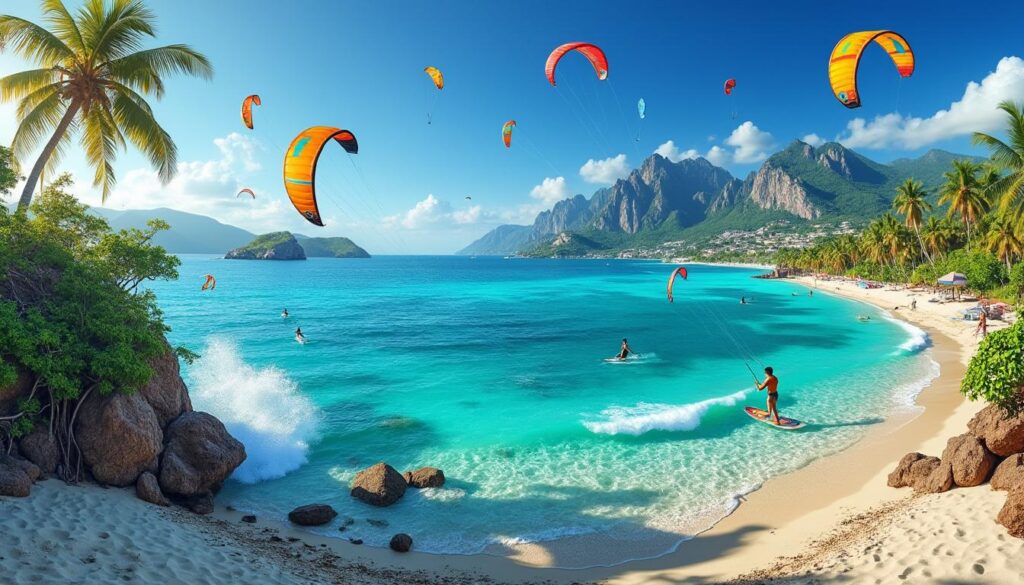
Kitesurf Watamu Kenya: wind, seasons and conditions of the “African paradise”
To understand why Kitesurf Watamu Kenya is considered one of the best kitesurf spots Italy… outside Italy, you need to start with the wind. Two main systems play here: the Kaskazi, a northeast trade wind that blows from December to April, and the Kuzi, a southeast trade wind that dominates between June and September. Both are equatorial winds, very regular, with contained gusts and an almost always cross or cross-onshore direction, therefore perfect even for those who are starting.
During the Kaskazi season, the typical day is clear: a calm morning, ideal for a SUP paddle or a theoretical lesson on learning kitesurf, and wind that comes in strongly around 11am. On average you travel around 20–25 knots. The most used sizes? A 9m becomes almost an extension of the arms, while the 12m comes into play in hours with slightly softer wind or for those who enjoy relaxed freeride at sunset.
With the Kuzi, from June to September, the tune changes. The wind strengthens, often reaching 25 knots and it’s not uncommon to see values over 30 knots on “pushed” days. In this period, those who love big air and loops find their dimension. The 7m is not a whim, but a must to pack. At the same time, the waves grow: Indian Ocean swells meet reefs and sandbanks, creating powerful breaks and organized lineups that tempt wave riders.
The air stays warm year-round, with peaks exceeding 30–36°C during the Kaskazi season. The Kuzi brings only light relief, but never a feeling of cold. The water, always between 25 and 30°C, lets you completely forget the wetsuit: boardshorts, swimsuit, UV lycra and you’re set for infinite sessions. For those used to kitesurf Ionio in spring or kitesurf Adriatico in autumn, the absence of neoprene is in itself a small revolution.
An often underrated aspect is the safety linked to wind direction and regularity. Cross-onshore means that in case of a mistake, fall or problem with the kite, you always end up towards shore and not offshore. This greatly reduces anxiety for those taking a kitesurf course or making their first steps in kitesurf for beginners, especially in open sea. Here the feeling is that you have a large “carpet of water” available, but without the risk of being carried away.
To give a quick overview of the seasons, here is a handy summary to keep in your pocket while planning your kitesurf holidays in Kenya.
| Period | Main wind | Average intensity | Direction | Recommended kite sizes | Ideal style |
|---|---|---|---|---|---|
| December – April | Kaskazi (NE) | 20–25 knots | Cross / cross-onshore | 9m – 12m | Freeride, beginner lessons, foil with medium wind |
| June – September | Kuzi (SE) | 25 knots, with peaks 30+ | Cross / cross-onshore | 7m – 9m | Wave riding, big air, downwind on the reef |
| October – November / May | Transition | Variable, 10–18 knots | Irregular | 12m – 15m / foil | Foil, SUP, alternative activities |
With this wind rhythm, Watamu becomes a tropical twin of some famous Mediterranean spots: those who have already tried kitesurf in Morocco between Dakhla and Essaouira will find the same continuity of sessions, but in a much wilder and greener setting. The common thread is always the same: reliable wind, spots spread along a wide bay and room for everyone, from foil riders to strapless addicts.
How to choose the right period for your kite trip to Watamu
The choice of the best period depends on what you are looking for. For a rider still close to the kitesurf for beginners phase, the Kaskazi season is often the most recommended. The wind enters progressively, you have time to prepare the equipment calmly and, above all, the flat lagoons are easier to read. Imagine a typical student, Luca: a few legs in Salento, some crashes in the Adriatic with chop and wind holes. In Watamu, with 20–22 knots regularly on flat water, his water start finally becomes smooth.
Those who live for jumps, kickers and spray will find the Kuzi more interesting. Ocean swells arrive bigger, reef sections work better and the wave becomes a natural playground for strapless and twin tip. It’s the kingdom of those who are already seasoned, perhaps after touring spots like kitesurf in Mauritius or other wave destinations in the world. In this case, the watchword is control: smaller kites, careful trim and respect for the reef.
The mid-season can be a smart choice for those who want a mix: days with softer wind, ideal for foil and long sessions, alternating with pumped breeze days for some sharper jumps. It’s also the time when the village is a bit quieter: fewer crowds, more space at the bar to exchange tips with local instructors.
In short, Watamu is not a place to mark only on the map, but a real wind calendar: just choose the right “page” according to your level and riding style.
Lagoons, reefs and sandbars: Watamu spots explained like a private lesson
The Watamu coast stretches for about five kilometers of very white sand, interrupted by tongues of reef and sandbanks that change shape with the tide. For a kiter this means one thing: different spots in the same place. Depending on the time and level, you can choose flat water at the sandbars, light chop near the reef or real waves on the barrier.
One of Watamu’s strengths is the presence of several schools along the bay, strategically positioned near natural lagoons. Here the water stays shallow for many meters, ideal for those starting their kitesurf course. Sandro, a beginner from Milan, said he unlocked his progress thanks to these natural pools: no fear of not touching bottom, no waves smashing him after every fall. Just warm water, steady wind and the instructor always a few steps away.
Further out, past the channel between reef and sand, the waves come into play. These are not unmanageable monsters, but long and regular swells, with smooth sections that allow clean bottom turns and cutbacks. For those coming from years of kitesurf Italy lived among short, messy Tyrrhenian waves, the difference is clear. Here the wave has time to develop and gives you space to maneuver.
The tide game adds an extra level of reading. With rising tide, some shallows disappear, channels fill and certain lagoons become perfect for soft downwinds. At ebb tide, instead, true “carpets” of sand emerge where the water reaches barely to the knee. Ideal for sessions to perfect body drag, relaunches and first transitions in total serenity.
An aspect that strongly resembles some Italian spots, like those described in guides on kitesurf Lecce, kitesurf Taranto or kitesurf on the Adriatic, is the variety concentrated in a few kilometers. The difference is that in Watamu, all this happens on warm water, without crowds and with a tropical backdrop of palms, fishermen’s dhows and saturated colors everywhere.
How to read the spot: practical examples for three rider profiles
To turn this theory into concrete choices, here are three typical profiles and their daily decisions on the same Watamu spot.
1. Beginner in lessons – Marta is on her third day of kitesurf school. She has just learned to control the kite on land and is starting body drag. The wind is around 18–20 knots, mid-tide rising. The natural choice is the inner lagoon: flat water, no waves, feet touching. The instructor follows her on foot along the sandbank, quick corrections and lots of repetitions. The priority is not long legs, but building confidence.
2. Intermediate progressing – Davide tacks and gybes, but is just starting to try jumps and first backrolls. Same day, same wind, but he decides to go out slightly further where the chop is light and the water is no longer mirror-flat. He has space to plane fast, pull longer legs and attempt jumps with soft landings. The lagoon would be too “still” for his goal.
3. Advanced wave / big air – Sara lives on hooked and unhooked moves, strapless and wave lines. She waits to see the wind rise above 22–23 knots and the tide bring enough water over the reef. She goes out with the 7m, heads for the channel, crosses the break and positions herself on the section where the waves close more gently. There she builds her playground, between bottom turns, cutbacks and off-the-lip jumps.
Three different riders, same spot, three completely different sessions. That is Watamu’s strength: the ability to tailor the session to you, just like in Salento when choosing between kitesurf Ionio and kitesurf Adriatico based on the wind. Here the concept is identical, only the setting is African and the water never drops below 25°C.
Logistics, transfers and daily life in Watamu for those coming from the Mediterranean
Getting to Watamu is not as complicated as it may seem to those used to organizing only trips within Europe for their kitesurf holidays. The first step is flying to Nairobi, served by airlines like Kenya Airways, British Airways, Turkish, Etihad or Qatar. From there you can choose to take a domestic flight to Malindi, the nearest airport, with local carriers like Jambojet, Fly 540 or AirKenya, or head to Mombasa and complete the journey by land with about two hours by car along a scenic coast.
Once in Malindi or Mombasa, many accommodations and schools organize private transfers, but it is also possible to arrange a local taxi. Fares are fairly standardized and, compared to many Mediterranean tourist destinations, often more affordable. The currency is the Kenyan Shilling (KSH), but dollars and euros are accepted in hotels and restaurants; for small purchases in local bars and supermarkets, it’s better to have cash in the local currency. ATMs are available and accept major international cards.
Daily mobility between spots is one of Watamu’s pluses. You don’t need to rent a car to move along the bay: tuk-tuks connect the various points for a few hundred shillings, allowing you to change beach based on wind and tide without the hassle of parking. For those who want to save even more there are bodaboda, fast but somewhat reckless motorcycle taxis, almost always without helmets. In that case, the basic rule is simple: if you don’t feel safe, choose the tuk-tuk, especially when traveling with boards and equipment.
For longer trips or explorations outside the village, for example to parks for safaris or nearby towns, renting a car can be a good idea. Daily rates stay in the $20–30 range, of course varying by season and type of vehicle. Those coming from the world of kitesurf Italy appreciate the freedom to combine days at sea with inland excursions without having to change base every two days.
Watamu is also well served digitally. 3G and 4G coverage is widespread, local SIMs are very cheap and can be topped up as needed. This allows you to work remotely between sessions or simply check forecast and wind maps with apps like Windy or Windguru, exactly as you would before a session of kitesurf Salento or kitesurf Liguria. Many hotels and guesthouses have Wi-Fi included, sufficient for work calls and video uploads of your sessions.
Where to sleep and what to eat: from kite lodges to ocean-view treehouses
The great thing about Watamu is the variety of accommodation. Those looking for an easy, kite-oriented solution can choose small seafront hotels and lodges, often with an integrated school, board storage and a compressor available. Then there are all-inclusive resorts right on the beach, ideal if you travel with family or non-kiter friends who can enjoy the sea and pool while you are out on a session.
For those who want a touch of originality, there are also special structures like treehouses dedicated to yoga, boutique hotels nestled in the vegetation or private villas rentable for groups of riders. This formula is beloved by those used to sharing houses in Italian spots or in destinations like Croatia or Greece, where the group rents a villa, fills the fridge and sets the rhythm between kite and home-style relaxation.
On the food side, Watamu remains first and foremost a fishing village. This translates into very fresh fish, lobster and crabs at prices decidedly lower than many European destinations. Local markets are a triumph of tropical fruit, vegetables and spices, while restaurants mix African cuisine with strong Italian influence: it’s not uncommon to find excellent pizzerias, a result of years of Italian presence on the Kenyan coast.
Evenings often start with a local beer, the famous Tusker, available in bars and venues at very low prices. The vibe is relaxed but for those who want to stay up late there are beach bars and clubs with music until dawn on some key nights of the week. The mood is that of kite communities scattered across the Mediterranean: few pointless chats, a strong desire to share wind stories and epic crashes, just like after a long day of kitesurf Adriatico or a session in Sardinia.
Simple logistics, genuine food, decent connection and accommodation options for every budget: the perfect mix to turn Watamu into a kite base, not just an exotic parenthesis.
Wind but not only: safaris, Mida Creek and “no wind” days in Watamu
Even in the most reliable destinations, a windless day can happen. Unlike many spots where a “no wind day” is a nightmare, in Watamu it becomes an opportunity to discover another side of Africa. Here the rule is simple: if the wind sleeps, you move.
A few hours’ drive away is the Tsavo National Park, one of Kenya’s largest protected areas, from which daily or weekend safaris depart in search of the “Big Five”. It’s not just a tourist trip: for many riders, seeing elephants and lions after days of kite puts everything back into perspective. There’s also the nearby Arabuko Sokoke forest, with a waterhole where elephants drink a short distance from the road, reachable in about fifteen minutes from Watamu center.
For those who prefer to stay close to the coast, Mida Creek is another world to explore. It’s a wide mangrove inlet, perfect for sunset SUP excursions, traditional dhow rides and floating aperitifs. Calm waters, lowering light and bird sounds create an atmosphere opposite to the adrenaline charge of a 25-knot session, but equally intense. Many riders say the best days are those where they combine kite in the morning and Mida Creek in the evening.
Alternative water activities are abundant: snorkeling, diving and offshore fishing are common. The coral reef hosts a very rich fauna, and boat trips often depart directly from the same shores used by kite schools. For those coming from the Mediterranean, where the seabed is often less colorful, the first dive in Watamu is a positive visual shock.
Finally, there is a whole world of small visits that enrich the stay: sea turtle rehabilitation centers, snake parks for those who want to learn more about local fauna, historical ruins that tell centuries of exchanges between Africa, the Middle East and the Arab world. In other words, kite remains the common thread, but not the only reason to be there.
Recovery, lifestyle and connections with other kitesurf spots around the world
A trip to Watamu is not just a sequence of legs. It is also a moment to recalibrate your rider lifestyle. Days often start early, with stretching, yoga or a simple beach walk, followed by wind checks and session planning. Evenings, between fiery sunsets and fish dinners, bring a healthy muscular tiredness that comes after full but not frantic days.
Those from the European spot circuit – from Greece and its windy islands to Croatia, from Liguria to Salento – often use Watamu as the next step in their progression. The constant conditions allow working on moves in sequence, without the frustration of wind holes. Practically, in one week here you do the same number of real attempts you would do in a month of intermittent outings.
This “wind-centric” but not obsessive lifestyle is what many riders seek: horizontal days made of session, recovery, good food and nature. With the awareness that, once back home, every new gust on kitesurf Salento or on kitesurf Adriatico will be read with more clarity, after having learned to interpret such regular equatorial winds.
Watamu, in the end, reminds you of one simple thing: you can’t command the wind, but you can understand it. And the more you learn to read it, in Africa as in Italy, the fuller, more precise and more yours every session – anywhere – becomes.
When is the best time to kitesurf in Watamu Kenya?
Watamu offers two main wind seasons: from December to April the Kaskazi blows from the northeast with 20–25 knots on average, ideal for freeride, progression and kitesurf for beginners; from June to September the Kuzi enters from the southeast, stronger (25–30 knots) and perfect for wave riding and big air. Transition months (May, October–November) can offer good days but are less consistent, so it’s better to choose them only if you accept some margin of uncertainty.
Is Watamu suitable for someone who wants to learn kitesurfing from scratch?
Yes, it is an excellent spot for absolute beginners. Internal lagoons with shallow, flat water, sandy bottoms and cross-onshore wind create a safe and controlled environment. Local schools are used to working with beginners, setting progressive courses over several days. The warm water helps reduce fatigue and fear: no thick wetsuit, just plenty of focus on kite control and the water start.
What equipment is needed for a kite trip to Watamu?
For most riders two kites are sufficient: a 9m and a 12m for the Kaskazi season, or a 7m and a 9m for the stronger Kuzi. A twin tip freeride board is fine; wave riders can bring a strapless board or rent one locally. No wetsuit is needed: UV lycra, a hat, glasses with a retainer and lots of sunscreen. Pumps and some basic spares (pads, screws, lines) are useful, but many schools already provide everything on site.
How to get to Watamu from Italy?
From Italy you fly first to Nairobi with airlines like Kenya Airways, Turkish, Qatar, Etihad or British Airways. From there you can take a domestic flight to Malindi, the nearest airport to Watamu, with carriers such as Jambojet, Fly 540 or AirKenya. Alternatively you can land in Mombasa and then continue by road for about two hours. Many accommodations and schools offer organized transfers from the airport, so coordinating arrival and equipment transport is easy.
What can I do in Watamu if there is no wind?
No-wind days in Watamu are not a problem. You can organize one- or multi-day safaris in Tsavo National Park, explore Mida Creek by SUP or dhow at sunset, snorkel or dive on the coral reef, join offshore fishing trips or visit sea turtle rescue centers and historical coastal ruins. Many riders also use the time for yoga, stretching and muscle recovery, so they return to the water fresher for the next wind window.
Kitesurf Watamu Kenya: wind, seasons and conditions of the “African paradise”
To understand why Kitesurf Watamu Kenya is considered one of the best kitesurf spots Italy… outside Italy, you need to start with the wind. Two main systems play here: the Kaskazi, a northeast trade wind that blows from December to April, and the Kuzi, a southeast trade wind that dominates between June and September. Both are equatorial winds, very regular, with contained gusts and an almost always cross or cross-onshore direction, therefore perfect even for those who are starting.
During the Kaskazi season, the typical day is clear: a calm morning, ideal for a SUP paddle or a theoretical lesson on learning kitesurf, and wind that comes in strongly around 11am. On average you travel around 20–25 knots. The most used sizes? A 9m becomes almost an extension of the arms, while the 12m comes into play in hours with slightly softer wind or for those who enjoy relaxed freeride at sunset.
With the Kuzi, from June to September, the tune changes. The wind strengthens, often reaching 25 knots and it’s not uncommon to see values over 30 knots on “pushed” days. In this period, those who love big air and loops find their dimension. The 7m is not a whim, but a must to pack. At the same time, the waves grow: Indian Ocean swells meet reefs and sandbanks, creating powerful breaks and organized lineups that tempt wave riders.
The air stays warm year-round, with peaks exceeding 30–36°C during the Kaskazi season. The Kuzi brings only light relief, but never a feeling of cold. The water, always between 25 and 30°C, lets you completely forget the wetsuit: boardshorts, swimsuit, UV lycra and you’re set for infinite sessions. For those used to kitesurf Ionio in spring or kitesurf Adriatico in autumn, the absence of neoprene is in itself a small revolution.
An often underrated aspect is the safety linked to wind direction and regularity. Cross-onshore means that in case of a mistake, fall or problem with the kite, you always end up towards shore and not offshore. This greatly reduces anxiety for those taking a kitesurf course or making their first steps in kitesurf for beginners, especially in open sea. Here the feeling is that you have a large “carpet of water” available, but without the risk of being carried away.
To give a quick overview of the seasons, here is a handy summary to keep in your pocket while planning your kitesurf holidays in Kenya.
| Period | Main wind | Average intensity | Direction | Recommended kite sizes | Ideal style |
|---|---|---|---|---|---|
| December – April | Kaskazi (NE) | 20–25 knots | Cross / cross-onshore | 9m – 12m | Freeride, beginner lessons, foil with medium wind |
| June – September | Kuzi (SE) | 25 knots, with peaks 30+ | Cross / cross-onshore | 7m – 9m | Wave riding, big air, downwind on the reef |
| October – November / May | Transition | Variable, 10–18 knots | Irregular | 12m – 15m / foil | Foil, SUP, alternative activities |
With this wind rhythm, Watamu becomes a tropical twin of some famous Mediterranean spots: those who have already tried kitesurf in Morocco between Dakhla and Essaouira will find the same continuity of sessions, but in a much wilder and greener setting. The common thread is always the same: reliable wind, spots spread along a wide bay and room for everyone, from foil riders to strapless addicts.
How to choose the right period for your kite trip to Watamu
The choice of the best period depends on what you are looking for. For a rider still close to the kitesurf for beginners phase, the Kaskazi season is often the most recommended. The wind enters progressively, you have time to prepare the equipment calmly and, above all, the flat lagoons are easier to read. Imagine a typical student, Luca: a few legs in Salento, some crashes in the Adriatic with chop and wind holes. In Watamu, with 20–22 knots regularly on flat water, his water start finally becomes smooth.
Those who live for jumps, kickers and spray will find the Kuzi more interesting. Ocean swells arrive bigger, reef sections work better and the wave becomes a natural playground for strapless and twin tip. It’s the kingdom of those who are already seasoned, perhaps after touring spots like kitesurf in Mauritius or other wave destinations in the world. In this case, the watchword is control: smaller kites, careful trim and respect for the reef.
The mid-season can be a smart choice for those who want a mix: days with softer wind, ideal for foil and long sessions, alternating with pumped breeze days for some sharper jumps. It’s also the time when the village is a bit quieter: fewer crowds, more space at the bar to exchange tips with local instructors.
In short, Watamu is not a place to mark only on the map, but a real wind calendar: just choose the right “page” according to your level and riding style.
Lagoons, reefs and sandbars: Watamu spots explained like a private lesson
The Watamu coast stretches for about five kilometers of very white sand, interrupted by tongues of reef and sandbanks that change shape with the tide. For a kiter this means one thing: different spots in the same place. Depending on the time and level, you can choose flat water at the sandbars, light chop near the reef or real waves on the barrier.
One of Watamu’s strengths is the presence of several schools along the bay, strategically positioned near natural lagoons. Here the water stays shallow for many meters, ideal for those starting their kitesurf course. Sandro, a beginner from Milan, said he unlocked his progress thanks to these natural pools: no fear of not touching bottom, no waves smashing him after every fall. Just warm water, steady wind and the instructor always a few steps away.
Further out, past the channel between reef and sand, the waves come into play. These are not unmanageable monsters, but long and regular swells, with smooth sections that allow clean bottom turns and cutbacks. For those coming from years of kitesurf Italy lived among short, messy Tyrrhenian waves, the difference is clear. Here the wave has time to develop and gives you space to maneuver.
The tide game adds an extra level of reading. With rising tide, some shallows disappear, channels fill and certain lagoons become perfect for soft downwinds. At ebb tide, instead, true “carpets” of sand emerge where the water reaches barely to the knee. Ideal for sessions to perfect body drag, relaunches and first transitions in total serenity.
An aspect that strongly resembles some Italian spots, like those described in guides on kitesurf Lecce, kitesurf Taranto or kitesurf on the Adriatic, is the variety concentrated in a few kilometers. The difference is that in Watamu, all this happens on warm water, without crowds and with a tropical backdrop of palms, fishermen’s dhows and saturated colors everywhere.
How to read the spot: practical examples for three rider profiles
To turn this theory into concrete choices, here are three typical profiles and their daily decisions on the same Watamu spot.
1. Beginner in lessons – Marta is on her third day of kitesurf school. She has just learned to control the kite on land and is starting body drag. The wind is around 18–20 knots, mid-tide rising. The natural choice is the inner lagoon: flat water, no waves, feet touching. The instructor follows her on foot along the sandbank, quick corrections and lots of repetitions. The priority is not long legs, but building confidence.
2. Intermediate progressing – Davide tacks and gybes, but is just starting to try jumps and first backrolls. Same day, same wind, but he decides to go out slightly further where the chop is light and the water is no longer mirror-flat. He has space to plane fast, pull longer legs and attempt jumps with soft landings. The lagoon would be too “still” for his goal.
3. Advanced wave / big air – Sara lives on hooked and unhooked moves, strapless and wave lines. She waits to see the wind rise above 22–23 knots and the tide bring enough water over the reef. She goes out with the 7m, heads for the channel, crosses the break and positions herself on the section where the waves close more gently. There she builds her playground, between bottom turns, cutbacks and off-the-lip jumps.
Three different riders, same spot, three completely different sessions. That is Watamu’s strength: the ability to tailor the session to you, just like in Salento when choosing between kitesurf Ionio and kitesurf Adriatico based on the wind. Here the concept is identical, only the setting is African and the water never drops below 25°C.
Logistics, transfers and daily life in Watamu for those coming from the Mediterranean
Getting to Watamu is not as complicated as it may seem to those used to organizing only trips within Europe for their kitesurf holidays. The first step is flying to Nairobi, served by airlines like Kenya Airways, British Airways, Turkish, Etihad or Qatar. From there you can choose to take a domestic flight to Malindi, the nearest airport, with local carriers like Jambojet, Fly 540 or AirKenya, or head to Mombasa and complete the journey by land with about two hours by car along a scenic coast.
Once in Malindi or Mombasa, many accommodations and schools organize private transfers, but it is also possible to arrange a local taxi. Fares are fairly standardized and, compared to many Mediterranean tourist destinations, often more affordable. The currency is the Kenyan Shilling (KSH), but dollars and euros are accepted in hotels and restaurants; for small purchases in local bars and supermarkets, it’s better to have cash in the local currency. ATMs are available and accept major international cards.
Daily mobility between spots is one of Watamu’s pluses. You don’t need to rent a car to move along the bay: tuk-tuks connect the various points for a few hundred shillings, allowing you to change beach based on wind and tide without the hassle of parking. For those who want to save even more there are bodaboda, fast but somewhat reckless motorcycle taxis, almost always without helmets. In that case, the basic rule is simple: if you don’t feel safe, choose the tuk-tuk, especially when traveling with boards and equipment.
For longer trips or explorations outside the village, for example to parks for safaris or nearby towns, renting a car can be a good idea. Daily rates stay in the $20–30 range, of course varying by season and type of vehicle. Those coming from the world of kitesurf Italy appreciate the freedom to combine days at sea with inland excursions without having to change base every two days.
Watamu is also well served digitally. 3G and 4G coverage is widespread, local SIMs are very cheap and can be topped up as needed. This allows you to work remotely between sessions or simply check forecast and wind maps with apps like Windy or Windguru, exactly as you would before a session of kitesurf Salento or kitesurf Liguria. Many hotels and guesthouses have Wi-Fi included, sufficient for work calls and video uploads of your sessions.
Where to sleep and what to eat: from kite lodges to ocean-view treehouses
The great thing about Watamu is the variety of accommodation. Those looking for an easy, kite-oriented solution can choose small seafront hotels and lodges, often with an integrated school, board storage and a compressor available. Then there are all-inclusive resorts right on the beach, ideal if you travel with family or non-kiter friends who can enjoy the sea and pool while you are out on a session.
For those who want a touch of originality, there are also special structures like treehouses dedicated to yoga, boutique hotels nestled in the vegetation or private villas rentable for groups of riders. This formula is beloved by those used to sharing houses in Italian spots or in destinations like Croatia or Greece, where the group rents a villa, fills the fridge and sets the rhythm between kite and home-style relaxation.
On the food side, Watamu remains first and foremost a fishing village. This translates into very fresh fish, lobster and crabs at prices decidedly lower than many European destinations. Local markets are a triumph of tropical fruit, vegetables and spices, while restaurants mix African cuisine with strong Italian influence: it’s not uncommon to find excellent pizzerias, a result of years of Italian presence on the Kenyan coast.
Evenings often start with a local beer, the famous Tusker, available in bars and venues at very low prices. The vibe is relaxed but for those who want to stay up late there are beach bars and clubs with music until dawn on some key nights of the week. The mood is that of kite communities scattered across the Mediterranean: few pointless chats, a strong desire to share wind stories and epic crashes, just like after a long day of kitesurf Adriatico or a session in Sardinia.
Simple logistics, genuine food, decent connection and accommodation options for every budget: the perfect mix to turn Watamu into a kite base, not just an exotic parenthesis.
Wind but not only: safaris, Mida Creek and “no wind” days in Watamu
Even in the most reliable destinations, a windless day can happen. Unlike many spots where a “no wind day” is a nightmare, in Watamu it becomes an opportunity to discover another side of Africa. Here the rule is simple: if the wind sleeps, you move.
A few hours’ drive away is the Tsavo National Park, one of Kenya’s largest protected areas, from which daily or weekend safaris depart in search of the “Big Five”. It’s not just a tourist trip: for many riders, seeing elephants and lions after days of kite puts everything back into perspective. There’s also the nearby Arabuko Sokoke forest, with a waterhole where elephants drink a short distance from the road, reachable in about fifteen minutes from Watamu center.
For those who prefer to stay close to the coast, Mida Creek is another world to explore. It’s a wide mangrove inlet, perfect for sunset SUP excursions, traditional dhow rides and floating aperitifs. Calm waters, lowering light and bird sounds create an atmosphere opposite to the adrenaline charge of a 25-knot session, but equally intense. Many riders say the best days are those where they combine kite in the morning and Mida Creek in the evening.
Alternative water activities are abundant: snorkeling, diving and offshore fishing are common. The coral reef hosts a very rich fauna, and boat trips often depart directly from the same shores used by kite schools. For those coming from the Mediterranean, where the seabed is often less colorful, the first dive in Watamu is a positive visual shock.
Finally, there is a whole world of small visits that enrich the stay: sea turtle rehabilitation centers, snake parks for those who want to learn more about local fauna, historical ruins that tell centuries of exchanges between Africa, the Middle East and the Arab world. In other words, kite remains the common thread, but not the only reason to be there.
Recovery, lifestyle and connections with other kitesurf spots around the world
A trip to Watamu is not just a sequence of legs. It is also a moment to recalibrate your rider lifestyle. Days often start early, with stretching, yoga or a simple beach walk, followed by wind checks and session planning. Evenings, between fiery sunsets and fish dinners, bring a healthy muscular tiredness that comes after full but not frantic days.
Those from the European spot circuit – from Greece and its windy islands to Croatia, from Liguria to Salento – often use Watamu as the next step in their progression. The constant conditions allow working on moves in sequence, without the frustration of wind holes. Practically, in one week here you do the same number of real attempts you would do in a month of intermittent outings.
This “wind-centric” but not obsessive lifestyle is what many riders seek: horizontal days made of session, recovery, good food and nature. With the awareness that, once back home, every new gust on kitesurf Salento or on kitesurf Adriatico will be read with more clarity, after having learned to interpret such regular equatorial winds.
Watamu, in the end, reminds you of one simple thing: you can’t command the wind, but you can understand it. And the more you learn to read it, in Africa as in Italy, the fuller, more precise and more yours every session – anywhere – becomes.
When is the best time to kitesurf in Watamu Kenya?
Watamu offers two main wind seasons: from December to April the Kaskazi blows from the northeast with 20–25 knots on average, ideal for freeride, progression and kitesurf for beginners; from June to September the Kuzi enters from the southeast, stronger (25–30 knots) and perfect for wave riding and big air. Transition months (May, October–November) can offer good days but are less consistent, so it’s better to choose them only if you accept some margin of uncertainty.
Is Watamu suitable for someone who wants to learn kitesurfing from scratch?
Yes, it is an excellent spot for absolute beginners. Internal lagoons with shallow, flat water, sandy bottoms and cross-onshore wind create a safe and controlled environment. Local schools are used to working with beginners, setting progressive courses over several days. The warm water helps reduce fatigue and fear: no thick wetsuit, just plenty of focus on kite control and the water start.
What equipment is needed for a kite trip to Watamu?
For most riders two kites are sufficient: a 9m and a 12m for the Kaskazi season, or a 7m and a 9m for the stronger Kuzi. A twin tip freeride board is fine; wave riders can bring a strapless board or rent one locally. No wetsuit is needed: UV lycra, a hat, glasses with a retainer and lots of sunscreen. Pumps and some basic spares (pads, screws, lines) are useful, but many schools already provide everything on site.
How to get to Watamu from Italy?
From Italy you fly first to Nairobi with airlines like Kenya Airways, Turkish, Qatar, Etihad or British Airways. From there you can take a domestic flight to Malindi, the nearest airport to Watamu, with carriers such as Jambojet, Fly 540 or AirKenya. Alternatively you can land in Mombasa and then continue by road for about two hours. Many accommodations and schools offer organized transfers from the airport, so coordinating arrival and equipment transport is easy.
What can I do in Watamu if there is no wind?
No-wind days in Watamu are not a problem. You can organize one- or multi-day safaris in Tsavo National Park, explore Mida Creek by SUP or dhow at sunset, snorkel or dive on the coral reef, join offshore fishing trips or visit sea turtle rescue centers and historical coastal ruins. Many riders also use the time for yoga, stretching and muscle recovery, so they return to the water fresher for the next wind window.
Kitesurf Watamu Kenya: wind, seasons and conditions of the “African paradise”
To understand why Kitesurf Watamu Kenya is considered one of the best kitesurf spots Italy… outside Italy, you need to start with the wind. Two main systems play here: the Kaskazi, a northeast trade wind that blows from December to April, and the Kuzi, a southeast trade wind that dominates between June and September. Both are equatorial winds, very regular, with contained gusts and an almost always cross or cross-onshore direction, therefore perfect even for those who are starting.
During the Kaskazi season, the typical day is clear: a calm morning, ideal for a SUP paddle or a theoretical lesson on learning kitesurf, and wind that comes in strongly around 11am. On average you travel around 20–25 knots. The most used sizes? A 9m becomes almost an extension of the arms, while the 12m comes into play in hours with slightly softer wind or for those who enjoy relaxed freeride at sunset.
With the Kuzi, from June to September, the tune changes. The wind strengthens, often reaching 25 knots and it’s not uncommon to see values over 30 knots on “pushed” days. In this period, those who love big air and loops find their dimension. The 7m is not a whim, but a must to pack. At the same time, the waves grow: Indian Ocean swells meet reefs and sandbanks, creating powerful breaks and organized lineups that tempt wave riders.
The air stays warm year-round, with peaks exceeding 30–36°C during the Kaskazi season. The Kuzi brings only light relief, but never a feeling of cold. The water, always between 25 and 30°C, lets you completely forget the wetsuit: boardshorts, swimsuit, UV lycra and you’re set for infinite sessions. For those used to kitesurf Ionio in spring or kitesurf Adriatico in autumn, the absence of neoprene is in itself a small revolution.
An often underrated aspect is the safety linked to wind direction and regularity. Cross-onshore means that in case of a mistake, fall or problem with the kite, you always end up towards shore and not offshore. This greatly reduces anxiety for those taking a kitesurf course or making their first steps in kitesurf for beginners, especially in open sea. Here the feeling is that you have a large “carpet of water” available, but without the risk of being carried away.
To give a quick overview of the seasons, here is a handy summary to keep in your pocket while planning your kitesurf holidays in Kenya.
| Period | Main wind | Average intensity | Direction | Recommended kite sizes | Ideal style |
|---|---|---|---|---|---|
| December – April | Kaskazi (NE) | 20–25 knots | Cross / cross-onshore | 9m – 12m | Freeride, beginner lessons, foil with medium wind |
| June – September | Kuzi (SE) | 25 knots, with peaks 30+ | Cross / cross-onshore | 7m – 9m | Wave riding, big air, downwind on the reef |
| October – November / May | Transition | Variable, 10–18 knots | Irregular | 12m – 15m / foil | Foil, SUP, alternative activities |
With this wind rhythm, Watamu becomes a tropical twin of some famous Mediterranean spots: those who have already tried kitesurf in Morocco between Dakhla and Essaouira will find the same continuity of sessions, but in a much wilder and greener setting. The common thread is always the same: reliable wind, spots spread along a wide bay and room for everyone, from foil riders to strapless addicts.
How to choose the right period for your kite trip to Watamu
The choice of the best period depends on what you are looking for. For a rider still close to the kitesurf for beginners phase, the Kaskazi season is often the most recommended. The wind enters progressively, you have time to prepare the equipment calmly and, above all, the flat lagoons are easier to read. Imagine a typical student, Luca: a few legs in Salento, some crashes in the Adriatic with chop and wind holes. In Watamu, with 20–22 knots regularly on flat water, his water start finally becomes smooth.
Those who live for jumps, kickers and spray will find the Kuzi more interesting. Ocean swells arrive bigger, reef sections work better and the wave becomes a natural playground for strapless and twin tip. It’s the kingdom of those who are already seasoned, perhaps after touring spots like kitesurf in Mauritius or other wave destinations in the world. In this case, the watchword is control: smaller kites, careful trim and respect for the reef.
The mid-season can be a smart choice for those who want a mix: days with softer wind, ideal for foil and long sessions, alternating with pumped breeze days for some sharper jumps. It’s also the time when the village is a bit quieter: fewer crowds, more space at the bar to exchange tips with local instructors.
In short, Watamu is not a place to mark only on the map, but a real wind calendar: just choose the right “page” according to your level and riding style.
Lagoons, reefs and sandbars: Watamu spots explained like a private lesson
The Watamu coast stretches for about five kilometers of very white sand, interrupted by tongues of reef and sandbanks that change shape with the tide. For a kiter this means one thing: different spots in the same place. Depending on the time and level, you can choose flat water at the sandbars, light chop near the reef or real waves on the barrier.
One of Watamu’s strengths is the presence of several schools along the bay, strategically positioned near natural lagoons. Here the water stays shallow for many meters, ideal for those starting their kitesurf course. Sandro, a beginner from Milan, said he unlocked his progress thanks to these natural pools: no fear of not touching bottom, no waves smashing him after every fall. Just warm water, steady wind and the instructor always a few steps away.
Further out, past the channel between reef and sand, the waves come into play. These are not unmanageable monsters, but long and regular swells, with smooth sections that allow clean bottom turns and cutbacks. For those coming from years of kitesurf Italy lived among short, messy Tyrrhenian waves, the difference is clear. Here the wave has time to develop and gives you space to maneuver.
The tide game adds an extra level of reading. With rising tide, some shallows disappear, channels fill and certain lagoons become perfect for soft downwinds. At ebb tide, instead, true “carpets” of sand emerge where the water reaches barely to the knee. Ideal for sessions to perfect body drag, relaunches and first transitions in total serenity.
An aspect that strongly resembles some Italian spots, like those described in guides on kitesurf Lecce, kitesurf Taranto or kitesurf on the Adriatic, is the variety concentrated in a few kilometers. The difference is that in Watamu, all this happens on warm water, without crowds and with a tropical backdrop of palms, fishermen’s dhows and saturated colors everywhere.
How to read the spot: practical examples for three rider profiles
To turn this theory into concrete choices, here are three typical profiles and their daily decisions on the same Watamu spot.
1. Beginner in lessons – Marta is on her third day of kitesurf school. She has just learned to control the kite on land and is starting body drag. The wind is around 18–20 knots, mid-tide rising. The natural choice is the inner lagoon: flat water, no waves, feet touching. The instructor follows her on foot along the sandbank, quick corrections and lots of repetitions. The priority is not long legs, but building confidence.
2. Intermediate progressing – Davide tacks and gybes, but is just starting to try jumps and first backrolls. Same day, same wind, but he decides to go out slightly further where the chop is light and the water is no longer mirror-flat. He has space to plane fast, pull longer legs and attempt jumps with soft landings. The lagoon would be too “still” for his goal.
3. Advanced wave / big air – Sara lives on hooked and unhooked moves, strapless and wave lines. She waits to see the wind rise above 22–23 knots and the tide bring enough water over the reef. She goes out with the 7m, heads for the channel, crosses the break and positions herself on the section where the waves close more gently. There she builds her playground, between bottom turns, cutbacks and off-the-lip jumps.
Three different riders, same spot, three completely different sessions. That is Watamu’s strength: the ability to tailor the session to you, just like in Salento when choosing between kitesurf Ionio and kitesurf Adriatico based on the wind. Here the concept is identical, only the setting is African and the water never drops below 25°C.
Logistics, transfers and daily life in Watamu for those coming from the Mediterranean
Getting to Watamu is not as complicated as it may seem to those used to organizing only trips within Europe for their kitesurf holidays. The first step is flying to Nairobi, served by airlines like Kenya Airways, British Airways, Turkish, Etihad or Qatar. From there you can choose to take a domestic flight to Malindi, the nearest airport, with local carriers like Jambojet, Fly 540 or AirKenya, or head to Mombasa and complete the journey by land with about two hours by car along a scenic coast.
Once in Malindi or Mombasa, many accommodations and schools organize private transfers, but it is also possible to arrange a local taxi. Fares are fairly standardized and, compared to many Mediterranean tourist destinations, often more affordable. The currency is the Kenyan Shilling (KSH), but dollars and euros are accepted in hotels and restaurants; for small purchases in local bars and supermarkets, it’s better to have cash in the local currency. ATMs are available and accept major international cards.
Daily mobility between spots is one of Watamu’s pluses. You don’t need to rent a car to move along the bay: tuk-tuks connect the various points for a few hundred shillings, allowing you to change beach based on wind and tide without the hassle of parking. For those who want to save even more there are bodaboda, fast but somewhat reckless motorcycle taxis, almost always without helmets. In that case, the basic rule is simple: if you don’t feel safe, choose the tuk-tuk, especially when traveling with boards and equipment.
For longer trips or explorations outside the village, for example to parks for safaris or nearby towns, renting a car can be a good idea. Daily rates stay in the $20–30 range, of course varying by season and type of vehicle. Those coming from the world of kitesurf Italy appreciate the freedom to combine days at sea with inland excursions without having to change base every two days.
Watamu is also well served digitally. 3G and 4G coverage is widespread, local SIMs are very cheap and can be topped up as needed. This allows you to work remotely between sessions or simply check forecast and wind maps with apps like Windy or Windguru, exactly as you would before a session of kitesurf Salento or kitesurf Liguria. Many hotels and guesthouses have Wi-Fi included, sufficient for work calls and video uploads of your sessions.
Where to sleep and what to eat: from kite lodges to ocean-view treehouses
The great thing about Watamu is the variety of accommodation. Those looking for an easy, kite-oriented solution can choose small seafront hotels and lodges, often with an integrated school, board storage and a compressor available. Then there are all-inclusive resorts right on the beach, ideal if you travel with family or non-kiter friends who can enjoy the sea and pool while you are out on a session.
For those who want a touch of originality, there are also special structures like treehouses dedicated to yoga, boutique hotels nestled in the vegetation or private villas rentable for groups of riders. This formula is beloved by those used to sharing houses in Italian spots or in destinations like Croatia or Greece, where the group rents a villa, fills the fridge and sets the rhythm between kite and home-style relaxation.
On the food side, Watamu remains first and foremost a fishing village. This translates into very fresh fish, lobster and crabs at prices decidedly lower than many European destinations. Local markets are a triumph of tropical fruit, vegetables and spices, while restaurants mix African cuisine with strong Italian influence: it’s not uncommon to find excellent pizzerias, a result of years of Italian presence on the Kenyan coast.
Evenings often start with a local beer, the famous Tusker, available in bars and venues at very low prices. The vibe is relaxed but for those who want to stay up late there are beach bars and clubs with music until dawn on some key nights of the week. The mood is that of kite communities scattered across the Mediterranean: few pointless chats, a strong desire to share wind stories and epic crashes, just like after a long day of kitesurf Adriatico or a session in Sardinia.
Simple logistics, genuine food, decent connection and accommodation options for every budget: the perfect mix to turn Watamu into a kite base, not just an exotic parenthesis.
Wind but not only: safaris, Mida Creek and “no wind” days in Watamu
Even in the most reliable destinations, a windless day can happen. Unlike many spots where a “no wind day” is a nightmare, in Watamu it becomes an opportunity to discover another side of Africa. Here the rule is simple: if the wind sleeps, you move.
A few hours’ drive away is the Tsavo National Park, one of Kenya’s largest protected areas, from which daily or weekend safaris depart in search of the “Big Five”. It’s not just a tourist trip: for many riders, seeing elephants and lions after days of kite puts everything back into perspective. There’s also the nearby Arabuko Sokoke forest, with a waterhole where elephants drink a short distance from the road, reachable in about fifteen minutes from Watamu center.
For those who prefer to stay close to the coast, Mida Creek is another world to explore. It’s a wide mangrove inlet, perfect for sunset SUP excursions, traditional dhow rides and floating aperitifs. Calm waters, lowering light and bird sounds create an atmosphere opposite to the adrenaline charge of a 25-knot session, but equally intense. Many riders say the best days are those where they combine kite in the morning and Mida Creek in the evening.
Alternative water activities are abundant: snorkeling, diving and offshore fishing are common. The coral reef hosts a very rich fauna, and boat trips often depart directly from the same shores used by kite schools. For those coming from the Mediterranean, where the seabed is often less colorful, the first dive in Watamu is a positive visual shock.
Finally, there is a whole world of small visits that enrich the stay: sea turtle rehabilitation centers, snake parks for those who want to learn more about local fauna, historical ruins that tell centuries of exchanges between Africa, the Middle East and the Arab world. In other words, kite remains the common thread, but not the only reason to be there.
Recovery, lifestyle and connections with other kitesurf spots around the world
A trip to Watamu is not just a sequence of legs. It is also a moment to recalibrate your rider lifestyle. Days often start early, with stretching, yoga or a simple beach walk, followed by wind checks and session planning. Evenings, between fiery sunsets and fish dinners, bring a healthy muscular tiredness that comes after full but not frantic days.
Those from the European spot circuit – from Greece and its windy islands to Croatia, from Liguria to Salento – often use Watamu as the next step in their progression. The constant conditions allow working on moves in sequence, without the frustration of wind holes. Practically, in one week here you do the same number of real attempts you would do in a month of intermittent outings.
This “wind-centric” but not obsessive lifestyle is what many riders seek: horizontal days made of session, recovery, good food and nature. With the awareness that, once back home, every new gust on kitesurf Salento or on kitesurf Adriatico will be read with more clarity, after having learned to interpret such regular equatorial winds.
Watamu, in the end, reminds you of one simple thing: you can’t command the wind, but you can understand it. And the more you learn to read it, in Africa as in Italy, the fuller, more precise and more yours every session – anywhere – becomes.
When is the best time to kitesurf in Watamu Kenya?
Watamu offers two main wind seasons: from December to April the Kaskazi blows from the northeast with 20–25 knots on average, ideal for freeride, progression and kitesurf for beginners; from June to September the Kuzi enters from the southeast, stronger (25–30 knots) and perfect for wave riding and big air. Transition months (May, October–November) can offer good days but are less consistent, so it’s better to choose them only if you accept some margin of uncertainty.
Is Watamu suitable for someone who wants to learn kitesurfing from scratch?
Yes, it is an excellent spot for absolute beginners. Internal lagoons with shallow, flat water, sandy bottoms and cross-onshore wind create a safe and controlled environment. Local schools are used to working with beginners, setting progressive courses over several days. The warm water helps reduce fatigue and fear: no thick wetsuit, just plenty of focus on kite control and the water start.
What equipment is needed for a kite trip to Watamu?
For most riders two kites are sufficient: a 9m and a 12m for the Kaskazi season, or a 7m and a 9m for the stronger Kuzi. A twin tip freeride board is fine; wave riders can bring a strapless board or rent one locally. No wetsuit is needed: UV lycra, a hat, glasses with a retainer and lots of sunscreen. Pumps and some basic spares (pads, screws, lines) are useful, but many schools already provide everything on site.
How to get to Watamu from Italy?
From Italy you fly first to Nairobi with airlines like Kenya Airways, Turkish, Qatar, Etihad or British Airways. From there you can take a domestic flight to Malindi, the nearest airport to Watamu, with carriers such as Jambojet, Fly 540 or AirKenya. Alternatively you can land in Mombasa and then continue by road for about two hours. Many accommodations and schools offer organized transfers from the airport, so coordinating arrival and equipment transport is easy.
What can I do in Watamu if there is no wind?
No-wind days in Watamu are not a problem. You can organize one- or multi-day safaris in Tsavo National Park, explore Mida Creek by SUP or dhow at sunset, snorkel or dive on the coral reef, join offshore fishing trips or visit sea turtle rescue centers and historical coastal ruins. Many riders also use the time for yoga, stretching and muscle recovery, so they return to the water fresher for the next wind window.
Kitesurf Watamu Kenya: wind, seasons and conditions of the “African paradise”
To understand why Kitesurf Watamu Kenya is considered one of the best kitesurf spots Italy… outside Italy, you need to start with the wind. Two main systems play here: the Kaskazi, a northeast trade wind that blows from December to April, and the Kuzi, a southeast trade wind that dominates between June and September. Both are equatorial winds, very regular, with contained gusts and an almost always cross or cross-onshore direction, therefore perfect even for those who are starting.
During the Kaskazi season, the typical day is clear: a calm morning, ideal for a SUP paddle or a theoretical lesson on learning kitesurf, and wind that comes in strongly around 11am. On average you travel around 20–25 knots. The most used sizes? A 9m becomes almost an extension of the arms, while the 12m comes into play in hours with slightly softer wind or for those who enjoy relaxed freeride at sunset.
With the Kuzi, from June to September, the tune changes. The wind strengthens, often reaching 25 knots and it’s not uncommon to see values over 30 knots on “pushed” days. In this period, those who love big air and loops find their dimension. The 7m is not a whim, but a must to pack. At the same time, the waves grow: Indian Ocean swells meet reefs and sandbanks, creating powerful breaks and organized lineups that tempt wave riders.
The air stays warm year-round, with peaks exceeding 30–36°C during the Kaskazi season. The Kuzi brings only light relief, but never a feeling of cold. The water, always between 25 and 30°C, lets you completely forget the wetsuit: boardshorts, swimsuit, UV lycra and you’re set for infinite sessions. For those used to kitesurf Ionio in spring or kitesurf Adriatico in autumn, the absence of neoprene is in itself a small revolution.
An often underrated aspect is the safety linked to wind direction and regularity. Cross-onshore means that in case of a mistake, fall or problem with the kite, you always end up towards shore and not offshore. This greatly reduces anxiety for those taking a kitesurf course or making their first steps in kitesurf for beginners, especially in open sea. Here the feeling is that you have a large “carpet of water” available, but without the risk of being carried away.
To give a quick overview of the seasons, here is a handy summary to keep in your pocket while planning your kitesurf holidays in Kenya.
| Period | Main wind | Average intensity | Direction | Recommended kite sizes | Ideal style |
|---|---|---|---|---|---|
| December – April | Kaskazi (NE) | 20–25 knots | Cross / cross-onshore | 9m – 12m | Freeride, beginner lessons, foil with medium wind |
| June – September | Kuzi (SE) | 25 knots, with peaks 30+ | Cross / cross-onshore | 7m – 9m | Wave riding, big air, downwind on the reef |
| October – November / May | Transition | Variable, 10–18 knots | Irregular | 12m – 15m / foil | Foil, SUP, alternative activities |
With this wind rhythm, Watamu becomes a tropical twin of some famous Mediterranean spots: those who have already tried kitesurf in Morocco between Dakhla and Essaouira will find the same continuity of sessions, but in a much wilder and greener setting. The common thread is always the same: reliable wind, spots spread along a wide bay and room for everyone, from foil riders to strapless addicts.
How to choose the right period for your kite trip to Watamu
The choice of the best period depends on what you are looking for. For a rider still close to the kitesurf for beginners phase, the Kaskazi season is often the most recommended. The wind enters progressively, you have time to prepare the equipment calmly and, above all, the flat lagoons are easier to read. Imagine a typical student, Luca: a few legs in Salento, some crashes in the Adriatic with chop and wind holes. In Watamu, with 20–22 knots regularly on flat water, his water start finally becomes smooth.
Those who live for jumps, kickers and spray will find the Kuzi more interesting. Ocean swells arrive bigger, reef sections work better and the wave becomes a natural playground for strapless and twin tip. It’s the kingdom of those who are already seasoned, perhaps after touring spots like kitesurf in Mauritius or other wave destinations in the world. In this case, the watchword is control: smaller kites, careful trim and respect for the reef.
The mid-season can be a smart choice for those who want a mix: days with softer wind, ideal for foil and long sessions, alternating with pumped breeze days for some sharper jumps. It’s also the time when the village is a bit quieter: fewer crowds, more space at the bar to exchange tips with local instructors.
In short, Watamu is not a place to mark only on the map, but a real wind calendar: just choose the right “page” according to your level and riding style.
Lagoons, reefs and sandbars: Watamu spots explained like a private lesson
The Watamu coast stretches for about five kilometers of very white sand, interrupted by tongues of reef and sandbanks that change shape with the tide. For a kiter this means one thing: different spots in the same place. Depending on the time and level, you can choose flat water at the sandbars, light chop near the reef or real waves on the barrier.
One of Watamu’s strengths is the presence of several schools along the bay, strategically positioned near natural lagoons. Here the water stays shallow for many meters, ideal for those starting their kitesurf course. Sandro, a beginner from Milan, said he unlocked his progress thanks to these natural pools: no fear of not touching bottom, no waves smashing him after every fall. Just warm water, steady wind and the instructor always a few steps away.
Further out, past the channel between reef and sand, the waves come into play. These are not unmanageable monsters, but long and regular swells, with smooth sections that allow clean bottom turns and cutbacks. For those coming from years of kitesurf Italy lived among short, messy Tyrrhenian waves, the difference is clear. Here the wave has time to develop and gives you space to maneuver.
The tide game adds an extra level of reading. With rising tide, some shallows disappear, channels fill and certain lagoons become perfect for soft downwinds. At ebb tide, instead, true “carpets” of sand emerge where the water reaches barely to the knee. Ideal for sessions to perfect body drag, relaunches and first transitions in total serenity.
An aspect that strongly resembles some Italian spots, like those described in guides on kitesurf Lecce, kitesurf Taranto or kitesurf on the Adriatic, is the variety concentrated in a few kilometers. The difference is that in Watamu, all this happens on warm water, without crowds and with a tropical backdrop of palms, fishermen’s dhows and saturated colors everywhere.
How to read the spot: practical examples for three rider profiles
To turn this theory into concrete choices, here are three typical profiles and their daily decisions on the same Watamu spot.
1. Beginner in lessons – Marta is on her third day of kitesurf school. She has just learned to control the kite on land and is starting body drag. The wind is around 18–20 knots, mid-tide rising. The natural choice is the inner lagoon: flat water, no waves, feet touching. The instructor follows her on foot along the sandbank, quick corrections and lots of repetitions. The priority is not long legs, but building confidence.
2. Intermediate progressing – Davide tacks and gybes, but is just starting to try jumps and first backrolls. Same day, same wind, but he decides to go out slightly further where the chop is light and the water is no longer mirror-flat. He has space to plane fast, pull longer legs and attempt jumps with soft landings. The lagoon would be too “still” for his goal.
3. Advanced wave / big air – Sara lives on hooked and unhooked moves, strapless and wave lines. She waits to see the wind rise above 22–23 knots and the tide bring enough water over the reef. She goes out with the 7m, heads for the channel, crosses the break and positions herself on the section where the waves close more gently. There she builds her playground, between bottom turns, cutbacks and off-the-lip jumps.
Three different riders, same spot, three completely different sessions. That is Watamu’s strength: the ability to tailor the session to you, just like in Salento when choosing between kitesurf Ionio and kitesurf Adriatico based on the wind. Here the concept is identical, only the setting is African and the water never drops below 25°C.
Logistics, transfers and daily life in Watamu for those coming from the Mediterranean
Getting to Watamu is not as complicated as it may seem to those used to organizing only trips within Europe for their kitesurf holidays. The first step is flying to Nairobi, served by airlines like Kenya Airways, British Airways, Turkish, Etihad or Qatar. From there you can choose to take a domestic flight to Malindi, the nearest airport, with local carriers like Jambojet, Fly 540 or AirKenya, or head to Mombasa and complete the journey by land with about two hours by car along a scenic coast.
Once in Malindi or Mombasa, many accommodations and schools organize private transfers, but it is also possible to arrange a local taxi. Fares are fairly standardized and, compared to many Mediterranean tourist destinations, often more affordable. The currency is the Kenyan Shilling (KSH), but dollars and euros are accepted in hotels and restaurants; for small purchases in local bars and supermarkets, it’s better to have cash in the local currency. ATMs are available and accept major international cards.
Daily mobility between spots is one of Watamu’s pluses. You don’t need to rent a car to move along the bay: tuk-tuks connect the various points for a few hundred shillings, allowing you to change beach based on wind and tide without the hassle of parking. For those who want to save even more there are bodaboda, fast but somewhat reckless motorcycle taxis, almost always without helmets. In that case, the basic rule is simple: if you don’t feel safe, choose the tuk-tuk, especially when traveling with boards and equipment.
For longer trips or explorations outside the village, for example to parks for safaris or nearby towns, renting a car can be a good idea. Daily rates stay in the $20–30 range, of course varying by season and type of vehicle. Those coming from the world of kitesurf Italy appreciate the freedom to combine days at sea with inland excursions without having to change base every two days.
Watamu is also well served digitally. 3G and 4G coverage is widespread, local SIMs are very cheap and can be topped up as needed. This allows you to work remotely between sessions or simply check forecast and wind maps with apps like Windy or Windguru, exactly as you would before a session of kitesurf Salento or kitesurf Liguria. Many hotels and guesthouses have Wi-Fi included, sufficient for work calls and video uploads of your sessions.
Where to sleep and what to eat: from kite lodges to ocean-view treehouses
The great thing about Watamu is the variety of accommodation. Those looking for an easy, kite-oriented solution can choose small seafront hotels and lodges, often with an integrated school, board storage and a compressor available. Then there are all-inclusive resorts right on the beach, ideal if you travel with family or non-kiter friends who can enjoy the sea and pool while you are out on a session.
For those who want a touch of originality, there are also special structures like treehouses dedicated to yoga, boutique hotels nestled in the vegetation or private villas rentable for groups of riders. This formula is beloved by those used to sharing houses in Italian spots or in destinations like Croatia or Greece, where the group rents a villa, fills the fridge and sets the rhythm between kite and home-style relaxation.
On the food side, Watamu remains first and foremost a fishing village. This translates into very fresh fish, lobster and crabs at prices decidedly lower than many European destinations. Local markets are a triumph of tropical fruit, vegetables and spices, while restaurants mix African cuisine with strong Italian influence: it’s not uncommon to find excellent pizzerias, a result of years of Italian presence on the Kenyan coast.
Evenings often start with a local beer, the famous Tusker, available in bars and venues at very low prices. The vibe is relaxed but for those who want to stay up late there are beach bars and clubs with music until dawn on some key nights of the week. The mood is that of kite communities scattered across the Mediterranean: few pointless chats, a strong desire to share wind stories and epic crashes, just like after a long day of kitesurf Adriatico or a session in Sardinia.
Simple logistics, genuine food, decent connection and accommodation options for every budget: the perfect mix to turn Watamu into a kite base, not just an exotic parenthesis.
Wind but not only: safaris, Mida Creek and “no wind” days in Watamu
Even in the most reliable destinations, a windless day can happen. Unlike many spots where a “no wind day” is a nightmare, in Watamu it becomes an opportunity to discover another side of Africa. Here the rule is simple: if the wind sleeps, you move.
A few hours’ drive away is the Tsavo National Park, one of Kenya’s largest protected areas, from which daily or weekend safaris depart in search of the “Big Five”. It’s not just a tourist trip: for many riders, seeing elephants and lions after days of kite puts everything back into perspective. There’s also the nearby Arabuko Sokoke forest, with a waterhole where elephants drink a short distance from the road, reachable in about fifteen minutes from Watamu center.
For those who prefer to stay close to the coast, Mida Creek is another world to explore. It’s a wide mangrove inlet, perfect for sunset SUP excursions, traditional dhow rides and floating aperitifs. Calm waters, lowering light and bird sounds create an atmosphere opposite to the adrenaline charge of a 25-knot session, but equally intense. Many riders say the best days are those where they combine kite in the morning and Mida Creek in the evening.
Alternative water activities are abundant: snorkeling, diving and offshore fishing are common. The coral reef hosts a very rich fauna, and boat trips often depart directly from the same shores used by kite schools. For those coming from the Mediterranean, where the seabed is often less colorful, the first dive in Watamu is a positive visual shock.
Finally, there is a whole world of small visits that enrich the stay: sea turtle rehabilitation centers, snake parks for those who want to learn more about local fauna, historical ruins that tell centuries of exchanges between Africa, the Middle East and the Arab world. In other words, kite remains the common thread, but not the only reason to be there.
Recovery, lifestyle and connections with other kitesurf spots around the world
A trip to Watamu is not just a sequence of legs. It is also a moment to recalibrate your rider lifestyle. Days often start early, with stretching, yoga or a simple beach walk, followed by wind checks and session planning. Evenings, between fiery sunsets and fish dinners, bring a healthy muscular tiredness that comes after full but not frantic days.
Those from the European spot circuit – from Greece and its windy islands to Croatia, from Liguria to Salento – often use Watamu as the next step in their progression. The constant conditions allow working on moves in sequence, without the frustration of wind holes. Practically, in one week here you do the same number of real attempts you would do in a month of intermittent outings.
This “wind-centric” but not obsessive lifestyle is what many riders seek: horizontal days made of session, recovery, good food and nature. With the awareness that, once back home, every new gust on kitesurf Salento or on kitesurf Adriatico will be read with more clarity, after having learned to interpret such regular equatorial winds.
Watamu, in the end, reminds you of one simple thing: you can’t command the wind, but you can understand it. And the more you learn to read it, in Africa as in Italy, the fuller, more precise and more yours every session – anywhere – becomes.
When is the best time to kitesurf in Watamu Kenya?
Watamu offers two main wind seasons: from December to April the Kaskazi blows from the northeast with 20–25 knots on average, ideal for freeride, progression and kitesurf for beginners; from June to September the Kuzi enters from the southeast, stronger (25–30 knots) and perfect for wave riding and big air. Transition months (May, October–November) can offer good days but are less consistent, so it’s better to choose them only if you accept some margin of uncertainty.
Is Watamu suitable for someone who wants to learn kitesurfing from scratch?
Yes, it is an excellent spot for absolute beginners. Internal lagoons with shallow, flat water, sandy bottoms and cross-onshore wind create a safe and controlled environment. Local schools are used to working with beginners, setting progressive courses over several days. The warm water helps reduce fatigue and fear: no thick wetsuit, just plenty of focus on kite control and the water start.
What equipment is needed for a kite trip to Watamu?
For most riders two kites are sufficient: a 9m and a 12m for the Kaskazi season, or a 7m and a 9m for the stronger Kuzi. A twin tip freeride board is fine; wave riders can bring a strapless board or rent one locally. No wetsuit is needed: UV lycra, a hat, glasses with a retainer and lots of sunscreen. Pumps and some basic spares (pads, screws, lines) are useful, but many schools already provide everything on site.
How to get to Watamu from Italy?
From Italy you fly first to Nairobi with airlines like Kenya Airways, Turkish, Qatar, Etihad or British Airways. From there you can take a domestic flight to Malindi, the nearest airport to Watamu, with carriers such as Jambojet, Fly 540 or AirKenya. Alternatively you can land in Mombasa and then continue by road for about two hours. Many accommodations and schools offer organized transfers from the airport, so coordinating arrival and equipment transport is easy.
What can I do in Watamu if there is no wind?
No-wind days in Watamu are not a problem. You can organize one- or multi-day safaris in Tsavo National Park, explore Mida Creek by SUP or dhow at sunset, snorkel or dive on the coral reef, join offshore fishing trips or visit sea turtle rescue centers and historical coastal ruins. Many riders also use the time for yoga, stretching and muscle recovery, so they return to the water fresher for the next wind window.
Kitesurf Watamu Kenya: wind, seasons and conditions of the “African paradise”
To understand why Kitesurf Watamu Kenya is considered one of the best kitesurf spots Italy… outside Italy, you need to start with the wind. Two main systems play here: the Kaskazi, a northeast trade wind that blows from December to April, and the Kuzi, a southeast trade wind that dominates between June and September. Both are equatorial winds, very regular, with contained gusts and an almost always cross or cross-onshore direction, therefore perfect even for those who are starting.
During the Kaskazi season, the typical day is clear: a calm morning, ideal for a SUP paddle or a theoretical lesson on learning kitesurf, and wind that comes in strongly around 11am. On average you travel around 20–25 knots. The most used sizes? A 9m becomes almost an extension of the arms, while the 12m comes into play in hours with slightly softer wind or for those who enjoy relaxed freeride at sunset.
With the Kuzi, from June to September, the tune changes. The wind strengthens, often reaching 25 knots and it’s not uncommon to see values over 30 knots on “pushed” days. In this period, those who love big air and loops find their dimension. The 7m is not a whim, but a must to pack. At the same time, the waves grow: Indian Ocean swells meet reefs and sandbanks, creating powerful breaks and organized lineups that tempt wave riders.
The air stays warm year-round, with peaks exceeding 30–36°C during the Kaskazi season. The Kuzi brings only light relief, but never a feeling of cold. The water, always between 25 and 30°C, lets you completely forget the wetsuit: boardshorts, swimsuit, UV lycra and you’re set for infinite sessions. For those used to kitesurf Ionio in spring or kitesurf Adriatico in autumn, the absence of neoprene is in itself a small revolution.
An often underrated aspect is the safety linked to wind direction and regularity. Cross-onshore means that in case of a mistake, fall or problem with the kite, you always end up towards shore and not offshore. This greatly reduces anxiety for those taking a kitesurf course or making their first steps in kitesurf for beginners, especially in open sea. Here the feeling is that you have a large “carpet of water” available, but without the risk of being carried away.
To give a quick overview of the seasons, here is a handy summary to keep in your pocket while planning your kitesurf holidays in Kenya.
| Period | Main wind | Average intensity | Direction | Recommended kite sizes | Ideal style |
|---|---|---|---|---|---|
| December – April | Kaskazi (NE) | 20–25 knots | Cross / cross-onshore | 9m – 12m | Freeride, beginner lessons, foil with medium wind |
| June – September | Kuzi (SE) | 25 knots, with peaks 30+ | Cross / cross-onshore | 7m – 9m | Wave riding, big air, downwind on the reef |
| October – November / May | Transition | Variable, 10–18 knots | Irregular | 12m – 15m / foil | Foil, SUP, alternative activities |
With this wind rhythm, Watamu becomes a tropical twin of some famous Mediterranean spots: those who have already tried kitesurf in Morocco between Dakhla and Essaouira will find the same continuity of sessions, but in a much wilder and greener setting. The common thread is always the same: reliable wind, spots spread along a wide bay and room for everyone, from foil riders to strapless addicts.
How to choose the right period for your kite trip to Watamu
The choice of the best period depends on what you are looking for. For a rider still close to the kitesurf for beginners phase, the Kaskazi season is often the most recommended. The wind enters progressively, you have time to prepare the equipment calmly and, above all, the flat lagoons are easier to read. Imagine a typical student, Luca: a few legs in Salento, some crashes in the Adriatic with chop and wind holes. In Watamu, with 20–22 knots regularly on flat water, his water start finally becomes smooth.
Those who live for jumps, kickers and spray will find the Kuzi more interesting. Ocean swells arrive bigger, reef sections work better and the wave becomes a natural playground for strapless and twin tip. It’s the kingdom of those who are already seasoned, perhaps after touring spots like kitesurf in Mauritius or other wave destinations in the world. In this case, the watchword is control: smaller kites, careful trim and respect for the reef.
The mid-season can be a smart choice for those who want a mix: days with softer wind, ideal for foil and long sessions, alternating with pumped breeze days for some sharper jumps. It’s also the time when the village is a bit quieter: fewer crowds, more space at the bar to exchange tips with local instructors.
In short, Watamu is not a place to mark only on the map, but a real wind calendar: just choose the right “page” according to your level and riding style.
Lagoons, reefs and sandbars: Watamu spots explained like a private lesson
The Watamu coast stretches for about five kilometers of very white sand, interrupted by tongues of reef and sandbanks that change shape with the tide. For a kiter this means one thing: different spots in the same place. Depending on the time and level, you can choose flat water at the sandbars, light chop near the reef or real waves on the barrier.
One of Watamu’s strengths is the presence of several schools along the bay, strategically positioned near natural lagoons. Here the water stays shallow for many meters, ideal for those starting their kitesurf course. Sandro, a beginner from Milan, said he unlocked his progress thanks to these natural pools: no fear of not touching bottom, no waves smashing him after every fall. Just warm water, steady wind and the instructor always a few steps away.
Further out, past the channel between reef and sand, the waves come into play. These are not unmanageable monsters, but long and regular swells, with smooth sections that allow clean bottom turns and cutbacks. For those coming from years of kitesurf Italy lived among short, messy Tyrrhenian waves, the difference is clear. Here the wave has time to develop and gives you space to maneuver.
The tide game adds an extra level of reading. With rising tide, some shallows disappear, channels fill and certain lagoons become perfect for soft downwinds. At ebb tide, instead, true “carpets” of sand emerge where the water reaches barely to the knee. Ideal for sessions to perfect body drag, relaunches and first transitions in total serenity.
An aspect that strongly resembles some Italian spots, like those described in guides on kitesurf Lecce, kitesurf Taranto or kitesurf on the Adriatic, is the variety concentrated in a few kilometers. The difference is that in Watamu, all this happens on warm water, without crowds and with a tropical backdrop of palms, fishermen’s dhows and saturated colors everywhere.
How to read the spot: practical examples for three rider profiles
To turn this theory into concrete choices, here are three typical profiles and their daily decisions on the same Watamu spot.
1. Beginner in lessons – Marta is on her third day of kitesurf school. She has just learned to control the kite on land and is starting body drag. The wind is around 18–20 knots, mid-tide rising. The natural choice is the inner lagoon: flat water, no waves, feet touching. The instructor follows her on foot along the sandbank, quick corrections and lots of repetitions. The priority is not long legs, but building confidence.
2. Intermediate progressing – Davide tacks and gybes, but is just starting to try jumps and first backrolls. Same day, same wind, but he decides to go out slightly further where the chop is light and the water is no longer mirror-flat. He has space to plane fast, pull longer legs and attempt jumps with soft landings. The lagoon would be too “still” for his goal.
3. Advanced wave / big air – Sara lives on hooked and unhooked moves, strapless and wave lines. She waits to see the wind rise above 22–23 knots and the tide bring enough water over the reef. She goes out with the 7m, heads for the channel, crosses the break and positions herself on the section where the waves close more gently. There she builds her playground, between bottom turns, cutbacks and off-the-lip jumps.
Three different riders, same spot, three completely different sessions. That is Watamu’s strength: the ability to tailor the session to you, just like in Salento when choosing between kitesurf Ionio and kitesurf Adriatico based on the wind. Here the concept is identical, only the setting is African and the water never drops below 25°C.
Logistics, transfers and daily life in Watamu for those coming from the Mediterranean
Getting to Watamu is not as complicated as it may seem to those used to organizing only trips within Europe for their kitesurf holidays. The first step is flying to Nairobi, served by airlines like Kenya Airways, British Airways, Turkish, Etihad or Qatar. From there you can choose to take a domestic flight to Malindi, the nearest airport, with local carriers like Jambojet, Fly 540 or AirKenya, or head to Mombasa and complete the journey by land with about two hours by car along a scenic coast.
Once in Malindi or Mombasa, many accommodations and schools organize private transfers, but it is also possible to arrange a local taxi. Fares are fairly standardized and, compared to many Mediterranean tourist destinations, often more affordable. The currency is the Kenyan Shilling (KSH), but dollars and euros are accepted in hotels and restaurants; for small purchases in local bars and supermarkets, it’s better to have cash in the local currency. ATMs are available and accept major international cards.
Daily mobility between spots is one of Watamu’s pluses. You don’t need to rent a car to move along the bay: tuk-tuks connect the various points for a few hundred shillings, allowing you to change beach based on wind and tide without the hassle of parking. For those who want to save even more there are bodaboda, fast but somewhat reckless motorcycle taxis, almost always without helmets. In that case, the basic rule is simple: if you don’t feel safe, choose the tuk-tuk, especially when traveling with boards and equipment.
For longer trips or explorations outside the village, for example to parks for safaris or nearby towns, renting a car can be a good idea. Daily rates stay in the $20–30 range, of course varying by season and type of vehicle. Those coming from the world of kitesurf Italy appreciate the freedom to combine days at sea with inland excursions without having to change base every two days.
Watamu is also well served digitally. 3G and 4G coverage is widespread, local SIMs are very cheap and can be topped up as needed. This allows you to work remotely between sessions or simply check forecast and wind maps with apps like Windy or Windguru, exactly as you would before a session of kitesurf Salento or kitesurf Liguria. Many hotels and guesthouses have Wi-Fi included, sufficient for work calls and video uploads of your sessions.
Where to sleep and what to eat: from kite lodges to ocean-view treehouses
The great thing about Watamu is the variety of accommodation. Those looking for an easy, kite-oriented solution can choose small seafront hotels and lodges, often with an integrated school, board storage and a compressor available. Then there are all-inclusive resorts right on the beach, ideal if you travel with family or non-kiter friends who can enjoy the sea and pool while you are out on a session.
For those who want a touch of originality, there are also special structures like treehouses dedicated to yoga, boutique hotels nestled in the vegetation or private villas rentable for groups of riders. This formula is beloved by those used to sharing houses in Italian spots or in destinations like Croatia or Greece, where the group rents a villa, fills the fridge and sets the rhythm between kite and home-style relaxation.
On the food side, Watamu remains first and foremost a fishing village. This translates into very fresh fish, lobster and crabs at prices decidedly lower than many European destinations. Local markets are a triumph of tropical fruit, vegetables and spices, while restaurants mix African cuisine with strong Italian influence: it’s not uncommon to find excellent pizzerias, a result of years of Italian presence on the Kenyan coast.
Evenings often start with a local beer, the famous Tusker, available in bars and venues at very low prices. The vibe is relaxed but for those who want to stay up late there are beach bars and clubs with music until dawn on some key nights of the week. The mood is that of kite communities scattered across the Mediterranean: few pointless chats, a strong desire to share wind stories and epic crashes, just like after a long day of kitesurf Adriatico or a session in Sardinia.
Simple logistics, genuine food, decent connection and accommodation options for every budget: the perfect mix to turn Watamu into a kite base, not just an exotic parenthesis.
Wind but not only: safaris, Mida Creek and “no wind” days in Watamu
Even in the most reliable destinations, a windless day can happen. Unlike many spots where a “no wind day” is a nightmare, in Watamu it becomes an opportunity to discover another side of Africa. Here the rule is simple: if the wind sleeps, you move.
A few hours’ drive away is the Tsavo National Park, one of Kenya’s largest protected areas, from which daily or weekend safaris depart in search of the “Big Five”. It’s not just a tourist trip: for many riders, seeing elephants and lions after days of kite puts everything back into perspective. There’s also the nearby Arabuko Sokoke forest, with a waterhole where elephants drink a short distance from the road, reachable in about fifteen minutes from Watamu center.
For those who prefer to stay close to the coast, Mida Creek is another world to explore. It’s a wide mangrove inlet, perfect for sunset SUP excursions, traditional dhow rides and floating aperitifs. Calm waters, lowering light and bird sounds create an atmosphere opposite to the adrenaline charge of a 25-knot session, but equally intense. Many riders say the best days are those where they combine kite in the morning and Mida Creek in the evening.
Alternative water activities are abundant: snorkeling, diving and offshore fishing are common. The coral reef hosts a very rich fauna, and boat trips often depart directly from the same shores used by kite schools. For those coming from the Mediterranean, where the seabed is often less colorful, the first dive in Watamu is a positive visual shock.
Finally, there is a whole world of small visits that enrich the stay: sea turtle rehabilitation centers, snake parks for those who want to learn more about local fauna, historical ruins that tell centuries of exchanges between Africa, the Middle East and the Arab world. In other words, kite remains the common thread, but not the only reason to be there.
Recovery, lifestyle and connections with other kitesurf spots around the world
A trip to Watamu is not just a sequence of legs. It is also a moment to recalibrate your rider lifestyle. Days often start early, with stretching, yoga or a simple beach walk, followed by wind checks and session planning. Evenings, between fiery sunsets and fish dinners, bring a healthy muscular tiredness that comes after full but not frantic days.
Those from the European spot circuit – from Greece and its windy islands to Croatia, from Liguria to Salento – often use Watamu as the next step in their progression. The constant conditions allow working on moves in sequence, without the frustration of wind holes. Practically, in one week here you do the same number of real attempts you would do in a month of intermittent outings.
This “wind-centric” but not obsessive lifestyle is what many riders seek: horizontal days made of session, recovery, good food and nature. With the awareness that, once back home, every new gust on kitesurf Salento or on kitesurf Adriatico will be read with more clarity, after having learned to interpret such regular equatorial winds.
Watamu, in the end, reminds you of one simple thing: you can’t command the wind, but you can understand it. And the more you learn to read it, in Africa as in Italy, the fuller, more precise and more yours every session – anywhere – becomes.
When is the best time to kitesurf in Watamu Kenya?
Watamu offers two main wind seasons: from December to April the Kaskazi blows from the northeast with 20–25 knots on average, ideal for freeride, progression and kitesurf for beginners; from June to September the Kuzi enters from the southeast, stronger (25–30 knots) and perfect for wave riding and big air. Transition months (May, October–November) can offer good days but are less consistent, so it’s better to choose them only if you accept some margin of uncertainty.
Is Watamu suitable for someone who wants to learn kitesurfing from scratch?
Yes, it is an excellent spot for absolute beginners. Internal lagoons with shallow, flat water, sandy bottoms and cross-onshore wind create a safe and controlled environment. Local schools are used to working with beginners, setting progressive courses over several days. The warm water helps reduce fatigue and fear: no thick wetsuit, just plenty of focus on kite control and the water start.
What equipment is needed for a kite trip to Watamu?
For most riders two kites are sufficient: a 9m and a 12m for the Kaskazi season, or a 7m and a 9m for the stronger Kuzi. A twin tip freeride board is fine; wave riders can bring a strapless board or rent one locally. No wetsuit is needed: UV lycra, a hat, glasses with a retainer and lots of sunscreen. Pumps and some basic spares (pads, screws, lines) are useful, but many schools already provide everything on site.
How to get to Watamu from Italy?
From Italy you fly first to Nairobi with airlines like Kenya Airways, Turkish, Qatar, Etihad or British Airways. From there you can take a domestic flight to Malindi, the nearest airport to Watamu, with carriers such as Jambojet, Fly 540 or AirKenya. Alternatively you can land in Mombasa and then continue by road for about two hours. Many accommodations and schools offer organized transfers from the airport, so coordinating arrival and equipment transport is easy.
What can I do in Watamu if there is no wind?
No-wind days in Watamu are not a problem. You can organize one- or multi-day safaris in Tsavo National Park, explore Mida Creek by SUP or dhow at sunset, snorkel or dive on the coral reef, join offshore fishing trips or visit sea turtle rescue centers and historical coastal ruins. Many riders also use the time for yoga, stretching and muscle recovery, so they return to the water fresher for the next wind window.
Kitesurf Watamu Kenya: wind, seasons and conditions of the “African paradise”
To understand why Kitesurf Watamu Kenya is considered one of the best kitesurf spots Italy… outside Italy, you need to start with the wind. Two main systems play here: the Kaskazi, a northeast trade wind that blows from December to April, and the Kuzi, a southeast trade wind that dominates between June and September. Both are equatorial winds, very regular, with contained gusts and an almost always cross or cross-onshore direction, therefore perfect even for those who are starting.
During the Kaskazi season, the typical day is clear: a calm morning, ideal for a SUP paddle or a theoretical lesson on learning kitesurf, and wind that comes in strongly around 11am. On average you travel around 20–25 knots. The most used sizes? A 9m becomes almost an extension of the arms, while the 12m comes into play in hours with slightly softer wind or for those who enjoy relaxed freeride at sunset.
With the Kuzi, from June to September, the tune changes. The wind strengthens, often reaching 25 knots and it’s not uncommon to see values over 30 knots on “pushed” days. In this period, those who love big air and loops find their dimension. The 7m is not a whim, but a must to pack. At the same time, the waves grow: Indian Ocean swells meet reefs and sandbanks, creating powerful breaks and organized lineups that tempt wave riders.
The air stays warm year-round, with peaks exceeding 30–36°C during the Kaskazi season. The Kuzi brings only light relief, but never a feeling of cold. The water, always between 25 and 30°C, lets you completely forget the wetsuit: boardshorts, swimsuit, UV lycra and you’re set for infinite sessions. For those used to kitesurf Ionio in spring or kitesurf Adriatico in autumn, the absence of neoprene is in itself a small revolution.
An often underrated aspect is the safety linked to wind direction and regularity. Cross-onshore means that in case of a mistake, fall or problem with the kite, you always end up towards shore and not offshore. This greatly reduces anxiety for those taking a kitesurf course or making their first steps in kitesurf for beginners, especially in open sea. Here the feeling is that you have a large “carpet of water” available, but without the risk of being carried away.
To give a quick overview of the seasons, here is a handy summary to keep in your pocket while planning your kitesurf holidays in Kenya.
| Period | Main wind | Average intensity | Direction | Recommended kite sizes | Ideal style |
|---|---|---|---|---|---|
| December – April | Kaskazi (NE) | 20–25 knots | Cross / cross-onshore | 9m – 12m | Freeride, beginner lessons, foil with medium wind |
| June – September | Kuzi (SE) | 25 knots, with peaks 30+ | Cross / cross-onshore | 7m – 9m | Wave riding, big air, downwind on the reef |
| October – November / May | Transition | Variable, 10–18 knots | Irregular | 12m – 15m / foil | Foil, SUP, alternative activities |
With this wind rhythm, Watamu becomes a tropical twin of some famous Mediterranean spots: those who have already tried kitesurf in Morocco between Dakhla and Essaouira will find the same continuity of sessions, but in a much wilder and greener setting. The common thread is always the same: reliable wind, spots spread along a wide bay and room for everyone, from foil riders to strapless addicts.
How to choose the right period for your kite trip to Watamu
The choice of the best period depends on what you are looking for. For a rider still close to the kitesurf for beginners phase, the Kaskazi season is often the most recommended. The wind enters progressively, you have time to prepare the equipment calmly and, above all, the flat lagoons are easier to read. Imagine a typical student, Luca: a few legs in Salento, some crashes in the Adriatic with chop and wind holes. In Watamu, with 20–22 knots regularly on flat water, his water start finally becomes smooth.
Those who live for jumps, kickers and spray will find the Kuzi more interesting. Ocean swells arrive bigger, reef sections work better and the wave becomes a natural playground for strapless and twin tip. It’s the kingdom of those who are already seasoned, perhaps after touring spots like kitesurf in Mauritius or other wave destinations in the world. In this case, the watchword is control: smaller kites, careful trim and respect for the reef.
The mid-season can be a smart choice for those who want a mix: days with softer wind, ideal for foil and long sessions, alternating with pumped breeze days for some sharper jumps. It’s also the time when the village is a bit quieter: fewer crowds, more space at the bar to exchange tips with local instructors.
In short, Watamu is not a place to mark only on the map, but a real wind calendar: just choose the right “page” according to your level and riding style.
Lagoons, reefs and sandbars: Watamu spots explained like a private lesson
The Watamu coast stretches for about five kilometers of very white sand, interrupted by tongues of reef and sandbanks that change shape with the tide. For a kiter this means one thing: different spots in the same place. Depending on the time and level, you can choose flat water at the sandbars, light chop near the reef or real waves on the barrier.
One of Watamu’s strengths is the presence of several schools along the bay, strategically positioned near natural lagoons. Here the water stays shallow for many meters, ideal for those starting their kitesurf course. Sandro, a beginner from Milan, said he unlocked his progress thanks to these natural pools: no fear of not touching bottom, no waves smashing him after every fall. Just warm water, steady wind and the instructor always a few steps away.
Further out, past the channel between reef and sand, the waves come into play. These are not unmanageable monsters, but long and regular swells, with smooth sections that allow clean bottom turns and cutbacks. For those coming from years of kitesurf Italy lived among short, messy Tyrrhenian waves, the difference is clear. Here the wave has time to develop and gives you space to maneuver.
The tide game adds an extra level of reading. With rising tide, some shallows disappear, channels fill and certain lagoons become perfect for soft downwinds. At ebb tide, instead, true “carpets” of sand emerge where the water reaches barely to the knee. Ideal for sessions to perfect body drag, relaunches and first transitions in total serenity.
An aspect that strongly resembles some Italian spots, like those described in guides on kitesurf Lecce, kitesurf Taranto or kitesurf on the Adriatic, is the variety concentrated in a few kilometers. The difference is that in Watamu, all this happens on warm water, without crowds and with a tropical backdrop of palms, fishermen’s dhows and saturated colors everywhere.
How to read the spot: practical examples for three rider profiles
To turn this theory into concrete choices, here are three typical profiles and their daily decisions on the same Watamu spot.
1. Beginner in lessons – Marta is on her third day of kitesurf school. She has just learned to control the kite on land and is starting body drag. The wind is around 18–20 knots, mid-tide rising. The natural choice is the inner lagoon: flat water, no waves, feet touching. The instructor follows her on foot along the sandbank, quick corrections and lots of repetitions. The priority is not long legs, but building confidence.
2. Intermediate progressing – Davide tacks and gybes, but is just starting to try jumps and first backrolls. Same day, same wind, but he decides to go out slightly further where the chop is light and the water is no longer mirror-flat. He has space to plane fast, pull longer legs and attempt jumps with soft landings. The lagoon would be too “still” for his goal.
3. Advanced wave / big air – Sara lives on hooked and unhooked moves, strapless and wave lines. She waits to see the wind rise above 22–23 knots and the tide bring enough water over the reef. She goes out with the 7m, heads for the channel, crosses the break and positions herself on the section where the waves close more gently. There she builds her playground, between bottom turns, cutbacks and off-the-lip jumps.
Three different riders, same spot, three completely different sessions. That is Watamu’s strength: the ability to tailor the session to you, just like in Salento when choosing between kitesurf Ionio and kitesurf Adriatico based on the wind. Here the concept is identical, only the setting is African and the water never drops below 25°C.
Logistics, transfers and daily life in Watamu for those coming from the Mediterranean
Getting to Watamu is not as complicated as it may seem to those used to organizing only trips within Europe for their kitesurf holidays. The first step is flying to Nairobi, served by airlines like Kenya Airways, British Airways, Turkish, Etihad or Qatar. From there you can choose to take a domestic flight to Malindi, the nearest airport, with local carriers like Jambojet, Fly 540 or AirKenya, or head to Mombasa and complete the journey by land with about two hours by car along a scenic coast.
Once in Malindi or Mombasa, many accommodations and schools organize private transfers, but it is also possible to arrange a local taxi. Fares are fairly standardized and, compared to many Mediterranean tourist destinations, often more affordable. The currency is the Kenyan Shilling (KSH), but dollars and euros are accepted in hotels and restaurants; for small purchases in local bars and supermarkets, it’s better to have cash in the local currency. ATMs are available and accept major international cards.
Daily mobility between spots is one of Watamu’s pluses. You don’t need to rent a car to move along the bay: tuk-tuks connect the various points for a few hundred shillings, allowing you to change beach based on wind and tide without the hassle of parking. For those who want to save even more there are bodaboda, fast but somewhat reckless motorcycle taxis, almost always without helmets. In that case, the basic rule is simple: if you don’t feel safe, choose the tuk-tuk, especially when traveling with boards and equipment.
For longer trips or explorations outside the village, for example to parks for safaris or nearby towns, renting a car can be a good idea. Daily rates stay in the $20–30 range, of course varying by season and type of vehicle. Those coming from the world of kitesurf Italy appreciate the freedom to combine days at sea with inland excursions without having to change base every two days.
Watamu is also well served digitally. 3G and 4G coverage is widespread, local SIMs are very cheap and can be topped up as needed. This allows you to work remotely between sessions or simply check forecast and wind maps with apps like Windy or Windguru, exactly as you would before a session of kitesurf Salento or kitesurf Liguria. Many hotels and guesthouses have Wi-Fi included, sufficient for work calls and video uploads of your sessions.
Where to sleep and what to eat: from kite lodges to ocean-view treehouses
The great thing about Watamu is the variety of accommodation. Those looking for an easy, kite-oriented solution can choose small seafront hotels and lodges, often with an integrated school, board storage and a compressor available. Then there are all-inclusive resorts right on the beach, ideal if you travel with family or non-kiter friends who can enjoy the sea and pool while you are out on a session.
For those who want a touch of originality, there are also special structures like treehouses dedicated to yoga, boutique hotels nestled in the vegetation or private villas rentable for groups of riders. This formula is beloved by those used to sharing houses in Italian spots or in destinations like Croatia or Greece, where the group rents a villa, fills the fridge and sets the rhythm between kite and home-style relaxation.
On the food side, Watamu remains first and foremost a fishing village. This translates into very fresh fish, lobster and crabs at prices decidedly lower than many European destinations. Local markets are a triumph of tropical fruit, vegetables and spices, while restaurants mix African cuisine with strong Italian influence: it’s not uncommon to find excellent pizzerias, a result of years of Italian presence on the Kenyan coast.
Evenings often start with a local beer, the famous Tusker, available in bars and venues at very low prices. The vibe is relaxed but for those who want to stay up late there are beach bars and clubs with music until dawn on some key nights of the week. The mood is that of kite communities scattered across the Mediterranean: few pointless chats, a strong desire to share wind stories and epic crashes, just like after a long day of kitesurf Adriatico or a session in Sardinia.
Simple logistics, genuine food, decent connection and accommodation options for every budget: the perfect mix to turn Watamu into a kite base, not just an exotic parenthesis.
Wind but not only: safaris, Mida Creek and “no wind” days in Watamu
Even in the most reliable destinations, a windless day can happen. Unlike many spots where a “no wind day” is a nightmare, in Watamu it becomes an opportunity to discover another side of Africa. Here the rule is simple: if the wind sleeps, you move.
A few hours’ drive away is the Tsavo National Park, one of Kenya’s largest protected areas, from which daily or weekend safaris depart in search of the “Big Five”. It’s not just a tourist trip: for many riders, seeing elephants and lions after days of kite puts everything back into perspective. There’s also the nearby Arabuko Sokoke forest, with a waterhole where elephants drink a short distance from the road, reachable in about fifteen minutes from Watamu center.
For those who prefer to stay close to the coast, Mida Creek is another world to explore. It’s a wide mangrove inlet, perfect for sunset SUP excursions, traditional dhow rides and floating aperitifs. Calm waters, lowering light and bird sounds create an atmosphere opposite to the adrenaline charge of a 25-knot session, but equally intense. Many riders say the best days are those where they combine kite in the morning and Mida Creek in the evening.
Alternative water activities are abundant: snorkeling, diving and offshore fishing are common. The coral reef hosts a very rich fauna, and boat trips often depart directly from the same shores used by kite schools. For those coming from the Mediterranean, where the seabed is often less colorful, the first dive in Watamu is a positive visual shock.
Finally, there is a whole world of small visits that enrich the stay: sea turtle rehabilitation centers, snake parks for those who want to learn more about local fauna, historical ruins that tell centuries of exchanges between Africa, the Middle East and the Arab world. In other words, kite remains the common thread, but not the only reason to be there.
Recovery, lifestyle and connections with other kitesurf spots around the world
A trip to Watamu is not just a sequence of legs. It is also a moment to recalibrate your rider lifestyle. Days often start early, with stretching, yoga or a simple beach walk, followed by wind checks and session planning. Evenings, between fiery sunsets and fish dinners, bring a healthy muscular tiredness that comes after full but not frantic days.
Those from the European spot circuit – from Greece and its windy islands to Croatia, from Liguria to Salento – often use Watamu as the next step in their progression. The constant conditions allow working on moves in sequence, without the frustration of wind holes. Practically, in one week here you do the same number of real attempts you would do in a month of intermittent outings.
This “wind-centric” but not obsessive lifestyle is what many riders seek: horizontal days made of session, recovery, good food and nature. With the awareness that, once back home, every new gust on kitesurf Salento or on kitesurf Adriatico will be read with more clarity, after having learned to interpret such regular equatorial winds.
Watamu, in the end, reminds you of one simple thing: you can’t command the wind, but you can understand it. And the more you learn to read it, in Africa as in Italy, the fuller, more precise and more yours every session – anywhere – becomes.
When is the best time to kitesurf in Watamu Kenya?
Watamu offers two main wind seasons: from December to April the Kaskazi blows from the northeast with 20–25 knots on average, ideal for freeride, progression and kitesurf for beginners; from June to September the Kuzi enters from the southeast, stronger (25–30 knots) and perfect for wave riding and big air. Transition months (May, October–November) can offer good days but are less consistent, so it’s better to choose them only if you accept some margin of uncertainty.
Is Watamu suitable for someone who wants to learn kitesurfing from scratch?
Yes, it is an excellent spot for absolute beginners. Internal lagoons with shallow, flat water, sandy bottoms and cross-onshore wind create a safe and controlled environment. Local schools are used to working with beginners, setting progressive courses over several days. The warm water helps reduce fatigue and fear: no thick wetsuit, just plenty of focus on kite control and the water start.
What equipment is needed for a kite trip to Watamu?
For most riders two kites are sufficient: a 9m and a 12m for the Kaskazi season, or a 7m and a 9m for the stronger Kuzi. A twin tip freeride board is fine; wave riders can bring a strapless board or rent one locally. No wetsuit is needed: UV lycra, a hat, glasses with a retainer and lots of sunscreen. Pumps and some basic spares (pads, screws, lines) are useful, but many schools already provide everything on site.
How to get to Watamu from Italy?
From Italy you fly first to Nairobi with airlines like Kenya Airways, Turkish, Qatar, Etihad or British Airways. From there you can take a domestic flight to Malindi, the nearest airport to Watamu, with carriers such as Jambojet, Fly 540 or AirKenya. Alternatively you can land in Mombasa and then continue by road for about two hours. Many accommodations and schools offer organized transfers from the airport, so coordinating arrival and equipment transport is easy.
What can I do in Watamu if there is no wind?
No-wind days in Watamu are not a problem. You can organize one- or multi-day safaris in Tsavo National Park, explore Mida Creek by SUP or dhow at sunset, snorkel or dive on the coral reef, join offshore fishing trips or visit sea turtle rescue centers and historical coastal ruins. Many riders also use the time for yoga, stretching and muscle recovery, so they return to the water fresher for the next wind window.
- Wind: two trade wind seasons (Kaskazi and Kuzi) with an average range of 20–30 knots and cross / cross-on direction, ideal for safety.
- Water: flat lagoons on white sand, reefs with powerful waves, temperature always between 25 and 30°C, no wetsuit.
- Level: perfect both for kitesurf for beginners and for advanced riders seeking waves and big air jumps.
- Logistics: flights via Nairobi to Malindi or Mombasa, simple transfers, cheap tuk-tuks to move between spots.
- Beyond kite: Tsavo safaris, Mida Creek, snorkeling, diving, a mellow but lively nightlife among beach bars and sand parties.
Kitesurf Watamu Kenya: wind, seasons and conditions of the “African paradise”
To understand why Kitesurf Watamu Kenya is considered one of the best kitesurf spots Italy… outside Italy, you need to start with the wind. Two main systems play here: the Kaskazi, a northeast trade wind that blows from December to April, and the Kuzi, a southeast trade wind that dominates between June and September. Both are equatorial winds, very regular, with contained gusts and an almost always cross or cross-onshore direction, therefore perfect even for those who are starting.
During the Kaskazi season, the typical day is clear: a calm morning, ideal for a SUP paddle or a theoretical lesson on learning kitesurf, and wind that comes in strongly around 11am. On average you travel around 20–25 knots. The most used sizes? A 9m becomes almost an extension of the arms, while the 12m comes into play in hours with slightly softer wind or for those who enjoy relaxed freeride at sunset.
With the Kuzi, from June to September, the tune changes. The wind strengthens, often reaching 25 knots and it’s not uncommon to see values over 30 knots on “pushed” days. In this period, those who love big air and loops find their dimension. The 7m is not a whim, but a must to pack. At the same time, the waves grow: Indian Ocean swells meet reefs and sandbanks, creating powerful breaks and organized lineups that tempt wave riders.
The air stays warm year-round, with peaks exceeding 30–36°C during the Kaskazi season. The Kuzi brings only light relief, but never a feeling of cold. The water, always between 25 and 30°C, lets you completely forget the wetsuit: boardshorts, swimsuit, UV lycra and you’re set for infinite sessions. For those used to kitesurf Ionio in spring or kitesurf Adriatico in autumn, the absence of neoprene is in itself a small revolution.
An often underrated aspect is the safety linked to wind direction and regularity. Cross-onshore means that in case of a mistake, fall or problem with the kite, you always end up towards shore and not offshore. This greatly reduces anxiety for those taking a kitesurf course or making their first steps in kitesurf for beginners, especially in open sea. Here the feeling is that you have a large “carpet of water” available, but without the risk of being carried away.
To give a quick overview of the seasons, here is a handy summary to keep in your pocket while planning your kitesurf holidays in Kenya.
| Period | Main wind | Average intensity | Direction | Recommended kite sizes | Ideal style |
|---|---|---|---|---|---|
| December – April | Kaskazi (NE) | 20–25 knots | Cross / cross-onshore | 9m – 12m | Freeride, beginner lessons, foil with medium wind |
| June – September | Kuzi (SE) | 25 knots, with peaks 30+ | Cross / cross-onshore | 7m – 9m | Wave riding, big air, downwind on the reef |
| October – November / May | Transition | Variable, 10–18 knots | Irregular | 12m – 15m / foil | Foil, SUP, alternative activities |
With this wind rhythm, Watamu becomes a tropical twin of some famous Mediterranean spots: those who have already tried kitesurf in Morocco between Dakhla and Essaouira will find the same continuity of sessions, but in a much wilder and greener setting. The common thread is always the same: reliable wind, spots spread along a wide bay and room for everyone, from foil riders to strapless addicts.
How to choose the right period for your kite trip to Watamu
The choice of the best period depends on what you are looking for. For a rider still close to the kitesurf for beginners phase, the Kaskazi season is often the most recommended. The wind enters progressively, you have time to prepare the equipment calmly and, above all, the flat lagoons are easier to read. Imagine a typical student, Luca: a few legs in Salento, some crashes in the Adriatic with chop and wind holes. In Watamu, with 20–22 knots regularly on flat water, his water start finally becomes smooth.
Those who live for jumps, kickers and spray will find the Kuzi more interesting. Ocean swells arrive bigger, reef sections work better and the wave becomes a natural playground for strapless and twin tip. It’s the kingdom of those who are already seasoned, perhaps after touring spots like kitesurf in Mauritius or other wave destinations in the world. In this case, the watchword is control: smaller kites, careful trim and respect for the reef.
The mid-season can be a smart choice for those who want a mix: days with softer wind, ideal for foil and long sessions, alternating with pumped breeze days for some sharper jumps. It’s also the time when the village is a bit quieter: fewer crowds, more space at the bar to exchange tips with local instructors.
In short, Watamu is not a place to mark only on the map, but a real wind calendar: just choose the right “page” according to your level and riding style.
Lagoons, reefs and sandbars: Watamu spots explained like a private lesson
The Watamu coast stretches for about five kilometers of very white sand, interrupted by tongues of reef and sandbanks that change shape with the tide. For a kiter this means one thing: different spots in the same place. Depending on the time and level, you can choose flat water at the sandbars, light chop near the reef or real waves on the barrier.
One of Watamu’s strengths is the presence of several schools along the bay, strategically positioned near natural lagoons. Here the water stays shallow for many meters, ideal for those starting their kitesurf course. Sandro, a beginner from Milan, said he unlocked his progress thanks to these natural pools: no fear of not touching bottom, no waves smashing him after every fall. Just warm water, steady wind and the instructor always a few steps away.
Further out, past the channel between reef and sand, the waves come into play. These are not unmanageable monsters, but long and regular swells, with smooth sections that allow clean bottom turns and cutbacks. For those coming from years of kitesurf Italy lived among short, messy Tyrrhenian waves, the difference is clear. Here the wave has time to develop and gives you space to maneuver.
The tide game adds an extra level of reading. With rising tide, some shallows disappear, channels fill and certain lagoons become perfect for soft downwinds. At ebb tide, instead, true “carpets” of sand emerge where the water reaches barely to the knee. Ideal for sessions to perfect body drag, relaunches and first transitions in total serenity.
An aspect that strongly resembles some Italian spots, like those described in guides on kitesurf Lecce, kitesurf Taranto or kitesurf on the Adriatic, is the variety concentrated in a few kilometers. The difference is that in Watamu, all this happens on warm water, without crowds and with a tropical backdrop of palms, fishermen’s dhows and saturated colors everywhere.
How to read the spot: practical examples for three rider profiles
To turn this theory into concrete choices, here are three typical profiles and their daily decisions on the same Watamu spot.
1. Beginner in lessons – Marta is on her third day of kitesurf school. She has just learned to control the kite on land and is starting body drag. The wind is around 18–20 knots, mid-tide rising. The natural choice is the inner lagoon: flat water, no waves, feet touching. The instructor follows her on foot along the sandbank, quick corrections and lots of repetitions. The priority is not long legs, but building confidence.
2. Intermediate progressing – Davide tacks and gybes, but is just starting to try jumps and first backrolls. Same day, same wind, but he decides to go out slightly further where the chop is light and the water is no longer mirror-flat. He has space to plane fast, pull longer legs and attempt jumps with soft landings. The lagoon would be too “still” for his goal.
3. Advanced wave / big air – Sara lives on hooked and unhooked moves, strapless and wave lines. She waits to see the wind rise above 22–23 knots and the tide bring enough water over the reef. She goes out with the 7m, heads for the channel, crosses the break and positions herself on the section where the waves close more gently. There she builds her playground, between bottom turns, cutbacks and off-the-lip jumps.
Three different riders, same spot, three completely different sessions. That is Watamu’s strength: the ability to tailor the session to you, just like in Salento when choosing between kitesurf Ionio and kitesurf Adriatico based on the wind. Here the concept is identical, only the setting is African and the water never drops below 25°C.
Logistics, transfers and daily life in Watamu for those coming from the Mediterranean
Getting to Watamu is not as complicated as it may seem to those used to organizing only trips within Europe for their kitesurf holidays. The first step is flying to Nairobi, served by airlines like Kenya Airways, British Airways, Turkish, Etihad or Qatar. From there you can choose to take a domestic flight to Malindi, the nearest airport, with local carriers like Jambojet, Fly 540 or AirKenya, or head to Mombasa and complete the journey by land with about two hours by car along a scenic coast.
Once in Malindi or Mombasa, many accommodations and schools organize private transfers, but it is also possible to arrange a local taxi. Fares are fairly standardized and, compared to many Mediterranean tourist destinations, often more affordable. The currency is the Kenyan Shilling (KSH), but dollars and euros are accepted in hotels and restaurants; for small purchases in local bars and supermarkets, it’s better to have cash in the local currency. ATMs are available and accept major international cards.
Daily mobility between spots is one of Watamu’s pluses. You don’t need to rent a car to move along the bay: tuk-tuks connect the various points for a few hundred shillings, allowing you to change beach based on wind and tide without the hassle of parking. For those who want to save even more there are bodaboda, fast but somewhat reckless motorcycle taxis, almost always without helmets. In that case, the basic rule is simple: if you don’t feel safe, choose the tuk-tuk, especially when traveling with boards and equipment.
For longer trips or explorations outside the village, for example to parks for safaris or nearby towns, renting a car can be a good idea. Daily rates stay in the $20–30 range, of course varying by season and type of vehicle. Those coming from the world of kitesurf Italy appreciate the freedom to combine days at sea with inland excursions without having to change base every two days.
Watamu is also well served digitally. 3G and 4G coverage is widespread, local SIMs are very cheap and can be topped up as needed. This allows you to work remotely between sessions or simply check forecast and wind maps with apps like Windy or Windguru, exactly as you would before a session of kitesurf Salento or kitesurf Liguria. Many hotels and guesthouses have Wi-Fi included, sufficient for work calls and video uploads of your sessions.
Where to sleep and what to eat: from kite lodges to ocean-view treehouses
The great thing about Watamu is the variety of accommodation. Those looking for an easy, kite-oriented solution can choose small seafront hotels and lodges, often with an integrated school, board storage and a compressor available. Then there are all-inclusive resorts right on the beach, ideal if you travel with family or non-kiter friends who can enjoy the sea and pool while you are out on a session.
For those who want a touch of originality, there are also special structures like treehouses dedicated to yoga, boutique hotels nestled in the vegetation or private villas rentable for groups of riders. This formula is beloved by those used to sharing houses in Italian spots or in destinations like Croatia or Greece, where the group rents a villa, fills the fridge and sets the rhythm between kite and home-style relaxation.
On the food side, Watamu remains first and foremost a fishing village. This translates into very fresh fish, lobster and crabs at prices decidedly lower than many European destinations. Local markets are a triumph of tropical fruit, vegetables and spices, while restaurants mix African cuisine with strong Italian influence: it’s not uncommon to find excellent pizzerias, a result of years of Italian presence on the Kenyan coast.
Evenings often start with a local beer, the famous Tusker, available in bars and venues at very low prices. The vibe is relaxed but for those who want to stay up late there are beach bars and clubs with music until dawn on some key nights of the week. The mood is that of kite communities scattered across the Mediterranean: few pointless chats, a strong desire to share wind stories and epic crashes, just like after a long day of kitesurf Adriatico or a session in Sardinia.
Simple logistics, genuine food, decent connection and accommodation options for every budget: the perfect mix to turn Watamu into a kite base, not just an exotic parenthesis.
Wind but not only: safaris, Mida Creek and “no wind” days in Watamu
Even in the most reliable destinations, a windless day can happen. Unlike many spots where a “no wind day” is a nightmare, in Watamu it becomes an opportunity to discover another side of Africa. Here the rule is simple: if the wind sleeps, you move.
A few hours’ drive away is the Tsavo National Park, one of Kenya’s largest protected areas, from which daily or weekend safaris depart in search of the “Big Five”. It’s not just a tourist trip: for many riders, seeing elephants and lions after days of kite puts everything back into perspective. There’s also the nearby Arabuko Sokoke forest, with a waterhole where elephants drink a short distance from the road, reachable in about fifteen minutes from Watamu center.
For those who prefer to stay close to the coast, Mida Creek is another world to explore. It’s a wide mangrove inlet, perfect for sunset SUP excursions, traditional dhow rides and floating aperitifs. Calm waters, lowering light and bird sounds create an atmosphere opposite to the adrenaline charge of a 25-knot session, but equally intense. Many riders say the best days are those where they combine kite in the morning and Mida Creek in the evening.
Alternative water activities are abundant: snorkeling, diving and offshore fishing are common. The coral reef hosts a very rich fauna, and boat trips often depart directly from the same shores used by kite schools. For those coming from the Mediterranean, where the seabed is often less colorful, the first dive in Watamu is a positive visual shock.
Finally, there is a whole world of small visits that enrich the stay: sea turtle rehabilitation centers, snake parks for those who want to learn more about local fauna, historical ruins that tell centuries of exchanges between Africa, the Middle East and the Arab world. In other words, kite remains the common thread, but not the only reason to be there.
Recovery, lifestyle and connections with other kitesurf spots around the world
A trip to Watamu is not just a sequence of legs. It is also a moment to recalibrate your rider lifestyle. Days often start early, with stretching, yoga or a simple beach walk, followed by wind checks and session planning. Evenings, between fiery sunsets and fish dinners, bring a healthy muscular tiredness that comes after full but not frantic days.
Those from the European spot circuit – from Greece and its windy islands to Croatia, from Liguria to Salento – often use Watamu as the next step in their progression. The constant conditions allow working on moves in sequence, without the frustration of wind holes. Practically, in one week here you do the same number of real attempts you would do in a month of intermittent outings.
This “wind-centric” but not obsessive lifestyle is what many riders seek: horizontal days made of session, recovery, good food and nature. With the awareness that, once back home, every new gust on kitesurf Salento or on kitesurf Adriatico will be read with more clarity, after having learned to interpret such regular equatorial winds.
Watamu, in the end, reminds you of one simple thing: you can’t command the wind, but you can understand it. And the more you learn to read it, in Africa as in Italy, the fuller, more precise and more yours every session – anywhere – becomes.
When is the best time to kitesurf in Watamu Kenya?
Watamu offers two main wind seasons: from December to April the Kaskazi blows from the northeast with 20–25 knots on average, ideal for freeride, progression and kitesurf for beginners; from June to September the Kuzi enters from the southeast, stronger (25–30 knots) and perfect for wave riding and big air. Transition months (May, October–November) can offer good days but are less consistent, so it’s better to choose them only if you accept some margin of uncertainty.
Is Watamu suitable for someone who wants to learn kitesurfing from scratch?
Yes, it is an excellent spot for absolute beginners. Internal lagoons with shallow, flat water, sandy bottoms and cross-onshore wind create a safe and controlled environment. Local schools are used to working with beginners, setting progressive courses over several days. The warm water helps reduce fatigue and fear: no thick wetsuit, just plenty of focus on kite control and the water start.
What equipment is needed for a kite trip to Watamu?
For most riders two kites are sufficient: a 9m and a 12m for the Kaskazi season, or a 7m and a 9m for the stronger Kuzi. A twin tip freeride board is fine; wave riders can bring a strapless board or rent one locally. No wetsuit is needed: UV lycra, a hat, glasses with a retainer and lots of sunscreen. Pumps and some basic spares (pads, screws, lines) are useful, but many schools already provide everything on site.
How to get to Watamu from Italy?
From Italy you fly first to Nairobi with airlines like Kenya Airways, Turkish, Qatar, Etihad or British Airways. From there you can take a domestic flight to Malindi, the nearest airport to Watamu, with carriers such as Jambojet, Fly 540 or AirKenya. Alternatively you can land in Mombasa and then continue by road for about two hours. Many accommodations and schools offer organized transfers from the airport, so coordinating arrival and equipment transport is easy.
What can I do in Watamu if there is no wind?
No-wind days in Watamu are not a problem. You can organize one- or multi-day safaris in Tsavo National Park, explore Mida Creek by SUP or dhow at sunset, snorkel or dive on the coral reef, join offshore fishing trips or visit sea turtle rescue centers and historical coastal ruins. Many riders also use the time for yoga, stretching and muscle recovery, so they return to the water fresher for the next wind window.
Constant wind, turquoise water, reefs that shape clean waves and sandbanks that emerge at low tide: Watamu, on the Kenyan coast, is one of those places that stays with every kiter. Here the Indian Ocean plays with two trade winds, Kaskazi and Kuzi, offering whole days of riding with no wind holes, with spots for those doing their first legs and for those seeking serious wave surfing outside the reef. Far from the chaos of large resorts, the fishing village is still authentic, but at the same time it offers well-organized schools, accommodation for all budgets and a small international kite community that has chosen to plant its quiver here.
Those arriving from Europe, perhaps used to kitesurf Salento, kitesurf Adriatico or the classic kitesurf spots in Puglia, find themselves in a different setting: no wetsuits, no shoes, just lycra, boardshorts and lots of sunscreen. The flat lagoons that form with the tide resemble some Italian or Moroccan lagoon spots, but here the water temperature stays between 25 and 30°C all year round. Plus, when the Kuzi pumps above 25 knots, it’s time to pull out the 7m and play among natural kickers and long waves that unroll on the coral barrier. And when the wind stops? Safaris, Mida Creek at sunset, treehouse yoga and fish BBQs with local fishermen keep boredom at bay.
In short
- Wind: two trade wind seasons (Kaskazi and Kuzi) with an average range of 20–30 knots and cross / cross-on direction, ideal for safety.
- Water: flat lagoons on white sand, reefs with powerful waves, temperature always between 25 and 30°C, no wetsuit.
- Level: perfect both for kitesurf for beginners and for advanced riders seeking waves and big air jumps.
- Logistics: flights via Nairobi to Malindi or Mombasa, simple transfers, cheap tuk-tuks to move between spots.
- Beyond kite: Tsavo safaris, Mida Creek, snorkeling, diving, a mellow but lively nightlife among beach bars and sand parties.
Kitesurf Watamu Kenya: wind, seasons and conditions of the “African paradise”
To understand why Kitesurf Watamu Kenya is considered one of the best kitesurf spots Italy… outside Italy, you need to start with the wind. Two main systems play here: the Kaskazi, a northeast trade wind that blows from December to April, and the Kuzi, a southeast trade wind that dominates between June and September. Both are equatorial winds, very regular, with contained gusts and an almost always cross or cross-onshore direction, therefore perfect even for those who are starting.
During the Kaskazi season, the typical day is clear: a calm morning, ideal for a SUP paddle or a theoretical lesson on learning kitesurf, and wind that comes in strongly around 11am. On average you travel around 20–25 knots. The most used sizes? A 9m becomes almost an extension of the arms, while the 12m comes into play in hours with slightly softer wind or for those who enjoy relaxed freeride at sunset.
With the Kuzi, from June to September, the tune changes. The wind strengthens, often reaching 25 knots and it’s not uncommon to see values over 30 knots on “pushed” days. In this period, those who love big air and loops find their dimension. The 7m is not a whim, but a must to pack. At the same time, the waves grow: Indian Ocean swells meet reefs and sandbanks, creating powerful breaks and organized lineups that tempt wave riders.
The air stays warm year-round, with peaks exceeding 30–36°C during the Kaskazi season. The Kuzi brings only light relief, but never a feeling of cold. The water, always between 25 and 30°C, lets you completely forget the wetsuit: boardshorts, swimsuit, UV lycra and you’re set for infinite sessions. For those used to kitesurf Ionio in spring or kitesurf Adriatico in autumn, the absence of neoprene is in itself a small revolution.
An often underrated aspect is the safety linked to wind direction and regularity. Cross-onshore means that in case of a mistake, fall or problem with the kite, you always end up towards shore and not offshore. This greatly reduces anxiety for those taking a kitesurf course or making their first steps in kitesurf for beginners, especially in open sea. Here the feeling is that you have a large “carpet of water” available, but without the risk of being carried away.
To give a quick overview of the seasons, here is a handy summary to keep in your pocket while planning your kitesurf holidays in Kenya.
| Period | Main wind | Average intensity | Direction | Recommended kite sizes | Ideal style |
|---|---|---|---|---|---|
| December – April | Kaskazi (NE) | 20–25 knots | Cross / cross-onshore | 9m – 12m | Freeride, beginner lessons, foil with medium wind |
| June – September | Kuzi (SE) | 25 knots, with peaks 30+ | Cross / cross-onshore | 7m – 9m | Wave riding, big air, downwind on the reef |
| October – November / May | Transition | Variable, 10–18 knots | Irregular | 12m – 15m / foil | Foil, SUP, alternative activities |
With this wind rhythm, Watamu becomes a tropical twin of some famous Mediterranean spots: those who have already tried kitesurf in Morocco between Dakhla and Essaouira will find the same continuity of sessions, but in a much wilder and greener setting. The common thread is always the same: reliable wind, spots spread along a wide bay and room for everyone, from foil riders to strapless addicts.
How to choose the right period for your kite trip to Watamu
The choice of the best period depends on what you are looking for. For a rider still close to the kitesurf for beginners phase, the Kaskazi season is often the most recommended. The wind enters progressively, you have time to prepare the equipment calmly and, above all, the flat lagoons are easier to read. Imagine a typical student, Luca: a few legs in Salento, some crashes in the Adriatic with chop and wind holes. In Watamu, with 20–22 knots regularly on flat water, his water start finally becomes smooth.
Those who live for jumps, kickers and spray will find the Kuzi more interesting. Ocean swells arrive bigger, reef sections work better and the wave becomes a natural playground for strapless and twin tip. It’s the kingdom of those who are already seasoned, perhaps after touring spots like kitesurf in Mauritius or other wave destinations in the world. In this case, the watchword is control: smaller kites, careful trim and respect for the reef.
The mid-season can be a smart choice for those who want a mix: days with softer wind, ideal for foil and long sessions, alternating with pumped breeze days for some sharper jumps. It’s also the time when the village is a bit quieter: fewer crowds, more space at the bar to exchange tips with local instructors.
In short, Watamu is not a place to mark only on the map, but a real wind calendar: just choose the right “page” according to your level and riding style.
Lagoons, reefs and sandbars: Watamu spots explained like a private lesson
The Watamu coast stretches for about five kilometers of very white sand, interrupted by tongues of reef and sandbanks that change shape with the tide. For a kiter this means one thing: different spots in the same place. Depending on the time and level, you can choose flat water at the sandbars, light chop near the reef or real waves on the barrier.
One of Watamu’s strengths is the presence of several schools along the bay, strategically positioned near natural lagoons. Here the water stays shallow for many meters, ideal for those starting their kitesurf course. Sandro, a beginner from Milan, said he unlocked his progress thanks to these natural pools: no fear of not touching bottom, no waves smashing him after every fall. Just warm water, steady wind and the instructor always a few steps away.
Further out, past the channel between reef and sand, the waves come into play. These are not unmanageable monsters, but long and regular swells, with smooth sections that allow clean bottom turns and cutbacks. For those coming from years of kitesurf Italy lived among short, messy Tyrrhenian waves, the difference is clear. Here the wave has time to develop and gives you space to maneuver.
The tide game adds an extra level of reading. With rising tide, some shallows disappear, channels fill and certain lagoons become perfect for soft downwinds. At ebb tide, instead, true “carpets” of sand emerge where the water reaches barely to the knee. Ideal for sessions to perfect body drag, relaunches and first transitions in total serenity.
An aspect that strongly resembles some Italian spots, like those described in guides on kitesurf Lecce, kitesurf Taranto or kitesurf on the Adriatic, is the variety concentrated in a few kilometers. The difference is that in Watamu, all this happens on warm water, without crowds and with a tropical backdrop of palms, fishermen’s dhows and saturated colors everywhere.
How to read the spot: practical examples for three rider profiles
To turn this theory into concrete choices, here are three typical profiles and their daily decisions on the same Watamu spot.
1. Beginner in lessons – Marta is on her third day of kitesurf school. She has just learned to control the kite on land and is starting body drag. The wind is around 18–20 knots, mid-tide rising. The natural choice is the inner lagoon: flat water, no waves, feet touching. The instructor follows her on foot along the sandbank, quick corrections and lots of repetitions. The priority is not long legs, but building confidence.
2. Intermediate progressing – Davide tacks and gybes, but is just starting to try jumps and first backrolls. Same day, same wind, but he decides to go out slightly further where the chop is light and the water is no longer mirror-flat. He has space to plane fast, pull longer legs and attempt jumps with soft landings. The lagoon would be too “still” for his goal.
3. Advanced wave / big air – Sara lives on hooked and unhooked moves, strapless and wave lines. She waits to see the wind rise above 22–23 knots and the tide bring enough water over the reef. She goes out with the 7m, heads for the channel, crosses the break and positions herself on the section where the waves close more gently. There she builds her playground, between bottom turns, cutbacks and off-the-lip jumps.
Three different riders, same spot, three completely different sessions. That is Watamu’s strength: the ability to tailor the session to you, just like in Salento when choosing between kitesurf Ionio and kitesurf Adriatico based on the wind. Here the concept is identical, only the setting is African and the water never drops below 25°C.
Logistics, transfers and daily life in Watamu for those coming from the Mediterranean
Getting to Watamu is not as complicated as it may seem to those used to organizing only trips within Europe for their kitesurf holidays. The first step is flying to Nairobi, served by airlines like Kenya Airways, British Airways, Turkish, Etihad or Qatar. From there you can choose to take a domestic flight to Malindi, the nearest airport, with local carriers like Jambojet, Fly 540 or AirKenya, or head to Mombasa and complete the journey by land with about two hours by car along a scenic coast.
Once in Malindi or Mombasa, many accommodations and schools organize private transfers, but it is also possible to arrange a local taxi. Fares are fairly standardized and, compared to many Mediterranean tourist destinations, often more affordable. The currency is the Kenyan Shilling (KSH), but dollars and euros are accepted in hotels and restaurants; for small purchases in local bars and supermarkets, it’s better to have cash in the local currency. ATMs are available and accept major international cards.
Daily mobility between spots is one of Watamu’s pluses. You don’t need to rent a car to move along the bay: tuk-tuks connect the various points for a few hundred shillings, allowing you to change beach based on wind and tide without the hassle of parking. For those who want to save even more there are bodaboda, fast but somewhat reckless motorcycle taxis, almost always without helmets. In that case, the basic rule is simple: if you don’t feel safe, choose the tuk-tuk, especially when traveling with boards and equipment.
For longer trips or explorations outside the village, for example to parks for safaris or nearby towns, renting a car can be a good idea. Daily rates stay in the $20–30 range, of course varying by season and type of vehicle. Those coming from the world of kitesurf Italy appreciate the freedom to combine days at sea with inland excursions without having to change base every two days.
Watamu is also well served digitally. 3G and 4G coverage is widespread, local SIMs are very cheap and can be topped up as needed. This allows you to work remotely between sessions or simply check forecast and wind maps with apps like Windy or Windguru, exactly as you would before a session of kitesurf Salento or kitesurf Liguria. Many hotels and guesthouses have Wi-Fi included, sufficient for work calls and video uploads of your sessions.
Where to sleep and what to eat: from kite lodges to ocean-view treehouses
The great thing about Watamu is the variety of accommodation. Those looking for an easy, kite-oriented solution can choose small seafront hotels and lodges, often with an integrated school, board storage and a compressor available. Then there are all-inclusive resorts right on the beach, ideal if you travel with family or non-kiter friends who can enjoy the sea and pool while you are out on a session.
For those who want a touch of originality, there are also special structures like treehouses dedicated to yoga, boutique hotels nestled in the vegetation or private villas rentable for groups of riders. This formula is beloved by those used to sharing houses in Italian spots or in destinations like Croatia or Greece, where the group rents a villa, fills the fridge and sets the rhythm between kite and home-style relaxation.
On the food side, Watamu remains first and foremost a fishing village. This translates into very fresh fish, lobster and crabs at prices decidedly lower than many European destinations. Local markets are a triumph of tropical fruit, vegetables and spices, while restaurants mix African cuisine with strong Italian influence: it’s not uncommon to find excellent pizzerias, a result of years of Italian presence on the Kenyan coast.
Evenings often start with a local beer, the famous Tusker, available in bars and venues at very low prices. The vibe is relaxed but for those who want to stay up late there are beach bars and clubs with music until dawn on some key nights of the week. The mood is that of kite communities scattered across the Mediterranean: few pointless chats, a strong desire to share wind stories and epic crashes, just like after a long day of kitesurf Adriatico or a session in Sardinia.
Simple logistics, genuine food, decent connection and accommodation options for every budget: the perfect mix to turn Watamu into a kite base, not just an exotic parenthesis.
Wind but not only: safaris, Mida Creek and “no wind” days in Watamu
Even in the most reliable destinations, a windless day can happen. Unlike many spots where a “no wind day” is a nightmare, in Watamu it becomes an opportunity to discover another side of Africa. Here the rule is simple: if the wind sleeps, you move.
A few hours’ drive away is the Tsavo National Park, one of Kenya’s largest protected areas, from which daily or weekend safaris depart in search of the “Big Five”. It’s not just a tourist trip: for many riders, seeing elephants and lions after days of kite puts everything back into perspective. There’s also the nearby Arabuko Sokoke forest, with a waterhole where elephants drink a short distance from the road, reachable in about fifteen minutes from Watamu center.
For those who prefer to stay close to the coast, Mida Creek is another world to explore. It’s a wide mangrove inlet, perfect for sunset SUP excursions, traditional dhow rides and floating aperitifs. Calm waters, lowering light and bird sounds create an atmosphere opposite to the adrenaline charge of a 25-knot session, but equally intense. Many riders say the best days are those where they combine kite in the morning and Mida Creek in the evening.
Alternative water activities are abundant: snorkeling, diving and offshore fishing are common. The coral reef hosts a very rich fauna, and boat trips often depart directly from the same shores used by kite schools. For those coming from the Mediterranean, where the seabed is often less colorful, the first dive in Watamu is a positive visual shock.
Finally, there is a whole world of small visits that enrich the stay: sea turtle rehabilitation centers, snake parks for those who want to learn more about local fauna, historical ruins that tell centuries of exchanges between Africa, the Middle East and the Arab world. In other words, kite remains the common thread, but not the only reason to be there.
Recovery, lifestyle and connections with other kitesurf spots around the world
A trip to Watamu is not just a sequence of legs. It is also a moment to recalibrate your rider lifestyle. Days often start early, with stretching, yoga or a simple beach walk, followed by wind checks and session planning. Evenings, between fiery sunsets and fish dinners, bring a healthy muscular tiredness that comes after full but not frantic days.
Those from the European spot circuit – from Greece and its windy islands to Croatia, from Liguria to Salento – often use Watamu as the next step in their progression. The constant conditions allow working on moves in sequence, without the frustration of wind holes. Practically, in one week here you do the same number of real attempts you would do in a month of intermittent outings.
This “wind-centric” but not obsessive lifestyle is what many riders seek: horizontal days made of session, recovery, good food and nature. With the awareness that, once back home, every new gust on kitesurf Salento or on kitesurf Adriatico will be read with more clarity, after having learned to interpret such regular equatorial winds.
Watamu, in the end, reminds you of one simple thing: you can’t command the wind, but you can understand it. And the more you learn to read it, in Africa as in Italy, the fuller, more precise and more yours every session – anywhere – becomes.
When is the best time to kitesurf in Watamu Kenya?
Watamu offers two main wind seasons: from December to April the Kaskazi blows from the northeast with 20–25 knots on average, ideal for freeride, progression and kitesurf for beginners; from June to September the Kuzi enters from the southeast, stronger (25–30 knots) and perfect for wave riding and big air. Transition months (May, October–November) can offer good days but are less consistent, so it’s better to choose them only if you accept some margin of uncertainty.
Is Watamu suitable for someone who wants to learn kitesurfing from scratch?
Yes, it is an excellent spot for absolute beginners. Internal lagoons with shallow, flat water, sandy bottoms and cross-onshore wind create a safe and controlled environment. Local schools are used to working with beginners, setting progressive courses over several days. The warm water helps reduce fatigue and fear: no thick wetsuit, just plenty of focus on kite control and the water start.
What equipment is needed for a kite trip to Watamu?
For most riders two kites are sufficient: a 9m and a 12m for the Kaskazi season, or a 7m and a 9m for the stronger Kuzi. A twin tip freeride board is fine; wave riders can bring a strapless board or rent one locally. No wetsuit is needed: UV lycra, a hat, glasses with a retainer and lots of sunscreen. Pumps and some basic spares (pads, screws, lines) are useful, but many schools already provide everything on site.
How to get to Watamu from Italy?
From Italy you fly first to Nairobi with airlines like Kenya Airways, Turkish, Qatar, Etihad or British Airways. From there you can take a domestic flight to Malindi, the nearest airport to Watamu, with carriers such as Jambojet, Fly 540 or AirKenya. Alternatively you can land in Mombasa and then continue by road for about two hours. Many accommodations and schools offer organized transfers from the airport, so coordinating arrival and equipment transport is easy.
What can I do in Watamu if there is no wind?
No-wind days in Watamu are not a problem. You can organize one- or multi-day safaris in Tsavo National Park, explore Mida Creek by SUP or dhow at sunset, snorkel or dive on the coral reef, join offshore fishing trips or visit sea turtle rescue centers and historical coastal ruins. Many riders also use the time for yoga, stretching and muscle recovery, so they return to the water fresher for the next wind window.