The wind calls, the sail fills, the board glides on the water… and everything seems perfect, until a safety detail is overlooked. In kitesurfing, every session is a mix of freedom and responsibility: knowing the rules, understanding the most common accidents and knowing how to avoid them makes the difference between an intense ride and a day ended in the emergency room. From the Salento wind to the major spots of kitesurf Italia, safety is not an accessory, but the foundation of every launch, jump and controlled landing. This guide dives into frequent mistakes, how the gear works, the role of schools and the common sense to keep on every spot, whether you ride the Adriatico, the Ionio or a distant lagoon.
Kitesurf safety does not mean saying goodbye to fun, but learning to read the wind, the water and the people around you with the eye of a rider who thinks two moves ahead. From the first body drag to the first serious downwind, every level has its own risks and its own reflexes to build. The lines, the bar, the leash, choosing the right spot kitesurf Puglia with the correct wind direction: everything intertwines. And when accidents are discussed, behind every story there is almost always the same root: underestimation, haste, or lack of preparation. Understanding these mechanisms is your best invisible helmet.
In short
- Knowing the wind and your personal limits is the first barrier against accidents in kitesurfing, in Salento as in any other spot of kitesurf Italia.
- Safe and well-set equipment (quick release, leash, kite size) drastically reduces risks even before entering the water.
- Right-of-way and space rules on the spot prevent collisions and tensions between riders, especially on crowded spots or with limited launch areas.
- Training at a good kitesurf school builds automatic reflexes: panic management, quick release, choosing the kite based on the wind.
- Analyzing incidents (your own and others’) allows you to progress faster and to turn every scare into a useful lesson for the next session.
Kitesurf safety and wind: read conditions before entering the water
There is often talk of helmets, impact vests and leashes, but the true “safety device” in kitesurfing is the ability to read the wind and the spot. The Salento wind, for example, can go from a gentle breeze to nasty gusts in a few minutes, especially with tramontana or maestrale that accelerate between the coasts of kitesurf Adriatico and kitesurf Ionio. A rider who knows the local dynamics automatically reduces the risk of accidents: they know when to go out, but above all when to stay at the bar and watch the sea.
Before any serious session, a safe routine starts well away from the shoreline. Check three different weather sources, compare forecasts of direction, strength and gusts, look at local webcams and ask those who live the spot: all this is not paranoia, it is respect for the wind. On the best spot kitesurf Puglia, like along the coasts of kitesurf Lecce and kitesurf Taranto, the same wind direction can behave differently depending on the bay, the presence of headlands and the seabed being shallower or deeper.
A concrete example: Lorenzo, a motivated beginner, arrives in Salento in June, sees 15 knots on an app and decides to rig a 12-meter kite inflating it “a little more, so it flies better”. Too bad the actual wind at the spot is 22 knots gusting, side-on but unstable. The result? Uncertain water starts, kite rising too quickly to zenith and, on a gust, dragging along the shore with the lines brushing other kiters in the launch area. Nothing dramatic, thanks to timely release, but a perfect example of a decision based more on the app than on a real reading of the wind.
The difference between forecast and reality lies in how you observe the sea. Watch the streaks on the surface, understand where the chop comes from, notice if experienced riders are reducing kite size or heading back early: these are signals that speak. In strong conditions, those who know kitesurf Salento well know that even a slight side-off on the Ionio, with violent gusts, can turn a simple jump into a long drift offshore, hard to manage for a beginner kitesurfer.
For this reason, those who want to learn kitesurf sensibly do not choose the most extreme moment but the most readable one. Side or side-on winds, stable intensity, free downwind space and no approaching thunderstorms should be the minimum parameters. Going out with cumulonimbus on the horizon, in the height of summer, means chasing a predictable risk: the classic “air bomb” with wind bursts that double then collapse, destabilizing even those with years of experience.
Observing the spot before rigging also brings hidden obstacles to light: submerged rocks, fishing nets, cross currents, bathing areas. In kitesurf Italia, especially in summer, many shorelines are shared with people who don’t know kite and don’t imagine the necessary safety distance. An attentive rider immediately identifies regulated areas, launch and landing corridors, and decides whether to stay or move to another stretch of coast.
The conclusion is clear: if the wind doesn’t speak clearly, the safest session is the postponed one. The sea will still be there tomorrow, the lines won’t if they end tangled in an avoidable accident.
Safety rules in kitesurfing: from launch to emergency management
Once you understand that the wind commands, the second pillar of safety comes into play: the behavior rules on the spot. They are not abstract theory, but routines that every serious kitesurf school drills from day one. Whoever arrives on the beach, rigs the kite and launches into the water without observing others is a walking risk, for themselves and those nearby.
The launch phase is where a large share of accidents happens. Crossed lines, a person holding the kite at the wrong point, starting with the kite too high or with the bar already trimmed to full power: a single mistake is enough to turn a simple “go” into a dangerous drag. Basic rule: check the lines calmly, one by one, make sure they don’t pass over other equipment, and communicate clearly with the launcher. Thumbs up only when you are really ready, no ambiguous gestures.
On frequented spots, right-of-way priorities are the common language between riders. Those sailing starboard (right hand forward) have priority over those sailing port; those entering the water give space to those exiting, jumping or maneuvering; those closer to the wind maintain direction, those downwind adapt their course. Not respecting these rules creates “chicken game” situations that stress everyone and, with a minimal mistake, lead to collisions of kites or boards.
Another key point is the use of the quick release and the safety leash. Too many riders, even intermediate ones, never test the release before each session. Yet, in a panic, the body falls into previously lived habits. Activating the release system dry, on the beach, watching how the kite reacts, builds that muscle memory that saves you when an obstacle suddenly appears downwind. And if the leash is poorly attached or not suitable for the type of kite, the release may not work as expected.
Some schools, especially during a kitesurf course dedicated to safety, simulate concrete situations: kite stuck at zenith and starting to pull back, board heading fast toward another rider, sudden loss of wind and need for self-rescue. Internalizing these maneuvers in shallow, controlled water is very different from trying them for the first time offshore, with chop and high adrenaline.
To get a clearer picture, a brief comparison helps between some main safety mistakes and the related preventive rules:
| Situation | Common mistake | Safety rule |
|---|---|---|
| Launching the kite | Starting with crossed or unchecked lines | Visual and tactile check of each line before the go signal |
| First tacks near the shore | Sailing too close to obstacles or bathers | Always keep a wide free downwind area |
| Increasing wind | Staying in the water with an oversized kite | Return and reduce kite size as soon as the wind changes |
| Crossing with other riders | Not respecting right-of-way and changing course at the last moment | Constantly apply international right-of-way rules |
| Losing the board offshore | Chasing the board without controlling the kite | Manage the kite first, then calmly recover the board |
Emergency management goes beyond personal action. On many kitesurf Italia spots there are contact numbers for sea rescue, assistance services with RIBs or jet skis, and areas where wearing a life jacket is mandatory. Getting informed beforehand is not overdoing it, it is simple prudence: knowing who to turn to in case of problems removes a level of anxiety and allows clear thinking if something happens.
Ultimately, rules do not take away freedom; they protect it. A rider who integrates them into their routine goes into the water lighter, because they know they have room to handle the unexpected.
Most common kitesurf accidents: what really happens and how to avoid it
Talking about safety without looking at real accidents would be incomplete. Every spot, whether a stretch of winter kitesurf Adriatico or a flat lagoon in summer, has its stories: kites that end up in trees, landings miscalculated onto other riders, knees put to the test by overpowered jumps. Understanding repeating patterns helps recognize immediately when you are entering a red zone.
The first big classic is the uncontrolled drag on the beach or in shore break. It often happens when you launch or land the kite too close to obstacles: chairs, umbrellas, rocks, walls. A sudden gust makes the kite rise into the maximum power zone (between 10 and 2 o’clock), the rider loses balance and is dragged onto the sand or straight into the water, risking hitting people or objects. Prevention lies in choosing a wide, free launch area, and keeping the kite low and stable until you move to a safe zone.
Another frequent accident is the collision between kiters. On famous spots like those told in guides on kitesurf in Greece or in the bays of kitesurf Salento on summer weekends, misjudging distances is common. Two riders target the same gust, one raises the kite just as the other lowers it, the lines cross and within seconds you find yourselves tied to each other, with kites pulling in opposite directions. In this case, the best solution is to communicate immediately, trigger the quick release if necessary and not try to “save the session” at all costs.
Less spectacular but very frequent is the accident from incorrect kite sizing. Whoever underestimates the wind fits a too-large sail, convinced they have “margin to depower with the trim”. The problem is that depower has a physical limit: with strong gusts, the sail still remains overpowered, especially during water start and the first meters of planning. Violent falls, hard landings after small jumps, difficulty stopping near the shore: signs that something is wrong. Cutting one or two kite sizes, especially if you are still a beginner kitesurfer, is a much safer choice than trying to “be a pro”.
Knee and ankle injuries, often linked to rotational impacts, almost always happen when you jump above your control level. Watching big air videos on spots like those described in articles on kitesurf in Brazil is inspiring, but replicating technical maneuvers without a structured progression is the fastest way to end up in physiotherapy. Work first on landing control, on managing power in the air and on safe release is much more effective than chasing a “mega jump” randomly.
One last scenario not to be underestimated concerns offshore or sideways winds that tend to carry you offshore. In many parts of kitesurf Italia, this wind is defined as “dangerous for beginners” precisely because, in case of losing the board, panic or a line break, the rider drifts farther and farther from the coast. This is where self-rescue technique comes into play: put the kite into a makeshift sail position, keep the lines in order and paddle with your body toward the shore. Whoever has never tried this maneuver in controlled conditions will hardly manage it calmly when needed.
To sum up, most accidents do not originate from “impossible” conditions, but from a sum of small repeated carelessnesses. Cutting these habits at the root is the real leap in safety.
Watching video analyses of incidents commented by expert instructors is a great way to understand what to correct already from the next session.
Kitesurf school, courses and protocols: learn kitesurf safely
Those who think that being “towed by a friend” is enough to learn kitesurf skip the most important part: structured safety training. A serious kitesurf school does not put the bar in your hands to take you straight to the water start; first it builds everything else: power management, body drag, relaunching the wing from the water, use of the quick release in realistic simulations. This approach is what makes the difference between a rider who reacts in panic and one who, even when they make mistakes, knows how to limit the damage.
In a good kitesurf course, the first hours often take place on land with a trainer kite or with the main sail in light wind. Here you learn the basic bar movements, the power and neutral zones of the wind window, the correct way to walk with the kite flying near the shore. The instructor observes posture, the ability to remain calm, the speed in correcting mistakes. Only when these elements are stable do you move to the water.
The typical progression for a well-structured beginner kitesurfer includes clear stages:
- Kite handling on land: understand the wind window, learn not to drop the wing into the power zone.
- Body drag downwind and upwind: train the ability to move in the water without the board, only with the kite.
- Assisted water start: first attempts to start with the board, always under the instructor’s close watch.
- First controlled beats: work on direction, speed and the ability to stop where you want.
- Advanced safety maneuvers: self-rescue, full release, recovering the board in current.
Each step integrates an extra piece of safety. For example, during the body drag upwind, you learn that kite control comes first: if you lose the board in kitesurf Adriatico with short, choppy waves, knowing how to carve upwind precisely allows you to recover it in a few minutes, without panicking and without obstructing other riders.
Kitesurf schools in Lecce or kitesurf Taranto that work seriously often insist also on extra-technical aspects: respect for the spot, managing fatigue, hydration, choosing the right wetsuit or impact vest for the season. In mid-summer, when temperatures are high, the risk is not only impact or collision, but also dehydration and heat stroke, especially for those who spend hours exposed to the sun between lessons and their own sessions.
Another advantage of attending a structured school is access to updated and well-maintained equipment. A beginner hardly knows how to judge the condition of bridles, valves, lines or chicken loop. A school that makes safety its banner checks every detail and replaces worn components before they become a problem. Anyone who has tried to relaunch a kite with an almost broken line knows well how quickly the situation can degenerate in full rider.
Finally, schools are also the first place to hear stories of accidents, successes and near-misses on the same spot. This collective memory is gold: knowing that on a stretch of Ionio coast, with southeast wind, a strong lateral current forms beyond a certain point allows you to set the session with clear limits. Learning kitesurf with this logic means growing not only technically but also mentally as a responsible rider.
Someone who comes out of a good training path is not the one who will never fall, but the one who will always know how to get back up calmly.
Following videos and explanations from recognized schools is useful for reviewing key concepts even away from the spot.
Equipment, maintenance and mindset: the real foundation of safety in kitesurfing
The last piece of safety is often the most underestimated: the combination of well-maintained equipment and the right mindset. A kite with leaking valves, lines of different lengths or a warped bar is not just annoying, it is dangerous. And yet, how many times do you see riders inflate the sail quickly without checking that the fabric is not damaged or that the depower slides smoothly?
A quick but complete check before each session should become a habit. Verify the correct kite pressure (neither underinflated nor “pumped up”), pull the quick release decisively to see if it jamming, run your fingers along the lines looking for knots or abrasions: small gestures that, added together, reduce the risk of sudden failures. On many kitesurf Italia spots, where the wind can stay strong for days, the temptation to do “just one more session” without checks is strong. Yet, it is precisely that one extra time that often betrays you.
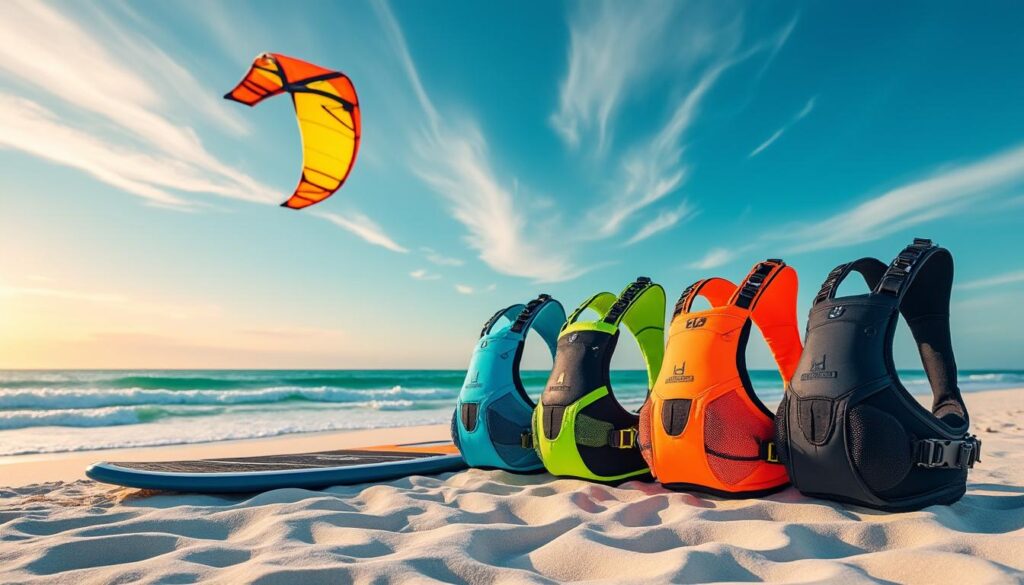
Personal safety equipment deserves the same level of attention. Helmet, impact vest, adequate wetsuit, line knife fixed to the harness: these are not objects for the “overly cautious”, but normal tools for those who take the sea seriously. One extra wave, a hit against the board or a line wrapped around the harness can turn into critical situations if even one of these elements is missing.
Mindset, however, remains the most powerful element. A rider who trains themselves to say no to a session that is too borderline, who accepts taking a smaller kite, who comes in earlier when fatigue sets in, is the one who stays in the game for a long time. It’s easy to be carried away by the euphoria of a group, by the “come on, go out, you can do it” shouted from the beach, especially on iconic spots like those described in kitesurf Mauritius or Morocco stories. But the sea does not see enthusiasm, it only sees the concrete setup: wind, level, material, physical energy.
Looking at destinations told by Salento Kiter – from the Adriatico to the Mediterranean islands described in the guide on kitesurf in Corsica, up to thermal lakes or oceanic lagoons – the same pattern always emerges: on the best spots, the most respected locals are those who know how to maximize time in the water while staying healthy. They are not necessarily the most spectacular, but those who always return on their own legs.
To shape this mindset, it can help to take example from an ideal character, let’s call him Marco. Marco is an intermediate rider: he can tack both ways, starts doing some small jumps, but does not yet have big tricks in his repertoire. On a kitesurfing vacation weekend in Salento, he finds strong conditions on the Ionio. Friends rig 7 and 8 meter kites, someone even tries a 9 “since there’s space”. Marco watches the sea, feels that the gusts are more aggressive than he feels ready to manage, and decides to go out after lunch, when the wind drops. It might seem like a surrender, but in reality it is a responsible choice: he goes out with more control, really enjoys himself and goes home confident, not scared.
This balance between the desire to progress and self-care is what makes kitesurfing a sport you can practice for many years, not a flash in the pan. Well-kept equipment, checked regularly and updated when needed, combined with a head that knows how to listen to the wind and the body, builds a safety that cannot be improvised.
After all, the true freedom of kitesurfing is born precisely there: from knowing you can push, play with the wind, explore new spots and tides, because the foundations are solid, from the bar to the last knot in the lines.
What is the most common safety mistake among beginners in kitesurfing?
The most frequent mistake is entering the water with a kite that is too large for the actual wind, often trusting only weather apps or copying other riders’ sizes. This leads to being overpowered, struggling in the water start and quickly losing control in a gust. The solution is to learn to read the wind at the spot, ask instructors or locals for advice, and always choose the more cautious size, especially in the first months of practice.
Are helmet and impact vest really necessary for kitesurfing?
Helmet and impact vest are not mandatory everywhere, but they are strongly recommended, particularly for those learning or trying new maneuvers. The helmet protects from impacts with the board, the wing or the seabed, while the impact vest helps both with flotation and impacts to the chest and ribs. On crowded spots or with shallow seabeds, these two items concretely reduce the severity of many accidents.
How can I train to use the quick release effectively?
The best way is to turn the release into an automatic gesture. Before each session, on land, pull the quick release following the full safety sequence, then reassemble the system calmly. You can also simulate controlled panic situations with the help of an instructor, in shallow water, to see how the kite reacts and what happens after the release. The more you repeat this gesture in calm conditions, the more your body will perform it quickly when it really matters.
Which wind conditions are safest for learning kitesurfing?
For learning, ideal conditions are side or side-onshore wind, between 12 and 20 knots, fairly stable and without approaching storms. The beach should have ample free downwind space, a gradual seabed and absence of obstacles such as submerged rocks or nearby piers. In these conditions the kite is manageable, errors cause less damage and technical progression is faster and calmer.
How to choose a kitesurf school that prioritizes safety?
A good kitesurf school makes its method clear immediately: small groups, helmet radio to communicate with the instructor, recent and well-maintained equipment, attention to weather conditions and students’ levels. Ask if the course includes specific sessions on self-rescue, use of release systems and spot reading. Also observe how instructors manage students already in the water: if they intervene quickly when something goes wrong, safety is likely a real priority.