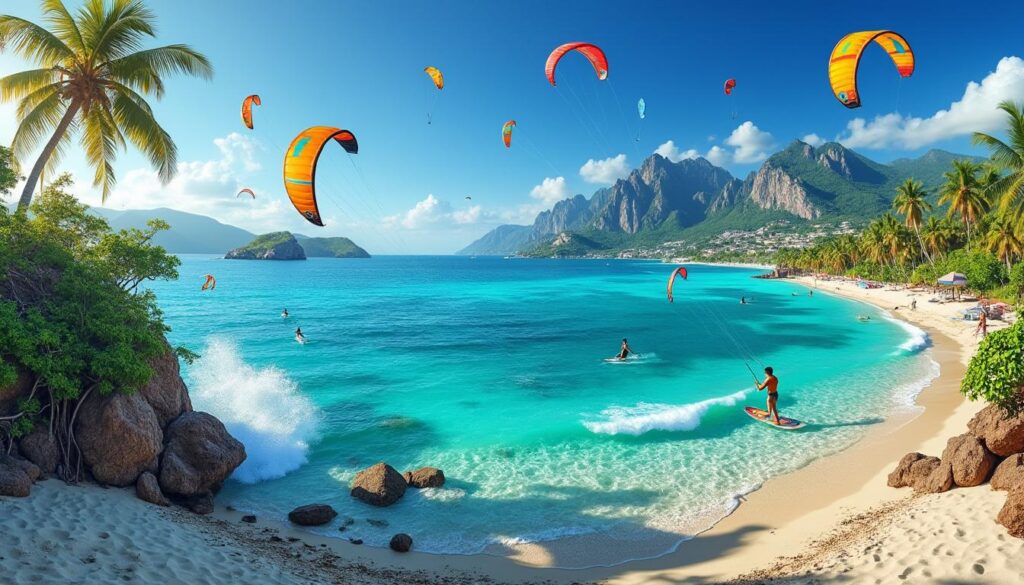
The wind that blows steadily along Brazil’s northeast coast has changed the world map of kiteboarding. Between golden dunes, fishing villages and mirror-flat lagoons, kitesurf in Brazil has gone from a niche spot to a fixed destination for those who plan their kitesurf holidays around the knots of wind. Jericoacoara, Cumbuco, Barra Grande, Taiba: names that come up again and again in conversations among riders at the end of every session in Italy, from kitesurf Salento to kitesurf Adriatico and the Ionian Sea. The question is no longer “if” to go, but “when” and “where” to land to make the most of every travel day. With a windy season that stretches to almost nine months, Brazil allows you to link different spots, alternating butter-flat lagoons, soft waves and endless downwinds.
For those who practice kitesurf in Italy year‑round and dream of a winter spent in lycra rather than in a drysuit, Jericoacoara – or simply Jeri – has become a kind of magic word. There the wind gives no mercy, but it offers rapid progression to those who know how to listen. Intermediate riders find ideal conditions to push jumps and maneuvers, while those arriving at a basic level can gradually enter the water in the area’s lagoons, supported by established schools and instructors used to working with students from every background. And while learning to control the kite on the Brazilian coast, the mind is already planning how to bring that control back to your home spots in Puglia, Sicily or on Lake Garda.
In short
- Jericoacoara and Preá: the heart of Brazilian kite, strong and consistent wind from July to December, great for freestyle progression and downwind.
- Cumbuco: a super accessible spot near Fortaleza, flat lagoons for kitesurf for beginners and a very active international community.
- Barra Grande and Ilha do Guajirú: paradises of shallow, flat water, perfect for learning and for those who want to train tricks with maximum safety.
- Taiba, Paracuru, Atins: ideal choices for those seeking waves, wilder scenery and less crowding compared to the more famous spots.
- Connection with Italy: what you train in Brazil will make you fly also on your home spots, from kitesurf Lecce to the spot kitesurf Puglia on the Ionian and Adriatic coasts.
Kitesurf Brazil: why Jericoacoara has become a global reference
When it comes to kitesurf in Brazil, Jericoacoara is always the first name that comes up. It’s no coincidence: this former fishing village in Ceará has gone in a few decades from a remote corner to a global reference for riders of all levels. The secret is a simple mix that’s rare to find elsewhere: strong and reliable wind, striking landscapes, a relaxed atmosphere and a network of schools and pousadas designed precisely for those who live with the bar in their hands. From the sunset seen on the main dune to the sandy streets without asphalt, everything revolves around water and wind.
The most solid period for kite generally runs from July to December. In these months the trade winds come in almost every day, with intensities that often range between 18 and 30 knots. For a rider used to Salento wind or winter days kitesurfing on the Ionian, the difference is clear: no more endless waits on the beach watching the weather change; here you rig the kite knowing your session will happen. That makes Jeri a perfect laboratory even for those coming from Europe with only a few days off and zero desire to waste them.
A recurring protagonist on Brazilian beaches is Luca, an intermediate rider who spends summers between kitesurf Taranto, Reggio Calabria and Sicily. After years chasing storms and thermals, he decided to winter in Jericoacoara to finally push strapless jumps. In a few weeks, thanks to the consistency of the wind and the variety of spots around the village, he went from simple control edges to full rotations in the air, with ever cleaner landings. Without that daily repetition of attempts and corrections, it would have taken him entire seasons in Italy.
Another aspect that makes this corner of Ceará unique is the evening atmosphere. The streets are sandy, the lights are low, bars full of boards leaning against the walls. There isn’t the “closed resort” feel often found in other exotic destinations: here kiters, windsurfers and surfers mix with non‑rider travelers, creating a fluid community where conversation always, one way or another, revolves around the wind of the next day. This shared energy motivates even the shyest to plan new outings, try advanced courses and raise the bar.
For those used to kitesurf in Italy, Jericoacoara will act like a mirror: it highlights strengths and limits of one’s riding. Intense days force work on physical endurance, edging technique, and gust management. Many riders coming from spots like the spot kitesurf Puglia or the lagoon of Taranto notice a clear improvement in speed control and in-air confidence. It’s like compressing a year of progression into a few weeks, with the opportunity to experiment in conditions that forgive but not too much.
The highlight of Jericoacoara, however, is often a few kilometers away: Preá, a wide, windy beach less crowded with nightlife. There the kites fill the sky, but the breadth of the shoreline still allows launches without the feeling of “traffic” on the water. Those who prefer a more focused session, with fewer distractions and more space, almost always end up spending most of their time at Preá. Between Jeri and Preá you build that simple but powerful routine every rider dreams of: wake up, check the wind, pick the spot, return to town only when your legs start to give out.
In short, Jericoacoara is not just a trendy destination, but a concrete tool for growth for those who live for kite. And the real value lies in knowing how to use it, a topic that connects directly to the next node: choosing the single best spot based on what you want to train.
Jericoacoara vs Preá: practical guide to the spot and choosing by level
Around Jericoacoara the discussion isn’t just “where the wind is”, but how to use that wind. The fundamental distinction is between Jeri’s beach and Preá, about 15 km to the east. The first attracts everything: tourists, surfers, windsurfers, expert riders and curious passersby. The second, although increasingly known, remains more focused on kite, with more structured practice areas and fewer shore-side interferences. For those learning or wanting to push seriously, the difference is felt every minute of the session.
On Jericoacoara town beach the alternation between tide, waves and the presence of bathers requires good board control. It’s not the ideal spot for absolute kitesurf beginners, unless followed by a kitesurf school that knows the quietest times and zones perfectly. Those arriving with a solid base – a secure water start, riding on both edges and the ability to return to the starting point – can enjoy a lively freeride, perhaps starting to work on basic jumps using the chop as a natural ramp.
Preá, by contrast, is the kingdom of full wind and space. Here the area dedicated to kite is much broader, the water entry is often more straightforward and the wind even seems tighter than in Jeri, thanks to the exposure. Schools have concentrated in this area for these reasons: when it comes to learning kitesurf or offering an advanced kitesurf course, being able to rely on a wide, obstacle‑free area makes a difference in terms of safety and learning quality.
To navigate the various scenarios, a practical table helps a lot:
| Area | Recommended level | Type of water | Main strength |
|---|---|---|---|
| Jericoacoara (village beach) | Intermediate – Advanced | Chop, small waves, variable tide | Atmosphere, direct exit from town |
| Preá | Beginner – Advanced | Regular chop, relatively flat areas | Very consistent wind and plenty of space |
| Nearby lagoons | Beginner – Freestyler | Flat, shallow water | Ideal conditions for maneuvers and learning |
A concrete example: Sara, who spends summers between kitesurf Lecce and Gargano, arrived in Brazil with a clear goal: to land her first hooked backrolls. In Jeri, between chop and water traffic, she struggled to find the timing. Moving to Preá, with full wind and cleaner lines, she was able to repeat dozens of attempts per session, always using the same wave ramp formed by the seabed. Within ten days, the backroll became an almost natural movement, which she then brought home to windy days on the Ionian Sea.
Do not underestimate the impact of daily logistics. Living in Jeri and moving to Preá requires a bit of organization: shared buggies, school transfers, or staying directly in Preá for those who want to be closer to the spot. In return you get a super efficient routine: early breakfast, first session when the wind comes in, light lunch break, second outing in the afternoon, return to Jeri for dinner and the sunset on the dune. For those used to squeezing kite between work and family in Italy, this simplicity almost surprises.
The beauty is that all this experience doesn’t stay locked in a Brazilian parenthesis. Chop management, the ability to read gusts and the habit of launching tricks in strong wind are useful even when you return to your home spots, whether it’s the kitesurf Adriatico in the north or the more sheltered bays in the south. Brazil thus becomes an amplifier of Mediterranean riding, and linking to other articles like this guide on kitesurfing in Paros in the Mediterranean helps place Jericoacoara within a real itinerary of destinations, not as an isolated destination.
Understanding this local dynamic between Jeri town and Preá is fundamental to making good use of the trip. But Brazil doesn’t end here: as soon as you move along the coast, an entire series of spots opens up, each with its own character.
The best kitesurf spots in Brazil beyond Jericoacoara
Once you’ve tasted Jeri’s wind, a spontaneous question arises: “What would you find if you moved further north or south?”. The answer is simple: a series of spots that, for wind quality and variety of conditions, could easily be on the list of the best kitesurf spots Italy, but on a Brazilian scale. Cumbuco, Barra Grande, Ilha do Guajirú, Paracuru, Taiba, Atins, Gostoso, Lagoinha, Pipa: each name is tied to a different combination of sea, lagoons and lifestyle.
Cumbuco is often the gateway. Just 30 km from Fortaleza, it allows you to land from an international flight and be in the water a few hours later. For those used to the longer transfers required by many extra‑European destinations, it’s a luxury. The wind, from July to January, blows regularly, the internal lagoons offer flat, shallow water, and the environment is perfect for those taking their first steps or for those who want to test new maneuvers safely. Not surprisingly, many students who started with a kitesurf course in Italy choose Cumbuco as their first step outside Europe.
Then there’s Barra Grande, in Piauí, a place that requires a bit more travel but rewards with rare tranquility. Here the wind typically ranges between 18 and 28 knots, over soft sandy beaches and lagoons that look designed for kite. It’s the ideal spot for those who want to combine technical sessions with a slow pace of life, away from the crowds. Many Italian riders who frequent less crowded spots in Puglia or Sardinia find that same feeling of a “still real place” here, but with a much wider wind window.
Ilha do Guajirú, often nicknamed “Kite Lagoon”, is another key stop for those who love flat water. A large internal lagoon, with shallow depth and a sandy bottom, creates a playground where beginners and freestylers share the same water plane, each at their own level. This type of environment recalls certain days in the internal lagoons used by kitesurf Salento, but with the plus of a windy season that runs from July to January almost without pause.
For those seeking more movement and waves, spots like Paracuru and Taiba come into play. At Paracuru, the combination of reef, formed waves and tides creates a training ground for wave riders and strapless enthusiasts. Taiba, with its bay where waves can reach two meters, quickly becomes a go‑to for those who want to push in surf riding. There you see the difference between chatting about wave riding and really living it: taking the right position in the lineup, choosing the wave, managing the kite while drawing the face of the wave.
Further west, Atins, at the gates of the Lençóis Maranhenses National Park, offers an almost surreal setting. Lagoons, rivers and ocean intersect creating different water planes within a few kilometers. It’s a spot that requires some logistical preparation, but the combination of wind, dunes and varied water hits even the most seasoned riders. Similarly, Pipa and São Miguel do Gostoso offer a mix of waves, long beaches and lively towns, with restaurants and venues that are very popular with travelers in couples or with friends who are not necessarily kiters.
Looking at the map as a whole, the Brazilian northeast functions as a long downwind “track.” It’s no coincidence that many travel projects consist precisely of planning a series of stages, starting from Cumbuco, passing through Taiba, Paracuru, Ilha do Guajirú, up to Jeri and beyond. Each leg allows you to adapt the distance to the group’s level: those already familiar with downwinds matured on the kitesurf Ionian or among Adriatic spots can tackle longer routes, while beginners stay closer to a land support.
To compare these spots with other international scenarios, it can be useful to look at destinations like Dakhla in Morocco or the Cape Verde islands. In both cases, as in Brazil, the common thread is always the same: solid wind, varied water and logistics increasingly tuned for European kiters. Brazil, however, has the trump card of the incredible length of its coast, which allows you to shape the trip exactly on the progression you’re looking for.
Understanding this geography of spots is the first step. The second, even more important, is translating these possibilities into a real personal progression plan on the board, step by step.
Learn and progress: Brazil as a training ground for beginners and intermediates
For those looking to learn kitesurf or who still consider themselves “uncertain intermediate,” Brazil is not just a dream destination: it’s a true outdoor gym. The strength lies in repetition. In Italy, between missed weekends and irregular wind days, a beginner can take months to consolidate a simple water start. In the lagoons of Cumbuco or Ilha do Guajirú, with wind that comes almost every day and shallow water that forgives mistakes, those same maneuvers are locked in after a few days of continuous practice.
The typical path for someone starting from zero and choosing Brazil develops like this: the first two or three days dedicated to kite control on land and body dragging, always with the assistance of a reliable kitesurf school; then, as soon as kite control is sufficient, move to the water start in a shallow lagoon. In this context, falling isn’t a problem, relaunching the kite is easier and the fear of “not touching bottom” diminishes. It is precisely this feeling of a safety margin that unlocks many students who, on their home spots, tense up at the first difficulty.
Those already beyond the initial phase can use Brazil to fill classic technical gaps. Edging at speed, early tacks on a surfboard, basic hooked jumps, correcting posture in strong rides: all these components require volume of attempts. A rider who throughout the year moves between kitesurf Lecce, Sicily and Sardinia often accumulates scattered sessions, with different conditions each time. In Brazil, instead, working a few consecutive weeks on a single aspect of riding literally changes the body: muscles learn repeated gestures, fears shrink, and automatic memory sets in.
To avoid wasting the potential of such a trip, a good strategy is to structure progression into small daily missions. A concrete example of an objective list could be:
- Days 1–3: consolidate the water start on both edges and the ability to return to a precise point on the beach.
- Days 4–6: work on controlled speed, long edge in steady riding, learn to brake without panic.
- Days 7–10: introduce the first basic hooked jumps or the first strapless maneuvers, always in flat water or light chop.
- After day 10: experiment with rougher conditions, short downwinds, spot changes to test the new confidence.
In Martina’s case, a rider used to the spot kitesurf Puglia on the Ionian coast, the usual block was fear of speed. In the lagoon, with constant wind and lack of obstacles, she was able to work precisely on that: she started with short edges, progressively increasing distance, then introduced small direction changes. At the end of the trip, that same speed that had terrified her in Italy became an ally for jumping better and for sailing upwind with less effort.
Brazil also works well for those already familiar with the Italian sea but who want to broaden their “toolbox.” Those who have years of kitesurf Adriatico or Tyrrhenian experience, where you often work with onshore or side‑on wind, find huge benefit in tackling spots where the wind is more side and regular. Reading the spot becomes easier and concentration can shift to board control, rotations and style, rather than simply surviving the chop.
Another little‑discussed but fundamental point is fatigue management. Daily sessions in strong wind require attention to nutrition, hydration and recovery — the same issues many overlook in daily riding in Italy. In this sense, the Brazilian experience teaches a lot about the “lifestyle side” of kite: you learn to eat lightly before entering the water, to take care of shoulders and lower back, to schedule active rest days. All this is useful when in spring you return to put your board on the waves of the kitesurf Ionian or on the lake thermals.
To complete the training picture, it’s worth crossing Brazil with other windy destinations described on Salento Kiter, such as the guide to kitesurfing in Fuerteventura. This way you build a coherent path: combining oceanic and Mediterranean spots to become a complete rider, able to adapt both to home gusts and to constant trade winds.
Used this way, Brazil is not just an exotic winter parenthesis, but a real accelerator for your progression. And the gear you bring with you – board, kites, habits – plays a key role in the success of this transformation.
Equipment, wind and travel style: how to prepare a kite trip to Brazil
Organizing kitesurf holidays in Brazil requires some clear choices, especially for those leaving from Italy bringing everything with them. The first knot is kite selection. With winds often between 18 and over 25 knots, most riders use relatively small kites compared to the typical sets for kitesurf in Italy. Many intermediates find themselves riding 7 and 9 metre kites almost every day, with the 11 brought out only on the lightest days or for long downwinds with less steady wind.
A practical rule: if in Salento or on your Mediterranean home spot the kite you use most is a 12, in Brazil you will more often need the smaller size. This doesn’t mean leaving the big ones at home, but prioritizing medium‑small sizes in your luggage, especially if weight is limited. For boards, twin‑tip riders generally feel comfortable with standard dimensions, while surfboard lovers can consider slightly more voluminous, forgiving shapes, ideal for the waves of Taiba, Paracuru or Pipa.
The type of equipment also ties into travel style. Those aiming for a fixed base, for example in Cumbuco or directly in Preá, can afford to bring a bit more gear and store it in a pousada. Those dreaming of a mobile itinerary, linking spots like Barra Grande, Ilha do Guajirú and Jeri, must travel lighter and perhaps rely on local rentals to cover quiver gaps. In many cases, local schools offer packages that combine accommodation, storage and access to the latest kites and boards.
Don’t forget the physical aspect. Strong wind and frequent sessions put pressure on shoulders, forearms and lower back. Those used to sporadic outings on kitesurf Salento or on spots like Taranto or Ostuni risk arriving a bit “depleted.” Including a few weeks of targeted preparation – mobility, core, endurance – before departure makes the experience more enjoyable. The goal is not to become an athlete, but to have a body ready to endure more hours in the water without turning the trip into a collection of pains.
Another variable to consider is the compromise between comfort and authenticity. Some spots, like Cumbuco and Jericoacoara, offer international‑level facilities, with curated pousadas, a variety of restaurants and services designed for European tourists. Others, like Barra Grande or Icaraizinho, remain simpler and more rooted, with a less touristy pace and quiet evenings. Choosing where to stay also based on your personality helps avoid feeling out of place: those looking for parties and social life will prefer certain villages; those who want just water, wind and little else will be happy in more straightforward places.
For those coming from the Mediterranean, Brazil also offers an interesting ground to test new equipment: foil, wing, mutant boards. The flat lagoons, with sandy bottoms and no rocks, are the perfect environment for making the first foil tries under your feet, without the fear of hitting unseen rocks or shoals. It’s common to see riders who during the year ride twin‑tip at kitesurf Taranto or Lecce use the Brazilian trip to try a foil course or a few wing hours, thus adding another arrow to their quiver.
For a clearer visual idea of the different setups and Brazilian conditions, some online videos show well the differences in boards and kites in action along the Ceará coast.
In parallel, it’s useful to compare the preparation of a Brazilian trip with that for other windy destinations like Cape Verde, Sri Lanka or the Red Sea, often also covered on Salento Kiter. This way you learn to build a “travel formula” adaptable: a basic structure of gear, physical training and wind management that can apply both to Brazilian trade winds and to Mediterranean thermals.
From Brazil to Italy: what you bring home to the Salento and Mediterranean spots
The real value of a kite trip to Brazil is not measured only in hours spent in lycra and in photos with dune sunsets, but in what you bring home. Those who return to their spots in Italy – from kitesurf Lecce along both Salento coasts to the Tyrrhenian, to northern lakes – notice almost immediately some concrete changes in their way of being on the water. The first thing that stands out is confidence with strong wind. After weeks with small kites pulled from morning to evening, the “big” days in Puglia or Sardinia become less scary.
Another element that transforms is spot reading. The Salento coasts, with the possibility of choosing between kitesurf Adriatico and Ionian depending on wind direction, become a kind of “mini Brazil” when observed with different eyes. After learning in Ceará to move according to trade wind directions, you learn to do the same at home: check weather charts, choose the right spot for each orientation, and not stubbornly stick to a single beach. It’s exactly the kind of mindset that distinguishes an occasional rider from someone who truly understands the wind.
The same goes for managing chop and waves. Those who worked in Brazil on edging and jumping in formed sea find it easier to face rough days on the Ionian or certain Adriatic spots. Gusts that previously destabilized become opportunities to gain height, and waves that were once merely “suffered” begin to be read as ramps to exploit. It’s a subtle but powerful transformation, visible immediately when watching a rider sailing.
Many also discover a different way of living training out of the water. Brazil, with its routine of regular sessions, forces you to take care of the body and carve out recovery moments. Returning to Italy, those who had this experience tend to maintain some habits: post‑session stretching, targeted exercises for shoulders and core, attention to not go out on the water depleted after exhausting days. It’s not about extreme performance, but longevity on the kite: the goal is to keep enjoying the wind without accumulating injuries.
Finally, there is the mental aspect. Seeing up close how riders of every level move on challenging spots, from the Brazilian beginner taking first steps in the lagoon to the European freestyler closing megaloops at Preá, changes perspective on one’s abilities. Direct comparison, if experienced without anxiety about comparison, is a huge motivator. Many Italians return home with a precise list of maneuvers and aspects to improve, almost a “training plan” to carry on at home beaches.
For those who love kitesurf Salento, the connection between Brazil and Puglia is particularly interesting. Both areas live by wind, by a double coast, by smart choices based on direction. The difference is scale and consistency: training in the trade winds and then bringing that sensitivity to thermals and fronts that brush Italy’s heel leads to a tangible step up. Each new session in Brazil adds a tile to this growth, and over time the line between “far trip” and “home spot” becomes thinner.
For those who want to immerse themselves even more in this logic of comparing destinations, many videos and travel stories show Italian crews alternating Salento, Greece, the Red Sea and Brazil in a sequence designed precisely to grow step by step.
The key is to keep alive the thread that connects each spot to the next: don’t simply collect passport stamps, but build a true personal path, where each session – from Brazilian swells to thermal days on the Ionian – has a precise role in your rider story.
What is the best time to kitesurf in Jericoacoara and along Brazil’s northeast coast?
The most reliable window for kitesurfing in northeast Brazil generally runs from July to January, with peak consistency between August and November. In Jericoacoara and Preá the wind blows almost every day, often between 18 and 30 knots. Some spots, like São Miguel do Gostoso, maintain good conditions even between November and March. If you want to maximize the chances of daily sessions, plan the trip in the middle of this range, taking into account that during peak months some villages are busier.
What level is needed to kitesurf in Brazil?
Brazil is suitable for all levels, but spot choice is crucial. Beginners should aim for lagoons like Cumbuco, Barra Grande or Ilha do Guajirú, where the water is flat and shallow and the schools are very organized. Intermediate and advanced riders can fully exploit areas like Jericoacoara, Preá, Paracuru or Taiba, where the wind is strong and the sea more formed. Before leaving, clarify your progression goals and choose based on them, not just on the most spectacular photos.
How many kites and what sizes should you bring from Italy?
For the northeast coast it’s wise to favor medium‑small kites, because the wind is often strong. Many intermediate riders use 7 and 9 metre kites almost all the time, with an 11 as an option on lighter days or for long downwinds. If your quiver in Italy revolves around a 12, consider bringing one size smaller as your main kite. Weigh the luggage, but try to have at least two sizes that cover a wide range, so you won’t be stuck on the beach if intensity changes.
Is it better to base yourself in one spot or organize an itinerant downwind trip?
It depends on your level and available time. A fixed base in spots like Cumbuco or Preá is ideal for beginners and intermediates who want to maximize progression with simple routines and regular sessions. Itinerant downwinds along the coast, linking different spots, suit more confident riders who can handle long navigations, recoveries and transfer logistics. You can also combine both: a stable first week to gain confidence and a second, more adventurous week with downwinds organized by local schools.
How does a trip to Brazil connect with kitesurfing practice in Italy?
A trip to Brazil can become an accelerator for your riding in Italy. There you train in a few weeks what would take a whole season at home: control in strong wind, chop management, maneuver safety. Returning to Italian spots – from kitesurf Salento to northern locations – you will automatically apply these skills. Planning trips to precede Italy’s windy periods lets you enter your home season already ‘warm’, with technique and confidence boosted.