- Have just finished a kitesurf course and want a ready and coherent solution.
- Can already ride upwind in both directions and are starting to work on pointing upwind.
- Desire a comfortable freeride board that doesn’t “bite” too much in sea chop or lake chop of the North.
- Want a single kite to range across kitesurf Adriatic, Ionian and some lake outings.
- Aim to learn the first jumps and, maybe in the future, some raley or basic hooked-in tricks.
In essence, it’s the package designed for the rider who feels they have passed the “just surviving” phase and now wants to really start playing with the wind, aware that good equipment can speed up progression without complicating life.
Duotone kitesurf 2026 prices: ranges, budgets and how to optimize spending
Talking about Duotone kitesurf 2026 prices means accepting a reality from the start: you’re not in the market’s low-cost segment. Duotone focuses on the use of advanced materials, a wide service network and products tested around the world, and this obviously affects the price list. At the same time, the variety of the range allows finding solutions for different budgets, especially by choosing carefully between standard, SLS, D/LAB versions and complete bundles.
In general terms, a Duotone Evo 2026 kite in the standard version sits in the mid-high range, accessible but not cheap. Moving up to SLS versions and especially D/LAB the price grows noticeably, following the jump in performance and material lightness. Those who have not yet developed solid technique often do not fully exploit these extras, so it’s wise to honestly assess your level before aiming for the top of the range. Better a standard Evo in the right sizes than an underused D/LAB.
An aspect not to be underestimated is the total cost of the quiver. The kite is only part of the equation: add bar, board, harness, wetsuit and accessories. The Evo + Select + Trust Bar complete bundles have the advantage of lowering the overall price compared to separate purchases and ensure total compatibility between components. For someone entering the world of kitesurf Italy now, this option is often the most sensible, because it avoids random mixes of boards and bars from different brands without a real logic behind them.
Those on a tighter budget can consider some strategies:
- Invest in a new kite and bar, but choose a used board in good condition.
- Focus on a single kite well-sized for the average winds of your main spot, postponing the purchase of a second kite to a later time.
- Look for seasonal deals or bundles where the retailer offers “discounted prices” on recent season stock.
In Italy, many riders build their Duotone quiver step by step. For example, you can start with an Evo 12 m for medium winds, paired with a simple freeride board, and only later add a 9 m for stronger winds typical of spring and autumn. The advantage is twofold: you spread the expense over time and you have the chance to better understand your real personal needs.
Given Duotone’s spread in major spots, the used market is also quite lively. This allows, for example, selling a kite in good condition to finance the move to an SLS or D/LAB version, without always having to start from scratch. In any case, it’s always advisable to check the condition of bridles, valves and fabric before completing a second-hand purchase, especially if the aim is heavy use in windy spots like kitesurf Taranto or on international trips.
Ultimately, Duotone 2026 prices reflect a premium positioning, but with thoughtful choices and by exploiting the right bundles you can build a convincing setup without exceeding your budget. The key question remains: how often and how intensely do you plan to use your kite? From there, you calibrate the investment.
Value over time and considerations on resale
A topic often little discussed is the value over time of the equipment. Duotone kites, precisely because of their popularity, generally retain good resale value on the second-hand market. This is important when planning the evolution of your quiver, especially with a view to transitioning to disciplines like hydrofoil or surfboard, where you might want to switch to different, lighter or more wave-oriented kites.
Also, the stability of the range – with names like Evo, Neo and Rebel present for years – helps those who buy used to better orient themselves on the real value of items. This makes buying and reselling over time safer, without the feeling of “playing the lottery” with unknown or experimental models.
Duotone and progression: from kitesurf for beginners to the advanced rider
One of the strengths of the Duotone range is the ability to accompany the rider along the entire path, from when they first get in the water with the board in hand to when they start throwing serious jumps. Schools that operate on spots like kitesurf Lecce or kitesurf Salento in general often choose these kites precisely for their combination of error forgiveness and progression potential. For beginners, recognizing the same kite on the home beach and in videos of more advanced riders gives extra motivation: the gear is not a limit, you grow with it.
In the early steps, a kitesurf for beginners signed Duotone must above all be predictable. Intuitive auto-relaunch, a clear wind window, effective depower when you pull the trim: these are the details that matter when you still have excitement in doing body drag upwind or recovering the board. Articles like the guide on kitesurf for beginners help clarify these priorities, avoiding being dazzled only by marketing about huge jumps.
As level increases, the same Evo or Neo you used to learn becomes the base to work on jumps, transitions, backrolls and first frontrolls. The Trust Bar, initially used in “full protection” mode with great attention to depower, ends up becoming a natural extension of the hands. The body learns to feel the kite even by just watching the waves or the chop ahead of the board, without needing to constantly stare at the sky.
Those who choose to move toward other disciplines, like foil, find in the Duotone range specific models oriented to light wind and low-speed stability. In this transition, content like the guide on how to learn hydrofoil kitesurf can become a valuable compass, explaining which kites in the catalog best suit flying-on-a-foil needs.
A typical progression can be told through Sara’s story, 28, who starts kitesurfing on the Ionian with a standard Evo package. After a season focused on the basics, the second year sees the entry of the first jumps and transition maneuvers. In the third, she decides to invest in a smaller Evo SLS for windy days and a second board dedicated to wave riding, while keeping the same bar. The common thread is clear: the gear grows with her, never forcing her to overhaul everything at once.
In this way, Duotone becomes for many Italian riders not just a brand, but a kind of “common language” across different levels: from the newbie asking for advice on the beach to the local expert pushing loops. The gear is the same, only the depth of use changes.
Technical progression and wind awareness
Having a stable and communicative kite also helps develop that wind sensitivity which is the real leap in quality for any rider. With a well-tuned Evo, for example, you learn to recognize when the power on the edge is no longer right for your weight or the board you’re using. This pushes you to think about wind knots, the type of water – flat, chop, wave – and the direction relative to the beach.
This awareness is not only useful to “do higher jumps”, but above all to choose the right sessions, perhaps avoiding forcing a 9 m in a 35-knot day when the sea is really too messy. Duotone equipment, with its predictable and progressive response, therefore becomes an additional teaching tool that trains you to read the wind with your body even before using weather apps.
Which Duotone 2026 model is most suitable for someone starting kitesurfing in Italy?
For those starting kitesurfing in Italy, the Evo 2026 in the standard version is the most balanced choice. It offers smooth power, easy relaunch from the water and predictable behavior that helps learn body drag, water start and first upwind legs. Paired with a freeride board like the Gonzales or the Select Concept Blue, it allows progression up to an intermediate level without having to change equipment immediately.
What is the difference between Duotone Evo standard, SLS and D/LAB?
All three models share the same allround base but differ in materials and performance. The standard Evo is designed for wide use, from beginner to intermediate, with a more accessible price. The Evo SLS uses lighter and stiffer materials to increase responsiveness and control in strong wind. The Evo D/LAB pushes to the maximum on lightness and performance for big air and advanced use, making it ideal for experienced riders seeking an extremely reactive and powerful kite.
Is it worth buying a complete Duotone package (kite, bar, board)?
For those coming out of a basic course and wanting a coherent set, the complete Duotone package with Evo 2026, Trust Bar and Select Concept Blue board is often the best solution. The bundle reduces the cost compared to buying separately, guarantees total compatibility between components and offers a setup designed as a unit for freeride and progression. It is particularly recommended for those who want to avoid mistakes when combining different equipment.
Is Duotone also suitable for those who mainly want to do wave riding?
Yes. The Neo 2026 model was specifically designed for wave riding, with controlled drift, stable power and great responsiveness to bar inputs. It is widely used in major wave spots in Italy and the Mediterranean. Paired with a surfboard suited to local conditions, it becomes a powerful setup for those wanting to move from simple freeride to kite-assisted surfing.
How to manage the budget for a Duotone quiver if you are a beginner?
The most sensible strategy is to start with a single kite well-sized for the typical winds of your main spot, paired with a bar and a freeride board. Later, you can add a second kite, smaller or larger, according to real needs. Complete bundles and end-of-season offers help contain costs. Moreover, Duotone’s good resale value on the used market allows selling part of the equipment to finance future upgrades to SLS or D/LAB versions.
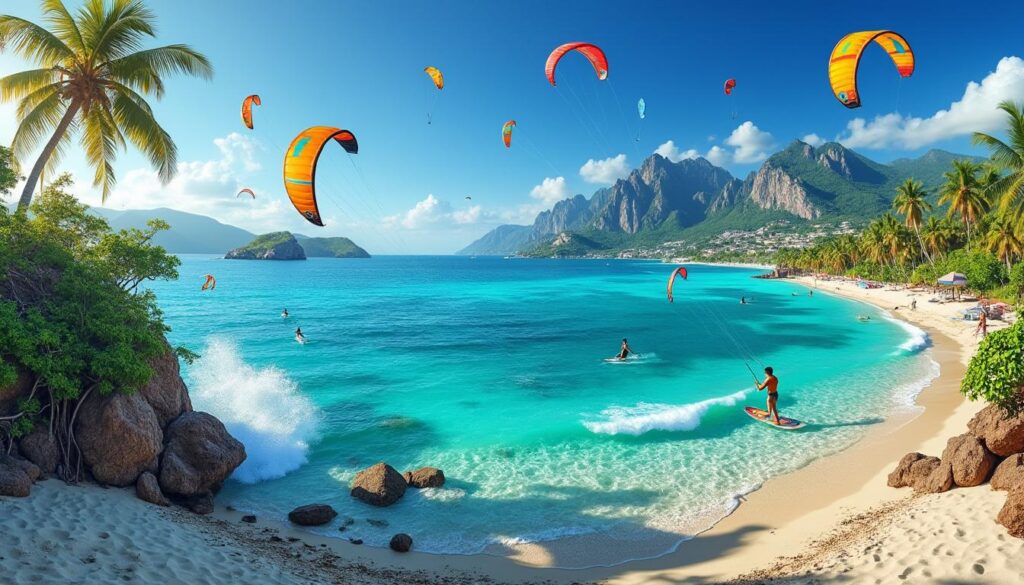
The wind picks up, the water ripples, and Duotone kites color the sky between the Adriatic and the Ionian. In the world of kitesurf Italy, this brand has become a point of reference for those who want to push hard in jumps, surf the waves with control or simply enjoy a relaxed freeride. The 2026 models mark an important step: lighter materials, more sustainable constructions and complete packages designed for those who want to get in the water with the right setup from the very first tack. From the beaches of kitesurf Salento to the lakes of the North, the name Duotone comes up everywhere when talking about reliable equipment and fast progression.
This scene doesn’t concern only experienced riders. Many today choose a kitesurf for beginners signed Duotone because they look for a kite that forgives mistakes but doesn’t become limiting after a few months. Bundles with the Evo kite, freeride boards like the Select Concept Blue and adjustable bars make it possible to move from first waterstarts to controlled jumps without having to change all the gear right away. At the same time, the SLS and D/LAB variants, more technical and performance-oriented, attract those aiming at big air and competitions, bringing materials like Aluula and Textreme from the lab straight to the spot. In between, the average Italian rider, who wants a single quiver for kitesurf holidays, after-work sessions and maybe a few weekends at new spots, finds in the Duotone 2026 models a concrete ally to handle the wind in every season.
In short
- Duotone Evo 2026: allround kite, ideal for freeride, light big air, freestyle and wave, with easy relaunch and smooth power delivery.
- Neo, Rebel, Select, Gonzales: models specific for waves, big air and comfortable freeride, designed to cover all riding styles.
- Complete bundles with kite, bar and board: a practical solution for those who want a ready, balanced setup suitable for progression.
- 2026 prices: wide range, from affordable bundles to top-of-the-line D/LAB kites with ultralight materials.
- Choice for Italian riders: great compromises for kitesurf Lecce, kitesurf Taranto, northern lakes and trips to major spots in the Mediterranean.
Duotone Evo 2026: the allround kite for kitesurf Italy between freeride and big air
When talking about Duotone kitesurf in 2026, the Evo is often the first name that comes up on the beach. It’s the kite designed for those who want to do a bit of everything: freeride, jumps, some unhooked tricks and maybe a few waves when the sea on the Ionian or the Adriatic gets up. The structure has been lightened and the geometry refined to make the turn quick and precise, without harsh jolts on the bar. Result: the kite accelerates smoothly, doesn’t yank, and gives you time to manage the power even if you’re still building confidence.
In practice, this means one clear thing: the course when riding upwind stays stable. On a typical Salento wind afternoon, with gusts that jump 5–8 knots, the Evo tends to filter the peaks instead of transmitting them all to the arms. For those still consolidating depower control, this is gold. Lift in jumps is progressive: you hit the pop, feel the pull building without surprises, and the hangtime is enough to adjust your body in the air and prepare clean landings. It’s not just marketing: in the field it translates into fewer crashes and more confidence already from the third or fourth session.
Relaunching from the water is another strong point of this model. The wingtips tend to lift quickly and the kite rotates without sinking the leading edge, even with wind at the low end of the range. For those learning body drag and first waterstarts, every minute lost with the kite stuck to the water is pure frustration. A well-inflated and tuned Evo saves you that constant struggle and lets you focus on body position and board control.
Many Italian riders use the Evo as their only kite to move between sea and lake. A typical season? Spring on Lake Como with medium thermal wind, summer in Puglia between kitesurf spots on the Adriatic and Ionian sides, and a few autumn weekends on the Piedmont lakes or on Garda. In all these scenarios the same model, chosen in the right size, allows you to cover most conditions from 14 to over 30 knots, especially if paired with a freeride board that gets plane early.
A concrete case: Luca, 35, starts kitesurfing with a kitesurf course of one week on the Ionian. After the first days at the kitesurf school, he gets an Evo 12 m with a 138 freeride board and in a single season moves from the fear of releasing the back hand to small controlled jumps, without changing kite. The key is precisely the model’s “easy but not boring” nature, which allows keeping the same quiver from leaving the beginner phase to intermediate-advanced.
In short, for those looking for a single kite for kitesurf for beginners that remains valid for years of progression, the Evo 2026 represents the heart of the Duotone range. It’s the kind of kite that accompanies you while you learn to read the wind and feel the plane under your feet.
Duotone Evo D/LAB and Evo SLS 2026: when the allround becomes high performance
For riders who love the Evo’s character but want something more extreme for big air or looped jumps, Duotone pushed the evolution with SLS and D/LAB versions. The D/LAB label indicates the use of materials like Aluula and advanced fabrics that reduce weight and increase structural stiffness. Translated to the bar: the kite accelerates faster, reacts to corrections instantly and holds a higher wind range, especially at the top end.
On strong mistral days on the kitesurf Adriatic, when the chop rises and jumps get serious, an Evo D/LAB 8 or 9 m allows you to push very high with surprising control at maximum power. Reduced inertia helps close more aggressive kiteloops without feeling dragged out of control. It’s not a kite meant for the very first tacks, but for those with solid basics who want to approach race-like riding, this material upgrade really makes the difference.
The Evo SLS, instead, occupies an intermediate position: lighter and more responsive than the standard version, but less extreme and more forgiving than the D/LAB. It’s often the choice of those doing advanced freeride, some moderate megaloops and who want a single kite that handles gust peaks well in the classic windy Mediterranean spots. On beaches like those of the kitesurf Ionio, where wind direction changes between morning and afternoon, having a kite that doesn’t lose consistency even when a gust suddenly rises means returning to shore with your legs still fresh.
For those looking at competitions, the fact that the Evo D/LAB has been used in international big air events, with athletes able to bring it to the podium, is a clear sign. You don’t need to reach that level to appreciate it: a good jumping technique and the desire to play with height are enough to immediately feel the plus compared to the classic version. In the end, the Evo remains the allround soul of the brand, but these SLS and D/LAB variants show how far you can push the concept of “one kite to do everything.”
Neo, Rebel and others: choosing the right Duotone model for your style
Not all riders seek the same feeling. Some only want to surf waves, others aim for maximum height in jumps, others still desire a smooth and relaxed freeride. The Duotone kitesurf 2026 range covers these needs with specific models: Neo for waves, Rebel for big air, Gonzales and Select for freeride more or less advanced, and other boards targeted at foil or freestyle.
The Neo is considered by many the “king of waves” in the Duotone catalog. Designed for down-the-line surfing, it combines a controlled drift with stable pull that accompanies you on the face without jerks. On a wave spot of the kitesurf Salento, when the wind isn’t perfectly side-off and you constantly have to reposition the kite to stay on the wave line, the Neo responds quickly and doesn’t drop out of the sky in wind holes. This lets you focus on the board, reading the set and choosing the sections to attack.
At the other end of the spectrum, the Rebel SLS 2026 speaks to those who dream of only one thing: rising as high as possible and staying suspended. The SLS construction (Strong Light Superior) combines stiffness, lightness and a profile designed to maximize lift and hangtime. In strong conditions, typical of some Tyrrhenian spots or the Northern Adriatic, a well-tuned Rebel can turn every gust into a trampoline. Experienced riders use this kite to push their limits a bit further each session, whether it’s local contests or simple challenges among friends.
For those still moving between first tacks and progressive freeride, boards like the Gonzales and the Select play a fundamental role. The Gonzales favors comfort, early planing and ease of control in chop, features perfect for those still working on edging and pointing upwind. The Select, especially in advanced versions like the Select SLS or the Select Concept Blue, adds responsiveness, upwind grip and smoother landings, becoming ideal for daily use in variable spots, from lakes to open sea.
To get a broader idea of the alternatives in Italy, it can be useful to look at how different riders manage gear choices in environments completely different from the sea, as discussed in the deep dives on kitesurf at Lake Maggiore. Understanding how a kite reacts to lake gusts compared to the “fuller” wind of the sea helps choose the model best suited to your main spot.
The key, in any case, is understanding what you really want from your session: clean lines on the waves, endless jumps, or simply smooth glides along the shore. Every Duotone 2026 model brings a precise personality and, if you correctly match kite and board, you can tailor a setup that responds exactly to your way of being on the water.
Comparison of Duotone kitesurf 2026 models for use in Italy
To guide those deciding how to compose their quiver, a concise comparison between the main models and the most frequent types of use in Italian contexts, from the best kitesurf spot Italy at sea to inland lakes, is useful.
| Duotone Model 2026 | Main use | Recommended level | Ideal spots in Italy |
|---|---|---|---|
| Evo | Freeride, moderate big air, occasional wave | From beginner to intermediate-advanced | Salento, northern lakes, Sardinia, Sicily |
| Evo SLS / D/LAB | Big air, high-performance freeride | Intermediate advanced / expert | Windy spots with strong and gusty wind |
| Neo | Wave riding, wave-oriented freeride | Intermediate and above | Wave spots on the Adriatic, Ionian, Tyrrhenian |
| Rebel SLS | Pure big air, maximum hangtime | Intermediate advanced / expert | Strong wind spots, windy lakes, open sea |
| Gonzales / Select | Comfort freeride, progression, upwind performance | From beginner to advanced | All spots, perfect for kitesurf holidays |
This kind of mental map helps understand where to place each piece of gear in your progression: the choice becomes less chaotic and more focused on the real wind you find when you get to the beach.
Duotone Evo 2026 bundle: complete package with Select Concept Blue board
One of the most interesting solutions for those who want to enter the Duotone world without getting lost among a thousand combinations is the complete package with Duotone Evo 2026, Trust Bar and Select Concept Blue board. It’s a true turnkey setup, designed for freeride and progression into big air, which puts kite, bar and board together coherently. The result is a balanced setup that doesn’t create surprises: power, control and comfort work well together.
The heart of the bundle is, of course, the Evo 2026. Already described as one of the most versatile kites, in this package it is tuned to accompany riders from the basic level up to a phase of daily riding. Its smooth power and quick but manageable turning make it ideal for those coming out of their first lessons at a kitesurf school and looking for a “friendly” kite that helps progression, from first upwind legs to first controlled jumps. The hangtime is enough to give enjoyment in jumps without causing that free-fall feeling that scares many beginners.
The Duotone Trust Bar Quad Control 2026 completes the picture with a clean and intuitive control system. The ability to adjust both the bar width and line length allows adapting the setup to different kite sizes and riding styles. This is particularly useful if in the future you add a second kite, either smaller or larger, to better cover the wind range of your usual spots. The depower is smooth and progressive, ideal for those who still need to develop the muscle memory for pulling and releasing the bar automatically.
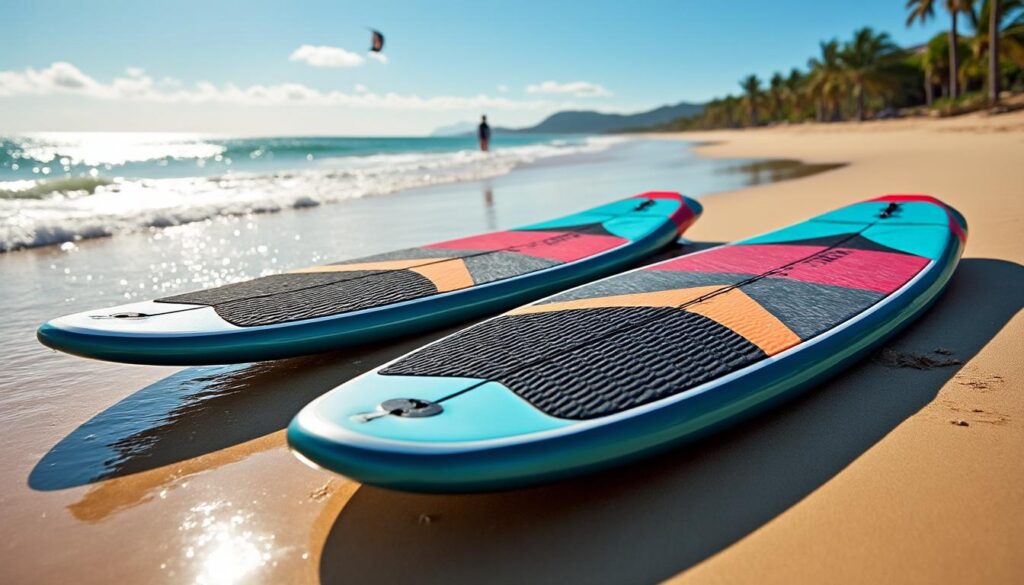
The Duotone Select Concept Blue 2026 board is a twin-tip freeride that combines performance and a choice of more sustainable materials. It uses flax and basalt fibers, paired with a double-concave base that improves both comfort in chop and hold in turns. Sharper rails increase upwind capability, making pointing more efficient with less effort on the legs. Space Flex technology on the tips softens the passage over short waves and jump landings, delivering a smooth yet responsive ride sensation.
The package also includes Vario Combo pads and straps, adjustable and designed to fit different foot shapes. Being able to precisely set stance width, position and strap angle is essential to reduce knee fatigue and increase control during edge changes. A beginner often underestimates this aspect, but with regular riding the fine adjustments of pads can make the difference between going home exhausted or still wanting “one last tack”.
Why does this bundle work so well? Because all components point in the same direction: progressive freeride with enough room to grow into big air and general control. It’s not a hyper-specialized kit, and for that reason it becomes the ideal companion for someone who kitesurfs every week and wants an “all-round” setup that responds both to summer breezes of the kitesurf Ionian and to windier sirocco days on the Adriatic.
In many shops this type of package is offered with advantageous conditions and sometimes limited availability. The combination “new product”, discounted price and reduced number of units attracts especially those who have decided to make the leap from a basic course to buying their first quiver. Ideally, it’s the setup you take straight on kitesurf holidays, without needing to rent each time, and it remains valid for several seasons.
Who the Evo + Select Concept Blue bundle is recommended for
This setup is particularly suitable for those who:
- Have just finished a kitesurf course and want a ready and coherent solution.
- Can already ride upwind in both directions and are starting to work on pointing upwind.
- Desire a comfortable freeride board that doesn’t “bite” too much in sea chop or lake chop of the North.
- Want a single kite to range across kitesurf Adriatic, Ionian and some lake outings.
- Aim to learn the first jumps and, maybe in the future, some raley or basic hooked-in tricks.
In essence, it’s the package designed for the rider who feels they have passed the “just surviving” phase and now wants to really start playing with the wind, aware that good equipment can speed up progression without complicating life.
Duotone kitesurf 2026 prices: ranges, budgets and how to optimize spending
Talking about Duotone kitesurf 2026 prices means accepting a reality from the start: you’re not in the market’s low-cost segment. Duotone focuses on the use of advanced materials, a wide service network and products tested around the world, and this obviously affects the price list. At the same time, the variety of the range allows finding solutions for different budgets, especially by choosing carefully between standard, SLS, D/LAB versions and complete bundles.
In general terms, a Duotone Evo 2026 kite in the standard version sits in the mid-high range, accessible but not cheap. Moving up to SLS versions and especially D/LAB the price grows noticeably, following the jump in performance and material lightness. Those who have not yet developed solid technique often do not fully exploit these extras, so it’s wise to honestly assess your level before aiming for the top of the range. Better a standard Evo in the right sizes than an underused D/LAB.
An aspect not to be underestimated is the total cost of the quiver. The kite is only part of the equation: add bar, board, harness, wetsuit and accessories. The Evo + Select + Trust Bar complete bundles have the advantage of lowering the overall price compared to separate purchases and ensure total compatibility between components. For someone entering the world of kitesurf Italy now, this option is often the most sensible, because it avoids random mixes of boards and bars from different brands without a real logic behind them.
Those on a tighter budget can consider some strategies:
- Invest in a new kite and bar, but choose a used board in good condition.
- Focus on a single kite well-sized for the average winds of your main spot, postponing the purchase of a second kite to a later time.
- Look for seasonal deals or bundles where the retailer offers “discounted prices” on recent season stock.
In Italy, many riders build their Duotone quiver step by step. For example, you can start with an Evo 12 m for medium winds, paired with a simple freeride board, and only later add a 9 m for stronger winds typical of spring and autumn. The advantage is twofold: you spread the expense over time and you have the chance to better understand your real personal needs.
Given Duotone’s spread in major spots, the used market is also quite lively. This allows, for example, selling a kite in good condition to finance the move to an SLS or D/LAB version, without always having to start from scratch. In any case, it’s always advisable to check the condition of bridles, valves and fabric before completing a second-hand purchase, especially if the aim is heavy use in windy spots like kitesurf Taranto or on international trips.
Ultimately, Duotone 2026 prices reflect a premium positioning, but with thoughtful choices and by exploiting the right bundles you can build a convincing setup without exceeding your budget. The key question remains: how often and how intensely do you plan to use your kite? From there, you calibrate the investment.
Value over time and considerations on resale
A topic often little discussed is the value over time of the equipment. Duotone kites, precisely because of their popularity, generally retain good resale value on the second-hand market. This is important when planning the evolution of your quiver, especially with a view to transitioning to disciplines like hydrofoil or surfboard, where you might want to switch to different, lighter or more wave-oriented kites.
Also, the stability of the range – with names like Evo, Neo and Rebel present for years – helps those who buy used to better orient themselves on the real value of items. This makes buying and reselling over time safer, without the feeling of “playing the lottery” with unknown or experimental models.
Duotone and progression: from kitesurf for beginners to the advanced rider
One of the strengths of the Duotone range is the ability to accompany the rider along the entire path, from when they first get in the water with the board in hand to when they start throwing serious jumps. Schools that operate on spots like kitesurf Lecce or kitesurf Salento in general often choose these kites precisely for their combination of error forgiveness and progression potential. For beginners, recognizing the same kite on the home beach and in videos of more advanced riders gives extra motivation: the gear is not a limit, you grow with it.
In the early steps, a kitesurf for beginners signed Duotone must above all be predictable. Intuitive auto-relaunch, a clear wind window, effective depower when you pull the trim: these are the details that matter when you still have excitement in doing body drag upwind or recovering the board. Articles like the guide on kitesurf for beginners help clarify these priorities, avoiding being dazzled only by marketing about huge jumps.
As level increases, the same Evo or Neo you used to learn becomes the base to work on jumps, transitions, backrolls and first frontrolls. The Trust Bar, initially used in “full protection” mode with great attention to depower, ends up becoming a natural extension of the hands. The body learns to feel the kite even by just watching the waves or the chop ahead of the board, without needing to constantly stare at the sky.
Those who choose to move toward other disciplines, like foil, find in the Duotone range specific models oriented to light wind and low-speed stability. In this transition, content like the guide on how to learn hydrofoil kitesurf can become a valuable compass, explaining which kites in the catalog best suit flying-on-a-foil needs.
A typical progression can be told through Sara’s story, 28, who starts kitesurfing on the Ionian with a standard Evo package. After a season focused on the basics, the second year sees the entry of the first jumps and transition maneuvers. In the third, she decides to invest in a smaller Evo SLS for windy days and a second board dedicated to wave riding, while keeping the same bar. The common thread is clear: the gear grows with her, never forcing her to overhaul everything at once.
In this way, Duotone becomes for many Italian riders not just a brand, but a kind of “common language” across different levels: from the newbie asking for advice on the beach to the local expert pushing loops. The gear is the same, only the depth of use changes.
Technical progression and wind awareness
Having a stable and communicative kite also helps develop that wind sensitivity which is the real leap in quality for any rider. With a well-tuned Evo, for example, you learn to recognize when the power on the edge is no longer right for your weight or the board you’re using. This pushes you to think about wind knots, the type of water – flat, chop, wave – and the direction relative to the beach.
This awareness is not only useful to “do higher jumps”, but above all to choose the right sessions, perhaps avoiding forcing a 9 m in a 35-knot day when the sea is really too messy. Duotone equipment, with its predictable and progressive response, therefore becomes an additional teaching tool that trains you to read the wind with your body even before using weather apps.
Which Duotone 2026 model is most suitable for someone starting kitesurfing in Italy?
For those starting kitesurfing in Italy, the Evo 2026 in the standard version is the most balanced choice. It offers smooth power, easy relaunch from the water and predictable behavior that helps learn body drag, water start and first upwind legs. Paired with a freeride board like the Gonzales or the Select Concept Blue, it allows progression up to an intermediate level without having to change equipment immediately.
What is the difference between Duotone Evo standard, SLS and D/LAB?
All three models share the same allround base but differ in materials and performance. The standard Evo is designed for wide use, from beginner to intermediate, with a more accessible price. The Evo SLS uses lighter and stiffer materials to increase responsiveness and control in strong wind. The Evo D/LAB pushes to the maximum on lightness and performance for big air and advanced use, making it ideal for experienced riders seeking an extremely reactive and powerful kite.
Is it worth buying a complete Duotone package (kite, bar, board)?
For those coming out of a basic course and wanting a coherent set, the complete Duotone package with Evo 2026, Trust Bar and Select Concept Blue board is often the best solution. The bundle reduces the cost compared to buying separately, guarantees total compatibility between components and offers a setup designed as a unit for freeride and progression. It is particularly recommended for those who want to avoid mistakes when combining different equipment.
Is Duotone also suitable for those who mainly want to do wave riding?
Yes. The Neo 2026 model was specifically designed for wave riding, with controlled drift, stable power and great responsiveness to bar inputs. It is widely used in major wave spots in Italy and the Mediterranean. Paired with a surfboard suited to local conditions, it becomes a powerful setup for those wanting to move from simple freeride to kite-assisted surfing.
How to manage the budget for a Duotone quiver if you are a beginner?
The most sensible strategy is to start with a single kite well-sized for the typical winds of your main spot, paired with a bar and a freeride board. Later, you can add a second kite, smaller or larger, according to real needs. Complete bundles and end-of-season offers help contain costs. Moreover, Duotone’s good resale value on the used market allows selling part of the equipment to finance future upgrades to SLS or D/LAB versions.