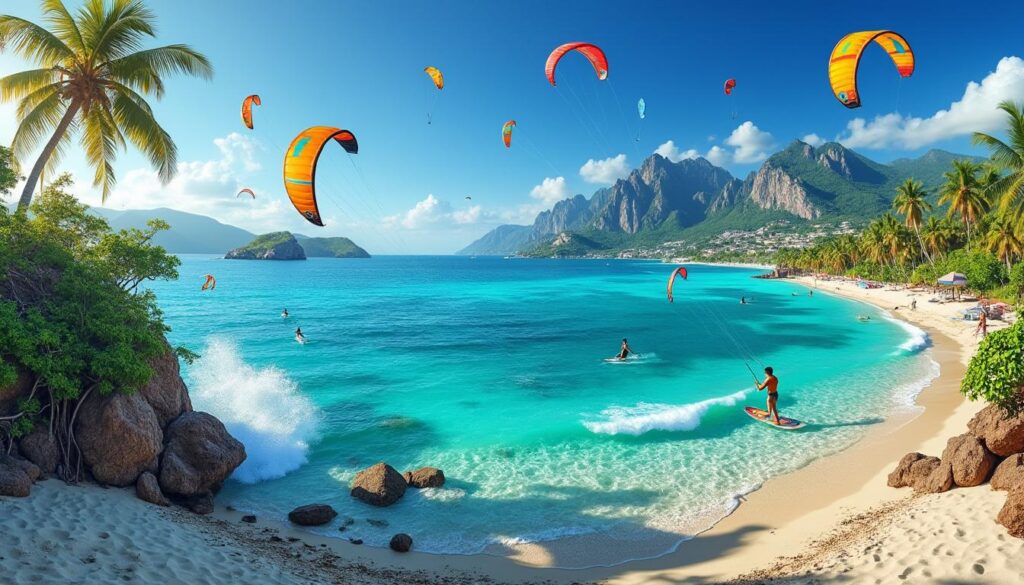
Wind blowing strong, water that changes color with every latitude, different cultures but united by the same desire to hook the kite and glide away. Kitesurfing in Europe is not just a list of spots; it is a true mosaic of conditions, lifestyles and local communities. From the Maestrale that clears the sky over Lago di Garda to the Levante that shakes Tarifa, passing through the Greek islands and Italian bays, the Old Continent offers a variety of settings that allows anyone to find their own rhythm. Those looking for technical progression find waves, chop, flat water and reliable thermals; those who simply want to switch off can arrange kitesurf holidays tailored to their needs, with schools, rentals and beach life just steps from the spot.
In these destinations, kitesurfing is not a postcard accessory but the axis around which the day turns: you have lunch when the wind drops, do stretching while checking the forecast, meet new people while preparing the bar on the sand. The great thing is that Europe allows you to jump from one sea to another in a few hours by plane, building a true “wind tour”. Those who started with a kitesurf course can plan their first trip among beginner-friendly spots, while experienced riders aim for tougher conditions, solid waves and gusts to manage with precision. Everywhere, you find the same language made of knots, wind directions and stories of sessions that ended at sunset with legs still trembling from adrenaline.
- Kitesurf Europe means a dense network of spots, from alpine lakes to oceanic bays, with seasons and conditions very different from one another.
- For those who want to learn kitesurfing, there are structured schools and local communities that guide the first steps, especially in Italy, Spain, Greece and Switzerland.
- Italy, with kitesurf Salento, Lago di Garda and Calabria, is today among the most interesting hubs on the continent for wind variety and ease of access.
- Good planning (weather, level, logistics) turns a simple outing into a real mini-journey of progression and fun.
Kitesurf Europe: why the Old Continent is an ideal playground
When we talk about kitesurf Europe, people often immediately think of Tarifa or the Canaries. In reality, the continent hides an enormous potential that combines 60,000 km of coastline, inland lakes, thermal winds and different weather systems. This means having almost always a place where the wind turns just right, even when the sea at home is flat. For a rider who lives in Italy, Germany or France, often an hour by plane is enough to completely change the scenery: from an alpine lake with controllable thermal wind to an oceanic bay with generous waves.
In recent years, kitesurf Italy has made a huge leap. It’s no longer just about a few isolated spots but a true network: kitesurf Adriatic for those who love longer water and chop, kitesurf Ionian for those seeking protected flat water, spot kitesurf Puglia and Calabria that increasingly attract foreigners. At the same time, Northern Europe keeps pushing with lagoons and strong winds, while countries like Greece and Portugal play the role of timeless classics. The result? An entire continent that now lives to the rhythm of the wind.
Those who organize kitesurf holidays today don’t just choose “a nice beach”, but think in terms of wind direction, average intensity and safety. For example, Lago di Garda has become a perfect natural laboratory: strong but predictable thermals, onshore services, structured schools and the possibility to stay near the spot. On the other side, Tarifa remains the European “gym of strong wind”, ideal for those who want to withstand intense gusts and improve bar control. In between, there are quieter realities like Lago di Silvaplana, which allows you to combine mountains, fresh water and afternoon sessions with steady wind.
A strong trend is the steady growth of kitesurf for beginners. More and more people come to kite after seeing friends glide or after reading articles about how to choose the best kitesurf destinations. Here the quality of the kitesurf school and the attention to safety come into play. In many European spots, local administrations now have clear regulations on kite zones, launch corridors, mandatory initial lessons and insurance. This makes the practice more accessible, but asks the rider to respect simple rules: keep distance, read the signs, always ask locals for information.
To know where and when to go, many European riders have started using a simple matrix: season, level and budget. Spring and autumn are perfect for those aiming for more stable wind and less crowded beaches. Summer is the prime season for inland lakes and islands, especially for those traveling with family or who want to combine kite and tourism. In winter, those who can’t stand thick wetsuits migrate to warmer spots, using guides dedicated to winter kite destinations. Everything always comes back to one point: there is no “the” perfect place, but the right place for your moment, your level and your wind.
Europe is therefore a complete playground, but only those who learn to read the continent through the wind really manage to take advantage of it.
Mental map of the European kitesurfer: north, south, east, west
To navigate among all these spots, many riders use a kind of mental compass. Northern Europe (Netherlands, Denmark, northern Germany) is associated with strong wind, cold water and large shallow lagoons. The west (Atlantic Spain, Portugal, Atlantic France) is the realm of waves and storms coming from the Atlantic. To the south, the Mediterranean offers warmer water, summer thermal winds and the mix between the Ionian, Adriatic and Tyrrhenian seas. To the east, Greece and Turkey complete the picture with Meltemi and very powerful island scenarios.
Understanding this logic helps to plan outings better. If you know that the Meltemi blows from the north in summer in the Aegean, you can target a Greek island for an August camp. If you love freeride on flat water, aim for lagoons and inland lakes. If wave riding attracts you, look to the Atlantic or Mediterranean spots exposed to the open sea. In any case, the trick is always the same: don’t choose only with your eyes, but with the wind.
Lago di Garda: the thermal wind that changed kitesurfing in Italy
Among the best kitesurf spots in Italy, Lago di Garda occupies a special place. It’s not a sea, but for many riders it was the first real “training field” where they felt the kite pull regularly. Here the magic is called the thermal: in the morning the Ora is still sleeping, but by midday it begins to swell and brings a wind that can remain stable for hours. This means predictable sessions, perfect for those who want to plan an intensive kitesurf course or simply stack as many sessions as possible during a weekend.
The combination of mountains, water and constant wind makes Garda a place that naturally combines tourism and sport. It’s not uncommon to see families hiking on the trails in the morning and in the afternoon gathering on the shore to watch the kites take off. The fact that the wind blows with the “right” strength throughout the year makes it ideal both for the rider consolidating water starts and first tacks, and for those working on jumps and more technical transitions. Even in high season, if you get up early, you can find yourself on the water with few kites and a light that alone makes the early wake-up worth it.
From a safety standpoint, the presence of schools and support boats is another strength. In many spots on Garda, outings are done with boat support, which takes riders to the center of the lake, away from obstacles and swimmers. For beginners, this means falling, restarting and making mistakes without worrying about ending up on buoys, rocks or piers. For more advanced riders, it means being able to enjoy long sessions with free space to test new maneuvers.
Of course, not everything is perfect. The lake requires respect: the water can be cold out of season, gusts sometimes change intensity quickly and you should always check weather bulletins and local alerts. It is essential to learn to observe the sky and the clouds coming from the north, understand when to return with a margin and not force the session if you’re already struggling. The motto remains valid everywhere: better five minutes early on land than five minutes late on the water.
Many Italian riders use Garda as a “base camp” year-round. From the first steps of kitesurf for beginners to advanced freestyle, here you can really grow. Some schools offer progressive packages, where once you have gained autonomy they gradually move you to less crowded or windier areas. It’s an intelligent approach, because it allows you to work in blocks: first sail control, then starts, then riding, then jumps. No rush to “become pro”, just steady evolution.
Lago di Garda clearly shows a simple truth: when the wind is reliable, you can devote your energy to progression instead of chasing conditions.
Garda and surroundings: how to organize a week of pure kite
Thinking of Garda only as a quick hit spot is reductive. A whole week allows you to alternate days of strong wind and lighter sessions. A practical example? Three days dedicated to the water, two to excursions, one for muscle recovery and one “bonus” depending on the forecast. Many riders integrate morning yoga to loosen shoulders and back, essential when you’re often hooked to the bar. Others experiment with related disciplines like foil or even landboarding, to discover maybe after reading guides such as kitesurf on land and landboard.
Those coming from southern Italy or abroad often combine Garda with other spots, creating a mini wind tour that touches lakes, the Adriatic and the Ionian Sea. The beauty of Europe is precisely this possibility to slot different worlds together in a few days.
Silvaplana, Sant’Eufemia and Tarifa: three icons of Kitesurf Europe
If there is one place that demonstrates how kitesurfing can transform a landscape, it is Lake Silvaplana, in the Canton of Graubünden. Located in an alpine context, with peaks all around and water of a cold but magnetic blue, this basin receives an afternoon wind that makes it perfect for orderly sessions. The presence of well-organized kitesurf schools means that those who want to learn kitesurfing find a reassuring environment: manageable wind, delimited spaces, instructors used to working with complete beginners.
Here the contrast is strong: thick wetsuits, fresh air but intense sun when the weather is good. It’s the ideal place for those who don’t just look for sea and beach but want a “different” kite, perhaps combined with trekking, biking or simply quiet days at altitude. Silvaplana shows how kite can adapt to the mountains without losing its essence: wind control, gliding and board management. Progression is often fast, precisely because the wind is less capricious compared to other contexts.
Moving south, the Gulf of Sant’Eufemia in Calabria, near Lamezia Terme, represents another face of kitesurf Italy. Here the best window runs from May to September, when thermals and sea breezes really start to work. The wind can become very strong, giving experienced riders the opportunity to head for longer stretches of coast, even up to the gates of Lamezia. It’s no coincidence that this stretch of sea has firmly entered European maps as a spot to mark for those who want a mix of warm sea, full wind and wide margins of space.
To better understand the local scene, it is worth reading specific guides on kitesurfing in Calabria and Gizzeria, which tell the details about wind types, active schools and precautions regarding bottoms and currents. Those who come here often discover a compact community, ready to give sincere tips on where to launch, when to rig smaller kites and how to handle days when the wind really “switches on.”
And then there’s Tarifa, in Spain, which for many represents the “capital” of kitesurf Europe. Nestled in the Strait of Gibraltar, it lives from the continuous dance between Levante and Ponente. In a few kilometers you move from open beaches with waves to more sheltered bays, with over a dozen accessible spots and about 16 active schools that in the last twenty years have trained thousands of riders. Tarifa is intense: wind often above 25 knots, significant gusts, skies full of kites. It’s not the place to go for your first time, but it is the right place when you really want to make a level step.
Its strength lies in the combination of simple logistics, frequent wind and a rooted kite culture. In town you can easily find specialized shops, workshops to repair sails and boards, accommodations designed for those traveling with gear. Life off the water also follows the rhythm of the sessions: people eat late, go out when the wind drops and gather to talk about trim, gusts and jumps as if they were everyday topics. Tarifa is not for those seeking absolute calm, but for those who want to really feel what it means to live in a town where the wind rules.
These three spots – Silvaplana, Sant’Eufemia and Tarifa – demonstrate one clear thing: European kitesurfing is not uniform. It is a constellation of different environments, each with a precise character, offering every rider the chance to find their own habitat.
Quick comparison between the three spots
To help you choose, here is a concise overview of the main characteristics of these places, designed precisely for those planning the next trip:
| Spot | Type of water | Best period | Recommended level | Strengths |
|---|---|---|---|---|
| Silvaplana (Switzerland) | Lake, fresh water | Summer | Beginners / Intermediates | Regular wind, structured schools, alpine setting |
| Gulf of Sant’Eufemia (Calabria) | Sea, light waves/chop | May – September | Intermediates / Advanced | Often strong wind, warm sea, wide spaces |
| Tarifa (Spain) | Sea, waves and chop | Almost all year | Solid Intermediates / Advanced | Frequent wind, many schools, rooted kite culture |
Using a mental table like this allows you to immediately understand if a spot matches your level and expectations. The right choice is not the “most famous” one, but the one that makes you get off the water with a smile and the desire to return the next day.
Greece and the islands of wind: the Aegean that won’t leave you alone
Staying in the southern Old Continent, Greece offers some of the purest settings for kitesurf Europe. Among these, the island of Lemnos, in the northern Aegean Sea, is a concentrate of wind, authenticity and space on the water. Here the winds blow for much of the year with intensity perfect for kite, driven by the Meltemi system and a geographic configuration that funnels currents between islands. Compared to more commercial spots, Lemnos still preserves a genuine soul: quiet villages, family-run tavernas, beaches where kite coexists with local life without invading it.
For those coming from the kitesurf Italy scene, Greece can initially seem like a jump: new rules, different languages, a bit more complex logistics. In reality, the organization is simpler than it seems. Many spots are now reachable with well-established combinations of flights and ferries. Once on site, you find schools and centers that often speak multiple languages, used to working with European riders. This also allows those still close to the kitesurf for beginners phase to take their first steps in a stimulating but not chaotic setting.
Lemnos, in particular, is suitable for those who appreciate slow rhythms on land and decisive wind on the water. The beaches are wide, the seabed often sandy, and the wind direction allows ample drift margin without immediately finding yourself against rocks or piers. This creates a natural teaching environment, where falling and getting back on the board becomes routine, without anxiety. More advanced riders, on the other hand, can take advantage of stronger wind days to work on jumps, strapless riding and sailing switch, with the horizon that seems to stretch to infinity.
Another strong aspect of Greece is the complementarity between spots. Those organizing a week or ten days can combine different islands, chasing the Meltemi with ferries and internal flights. It is a type of trip that trains you to read forecasts, wind maps and the behavior of local thermals even better. Instead of staying put waiting for the wind to arrive, you move to go find it. It’s a mindset change that transforms the rider into a true “gust hunter”, more aware and autonomous.
On land, life remains simple: eat well, rest, hydrate, prepare the equipment. The summer heat requires attention to sun exposure and recovery, especially if you go out multiple times a day. Many riders have learned to split the session into two blocks: one in the morning, with lighter wind, dedicated to technique and slow maneuvers; one in the afternoon, when the Meltemi raises its voice and you work on endurance and control. Managing these two phases well helps to progress without arriving completely depleted on the third day.
Greece teaches a simple but powerful thing: when wind is part of a place’s identity, kitesurfing becomes almost a shared language, even when words are not the same.
Practical checklist for a week of kite in Greece
To avoid being caught unprepared, a small checklist can be useful, designed precisely for those who want to get on a plane with everything at hand:
- Equipment tuned to the wind: at least two kites of different sizes to cover light and stronger wind days.
- Serious sun protection: long-sleeve rash guard, cap for breaks, water-resistant sunscreen.
- Hydration: bottle always full in the backpack, electrolytes if you plan double sessions in the same day.
- Documents and insurance: check in advance if your policy covers kite and inform yourself about any local requirements.
- Plan B without wind: light trekking, cultural visits, stretching moments so you don’t waste your off days.
Organizing these details before leaving allows you to focus on what really matters once you arrive at the spot: listen to the sound of the wind and decide when it’s time to launch the kite.
Italy, Salento and communities: the Mediterranean soul of kitesurfing
In the middle of this European puzzle, Italy today plays a central role, not only for the number of spots but for the quality of the communities that inhabit them. From kitesurf Lecce and kitesurf Taranto in the deep south, to the lakes of the north, passing through Tyrrhenian and Adriatic coasts, the country has become a real laboratory of kitesurf Italy. The Salento wind is now a keyword among riders looking for a territory where two seas – Adriatic and Ionian – allow you to choose the right beach based on wind direction, almost like turning a key and always finding an open door.
Here kite intertwines with daily life: fishermen watching the colorful sails, children asking what that “big eagle” in the sky is, families organizing their days based on the forecast of the Maestrale or Scirocco. kitesurf Salento is not only gliding, but getting in touch with a culture that has known the wind for centuries, used before to push sailing boats and today to tow boards and foils. This rootedness makes the Italian scene special: less glossy than some ultra-touristy locations, more made of recognizable faces, repeated encounters on the same beaches, tips exchanged as if people had known each other for a long time.
Italian kite communities are becoming real reference points for those who want to learn kitesurfing. Structured groups, local schools, sports associations create events, clinics, days open to kitesurf for beginners. Those who come from abroad often find an environment where you don’t need to elbow your way in: just introduce yourself, ask about wind and currents, and the conversation opens immediately. To deepen this human side, there are also dedicated contents about the kitesurf community in Italy, which tell how this network of spots and people is evolving.
In Puglia, the combination between spot kitesurf Puglia on the Adriatic and those on the Ionian offers a huge advantage. If the wind comes from the northeast and the Adriatic becomes rough, you can often find smoother water on the Ionian side. Conversely, with Scirocco or southerly winds, the Adriatic becomes the best playground. Those who know these dynamics read the models in the morning and decide in an instant which side of the heel of Italy to head to. It’s not magic, just experience and listening to the wind.
This approach is also reflected in the way of teaching. The most rooted Italian schools aim to build autonomy, not dependence on the instructor. Lessons are not just “pull the bar, release the bar”, but include basic meteorology, sea reading and choosing the right kite size. The goal is not to make you leave a kitesurf course with two nice photos for social media, but with the confidence to rig, launch and return safely. The rest – tricks, jumps, style – will come with time.
In the warmest season, kitesurf Lecce and kitesurf Taranto become a powerful draw even for those coming from northern Europe. Thermal wind, warm water, villages to explore after the session, food that aids recovery without sacrificing taste. Here kite is not detached from real life: you often end up dining with someone you met in the water the same afternoon, continuing to talk about wind as if it were an old friend to interpret rather than an opponent to beat.
Italy, and in particular Salento, remind of a truth that applies to every spot in Europe: the wind is not conquered, it is understood. The more you learn to read it, the more the continent becomes your personal playground.
Key areas to plan a kite trip in Italy
To truly exploit Italy’s potential, it’s worth thinking in terms of macro-areas, each with its own personality:
- North and lakes: Garda and other basins with reliable thermals, perfect for building a solid foundation and spending lots of time on the water.
- Adriatic: long stretches of coast, often side or side-on wind, ideal for those who love freeride and want space to carve safely.
- Ionian and south: warmer water, conditions ranging from flat to long waves, spots like those in Calabria and Puglia for progression and jumps.
- Islets and micro-spots: small bays and lesser-known beaches where wind finds particular channels known to the locals.
Choosing one of these areas as a base and moving day by day according to bulletins allows you to experience kitesurfing in Italy as a true trip, not just a simple day at the sea.
What is the best kitesurfing destination in Europe for beginners?
For those who are starting out, ideal spots have regular wind and wide spaces like Lago di Garda, Lake Silvaplana in Switzerland or some sheltered bays in Greece. In these places the wind tends to be less gusty and the presence of structured schools allows you to follow a clear beginner kitesurfing path, with attention to safety and step-by-step progression.
When is the best period to kitesurf in Italy and in Salento?
In much of Italy the wind-rich season runs from April to October, with differences between north and south. In Salento, thanks to exposure to both the Adriatic and the Ionian Sea and the often thermal Salento wind, you can find reliable conditions for many months, with a peak from late spring to early autumn. Winter can offer intense days, but it is mainly suitable for more experienced riders due to strong winds and lower temperatures.
Is a kitesurf school necessary or can I learn on my own?
Learning on your own is not recommended: kitesurfing requires technical and safety knowledge that cannot be improvised. Relying on a qualified kitesurf school means avoiding dangerous mistakes, learning to read the wind and spots and building good habits from the start. After a well-run kitesurf course, you will be able to train independently with much more awareness and peace of mind.
What is the difference between kitesurfing on the Adriatic and the Ionian Sea?
On the Adriatic you often have side or side-on winds, with longer water and chop, while on the Ionian many bays offer smoother water and conditions perfect for freeride and technical progression. The choice depends on the wind direction of the day: in Puglia and Salento, for example, it is common to move from one side to the other to find the cleanest spot based on the weather.
What minimum equipment is needed to organize kitesurf holidays in Europe?
For a kite trip in Europe you need at least two kites of different sizes to cover a good wind range, a board suitable for your weight and level, harness, a wetsuit matched to the water temperature, helmet and buoyancy aid if required locally. Don’t forget pumps, a repair kit and a safety leash. In many spots it is possible to rent part of the gear, but having your own equipment reduces adaptation time and lets you make the most of every session.