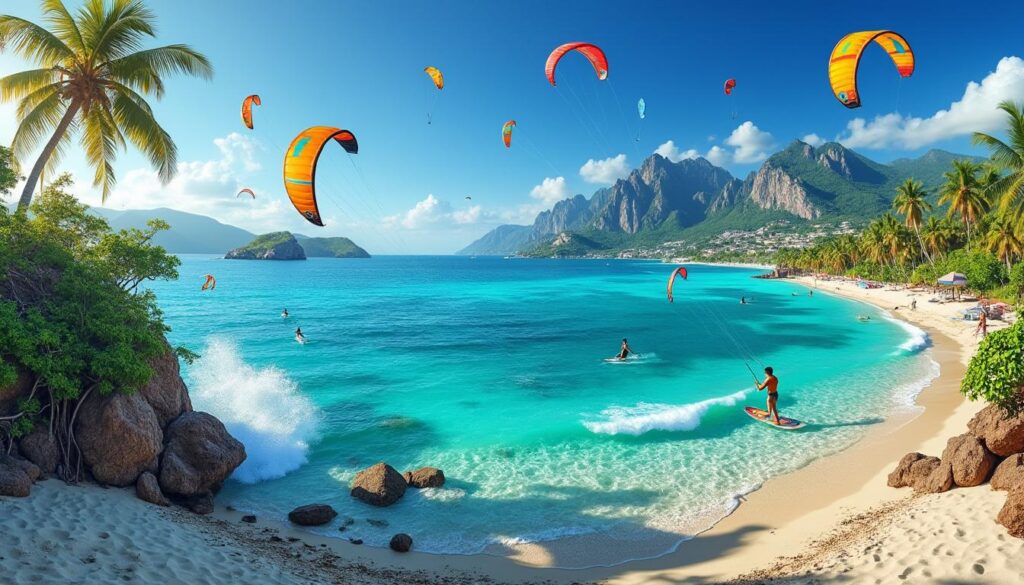
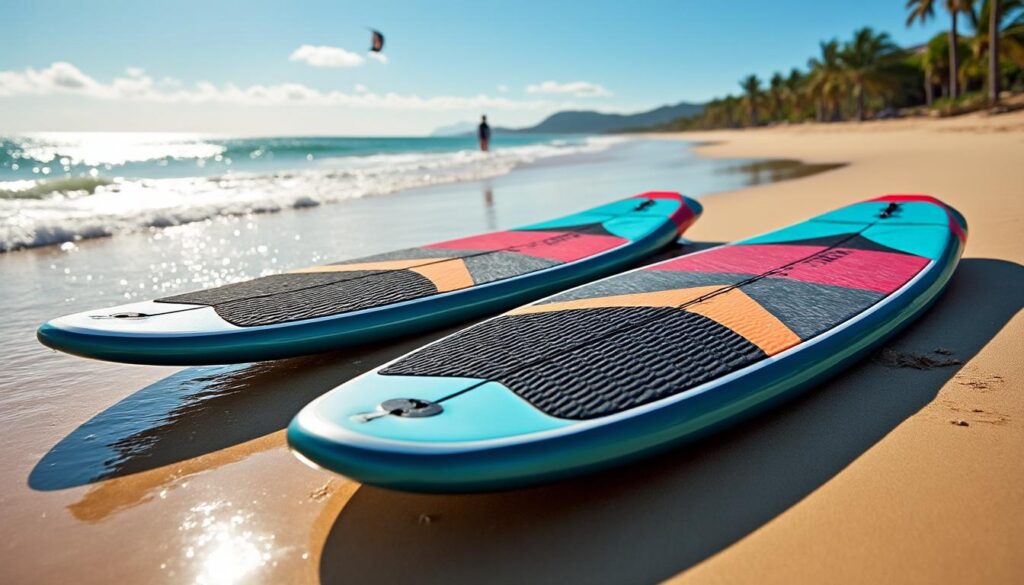
Compact sand under the wheels, a kite pulling hard like a full Maestrale on the Ionian, no need for a wetsuit nor to wash the board at the end of the session. The landboard kitesurf is the land version of kite: same pulling sensations, same downwind and upwind tacks, but on a board with inflatable wheels. It’s a perfect gateway for those who dream of kitesurfing for beginners in the water and an alternative playground for riders who, from kitesurf Salento to across kitesurf Italia, look for new ways to work on technique and kite control when the sea doesn’t cooperate.
Those used to a typical spot kitesurf Puglia – beach, water and wind of the Adriatic or the Ionian – discover with landboarding that even an abandoned agricultural field, a large empty parking lot or a dirt track can become a “near sea”. The idea is simple: you learn to handle the power of the sail, speed and direction on a mountainboard-type board, with wide wheels and straps, until it becomes natural to look ahead, keep the bar steady and use body weight to steer. All skills that, once you arrive at a classic spot like a kitesurf Lecce or kitesurf Taranto, greatly shorten the time needed for the water start and the first tacks in the water.
In short
- Landboard kitesurf: kite on land with a mountainboard, great for learning sail control and traction.
- Perfect for kitesurfing for beginners who want to arrive at the sea already confident with the bar.
- Requires large open spaces, steady wind and good protection (helmet, pads, closed shoes).
- Helps prepare for a kitesurf course in the water at any kitesurf school in Italy or abroad.
- In the kitesurf Italia context, it’s an ideal solution when the sea is rough or crowded but the wind is good.
Landboard kitesurf: what it is and why it makes you progress faster in the water
The term landboard kitesurf encompasses several labels: land kiteboarding, kite landboarding, flyboarding (the wheeled version, not the water jetpack), land surfing. In practice, it refers to a giant skateboard-like board, often called a mountainboard or landboard, with large pneumatic wheels and foot straps. The kite remains the same you know from classic kitesurfing: sail, lines, bar, harness. Only the surface beneath you changes.
The idea is the same as kitesurfing at sea: use the traction of the wind to glide over a surface. Only, instead of flat water or the chop of the Adriatic, you have smooth asphalt, short grass, a very wide and hard beach, even old disused military airstrips—much like near Mui Ne in Vietnam, where fields and airstrips are used for sessions when the sea isn’t rideable.
For those dreaming of learning kitesurf in an area like kitesurf Salento, landboarding offers a huge advantage: it separates the difficulty of kite handling from that of floating. When you’re at sea, you must think about a thousand things at once: board edge, depth, waves, starts, fear of losing the board. On land, you focus on the bar, power and direction. The brain records correct movements faster, without the distraction of water pushing or knocking you down.
A concrete example? Imagine a guy arriving at his first kitesurf course in a kitesurf school in Porto Cesareo. If he’s never held a bar before, the first day is mostly about understanding where to place the hands, how to depower, how to do body drag. If he has already done 4–5 landboard sessions in a large field near home, he already knows how to fly the sail in the window, manage gusts and is comfortable with the chicken loop. Result: in the water he almost immediately jumps to the most fun part, the water start and the first tacks.
There’s another often underrated point: the landboard develops a very honest sense of speed. At 20 knots of wind on flat sea you feel like flying; on land at 20 knots with wheels and vibrations, you understand exactly how much energy the sail is pulling. This shocks the more confident and reassures the more fearful, because you can modulate power and speed without the risk of “drinking half the Adriatic”. In areas of kitesurf Italia where the wind can rise to a dry 30 knots like the Maestrale on the Ionian, that awareness is pure gold.
In short, the landboard is a strict but fair coach: it tells you bluntly if you’re overpowered, if you keep the sail too low, if you look at your feet instead of the horizon. And all of this, before you even touch the water at your next spot kitesurf Puglia.
Key differences between kitesurfing on water and landboarding on land
Even if the sensations are similar, the landboard has slightly different dynamics compared to classic kite on the sea. First thing: friction. A wheeled board “scrubs” much more than water; this means the sail has to generate more traction to move you, but at the same time sudden accelerations are less brutal. For a beginner, it’s an excellent school for progressive power management.
Second difference: you don’t need much depth. Where at sea you look for “waist-deep water” for the first starts, on land it’s enough that the ground is clear and reasonably even. This opens possibilities for those living far from the coasts or for those in Puglia who on certain days find the sea rough but still have a steady wind inland to exploit.
Third element: you don’t have to recover the board if you fall. On the Ionian or the Adriatic, the fear of losing the board or not being able to windward back up often blocks progression. On land, in the early steps, you can even remove a foot from the strap to regain balance or jump off while running if you feel speed is no longer manageable. It’s not the height of style, but it avoids many unnecessary scares.
Finally, there’s the mental aspect. Doing kite on water, especially at new spots like when exploring the best kitesurf spot Italy, requires confidence in the environment: current, waves, depth. The landboard allows you to build this confidence “dry”, in a context that feels more controllable. When you then arrive at a beach like Frigole or San Cataldo for your first dip in the kitesurf Adriatic, the bar in your hands is no longer an alien object but an old acquaintance.
The key is to always link these two worlds: every run on land, every bar correction, every change of direction with the landboard is a direct investment in your future sessions at sea.
Watching a few well-explained videos helps visualize the correct posture and kite trajectories before moving on to practice.
Equipment for landboard kitesurf: board, kite and protections not to underestimate
To do landboard kitesurf sensibly, you need a few elements chosen with care. The heart of the setup is the board, a rigid mountainboard with wide trucks and inflatable wheels able to absorb holes and irregularities. The straps must hold the foot but still allow you to get out when needed; nothing like ultra-tight snowboard bindings: the priority is to be able to “slide” your foot out in a second if the kite pulls too much.
The kite can be the same you use for the sea, but it’s wise to start with smaller sizes, especially if the wind is similar to what makes the kitesurf holidays packages in Puglia work: 8 or 9 meters in 18–22 knots are more than enough to have fun without being dragged like a human kite. Many choose closed-cell foil kites for land, thanks to their stability in gusty winds and the absence of a pump; however, a good inflatable freeride kite also works well if you already know it well.
On the bar, the quick release system must be perfect. Every outing on land is an opportunity to test, hook and release multiple times until the action becomes instinctive. You put on the harness, check the chicken loop, safety leash, quick release, and only then raise the sail. It’s the same routine you’ll then use in the water, whether for kitesurf Lecce, Sardinia or Lake Garda.
The protections are not optional. Skate or kite helmet, knee pads, elbow pads, light gloves and closed shoes with a sturdy sole. The ground isn’t as soft as the wet sand of the spot kitesurf Puglia, and an impact on the ankles or a knee against a stone will leave a mark. Including this “light armor” in your normal outing ritual from the start helps you be more relaxed and focus on riding.
For a clear overview, here’s a summary:
| Element | Key characteristic | Why it’s important in landboard kitesurf |
|---|---|---|
| Landboard / Mountainboard | Large pneumatic wheels, wide trucks, adjustable straps | Provides stability and absorbs ground irregularities, reducing falls. |
| Kite (foil or inflatable) | Moderate size, freeride profile, good depower | Allows managing gusts and power on surfaces with high friction. |
| Bar and harness | Reliable quick release, lines in good condition | Safety is identical to kitesurfing on water and must be trained the same way. |
| Helmet and pads | Helmet, knee pads, elbow pads, closed shoes | Protects from impacts on hard ground, stones and unexpected obstacles. |
| Clothing | Long pants, technical top, optionally back protector | Reduces abrasions in case of slides and improves comfort in long sessions. |
In many spots of kitesurf Italia, the more organized schools are starting to offer packages that combine 2 days of landboard with 2 days in the water. The idea is to get you into the sail right away, so when you face your first strong wind on the Ionian you won’t be a total beginner anymore.
Equipment checklist: what to check before leaving
Before any session, whether it’s kitesurf holidays in Puglia or landboard behind your house, a simple checklist applies. It’s not bureaucracy: it’s what separates a clean session from a trip to the emergency room.
- Line condition: no knots, no obvious signs of wear.
- Valves and inner tubes: on the kite and the wheels, no leaks or cracks.
- Board straps: well tightened, but not so tight as to trap the foot.
- Quick release: quick test of release and re-attachment on the ground before raising the sail.
- Helmet and pads: fastened correctly, no obvious cracks.
Making these checks a habit will make you a more attentive rider, both in landboard parks and among the colorful kites of a classic afternoon of kitesurf Salento.
A good setup video can save you time, mistakes and money on equipment not suited to your level and spots.
Ideal spaces and conditions: where to landboard safely in Italy and Puglia
The immediate question is: where to do landboard kitesurf without bothering anyone and without getting into trouble? Rule number one is simple: you need space. Large, open, without wires, trees, poles, parked cars or houses in the immediate vicinity. If you respect downwind obstacle rules with a kite on the water, on land this rule becomes even more stringent.
Ideal grounds are fields with short grass and compact base, large deserted parking lots (like those of shopping centers closed on Sunday mornings), old disused sports fields or abandoned airstrips like those used in some areas of the Asian coast for land kitesurf sessions. In Puglia, large beaches with hard compact sand – away from bathers, deck chairs and umbrellas – can become a perfect playground in the shoulder seasons.
In a kitesurf Puglia context, the right idea is to differentiate: when the Adriatic in front of San Cataldo is too messy for a novice but the wind holds 18–20 knots, you can move the training session inland to a flat area where gusts and waves don’t complicate the picture. That way you don’t waste a day of vento Salento that would otherwise only show up on the forecast.
Wind conditions for landboard are generally more forgiving than at sea. A steady 12–15 knots is enough to move the board well with a mid-size kite. When it rises beyond 25–28 knots, instead, it’s better to already have good control. Think of how in spots like Mui Ne, Vietnam, 30–40 knots of dry cross-on wind invite only the most experienced to go out; on land, those numbers are manageable only if you already play with depower to the millimeter.
Also note the type of ground: compact sand is gentler, grass hides holes, asphalt offers grip but is brutal on falls. For this reason, before releasing the sail on the sand and starting to tack, it’s advisable to walk the entire area where you’ll be riding. A broken bottle, a hole or a rusty piece of metal can ruin the session in an instant.
Practical rules for choosing the right landboard spot
To turn a simple free space into a real landboard spot, it’s worth following some very concrete rules. They’re not theory: they’re the distillation of what makes a place rideable and what only creates problems.
First rule: analyze the wind. It’s not enough to know that “it’s blowing”. You must understand if it’s onshore, side or offshore relative to your riding direction, just as you would when assessing a new best kitesurf spot Italy. Too much offshore wind on land can push the sail toward areas with obstacles, trees or cables; a side-on is generally the easiest situation to manage.
Second rule: respect others. If cyclists, families or unleashed dogs pass by, change place or time. The spirit of kite, whether on the sea or on wheels, is not to impose your play but to integrate it into the territory without creating tension. In tourist places like some well-known beaches of kitesurf Salento, the very early morning hours or low-season days are ideal precisely because the coast is almost deserted.
Third rule: always enter and exit with a plan. Decide in advance where you will lay the sail in case of emergency, where you can stop if a gust becomes unmanageable, which area to avoid because the surface is worse. The same mental map you would use on a windy spot in the Ionian, applied to a parking lot or a field.
Following these criteria, many riders manage to build their “mini spot” a few kilometers from home, turning theoretically wasted days into pure functional training for future kite trips.
Learning landboard to improve at kitesurfing: step-by-step progression
Those aiming to learn kitesurf in the water often think everything starts with the board between their feet among the waves. In reality, a smart progression starts much earlier, and landboard kitesurf offers a perfect ground to break learning into manageable blocks. The goal? To show up at your first kitesurf course in the sea with half the work already done.
The first phase is kite control. On land, without the board at your feet, you focus only on the wind window: up and down with figure-eight trajectories, power management, recovering from gusts, using depower. It’s the same training a kitesurf school in Salento offers with a trainer kite on the beach, but with the freedom to repeat it until every movement becomes natural.
Second step: dragged steps. With the landboard at your feet, you start with small pulls on the upwind edge, letting the kite pull you forward a few meters. No need to really tack: the goal is to synchronize weight shifts with the sail. A kind of terrestrial body drag with wheels, which already prepares the brain for the future water start.
Third phase: first controlled tacks. Once you find confidence in traction passes, you work on direction. At first, just hold a long edge, without changing side, just to feel how the board reacts when you push on the heel or toe. This is where you begin to build the dynamic balance that will return identical in the water, especially in spots with the typical chop of the Adriatic.
Final step of the basic training: simple changes of direction. No tricks, no jumps. Just slow down, bring the sail up, change line, restart on the other edge. This routine, done dozens of times on land, removes the anxiety of “what happens when I get too close to the shore” that many feel in their first outings among the waves of the Ionian or the more open beaches of kitesurf Italia.
Example route: from the parking lot to your first spot in Salento
To make it concrete, imagine a rider living in the city, far from the sea but obsessed with kitesurf Puglia. He finds a large industrial parking lot empty on Sunday morning, with smooth asphalt and no upwind obstacles. He buys an entry-level landboard and a medium freeride kite. For a month, every weekend, he works on kite control and the first tacks, with a helmet and pads.
After 6–8 sessions, he books a four-day kitesurf holiday in Salento. He chooses a kitesurf school near Lecce. On the first day, the instructor immediately notices that kite handling is already fluid: he skips half the theory and goes straight to refining the body drag. On the second day, the rider is already in a water start on the twin-tip. The last two days are pure consolidation: longer tacks, first windward returns, small direction changes.
At the end of the trip, this rider achieved in four days what often takes a full week of course. The secret isn’t “hidden talent”, but dry training with landboard kitesurf, well planned. Smart progression is the real shortcut, much more realistic than the myth of three miraculous days.
This approach also works for intermediate riders. Those who regularly go out in spots like Porto Cesareo or Gallipoli but get stuck on the first jumps can use the landboard to work on pop movements, loading the back leg and the timing of the exit edge, reducing impacts and the fatigue of “grab the board, restart” after each failed attempt in the water.
The common thread is always the same: break complexity into simpler pieces, use the land to polish movements, and arrive in the water with your mind focused on rhythm, not fear.
Safety, common mistakes and tips to integrate landboard into your kitesurf sessions
Landboard kitesurf may seem more “harmless” than the sea, because there are no waves or currents. In reality, asphalt and dirt don’t forgive like wet sand does. For this reason, those coming from the kitesurf Italia world must immediately change mentality: no improvisation, no casual outings among cars, no kite raised if there are roads or houses downwind.
One of the biggest mistakes is overdoing the sail size. The same wind that would make you go out with a 9-meter on the Ionian may require a 7 or even less on land, especially if you’re light. Another classic error: underestimating gusts. While at sea you have some margin given by flotation, on land a sharp gust can pull you laterally violently, especially if the spot isn’t perfectly smooth.
Another critical point is handling the downwind. On open sea, if you fall too far downwind, at worst you end up a few dozen meters away and do a body drag to recover the board. On land, if you slide too far downwind, you risk ending up on stones, bushes or even on badly cut asphalt. For this reason, the basic technique must insist heavily on the ability to keep a controlled course, which will then be very useful in windy spots of the kitesurf Adriatic.
The main advice is to work with company. A friend who helps you launch and land the kite, who watches traffic or signals obstacles, is worth as much as a half course. The same spirit with which you share a spot like a spot kitesurf Puglia on the sea, brought to land.
How to integrate landboard into your rider routine
To really take advantage of the landboard kitesurf, it’s not enough to ride it twice a year. It must be thought of as part of your weekly or monthly routine, exactly as you check forecasts for the next burst of vento Salento.
A simple idea: dedicate one of the “borderline” days (good wind but sea not suitable for your level) to a dry session. If you have a week of kitesurf holidays booked in Taranto or Lecce, use the two weeks before to do at least 3 targeted landboard sessions: one for kite control only, one focusing on long tacks, one on changes of direction. You’ll arrive at the spot with movements fresh, like a musician who’s warmed up the scales before a concert.
For those living near a classic kitesurf Salento area, the landboard can become the official plan B for days when the Adriatic is inconsistent or the Ionian is too big. This way, every windy forecast becomes useful, regardless of sea state. It’s a powerful mindset shift: from “today we can’t go out” to “today we work on dry technique”.
Thus landboard stops being just an alternative game and becomes the concrete bridge between the desire to progress and the real weather conditions the Mediterranean offers week after week.
Do you need kitesurfing experience to start landboard kitesurf?
It is not mandatory to have water experience to start landboard. Many use landboard as the first step to learn kitesurfing: you start with kite control on land, then add the wheeled board and only after that move to the sea. Having already taken a basic kite flight course with a kitesurf school helps, but it is not indispensable if you follow safety rules and start in moderate wind.
Can landboard replace a kitesurf course in the water?
No, landboard does not replace a kitesurf course but complements it. It helps you develop bar control, power management and quick release safety, but it cannot teach you water starts, relaunching the kite from the water or wave management. The ideal combination is: a few landboard sessions, then a real kitesurf course with qualified instructors at your chosen spot.
What wind is recommended for a first landboard session?
For beginners, a steady wind between 10 and 16 knots is recommended, without strong gusts. Better to choose stable days that resemble the conditions of a calm sea breeze. With less wind you learn to move the sail well; with too much wind you risk being dragged. Priority, especially for beginners, is always control, not speed.
Which protections are really essential in landboard kitesurf?
Essential protections are a certified helmet, knee pads, elbow pads and closed shoes with a solid sole. Many riders add light gloves and, if the ground is hard, a back protector. The logic is simple: on land you don’t have water to cushion falls, so every fall must be managed with a minimum of “armor” to avoid unnecessary joint trauma.
Where is it permitted to do landboard in Italy?
There is no single rule for all of Italy: each municipality may have specific regulations on parks, beaches and public areas. In general, avoid crowded places, roads and private areas without authorization. The best choice is to find large open spaces, away from houses and power lines, and check with local riders or kitesurf schools, who often know the most suitable and tolerated terrestrial spots.