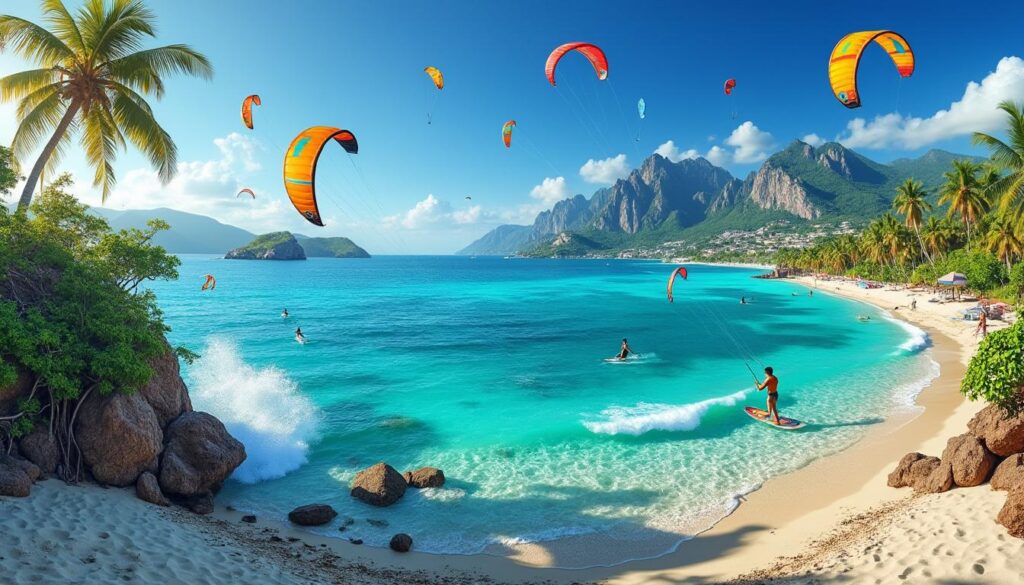
Gizzeria Lido, wedged between the blue of the Tyrrhenian Sea and the dark line of the Calabrian mountains, is one of those places where the wind is not a detail: it is the true protagonist. Those looking for the best kitesurf spot in Italy with reliable wind, clean sea and a beach dedicated almost exclusively to sails will find here exactly what they need to build session after session. The afternoon thermals that descend from the hills, the position at the narrowest point of Calabria and the venturi effect turn this stretch of coast into a tunnel of constant air, capable of keeping kites flying from May until late October. This is not catalog theory, it’s daily practice: sails full from the early hours of the afternoon until sunset, riders in the water alternating relaxed freeride and maneuvers pushed to the limit.
Gizzeria is not only about wind, though. It is an ecosystem of kitesurf schools, beach clubs, parking right by the beach and services designed to make the day simple, even when you arrive with the whole family in tow. The beaches along the coast – from Hang Loose Beach to Action Bay Fabiano and BClub – have become fixed hubs on the international circuit, so much so that the KiteSurf World Tour continues to choose this spot for one of its European stages. This means high technical levels in the water, but also a community ready to welcome those who are still at the beginning and need to understand how to navigate knots, directions, equipment and first glides. For those who have long dreamed of a kitesurf holiday in Italy with almost guaranteed wind, this tongue of Calabrian coast is more a calling than a simple option.
- Constant thermal wind from W–WNW, side-on and steady, perfect for learning and progressing safely.
- Three main kite beaches (Hang Loose Beach, Action Bay Fabiano, BClub) with full services, rescue and areas dedicated to courses.
- Very easy access: Lamezia Terme airport about 8 km away, nearby highway exit and connected train station.
- Long season: from May to October pleasant water and days with 13–20 knots almost daily.
- Level from beginner to advanced: freeride, freestyle and wind suitable for foil and long distance.
Kitesurf Gizzeria: wind, thermals and weather conditions that make the difference
To understand why Gizzeria is considered the most windy kitesurf spot in Calabria, you have to start from the geography. Calabria, at that point, narrows between the Tyrrhenian and the Ionian Seas. Right there the mountain chain breaks off and creates a sort of natural corridor. The result? A venturi effect that concentrates and accelerates the thermal winds from the west and northwest, making them more intense and, above all, more stable than other stretches of Tyrrhenian coast.
The typical days in Gizzeria, during the good season, follow an almost reassuring script. A calm morning, ideal for calmly setting up the kite, checking the lines and studying the sky. Then, between late morning and early afternoon, the sun heats the land, the thermal activates and the W–WNW side-on-shore begins to come in that turns the beach into a giant takeoff runway. The wind rises gradually, settles between 13 and 20 knots and remains so until evening, giving hours and hours of ridable water.
This regularity is pure gold for those who want to learn kitesurf. It means you can schedule lessons, choose the right wing, work on progression without spending half your holiday waiting for a gust. Those already familiar with reading forecasts find confirmation of how useful it is to know the local dynamics. It’s not enough to open an app: you need to interpret the direction relative to the coast, cloud cover, the temperature difference between sea and land. For a deeper look, it’s worth checking the analyses dedicated to wind and weather for kitesurfing, because the more you understand what’s happening in the sky, the more you can squeeze your sessions in Gizzeria.
On full thermal days, Gizzeria offers one of the best kitesurf scenarios in Italy for freeride: flat sea, very long runs parallel to the beach, huge space for everyone. When Atlantic disturbances pass, the script changes. The Tyrrhenian gets rough, the wind can shift more on-shore, come in stronger, and the sea rises with waves that can be significant. In these situations you need real experience: the shore break can be aggressive and mistiming the launch means fighting the white water instead of enjoying the glide.
Wind stability has another interesting side effect: over the years it has attracted international-level events. The KiteSurf World Tour periodically returns to this beach because here the chances of wind on competition days are very high. Watching the pros jump, loop and land with millimetric precision up close is a practical lesson on how to read gusts, coolings, micro changes in direction. And, inevitably, it increases the desire to raise your technical level.
For those coming from kitesurf Salento, used to playing between the Adriatic and the Ionian, Gizzeria is a sort of Tyrrhenian sibling: thermal wind but with different dynamics, same Mediterranean spirit, same mindset of riders who choose the day based on weather charts, not social photos. Having more reliable spots across Puglia, Calabria and Sicily allows building true kitesurf holiday itineraries without chasing promises, but following the real flow of the wind.
The key idea here is simple: in Gizzeria the wind is not a bonus, it’s a constant to start from when planning every one of your tacks.
The Gizzeria Lido spot: beaches, access and services for riders of every level
Getting in the water without stress starts on land. Gizzeria Lido is organized with precisely that logic. The kite beach is located in the Pesce e Anguille area, with parking right by the sand that allows you to unload boards, pumps and kites a few meters from the assembly point. To make the most of the beach clubs’ services, a membership fee is generally required: a light filter that nevertheless guarantees order on the beach, rescue in the water and safer management of the flow of riders.
The beaches dedicated to kite are mainly three. Hang Loose Beach is the beating heart, where events, demo tests and championship stages often concentrate. Action Bay Fabiano and the BClub complete the picture with other launch and landing areas, each with its own atmosphere but all sharing the same idea: leaving space for kitesurf beginners and advanced practice without creating chaos. The shoreline is wide and long, made of pebbles rather than fine sand, with a seabed that becomes very deep quickly. This detail must be understood: there’s no shallow lagoon like a “knee-deep water” school, here you go out and you don’t touch bottom after a few meters.
To move between water and beach there are clear rules. Areas dedicated to courses are often separated from freestyle zones. To favor lessons, independent riders may be asked to move a little away from the shoreline, leaving the downwind area freer for students. This is not a limit, it’s a guarantee for everyone: those still working on the water start don’t risk having a kite in a loop two meters away, those advanced have a clear horizon to launch tricks without worrying about chaotic crossings.
In daily practice, many riders arrive in the morning, set up calmly, check the wing pressure in the pump area, use the thermic waiting time to tidy lines and leashes. When the wind starts to come in, the flow into the water is progressive, not the typical rush for the last free inch. Those who make a wrong tack or find themselves too downwind can count on the rescue boat, a detail that reassures even those on their first outings in open water.
The proximity of services makes the day lighter: beach bars to eat between sessions, shaded areas to rest, showers, and often even corners dedicated to harnesses, spare pumps and small repairs. The environment is that typical of the kitesurf Italy communities: wind, background music, those who take down gear and those who set up, those who tell the story of the last run lost to a little knot and those who leave the school with the smile of the first meter of glide.
For those who want to use Gizzeria as a base for several days, the logistics help a lot. Lamezia airport is about 8 km away, the train station is connected and the Falerna exit on the Salerno–Reggio Calabria highway brings you practically a few minutes by car from the beach. The nearest town is Lamezia, modern and convenient for sleeping, while the larger reference city is Cosenza, about 60 km away, useful for those coming from farther by car.
In this mosaic of details – easy access, services, respect for rules in water and on land – it’s easy to understand why so many riders return every year. It’s not just for the wind: it’s because the spot is organized like a real playground for those who love kite.
Recommended equipment and types of sessions at Gizzeria
Choosing the right wing here is simpler than at other spots, precisely because the typical window is 13–20 knots. Medium-weight riders often play between 9, 10 and 12 metres, with the 12 becoming a kind of “all-round” wing for standard days. Lighter riders can drop a size, those comfortably over 85–90 kg prefer to stick to larger sizes, using twin tips with a good surface area.
In the height of summer, many choose the shorty wetsuit. The Tyrrhenian water warmed by the sun and the mild air allow long sessions without feeling cold, but it’s always a good idea to have a neoprene top for windy afternoons. The pebbly seabed also makes a pair of booties useful: not so much for the risk of sharp rocks, but for comfort when crossing the shore on days with some waves.
The most practiced disciplines are freeride and freestyle. The flat water invites long runs parallel to the coast, with plenty of space to land new school maneuvers, while those who prefer foil find perfect conditions in the hours when the thermal starts to rise but is not yet at maximum intensity. Windsurf and wing foil are present, but priority clearly remains for the kite. To vary training, some alternate days on the water with landboard and kite on land sessions, especially when they want to work on kite control without depending on waves.
In short, Gizzeria Lido is a spot that asks for minimal organization and gives you hours of clean sailing in return.
How to get to Gizzeria Lido and when to choose this spot for your kite holidays
Many riders decide to plan a kitesurf course or a whole week of practice only when they know that getting there will be simple. From this point of view, Gizzeria is an ally: Lamezia Terme airport is a few minutes by car from the beach. Those arriving with a trolley and kite bag can rent a car at the airport or arrange a direct transfer with local schools, without losing half a day to complicated transfers.
For those traveling by train, Lamezia station is the ideal reference. From there, a short stretch by bus or taxi and you’re already with your feet on the pebbles of the coast. By car, the route follows the Salerno–Reggio Calabria highway, with the Falerna exit and a stretch of coastal road until the signs for the beach and the beach clubs begin. It’s not uncommon to see cars loaded with kites bearing plates from half of Italy: from kitesurf Lecce and kitesurf Taranto the distance is not prohibitive, and many take advantage of calm periods in the Adriatic or Ionian for a quick hop to the Tyrrhenian Calabria.
The ideal window to plan a week full of sessions runs from May to late August, often with an interesting extension into September and October. In these months the thermals work regularly, the water is pleasant, and the beach clubs are active with full services. July and August bring more crowds, it’s true, but the width of the beach and the division into areas make coexistence manageable, provided rules and right-of-way in the water are respected.
To help you quickly visualize the main characteristics of the spot, here is a concise overview:
| Parameter | Gizzeria Lido details |
|---|---|
| Type of spot | Tyrrhenian bay, flat sea, seabed becomes deep immediately |
| Main wind | Thermal W–WNW, side-on-shore, average 13–20 knots |
| Best period | May–October, peak consistency between June and August |
| Required level | From beginner (with school) to advanced/freestyle |
| Beach services | Rescue boat, course areas, pump area, equipment rental, bar and shade |
| Access | Parking near the beach, membership fee for club services |
| Complementary activities | Windsurf, wing, beach relaxation, evening life in nearby towns |
Planning your kitesurf holiday in Gizzeria also means choosing the period based on your goals. Beginners often prefer May, June or September: less crowd, wind still present, climate still warm but softer. Those who live for the energy of big events and full beaches aim for July and August, when competitions bring the best athletes into the water and the air fills with loops, handle passes and spectacular landings.
A useful tip for those coming from another region is to combine Gizzeria with other southern Italy spots. An itinerary that includes Puglia kitesurf spots, like the Salento coasts, or the south coast of Sicily – also narrated here: kitesurf in south Sicily – allows you to follow the wind between the Ionian, Adriatic and Tyrrhenian. That way you never stay stuck for more than a day, moving to where conditions are best.
The essence is clear: those seeking reliable wind, easy access and an intensive week of practice find in Gizzeria a concrete ally, not a vague catalog promise.
Kitesurf for beginners in Gizzeria: learning safely between thermals and deep water
When we talk about kitesurf for beginners, everyone looks for the same balance: enough wind but not violent, space to make mistakes, instructors with feet firmly planted in reality. Gizzeria ticks all these boxes, provided you rely on a well-structured kitesurf school. The regular thermal, the side-on direction and the areas of sea dedicated to courses create the right context to face the first phases calmly, without already feeling in the middle of the “jungle” of advanced riders.
A typical student – let’s call him Luca – arrives on the beach maybe with a few hours of practice on the land harness, but still zero rides in the water. The first day is dedicated to kite control on land, bar management, and basic safety rules. Gizzeria’s wind, increasing gradually in the afternoon, allows the difficulty to be modulated: you start with smaller wings, then scale up when the air strengthens, avoiding traumatizing someone at their first contact with the kite’s power.
The water start, the moment many give up, is approached here with strategy. Instructors bring students far enough offshore to avoid the shore break, exploiting the flat and deep sea to focus on body position, the timing of the power stroke and edge control. You don’t have the safety of a foot on the ground, it’s true, but you have open space and rescue ready in case of too marked downwind drift. It’s a different way to approach learning kitesurf compared to shallow lagoons, but it teaches from the start to trust body drag and board recovery techniques.
Anyone starting in Gizzeria soon hears talk of basic physical preparation. You don’t need to become an Olympic athlete, but shoulders, core and general endurance should be considered. Resources dedicated to fitness for kitesurf help understand which exercises can make a difference even with a few minutes a day: planks, shoulder mobility, light squats. Arriving at the beach a little prepared means getting tired less, learning faster and reducing the typical mistakes of those who, after an hour, can no longer hold the bar with clarity.
The Gizzeria environment is also a good ground for those who want to involve the family. While you are in a lesson, the rest of the group can enjoy the beach, the bar, the sea. Children watch the colorful kites in the sky, some immediately ask when they can try. The Italian kite culture is moving towards increasing attention to kitesurf for children and the ideal ages to start, as specialized guides tell, and spots like this, with constant rescue and non-explosive wind, become a natural scenario for this kind of safe pathway.
Another point that reassures many beginners is the rider community. Gizzeria is frequented by locals but also by many kiters who travel around Italy, used to sharing information and tips about the place. Those arriving for the first time often find themselves chatting on the beach about kite sizes, wind directions, typical first-ride mistakes. The culture is “I’ll help you not repeat the same mistakes I made”, not an ego looking down at you.
To complete the picture, many schools offer structured multi-day kitesurf course packages, with a clear progression: kite control, body drag, water start, first rides and speed management. Combine this with wind consistency and you get the ideal mix to leave the holiday not only with some wetsuit selfies, but with solid foundations to become an autonomous rider.
The central lesson Gizzeria leaves beginners with is this: if you respect the wind, you learn quickly; if you underestimate it, it will dictate the rules.
Gizzeria in the mosaic of kitesurf in Italy: comparisons, community and Mediterranean lifestyle
Gizzeria is not an island in the kitesurf in Italy panorama. It is one of the most windy tiles of a mosaic that includes the Adriatic kitesurf, the Ionian kitesurf, the coasts of Puglia, Lazio, Tuscany, all the way to Sardinia and Sicily. Each area has its signature: the double sea of kitesurf Salento, with the possibility to change side if the wind shifts; the turquoise seabeds of south Sicily; winter swell waves in Liguria. Gizzeria brings its Calabrian Tyrrhenian with almost daily summer thermals and a now consolidated community.
For a rider who wants to build their annual calendar, the game is to understand when to move and where. Winter can be dedicated to waves of the Tyrrhenian further north or the Adriatic, spring to the awakening thermals in Puglia and Calabria, summer to long days between Gizzeria, Salento and Sicily, autumn to the last warm disturbances. In this continuous movement, having reliable spots like Gizzeria means you can plan short trips with good chances of finding the right conditions.
The community dimension is another key aspect. In recent years, the network of Italian riders has expanded thanks to groups, associations and specialized media. Those looking for a true kitesurf community in Italy find ideas and connections on dedicated platforms like Salento Kiter and the Italian kite community, where exchanges concern spots, used gear, travel companions and tips on serious schools. Gizzeria, with its wide beaches and numerous events, often becomes a concrete meeting place for people who may have only spoken online.
The lifestyle around the spot is typical of southern seaside areas: days marked by the wind more than by the clock, slow sunsets over the Tyrrhenian, fish-based dinners in nearby towns. Those who stay more than a few days get into the local rhythm: afternoon sessions, a beer or aperitif on the shoreline, stories of perfect runs and memorable catapults told with irony. Kite here is not just a sport, it’s a way to measure the days, to choose when to work and when it’s time to drop everything and set up the sail.
Compared to large tourist centers, Gizzeria maintains a more grounded dimension, less filtered by glossy brochures. Riders come for the wind, not for the postcard photo. This creates an atmosphere where true enthusiasts recognize each other immediately and first-timers find real examples, not just sweetened stories. The hospitality of locals, often mentioned by those who return year after year, helps make the spot more than just a point on the map.
In the broader vision of kitesurf in Italy, spots like this have a precise role: to demonstrate that the south is not just static sunbathing sea, but a serious playground for those who live by the wind. Whether you come from the north in search of stable thermals or from the nearby Ionian to vary the scenario, Gizzeria remains one of the most solid options to really feel the pull of the kite in your hands, day after day.
The message that the Gizzeria coast sends to every rider is simple and powerful: the wind is here, the beach is ready, now it’s up to you to take the bar.
What is the best period to kitesurf at Gizzeria Lido?
The most reliable period for kitesurfing in Gizzeria runs from May to October, with the highest wind consistency between June and August. In these months the W–WNW thermal usually arrives regularly from early afternoon, often between 13 and 20 knots, creating ideal conditions both for beginner courses and for advanced freeride and freestyle. September and October can offer nice, quieter days with less beach crowding.
Is Gizzeria suitable for beginners who want to learn kitesurfing?
Yes, Gizzeria is suitable for beginners, provided you rely on a structured kitesurf school. The thermal wind is relatively regular and side-on-shore, a factor that helps safety and progression. The seabed becomes deep immediately, so lessons are conducted with the support of a rescue boat and areas dedicated to teaching. This approach accustoms students from the start to deep water and kite control in open sea.
What equipment is recommended for kitesurfing at Gizzeria?
For a medium-weight rider, kites between 9 and 12 metres are recommended, depending on the intensity of the thermal, with a standard-size twin tip board. A shorty wetsuit is often sufficient in summer, while a neoprene top can be useful on windy days or at the start/end of the season. Light booties are recommended to comfortably walk on the pebbles of the shore and to handle potential shore break.
How can you easily reach the Gizzeria Lido spot?
The Gizzeria Lido spot is easily accessible. Lamezia Terme airport is about 8 km from the beach and represents the most convenient arrival point for those traveling by plane. By car you follow the Salerno–Reggio Calabria highway with the Falerna exit, then continue toward the coast. By train, Lamezia station allows organizing short transfers to the main beach clubs along the kite-dedicated stretch of coast.
Are there other activities besides kitesurf at Gizzeria?
Besides kitesurfing, windsurf, wing foil and classic beach activities are practiced in Gizzeria. The beach clubs offer relaxation areas, bars and shade, making the spot suitable also for those accompanying riders but not practicing. Nearby there are restaurants and evening venues, as well as coastal towns to stroll after the session. Many riders combine their stay here with visits to other spots in Calabria, Puglia or Sicily, following the wind on a road trip basis.