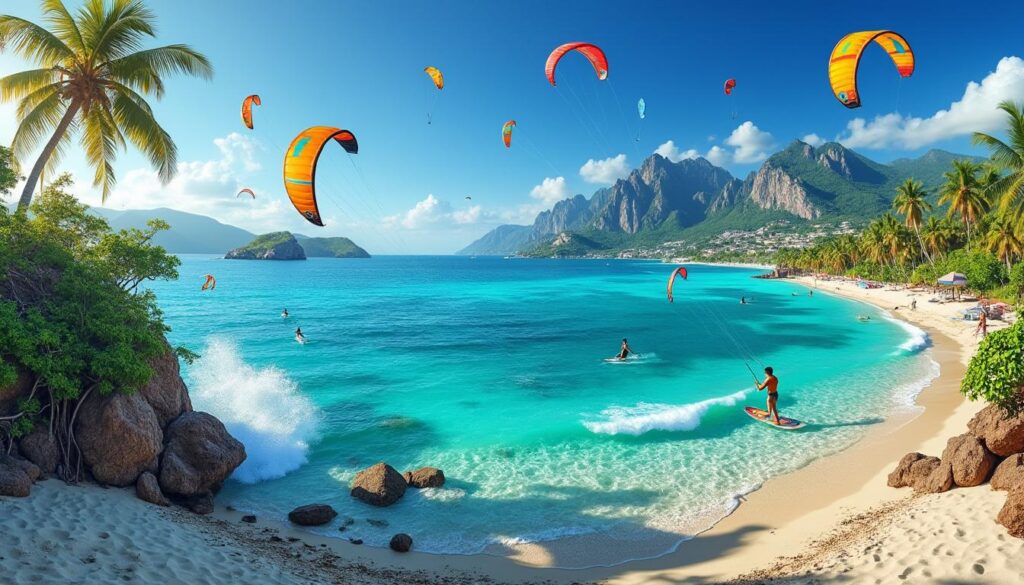
Ostia is not just beach clubs, evening aperitifs and summer chaos. When the wind turns right, the Roman coastline fills with colorful sails and riders who make use of every knot to tack in front of the capital. Kitesurfing in Ostia is the answer for those who live in Rome, have little time, but do not want to give up serious sessions, really learn to control the bar and build a solid level without taking a plane every weekend. The sea here may seem “easy,” but between shore break, currents and gusts, Ostia quickly teaches respect and technique to anyone who enters the water.
Those searching for kitesurf Italy often imagine only Puglia, Sardinia and Sicily. In reality the Roman coastline, with Ostia as a base, offers a powerful mix: certified schools, an active community all year round, up-to-date equipment and unbeatable logistics for those coming from the city. The ponente that blows steady, the maestrale that clears the air, the autumn disturbances that fire up the sea: every condition becomes a perfect laboratory to learn, progress and prepare future sessions at the great spots of kitesurf Salento, the Adriatic kitesurf spots or the Ionian kitesurf spots. Ostia does not promise postcards, but guarantees hours of real practice, the kind that truly grows your riding.
- Ostia is the reference point for kitesurfing in Rome, with structured schools, certified instructors and a community in steady growth.
- The wind on the Roman coastline is variable but usable: ponente, maestrale and scirocco offer different scenarios for beginners and intermediate riders.
- The kitesurf schools in Rome enjoy quality certification, with standards recognized at national level and insurance included at the end of the course.
- Ostia is an excellent springboard to then explore the best kitesurf spots in Italy, from the Puglia kitesurf spots to the great lakes of the North.
- Those who want to learn kitesurf can start here, with structured courses, safety taken care of in detail and an accessible, straightforward rider environment.
Kitesurf Ostia: why the Roman coastline is a real spot for riders
Talking about kitesurf Ostia means looking beyond the classic postcard of Rome. Here the sea is a natural extension of the city, reachable in little time by train or car, which turns the coastline into a sort of permanent gym for those who want to spend more hours on the board than on transfers. Many Roman riders organize their day around the wind: metro in the morning, bar in hand in the afternoon, return to the city in the evening. This rhythm allows accumulating dozens of sessions per year, a huge advantage compared to those who live far from the water.
The heart of the matter is simple: if you want to learn kitesurf without turning your life upside down, Ostia puts you in a position to do it. The coastline offers stretches of free beach, areas dedicated to water sports, easy accesses and simple logistics for storing equipment. We are not talking about an exotic spot, but a concrete and functional environment, ideal for those who must deal with work, study or family schedules. More than “kitesurf holidays,” here we talk about kitesurf routine, and it is this continuity that creates solid riders.
Many beginners come from Rome thinking the local sea is too “ordinary” to become really skilled. The reality is the opposite: variable conditions, seabed changing with storms, often gusty wind teach you to read the water and react quickly. Those who train here are then advantaged when they land at more regular spots like some Puglia kitesurf spots or the large flat water areas of the North. Ostia, in other words, trains versatility.
A concrete example is the story of Luca, 35, an office worker in South Rome. He started with a basic course in Ostia, going out only on weekends. In one season he achieved secure water starts, first upwind tacks and basic kite control in even slightly messy conditions. When he went kitesurfing in Salento for a week on the Ionian Sea, the clean wind and flat water seemed almost “easy” to him. What would have been a challenging spot for others became for him an amplifier of technique already built at home.
The added value of the Roman coastline also lies in the schools with a quality seal, recognized by the Associazione Kitesurf Italiana and federations like F.I.V. All kitesurf centers in Rome that meet these standards follow a precise protocol: structured teaching, use of helmets, radios, buoyancy aids, state-of-the-art kites and issuance of a final card with personal insurance included. For you it means one clear thing: less improvisation, more linear progression and control over risks.
When the ponente comes in strong, the view of the sea at Ostia changes radically. The sails align offshore, riders control the wind window, beginners stay alongside instructors in the dedicated area. Each experience level has its space, and this reduces the psychological stress typical of the first sessions in crowded spots. Beginners need to feel the sea is “organized,” not chaotic. Ostia, with its schools coordinated among themselves, often manages to guarantee this balance.
In the end, the Roman coastline works because it combines three elements that are hard to find together: proximity to the city, qualified facilities and an established kite culture. For those who live in Rome and are ready to take the bar seriously, this stretch of coast is much more than a weekend outlet: it is the operational base to truly become a rider.
Wind, sea and seasons: how to read Ostia like a local kiter
The first mistake of those who arrive in Ostia for beginner kitesurfing is thinking that seeing two waves and a breeze is enough to rig the wing. On the Roman coastline the wind often changes intensity and direction, and the difference between a productive session and a wasted afternoon is all in the ability to interpret forecasts, local deviations and the sea in real time. Those who live here have learned that the ponente may arrive later than expected, that the maestrale often clears the air but brings annoying chop, and that certain winter disturbances create interesting waves but are less suitable for novices.
For this reason the most organized riders always cross-check at least two weather models and the reports from portals specialized in Adriatic kitesurf, comparing them with historical data. The idea is simple: understand whether it’s worth moving, what kite size to rig and whether it’s the right day to push, try new maneuvers or stick to basic exercises. A beginner who relies only on “feeling” risks finding themselves with a 12-meter kite in hand in 30 knots, or spending hours on the beach with a 7 that never powers up.
Reading the seasons is equally important. Spring and autumn often bring stronger winds and less beach tourism, ideal conditions for learning kitesurf. Summer offers warm days, crowded seas and lighter winds, good for kite control exercises on the beach and first body drags in the water with space well managed by the schools. Winter, for those equipped with a thick wetsuit and a good mindset, offers the most technical days, where the sea has character and the level of attention must rise considerably.
Understanding Ostia like a local mainly means accepting that there are no guarantees, only probabilities managed intelligently. Those who learn to play with these variables on the Roman coastline then move with more confidence everywhere, from kitesurf Lecce to kitesurf Taranto, from Lake Como to Liguria. The Roman sea thus becomes the first true teacher of adaptation.
Learning kitesurf in Ostia: schools, courses and safety on the Roman coastline
When it comes to learning kitesurf, the difference between enthusiasm and frustration often comes down to the choice of school. Ostia, from this point of view, offers a network of centers that work in synergy and follow common standards. Many of these have obtained a THE QUALITY SCHOOL quality seal, recognized by the Associazione Kitesurf Italiana, which certifies method, safety and teaching continuity. It is not a “facade” seal: to obtain it, schools must meet concrete parameters on equipment, number of students per instructor, emergency management and continuous team training.
Instructors are often certified by F.I.V. or recognized bodies, registered in official registers and updated on new regulations. This means that every kitesurf course follows a clear program: basic theory of wind and the wind window, equipment preparation, kite control exercises on land, body drag, water start and first tacks under constant supervision. These are not “improvised little lessons,” but structured paths designed to bring you to gradual autonomy without skipping steps.
A key point that many underestimate is the card with personal insurance issued at the end of the course. In certified kitesurf centers in Rome, students obtain a card recognized by federations or sports promotion bodies, valid for practicing even after lessons end, generally until December 31. This coverage is fundamental, especially in the first months when human error is more frequent. Having a dedicated policy is not optional, it is an integral part of the growth path.
For those starting from zero who want to deepen theory before going into the water, it is useful to read guides like those on kitesurf for beginners, which explain in simple language concepts like the wind window, bar trim and kite size selection. Arriving on the beach with a clear theoretical base helps you use every minute of the course better, ask more precise questions and truly understand why the instructor insists on certain details.
Safety, on the Roman coastline, is a topic taken seriously. Schools manage launch and landing zones separated from the bathing area, organize briefings before the session, check that each rider has a leash, a working quick release, a helmet and a buoyancy aid. Those who want to delve deeper into this aspect can also look at content like kitesurf safety rules, which reiterate a simple concept: before flying, you must know how to stop.
Very often, on the Roman coastline, you see two types of novices: those who follow a recognized school and those who try to learn on their own, perhaps with a friend “who gets by.” The contrast after a few months is clear. The first group develops a clean technical base, knows danger signals, reads forecasts and handles equipment with respect. The second accumulates bad habits hard to correct, exposes themselves to unnecessary risks and, in the long run, spends more time grounded than in the water. Ostia puts you face to face with a clear choice: improvise or take the path seriously.
In the end, learning kitesurf in Ostia works because the system is well oiled: coordinated schools, shared standards, experienced instructors and a sea that forgives little but teaches a lot. For those who want to build solid foundations, this is exactly the kind of environment needed.
How to choose a kitesurf course in Ostia without wasting time and money
The question is direct: with all the proposals available, how do you choose the right kitesurf course without wasting weekends and budget? On the Roman coastline the rule is to verify three key elements: certifications, instructor/student ratio and clarity of the program. A serious school will tell you about these points right away, without beating around the bush. If information remains vague, it is a signal not to ignore.
A good basic course in Ostia should include at least: introduction to wind and safety, kite set-up, bar handling on land, body drag downwind and upwind, first water start attempts and assisted tacks. If someone promises you’ll “fly on your own” in a single day, better be wary. Extremely intensive sessions make sense only for those who already have consolidated basics. For beginners, progression must be dosed so that key movements are properly fixed.
It is also worth checking the equipment fleet: recent kites, dedicated school kites with a wide wind range and updated safety systems, easy boards with good volume and stable fins. Some schools allow testing different gear as you progress, a very useful practice to understand what to choose later, perhaps also reading tips like those on how to buy used kitesurf gear when you decide to have your own quiver.
Once you find the right course, the last variable is you. Show up rested, hydrated, without expecting miracles. The Roman sea rewards those who arrive with humility and a willingness to listen. Ostia is not a playground; it is an open-air school.
Conditions, wind and comparison with other kitesurf spots in Italy
To understand Ostia’s value in the Italian kitesurf scene, it makes sense to compare it with other well-known spots. Not to crown an “absolute best,” but to understand where the Roman coastline shines and where other places offer something different. Each spot is a mix of wind, water type, logistics and atmosphere. Knowing what to expect helps you build a sensible session calendar throughout the year.
Many riders who train in Rome, for example, spend periods on the Adriatic kitesurf spots further north, in Liguria or on the pre-Alpine lakes. Before getting there, however, they build their base right between Ostia, Fregene, Torvaianica and Anzio. This is because the Roman coastline is easily reachable, allows you to “train consistency” and forces you to think about the wind instead of following it passively. The result is a rider who does not only look for the perfect spot, but who learns to cope even on the less photogenic days.
One of the most interesting comparisons is with the lakes of Northern Italy, which in recent years have become true hubs for those who live far from the sea. Guides like those on kitesurf on Lake Como or Lake Maggiore show how these destinations offer regular thermal winds, different panoramas and flat waters managed with precise rules. Those who trained in Ostia often find themselves advantaged when they arrive at these bodies of water, because they already know how to manage gusts and read the weather quickly.
To have an overview, here is a comparative summary between Ostia and some typical contexts:
| Area | Type of spot | Strengths | Ideal for |
|---|---|---|---|
| Ostia (Roman coastline) | Open sea, variable waves, often gusty wind | Close to Rome, certified schools, active community year-round | Motivated beginners, intermediate riders who want many hours |
| Spot kitesurf Puglia (Salento) | Double sea Adriatic/Ionian, often flat water or light chop | Powerful Salento wind, variety of spots, mild climate most of the year | Intermediates and advanced, intensive courses and kitesurf holidays |
| Lake Como / Lake Maggiore | Inland lake, regular thermal winds, flat water managed | More predictable forecasts, convenient logistics from Northern Italy | Urban riders from the North, those who prefer lakes to the sea |
| Liguria | Open sea, narrow bays, often strong wind | Bigger waves, technical spots, interesting winter | Riders with a good base, wave enthusiasts |
This overview is not meant to declare a winner, but to make you understand a key concept: Ostia is an excellent starting point, not an end point. Here you accumulate experience, learn to handle the unexpected, build the legs and the mind of a rider. Then you can take all that baggage around Italy, from kitesurf Salento to the lakes, from Liguria to Sicily.
For those dreaming of more intense maneuvers, foiling or big jumps, the Roman coastline is also a ground for physical and mental preparation. Days with strong wind and a formed sea teach you to choose moments to go out carefully, reduce injury risk and respect your level. A kiter who learns these lessons in Ostia often has an edge when they arrive at an easier spot.
Wind windows: when Ostia works and how to fit sessions into life in Rome
One of Ostia’s key advantages is the possibility of fitting sessions into a “normal” week. Those who work in the city can monitor forecasts and choose the best moment: an evening outing with light thermal in summer, a long afternoon in autumn when the ponente comes in, a weekend full immersion with more intense fronts. The trick is to prepare in advance: equipment ready, car loaded, dry wetsuit, bars and water in the backpack.
Many Roman riders now live this rhythm: in the office they check the models, decide on the fly whether to extend lunch break or leave straight after work, and finish the day with a couple of hours on the board instead of the usual traffic. Ostia, in this sense, is a precious ally. It doesn’t ask you to organize an expedition, just to be ready when the wind calls. If you learn to answer that call, hours in the water increase almost by themselves.
Ostia as an urban gym: technical progression and rider mindset
The Roman coastline is not just a place to “have a swim with the kite,” it is a true urban gym to build your progression. The key is to change mindset: don’t think about the single perfect day, but about a series of connected sessions, each with a specific objective. This way, outings with borderline wind or slightly messy sea also become useful. Every time you enter the water, you can work on something: power control, posture, transitions, relaunching the kite in difficult conditions.
An intelligent approach is to set micro-goals by season. In spring you can focus on consolidating the water start and reaching a cross-shore ride; in summer, with often lighter winds, you work on bar finesse and underpowered starts; in autumn, when the sea gains character, you begin to study waves better, timing on chop and the first controlled gybes. Winter remains the domain of those who already have a good base, but even there the idea is clear: improve edging and depower use in gusts.
Ostia is perfect also for those who feel “stuck” at an intermediate level. Many riders already know how to go and return, but remain trapped in a loop: same tacks, same fears, same mistakes. The Roman sea, with its unpredictable days, forces them out of the comfort zone. Those who accept working purposefully, perhaps with some advanced coaching sessions, unlock transitions, toe-side riding, first small jumps and body control in the air within a few months.
Progression in a spot like this also passes through physical preparation. The chop of the Roman coastline stresses legs and core, pushes you to improve balance and endurance. Integrating some dryland exercises – squats, planks, hip and shoulder mobility – makes a big difference when you are in the water. Those who arrive on the beach already “fired up” last longer, handle surprises better and reduce the risk of strains or fatigue.
Another often underrated aspect is gear maintenance. In an urban spot like Ostia, you quickly learn to take care of your equipment: rinsing the kite with fresh water when needed, checking lines and bridles, stowing the bar without knots, verifying bladder and valve wear. This is not a detail for obsessives; it is one of the factors that prevent sudden breakages in the water, especially on windy days.
For many Roman riders, Ostia also becomes a psychological testing ground. You go in the water after work, tired, maybe not fully convinced, and you find yourself having to make quick decisions: do I go out or postpone? Do I change kite or grit my teeth? Do I stay in a bit longer or come back with margin? These choices train the mind as much as the body. A rider who learns to decide calmly under light stress will then evaluate what to do more coldly in a new spot.
In the end, Ostia as an urban gym works if you live it with this logic: you don’t just count the great sessions, but the number of lessons you take away. With this mindset, every outing on the Roman coastline becomes an investment in your future on the water, wherever you decide to go afterwards.
From the capital to Salento: using Ostia as a springboard to the great Italian spots
A common thread among Roman riders is this: they use Ostia to train, then organize targeted trips to the great spots of the South. Kitesurf Lecce, kitesurf Taranto, the bays of the Ionian and Adriatic coasts of Puglia become natural destinations after a season spent on the Roman coastline. Those who arrive there with technical baggage built in Ostia usually fall even more in love with the sea, because they immediately feel how the urban base helped them break through.
Training on the Roman sea and then gliding on the flat water of Salento is a bit like taking weights off your ankles: the tacks run longer, the kite reacts more predictably, the mind is free to focus on new goals. In this dynamic, Ostia is not a fallback but the first chapter of a much larger story that takes you to truly explore the best kitesurf spots in Italy with awareness and not just as a tourist.
Community, logistics and kite lifestyle on the Roman coastline
Kitesurf Ostia is not only technique and wind: it also means community. On the Roman coastline over the years a network of riders has formed who recognize each other on the beach, in message groups, in reports shared early in the morning. There are those who send photos of the sea at 7 a.m., those who update the wind every hour, those who report direction changes before models clearly show them. This shared culture is gold for beginners, because it means never feeling truly “alone” in the water.
Schools often become the natural meeting point: changing rooms, storage, small relaxation areas where people talk about maneuvers, new spots, gear tested. Those arriving from zero can latch onto these environments and quickly find session partners of similar level. For many, the biggest leap is not technical but social: going from arriving on the beach as a spectator to feeling part of the tribe of local riders.
From a logistical point of view, Ostia plays an unbeatable card: proximity to Rome. You can get there by train, use car sharing, organize carpooling with other kiters. This makes kitesurfing accessible even to those without a car or who do not want to spend hours on the highway. The possibility of slipping a session between daily commitments lowers the entry barrier to the sport and opens it up to students, freelancers, shift workers and those with flexible hours.
The resulting lifestyle is particular: it is not that of long kitesurf holidays, but of a daily relationship with the sea. You see riders leaving the office with the bag on their shoulder, changing on the beach as the light fades, ending the day with a sandwich and a quick debrief about the gusts they took. This way of living the kite needs no filters: it is concrete, sometimes a bit tired, but tremendously real.
Connections with the rest of Italy are another part of the picture. Riders who train in Ostia often organize trips to other Adriatic spots, or head south to taste the Salento wind, the Ionian kitesurf spots, the wild beaches of Puglia. Others aim for Ligurian itineraries or major sporting events, where kitesurfing is increasingly on the radar, also with an eye on the Olympic scene. Every return to Ostia brings new stories, new ideas, new suggestions on how to train better.
This continuous exchange creates a kitesurf culture in Rome that goes beyond the single spot. You are not just someone who does a few tacks at sea, but part of an ecosystem in motion. The Roman coastline thus becomes a dynamic base, a point of departure and return for those who want to keep a lasting relationship with the wind.
In the end, the message is clear: if you feel the water calling and live in Rome, Ostia is the gateway. It’s up to you to decide whether to stay watching from the shore or finally take the bar.
What is the best period to kitesurf in Ostia?
The most interesting seasons for kitesurfing in Ostia are spring and autumn, when the ponente and the maestrale arrive with good intensity and the beach is less crowded. Summer offers warmer days and often lighter winds, suitable for basic courses and kite control exercises. Winter brings the most technical conditions, suitable for those who already have a good level and an appropriate wetsuit.
Is Ostia suitable for beginner kitesurfing?
Yes, Ostia is suitable for beginners provided you rely on a structured school with certified instructors and areas dedicated to teaching. The Roman coastline can present gusty wind and chop, so it is not a spot to improvise on your own. With a well-organized course, however, it becomes a perfect gym to build solid foundations you can later use at other Italian spots.
What kind of equipment is needed to start kitesurfing in Ostia?
To start you primarily need the equipment provided by the school: a school kite with updated safety systems, an easy twin-tip board, a harness, helmet and buoyancy aid. In some cases a wetsuit may be required, especially out of season. Only after completing the course and reaching a minimum level of autonomy does it make sense to consider buying your own equipment, possibly with the help of experienced instructors to choose sizes and models suitable for Ostia’s wind.
Is insurance required to practice kitesurfing on the Roman coastline?
Yes, it is strongly recommended. Certified schools issue, at the end of the course, a card with personal insurance valid for practicing kitesurfing until the end of the year. This coverage is important especially in the early stages when mistakes are more frequent. Even those who are already autonomous should check that they have an active policy specific to water sports.
How long does it take to become autonomous in Ostia?
The time required varies from person to person, but on average after a complete course and some additional sessions you can begin to manage water starts and first rides autonomously, always respecting the spot’s rules. True autonomy, the kind that allows you to go out in different conditions and spots, however requires several dozen hours in the water. Ostia, thanks to its proximity to Rome, allows you to accumulate these hours consistently throughout the year.