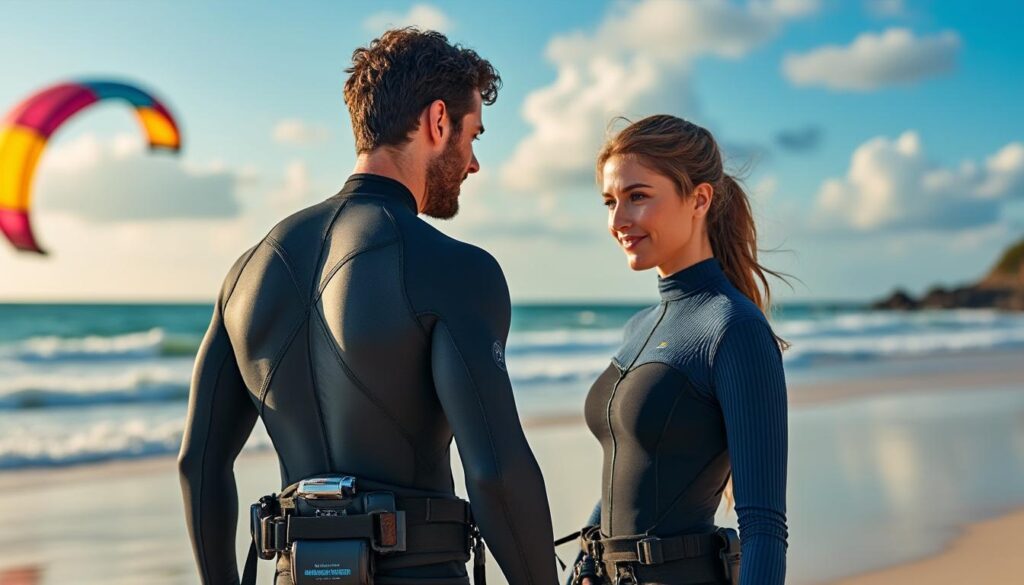
The wind that pulls you out of the water, the board that starts to plane, the arms that tremble a little but the smile that never fades: women’s kitesurfing is all this, and much more. More and more women in Italy are looking for a serious kitesurf course to start safely, truly understand how the kite works and choose equipment designed for the female body. Between Salento kitesurfing spots, specialized schools and lighter gear, learning today is not madness: it’s a clear choice for those who want a complete, physical but accessible sport.
This article goes into detail about everything needed to begin: from common mistakes when starting with kitesurfing for beginners, to specific advice for women on the harness, wetsuit, board and kite size. It also discusses the best kitesurfing spots in Italy for a first kite holiday, with particular attention to Puglia, where the Salento wind offers conditions almost year-round between the Adriatic kitesurfing and the Ionian kitesurfing. No miraculous promises: just concrete guidance to get you in the water prepared and enjoy every session from the first outings.
In short
- Kitesurfing for women: a physical but manageable sport, if you choose the right spots, wind and equipment from the start.
- Learn kitesurfing safely: rely on a certified kitesurf school, never on a “do-it-yourself” with a friend who “knows how to go”.
- Dedicated equipment: shaped harnesses, wetsuits with a female cut, boards and kites in the correct sizes speed up progression.
- Spots in Puglia: between kitesurfing in Lecce and kitesurfing in Taranto you’ll find conditions suitable for first glides and proper kitesurf holidays.
- The right mindset: don’t rush to jump; aim for kite control, body drag and the waterstart above all.
Women’s kitesurfing: busting myths and understanding if it’s really a sport for you
Around women’s kitesurfing there are still many myths: “you need a lot of arm strength”, “it’s dangerous”, “it’s a men’s sport”. In reality, those who work at training centers every day see the opposite: often riders who start from zero are more precise, listen more to instructions and respect weather limits. The result? Steady progression and very clean kite handling. The secret is not brute strength, but the ability to read the wind and use the harness to offload power to the body, not the arms.
We’re talking about a discipline where technique and sensitivity matter more than muscle. The modern kite, thanks to depower systems and quick releases, allows you to modulate all the power in a few centimeters. A lightweight rider who learns to pilot well can keep the kite safe even at 20 knots, if the sail is the right size and the spot is suitable. A reckless beginner who overestimates their abilities is much more dangerous than a woman who starts with respect for the rules and the wind window.
To understand if kitesurfing is really for you, ask yourself what you are looking for in a sport. Do you want an activity that is only aesthetic and gentle? It’s probably not the way. But if you love the water, enjoy feeling your body work and aren’t afraid to get wet, then kitesurfing in Italy, especially in windy months, can become your main sport. The nice thing is that you don’t need a competitive background: many women start from zero, often after 25–30 years old, and in one season they already manage to ride in both directions.
A concrete example: imagine Marta, 32, with no board sports background. She signs up for a 10-hour kitesurf course in Puglia. The first lessons are only about kite control on land, body drag and safety. After a few sessions, she begins the first waterstarts. No jumps, no crazy social media trials, just lots of basic technique. At the end of the season she rides comfortably in 15 knots, tacks and returns to the starting point. This is the realistic progression you can expect if you take the path seriously.
Then there’s the safety issue, which often scares people. Kitesurfing today is not the uncontrolled sport of the 2000s. Kites are stable, release systems are standardized, and reputable kitesurf schools have precise procedures to launch and land the kite, assess wind direction and choose the practice area. A rider who learns this way internalizes fundamental automatisms: where to position herself relative to the wind, when to return to shore, how to handle a sudden increase in intensity.
The real myth to break is that of the “fragile woman”. In kitesurfing patience matters, not ego. Those who accept learning step by step, listen to their body and don’t obsessively compare themselves to more advanced riders build solid foundations. Once this is clear, the next step is choosing where to learn, and this is where the Italian spots most suited to first outings come into play, starting from Salento.
Why many women choose Salento to learn kitesurfing
Those looking for a place in Italy to start find a strong ally in Salento kitesurfing. The peculiarity of this area is the double coast: Adriatic kitesurfing on one side, Ionian kitesurfing on the other. If one day is too gusty on one coast, often the other side’s sea and wind are more manageable. This means more usable days for lessons, less frustration and the possibility to choose gentle conditions ideal for a first experience.
Spots around kitesurfing in Lecce offer large sandy areas and gently sloping seabeds, perfect for those learning to control the kite without nearby obstacles. In the kitesurfing in Taranto area, on the Ionian side, the sea can become flatter with side-on wind, an ideal condition to focus on the waterstart and board trajectory without the anxiety of waves in front.
Compared to other kitesurf holiday destinations, Salento has a more relaxed atmosphere. There are tourists, of course, but many local riders who know every wind variation and will explain why with sirocco you go to one side of the peninsula and with maestrale to the other. For a beginner this “beach” support is pure gold, especially when you start moving autonomously without the instructor always beside you.
In short, women’s kitesurfing finds a concrete environment in Salento: double coast, many windy days, sandy spots and schools focused on real work, not perfect photos. It’s the ideal context to move from curiosity to your first session in full control.
Learning kitesurfing: step-by-step path for a beginner rider
To learn kitesurfing seriously, you need a clear structure. Renting a kite and throwing yourself in the water is not enough. An organized kitesurf school divides the path into phases, and each step must be respected without skipping stages. This is even more true for those who start with some fear or little confidence in the water. Knowing the process beforehand helps you understand what to ask when you contact a school in Italy, in Puglia or elsewhere.
Generally, the schedule of a kitesurf course for beginners includes:
- wind theory, wind window and safety on land;
- kite control with a school kite (often smaller and gentler);
- body drag in the water without the board, downwind and upwind;
- first departures (water start) with the board and a few meters of planing;
- riding in both directions and returning to the starting point.
Each block trains a specific element. In body drag you learn to trust the kite and use your body as a “fin” to get back to the board, a key skill if you lose it during the session. In the waterstart you learn how to distribute weight, how to bend your knees and when to bring power to the kite without being pulled off the board.
A frequent mistake? Wanting to put your feet on the board right away. Many women would like to “skip” the body drag part because it seems boring. In reality it’s the moment when you build confidence with the wind. If you learn to drag yourself safely without the board, when something goes wrong you’ll know how to get back and you won’t panic. The real leap happens when you stop fighting the kite and start using it as an extension of your body.
Those who choose to learn at a kitesurfing spot in Puglia have an advantage: the water is often shallow for tens of meters. This reduces the fear of “not touching” and lets you focus on kite and board. In the first lessons the instructor is still close, but knowing you can put your feet down helps relax your shoulders and breathe.
To clarify the phases of the path, here is a concise table designed specifically for a beginner:
| Phase | Main objective | Indicative duration | Sign that you are ready to move on |
|---|---|---|---|
| Theory & safety on land | Understand the wind window, priorities on the water, use of the quick release | 1–2 hours | You can explain where the kite pulls most and where it is neutral |
| Kite control on land | Keep the kite stable, make small controlled movements | 1–3 hours | You can park the kite at 10 and 2 without constantly watching the sail |
| Body drag | Use the kite to move in the water, recover the board | 2–4 hours | You move confidently upwind and downwind without losing control |
| Water start | Start with the board and make a few meters of planing | 2–5 hours | You can start 7–8 times out of 10 from the same side |
| Basic riding | Go and return to the same point, change direction | Variable | You finish the session without finding yourself kilometers downwind |
Of course every body has its own timing. Some women reach the waterstart in two days of good wind, others need more sessions. It’s not a race. The only thing that matters is being honest with yourself: if the instructor suggests repeating a day of body drag, it’s not to slow you down but to give you solid foundations. Real progression is built here.
Once you start riding, the topic of personal equipment arises. And it’s precisely there that women-specific gear comes into play, from the harness to the wetsuit up to the choice of the board.
Where to start with your own equipment
After finishing the course, the immediate question arises: “Is it better to keep renting or buy something?”. The most sensible solution is often hybrid. A personal board and harness allow you to better adapt the gear to your body, while for the kite you can still rely on rental or the school to understand which sizes you use most at your spot. In any case, before buying it’s useful to inform yourself well about what distinguishes a female setup from a generic one, especially for comfort and safety.
Kitesurf equipment for women: harness, wetsuit, board and kite
The difference between an enjoyable session and one full of discomfort often comes down to equipment details. For a rider, the kitesurf harness and the wetsuit are the two most underestimated elements, yet they are the ones in direct contact with the body for hours. A wrong cut means lower back pain, chafing, pressure points on the ribs or cold water ingress. To avoid this, it’s worth studying what the market offers and how to choose.
Let’s start with the harness. There are waist harness models and seat harnesses. To understand pros and cons, a useful resource to explore is this guide dedicated to the best kitesurf harnesses, where structural differences are explained. Many women choose the waist harness because it allows more freedom of movement at the pelvis, fundamental for carving and bending the knees. Some, especially at the beginning, feel better with a seat harness that tends to sit lower and not “ride up” under the ribs.
For those with pronounced hips or a very narrow waist, models with female-shaped cutouts are a great advantage. The back panel is designed to follow natural curves and distribute effort evenly. This way you can hold more power on the kite without feeling pricks in the back. It’s important to try the harness with the hook mounted, closing it well and simulating pull on the bar.
The wetsuit is the other protagonist. In kitesurfing you are not always submerged; often the legs are more exposed to the wind than the water. For this reason a generic surf wetsuit may not work perfectly. Female cuts take into account narrower shoulders and wider hips, improving fit and reducing entry points for water. To guide you among thicknesses, zips and seasons, you can take a look at this complete guide to the kitesurf wetsuit, very useful for those undecided about the purchase.
On the board, an average-built beginner often does well with an all-round twin-tip, slightly larger than average to facilitate take-off. A slightly bigger board floats better and planes with less power, which helps when you don’t want to deal with strong winds yet. As you gain control you can reduce size or move to shapes more specific for freestyle or waves.
The kite, finally, is the most delicate element. In windy spots like many kitesurfing spots in Puglia, a rider between 55 and 65 kg often uses kites between 7 and 10 meters, depending on the season and typical wind strength. In the initial phase, however, it’s smarter to rely on the school or a specialized kite shop that knows your spot well. Buying a kite that is too large “because I’ll use it always” is one of the most dangerous mistakes.
The key point: well-chosen equipment is not an aesthetic whim, it’s a form of safety. If the harness doesn’t massacre your back, if the wetsuit really protects you, if the board is the right size, you have more mental energy to concentrate on technique. And that’s when you really start to feel the glide, without unnecessary distractions.
Details that make the difference in women’s sessions
There are many small precautions that at first glance seem irrelevant, but after a few hours in the water change the day. For example, the choice of the type of hook on the harness: some brands offer spreader bars specific for freeride, which reduce the risk of chest impacts in forward falls. Or bar lines slightly shorter for those who prefer a quicker kite response, useful when you don’t yet have much arm strength.
Also the placement of straps on the board can be customized. A rider with small feet often needs to adjust angle and distance to avoid knee strain. Many modern boards allow very variable settings; ideally dedicate a whole session to trying micro-adjustments, instead of changing everything at once and not understanding what worked.
Finally, don’t underestimate accessories: a good lightweight helmet, an impact vest that doesn’t restrict movement, gloves and booties suitable for the season. All elements that don’t make “spectacle” on social media, but that let you reduce fear of falling and therefore dare a bit more when needed. Comfort is a base, not a luxury.
Spots in Italy and Puglia ideal for first female sessions
When you’re starting out, choosing the spot is half the work. The best kitesurfing spot in Italy for you is not necessarily the most famous one, but the one that offers manageable water, side-on wind and space to make mistakes without getting hurt. In Puglia this means mentally ruling out spots with aggressive shorebreak or rocky seabeds in the first weeks, and favoring sandy beaches with a low student-to-instructor ratio.
In the context of Salento kitesurfing, many schools carefully choose between the Adriatic and Ionian coasts based on forecasts. With moderate sirocco, some Adriatic spots offer soft waves and steady wind; with maestrale, the Ionian side often provides flatter water and perfect conditions to focus on board trajectory. This flexibility is one reason many women plan their kitesurf holidays in Puglia.
Another variable is beach crowding. Extremely crowded spots, with advanced riders jumping everywhere, are not ideal when you are still learning body drag. In Italy, outside the high season, many spots suddenly become human: more space, less tension, more possibility to make mistakes without feeling “in the way”. Those who can often choose May, June or October to learn, when temperatures are still pleasant but the number of bathers is reduced.
The quality of the local kitesurf school also weighs heavily in spot choice. A good school never puts you in the water with marginal wind, checks weather bulletins in advance, assesses the actual wind direction on site and explains why one day you go out and another you postpone. If you hear phrases like “we’ll try anyway, worst case we’ll come back to shore”, it’s a red flag.
To optimize each session, many riders use “spot check” guides with checklists: wind direction, upwind obstacles, wave breaks, currents, areas forbidden to navigation. Tools like these are essential for those who move between different spots, especially in a complex area like Salento, where a few degrees difference in wind direction change everything. Once you learn this approach, you’ll find you evaluate spots outside Italy differently too.
The point is clear: there is no perfect spot in absolute terms, there is the right spot for your level on that day. Knowing how to read Italy’s map with this eye saves you frustration and brings you closer to sessions filled with real progress.
How to choose the right season to start in Italy
The season greatly affects a beginner’s experience. In the middle of winter, even with a good wetsuit, the cold reduces sensitivity in the hands and makes it harder to grip the bar precisely. For this reason, unless you’re already used to cold water, it makes sense to plan the first lessons in late spring or early autumn in mild areas like Puglia.
In Salento, for example, the combination of temperatures and the Salento wind often makes April–June and September–November great periods. In these windows you have a good balance between usable wind and water that won’t freeze you after half an hour. Additionally, less congested beaches allow schools to dedicate more space to practice areas, without having to weave between umbrellas and bathers.
North Italy also offers valid spots, but the comfort window for a beginner can be shorter, and thicker wetsuits are often needed from the first lessons. If you want to make the most of your holidays, build your calendar around the wind statistics of the chosen place, rather than only on flight or accommodation prices.
Physical and mental preparation for women’s kitesurfing
Kitesurfing doesn’t require the physique of an Olympic athlete, but a minimum of preparation makes everything more enjoyable. For a rider at the beginning, the biggest challenge is not so much “being able to hold” the kite, but enduring an hour-long session with continuous restarts, walks in the water and climbing back with the board in hand. Legs, core and back work a lot. Arriving completely unfit is not a drama, but a small targeted workout before the course makes a difference.
The most useful exercises are simple: controlled squats, planks to strengthen the core, shoulder and lower back stretching. Even brisk walks or short bodyweight workouts get you used to managing fatigue. The point is not to “destroy yourself” at the gym, but to get your body used to being active for longer without giving in at the first wave of tiredness.
Then there’s the mental part. Kitesurfing is a sport where fear is legitimate: you feel the wind, the pull is real. A good school never pushes you beyond what you can handle, but a degree of apprehension remains. Instead of fighting it, it can be useful to accept it as part of the game. Regular breathing, small breaks between exercises, the possibility to ask continuous questions: all are tools to stay clear-headed.
Many women bring into the water a habit of “doing everything perfectly” on the first try. That doesn’t work here. The kite forces you to make mistakes, fall, restart. Training yourself to see mistakes as feedback, not failure, is perhaps the greatest gift this sport can give you. And it reflects outside the water too: more flexibility, less judgment, more confidence in your timing.
Practically, it’s useful to arrive at the course rested and hydrated. Bring simple snacks, water, high-protection sunscreen, hair ties and maybe a windbreaker for after the session. Details that seem trivial, but that allow you to stay on the beach a few more hours without collapsing. The goal is to get out of the water tired but satisfied, not wrecked.
When body and mind start working together, you realize what seemed “extreme” becomes just a new way of moving. And there kitesurfing stops being a distant project and becomes a concrete part of your lifestyle.
How long does it take a beginner to learn to kitesurf?
With a good structured kitesurf course, many women manage their first glides in 6–10 hours of lessons, spread over several days of good wind. To ride in both directions and return to the starting point usually requires some additional sessions independently, always choosing spots and conditions suited to your level. Times vary depending on water confidence, session frequency and quality of instruction.
Do you need a lot of arm strength to kitesurf?
No. In kitesurfing the main power is offloaded to the body through the harness, not held by the arms. Arm strength is more useful to steer the bar than to “hold” the kite. It is much more important to have a good depower setup, the correct kite size and a balanced posture than large musculature.
What is the minimum equipment to start as a woman?
To start you need a harness, wetsuit and, if you want, an all-round twin-tip board in the size suitable for your weight. You can use the kite and bar through the school or rental, at least until you understand which sizes you use most at your spot. A well-shaped harness and a wetsuit with a female cut increase comfort and safety from the start.
Is Salento suitable for first kitesurfing experiences?
Yes, Salento kitesurfing is particularly suitable for beginners because it offers two seas, Adriatic and Ionian, with often complementary conditions. This allows schools to choose each day the spot best suited to the students’ level. Many beaches are sandy with gently sloping seabeds, ideal for body drag and waterstart in safety.
Is it better to learn in Italy or abroad?
Learning in Italy, and particularly in Puglia, has the advantage of reducing travel costs and allowing you more sessions spread over time instead of a single intensive course. Spots like those in Salento offer excellent conditions for beginners and structured schools. Abroad may have longer wind seasons, but for those who live here the ideal mix is to build the basics in Italy and then, if desired, plan a kite trip when you feel more confident.