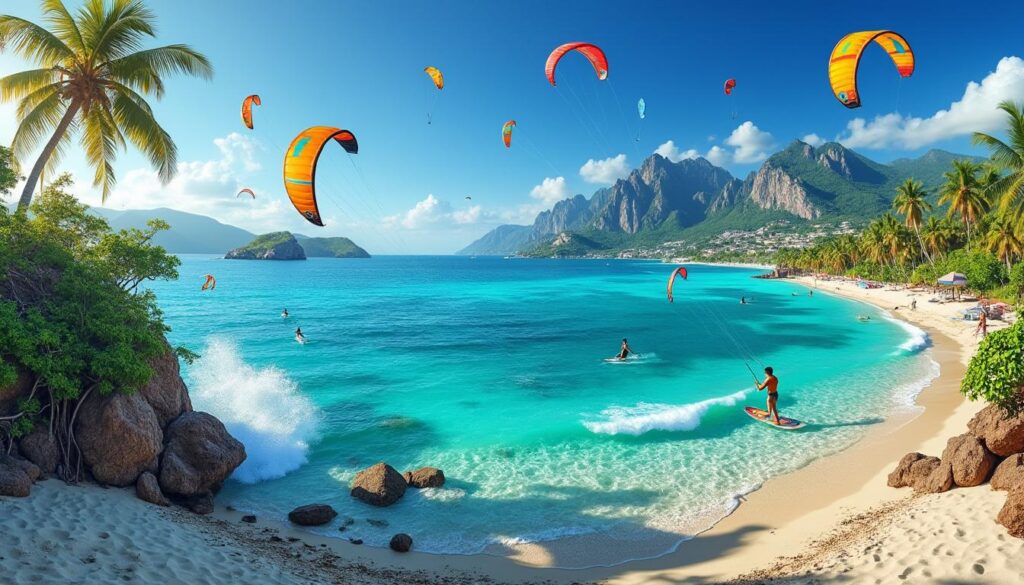
The right wind, a solid school and a group that rows (or rather, that laughs) in the same direction: that’s what turns a simple course into a true kitesurf camp in Italy. Along the coasts of the Adriatic and the Ionian, but also on the Northern lakes, increasingly targeted camps are emerging: intensive camps for those starting from scratch, technical clinics for those aiming at jumps, packages with accommodation and continuous coaching for those who want to spend an entire week with the bar in hand. Nothing like the occasional “hit-and-run” two-hour courses: here you switch to full immersion mode, you study the wind, you analyze the videos, you fail and you start again.
From kitesurf for beginners to advanced freestyle, through foil and wave, the best Italian camps have one thing in common: they are organised by riders who know every nuance of the Salento wind, the breezes of Garda or the thermals of the Adriatic. They choose the spot day by day, change the side of the coast if needed, and explain why that Mistral today shouldn’t be underestimated. If you’re thinking about kitesurf holidays in Italy, the camp option is the most honest shortcut to really learning, without illusions but with the certainty of coming home at a different level than when you left.
In short
- Kitesurf camp in Italy: intensive stages designed for all levels, with a real focus on progression and safety.
- Spot selection guided by local instructors: kitesurf in Salento, Northern lakes, Adriatic and Ionian work in synergy with the wind.
- Structured programs: theory, water practice, video analysis, weather briefings and continuous support even outside sessions.
- Specific camps: kitesurf for beginners, freestyle clinics, wave, foil, and personalized paths.
- Italy as a complete training ground: from kitesurf on the Adriatic to kitesurf on the Ionian, up to the alpine lakes, each camp has a clear identity.
Kitesurf Camp Italy: how to choose the right stage for your level
Choosing your first kitesurf camp in Italy can be confusing: grandiose names, super colorful packages, photos of sunsets and perfect smiles. But what matters, when you have your feet in the sand and the kite in the air, is only one thing: how much the camp is truly tailored to your level. A beginner put into an advanced group will only end up frustrated, an experienced rider among novices will get bored and waste good wind. For this reason, before booking, you need clear questions and clear answers.
Reputable kitesurf in Italy schools classify participants based on precise objectives: from the very first contact with the wing to the first stable upwind, from the first jumps to trick refinement. They often use recognized scales (like IKO or FIV) to define your starting point. If a facility accepts you without at least a phone check on your level, something’s off. Better to spend ten minutes explaining what you can do than waste a week stuck on the beach because the group isn’t homogeneous.
Many camps propose a tried-and-tested formula: 5 days of structured course, with theory and practice distributed intelligently. For example, in the morning you work on key concepts – the wind window, right of way, reading the weather – and practice kite control safely. In the afternoons you get in the water almost every day, from Monday to Friday, putting into practice the movements seen on land. This steady rhythm is what makes the difference: no endless dead time, no isolated lessons that force you to start from scratch each time.
In some camps on Lake Garda or in Puglia, teaching is accompanied by a boat assistance service, essential when working with the Lift: you enter the water almost independently, but you know the RIB is monitoring your progress, ready to intervene if something goes wrong. It’s a key step to detach from the instructor but not from safety. The onshore facilities also matter: changing rooms, relaxation area, space to rig and de-rig calmly, equipment storage, video room to review sessions. These are not “luxuries”, they are progression tools.
Another signal to watch is the instructor/student ratio. In well-run camps, a coach follows at most two or three people in the water, especially when it comes to kitesurf for beginners. Beyond these numbers, quality drops immediately: less time on the bar, less personalized feedback, more waiting on the beach. Those who truly care about your progression prefer to keep groups small and homogeneous.
Among those starting from zero, a recurring figure is Luca, 32, who arrives at the camp convinced he’ll be jumping in three days. After the first briefing he discovers that first you need to learn to understand the wind, the board, the priority to other riders. If the camp is well structured, at the end of the week Luca won’t yet be landing megaloops, but he will have a solid water start, know how to return to the starting point and read a weather forecast. The high flight comes later, but the foundations set this way last forever.
Many organizers collaborate with national bodies like trade associations that select, region by region, schools with high standards. Each center has a “sheet” with technical characteristics, services offered and feedback from riders who went before you. This system, combined with real reviews, lets you quickly understand whether the kitesurf stage you’re looking at is just marketing or has structure, up-to-date equipment and trained instructors.
The key point, in the end, is one: choose the camp based on where you want to get to, not just where you want to go. The spot comes after, the level before.
Levels, goals and certifications in Italian kitesurf camps
One certainty offered by the most serious camps is the issuance of an official certification at the end of the course: FIV, IKO or FISW/FISN, depending on the school’s affiliation. It’s not just a piece of paper: it indicates your real level and allows you, in the future, to access advanced stages in Italy and abroad without having to “start over” the assessment each time. Those who organize a good kitesurf course in camp mode keep track of all steps: from body drag to the first water start, from speed control to the first edges in switch.
In many cases, the program is broken down by days: the first two days dedicated to kite control on land and in the water, body drag and self-rescue; middle days with total focus on the water start and board control; final phase dedicated to continuous edging and managing the return to the starting point. Each completed step is recorded, so you don’t lose the history of your learning. This structure is essential to avoid that “going in circles” feeling many riders know.
Advanced camps, on the other hand, work with micro-goals: first clean jump, soft landings, basic rotations, transitions with speed control. Here videos, slow motion, direct comparison with the instructor segment by segment come into play. The most modern clinics also include briefings on race rules, positioning at the start and training off the water, especially since kitesurf at the Olympics has shone a spotlight on riders’ athletic preparation. The message is clear: high level doesn’t happen by chance, it’s built.
At the base of every choice remains the same question: “What level do I want to have in six months?”. If the answer is clear, the right camp is immediately recognizable.
Kitesurf camp at the lake: Garda, Maggiore, Como and the perfect training ground
When talking about kitesurf camp in Italy, many immediately think of the sea. Yet, some of the most effective courses are born on the Northern lakes, where the wind plays ahead and logistics are concentrated. Lake Garda, in particular, has been considered for years a true national gym: frequent wind, manageable water, support boats and schools used to working with intensive programs. Here camps are not limited to beach lessons: they are built like mini-academies, with areas dedicated to theory, changing rooms, relaxation areas for recovery and large spaces to rig and de-rig safely.
A typical camp on Lake Garda follows a tight but sustainable rhythm. From Monday to Wednesday morning blocks of theory and controlled practice alternate: local weather is discussed, the typical thermal winds of the lake are learned, technical videos are watched in a dedicated room, and immediately after you get in the water with the instructor. In the afternoons, from Monday to Friday, you ride almost always: sessions with Lift assistance by boat, where the instructor takes you to the best wind zone and follows you closely. It’s an ideal approach for those who have little time and want an intensive week, maybe included in their kitesurf holidays.
Other Northern bodies of water are also becoming protagonists. Kitesurf on Lake Maggiore now offers structured camps with lesson + accommodation packages, ideal for those living in the city who want a quality jump without flying to the ocean. The same goes for programs for kitesurf on Lake Como, increasingly oriented to small groups, dedicated coaching and attention to local wind details.
One of the most appreciated aspects of lake camps is compact logistics. You don’t have to drive from one spot to another, you don’t waste time looking for parking near the beach. Usually you arrive at the center, find the equipment already ready or easily accessible, do the briefing, change and get on the boat. That means more actual time with the kite in hand, less energy wasted on complex onshore maneuvers. For those who work all year and have few days off, every minute of water gained makes a difference.
In the real life of camps, a recurring example is Chiara, 27, who arrives at Garda with a single objective: complete the water start and sail the first edges independently. After five days of Lift-assisted sessions, with daily feedback and evening video analysis, she goes home with a stable edge on both sides, the ability to climb a little upwind and – above all – the confidence to sign up for the next stage at the sea in Puglia or Salento. The lake doesn’t replace the sea, but it’s a powerful springboard.
Lake camps also take care of the “after session”. Many centers offer evening meetings to talk about equipment, explain how to choose a used kite intelligently, or clarify doubts about safety systems. A useful resource in this sense is the guide dedicated to those who want to buy used kitesurf equipment, which helps avoid classic mistakes of those leaving a basic course and wanting to gear up.
In the end, the lake teaches a clear lesson: consistency beats spectacle. Better five days of regular wind, Lift assistance and complete facilities than chasing the perfect wave without ever managing to stay on the board.
Comparison between lake and sea camps
To understand where to book your next kitesurf camp in Italy, it’s useful to compare concretely what lake and sea offer. It’s not about deciding who wins, but understanding which environment serves your level and your goals.
| Type of camp | Strengths | Ideal for |
|---|---|---|
| Lake (Garda, Maggiore, Como) | Frequent and predictable wind, compact logistics, strong boat assistance, relatively flat water. | Kitesurf for beginners, returning after a long break, technical focus on water start and edges. |
| Adriatic Sea | Wide spaces, sandy spots, access to various Puglia kitesurf spots and central Italy, variable but usable wind. | Riders who want to move from lake to sea, first steps in chop and small waves. |
| Ionian Sea / Salento | Two seas at short distance, Salento wind exploitable in many directions, often crystal-clear water. | Multi-spot camps, progression from intermediate to advanced level, clinics on maneuvers and wave. |
Read this table honestly to avoid the wrong perspective: the sea makes you dream, the lake makes you grow. The real strength is knowing how to use both at the right time.
Watching some session videos on Italian lakes can give you a realistic idea of space, wind and teaching method. It’s not cinema: it’s real camp life.
Kitesurf camps in Salento and Puglia: spots, wind and stages for all levels
Moving from the lakes to the South, kitesurf camps in Salento play a different game. Here the keyword is “choice”: two seas, kitesurf on the Ionian and kitesurf on the Adriatic, connected by a strip of land that in an hour’s drive can take you from the Mistral to the Grecale, from the Tramontana to the Libeccio. In practice, if there’s wind somewhere, you find it. Well-structured camps in Puglia use this geography to their advantage: they decide each morning where to move based on wind direction and intensity, avoiding days wasted watching still flags.
A typical stage in the kitesurf in Lecce area includes a mix of water lessons, weather briefings and moments of considered rest. In the morning the charts are checked, autonomy, safety, currents and possible spot changes are discussed. Then you go out: Ionian when you need flatter water and gentle thermals, Adriatic when you’re looking for more structured wave or stronger conditions. For a beginner it’s an accelerated school of reading wind and sea; for the intermediate rider it’s the mandatory step to get out of the lake “comfort zone”.
For those seeking an overview of Adriatic spots, it’s useful to dive into guides like the one dedicated to kitesurf on the Adriatic, which explains characteristics, winds and practical advice from North to South. In Salento this knowledge becomes concrete in camps that alternate long beaches with more sheltered bays, always keeping safety in mind: seabeds, rocks, shore break lines are not improvised.
Moving towards Taranto, the scene changes again. Kitesurf in Taranto stages use areas with often calm waters and wide spaces, perfect for basic teaching and the first controlled downwinds. Here camps are aimed heavily at those living in the central-south who don’t necessarily want to go up to the lakes to learn. The method remains the same: solid theory, small groups, intelligent use of the wind. But the frame is the Mediterranean, with light, colors and smells that speak a different language.
An ideal protagonist of these camps is Sara, 24, who did her first basic course on a Northern lake and arrives in Salento to unlock two goals: tack with confidence and start working on first controlled jumps. In a week of stage, thanks to the possibility to change the side of the coast according to the wind, she tries different conditions: flat water, chop, small waves. Each session is dedicated to a tile: edging, timing the pop, landing control. At the end of the camp she hasn’t become a pro, but she has hooked the first clean pops and, above all, learned when it’s better to stay ashore.
Puglia kitesurf camps increasingly take care of pre- and post-session aspects: they talk about light but effective nutrition, managing fatigue, how to organize equipment to avoid leaving tools on the beach. In quiet moments, conversation often drifts to more distant destinations, like kitesurfing in Watamu, Kenya, which many Italian riders use as a winter stop when Mediterranean winds drop.
The common thread always remains: understand the wind before trying to dominate it. In Salento, this rule applies twice over.
Specific stages: beginners, intermediate and advanced in Puglia
In Salento and Puglian camps, the division by level is particularly clear, because spots change character very quickly. Kitesurf camps for beginners prefer bays with sandy seabeds and wide shallow water areas, where first mistakes don’t become serious problems. Here work focuses on kite control, beach launch, first water start and board recovery. The goal is to get you out of the camp with a solid base to continue independently or with single lessons.
Intermediate camps move more often, seeking conditions that force you to read the sea: chop, small waves, gusts and wind holes. It’s the perfect gym to learn how to choose body position, manage board trim and understand how to react when the wind isn’t “by the book”. Advanced stages, finally, often have a specialization: freestyle, wave or foil. Here fine equipment choice comes into play, the use of smaller or specific sails, and a very detailed work on maneuver timing.
In all cases, the best Puglian camps focus on a clear message: no magic, only method and wind. It’s a promise that, when kept, is worth more than any slogan.
Videos and reports of Salento sessions help visualize the variety of conditions you can encounter between the Adriatic and the Ionian in the same stage.
Kitesurf school, safety and camp life: what you should really expect
A kitesurf camp in Italy is not just a series of lessons hung on the wind. It’s a microcosm where the kitesurf school becomes almost a small temporary community: riders who wake up together, check the forecast, rig the wings and in the evening meet tired but clear-headed to talk about the session. This collective dimension can be a huge push if managed well. Seeing someone else succeed in the water start that drove you crazy for two days is a powerful motivation. At the same time, you need an instructor capable of keeping the group united without flattening out differences in level.
The kitesurf schools that run serious camps base the day on three pillars: safety briefing, water session, debriefing. In the first moment wind, spot, possible risks (obstacles, currents, forbidden zones), emergency plans and shared signals are defined. In the water, work is done in blocks: a clear exercise, repeated until it comes out “clean”, then move to the next. At the end, everyone meets again to analyze what worked and what didn’t, often with the help of video recordings.
Safety is not a separate chapter, it’s woven into every gesture: from choosing the right leash to checking the quick releases, from checking the wind window on the beach to managing passages near other kites. In well-structured camps, the goal is not only to get you standing on the board, but to teach you not to endanger yourself and others. It’s a point many underestimate when they only look at the photos.
Alongside methodological moments there are pure camp-life ones. Sharing accommodation, meals and transfers creates bonds that often outlast the week of the stage. Groups are born that continue to travel together, that meet on other spots, from Ostia and the Roman coastline to Liguria and its wind spots. In this sense, the camp also becomes a social accelerator: if you’re entering the kite world without knowing anyone, you come out with a small crew.
The instructor’s figure is central. Reference portals, in recent years, have begun to register schools and even individual instructors with personal profiles and feedback left by students. We’re not talking about generic reviews, but evaluations on method, clarity of explanations, ability to manage safety in complex moments. This helps choose not only the place, but the people you will entrust your progression to.
In the routine of a week-long camp, habits that make the difference emerge quickly: who checks the board and bar at night, who hydrates and eats properly, who rests instead of partying hard before a big wind day. The most attentive instructors always dedicate a few minutes to these lifestyle aspects, because a rested body and a clear mind are part of the equation as much as a good kite.
At the end of each stage, the most honest question to ask yourself is not “did I have fun?”, but “how much have I changed in the water and how much more aware of the wind am I?”. If the answer is “a lot”, the camp has done its job.
Fundamental elements of a good kitesurf camp
To recognize a stage that’s worth the wind it promises, you can use a small mental checklist. The key elements to look for are few but decisive, and each has a direct impact on how you get into and stay in the water.
- Clear program: schedule of days, technical objectives, hours flexible but defined according to the wind.
- Small and homogeneous groups: no mixed classes with beginners and advanced together, realistic instructor/student ratio.
- Spots suitable for the level: seabed, maneuvering space and conditions truly chosen based on what you need to learn.
- Complete onshore facilities: changing rooms, storage, rigging area, room for theory and video analysis.
- Integrated safety: serious briefings, rescue boat when needed, clear emergency plans.
- Feedback and certifications: honest evaluations, issuance of a certificate indicating the level reached.
If at least these points are covered, you have good chances to turn your camp week into real progression, not just a holiday disguised as a course.
Programs, duration and progression strategies: from beginner to advanced rider
A well-thought-out kitesurf camp in Italy doesn’t just squeeze as many hours as possible into a few days. It works on progression, that is on how your body and mind absorb, consolidate and then use the information. For this reason the most effective programs develop over an average duration of a week, with a calibrated mix of intense practice and recovery moments. It’s no coincidence that many basic stages are structured over five days of formal course plus possible extra days of assisted riding.
For those in first contact with the kite, the typical path starts from kite control on land, moves to body drag in the water, self-rescue, and reaches the first water start. Once you stand up for a few seconds, the temptation is to think that “the hard part is done”. In reality, it’s only the first step. The most honest camps won’t sell you the dream of “pro in three days”, but will give you the tools to continue safely after the stage ends, perhaps recommending local spots or other schools to carry on with.
For those in the “stuck intermediate” category – the rider who leaves but loses the board, who can’t climb upwind, who finishes the edge randomly – camps are often a turning point. Working every day, with continuous feedback and a structure that eliminates dead time, unlocks knots that would otherwise remain for months. In many cases, two or three posture adjustments, choosing a more suitable kite or a simple spot change are enough to radically change the feeling on the board.
Programming for advanced riders, instead, looks more like that of an athlete. Precise technical objectives are set – a new trick, clean transitions, control in strong wind – and broken down into basic movements. Each session has a single focus: no “I try a bit of everything”, but targeted exercises. Dryland work on coordination, mobility and specific strength is often integrated, especially now that kitesurf at the Olympics has raised attention on athletic preparation.
Many schools, finally, structure their annual calendar alternating camps in Italy with stages abroad: Salento in spring and autumn, Northern lakes in summer, tropical or windy destinations in the colder months. In this way, those who join the camp circuit can follow continuous progression, without long breaks forced by the season. The concept is clear: you cannot control the wind, but you can organise to find it year-round.
The summary of all this is simple: there is no single “best” camp, but there is the best camp for your current moment. The more honest you are with yourself in defining it, the more your week on the spot will become a real step forward.
How long does a kitesurf camp in Italy usually last?
Most kitesurf camps in Italy last between 5 and 7 days. Basic programs concentrate theory and practice into five days, often from Monday to Friday, with possible extra assisted riding at the weekend. There are also shorter camps, 3 intensive days, and extended courses over two weeks for those who want to combine a long holiday with technical progression. The best choice depends on your free time and starting level: beginners often get the most from a full week of immersion.
Can a beginner enroll in any kitesurf camp?
No. A beginner should choose only camps explicitly aimed at kitesurf beginners, with small groups, suitable spots (sandy seabed, wide shallow areas, absence of obstacles) and strong attention to safety. Before booking, it’s advisable to ask explicitly how levels are divided, what instructor/student ratio is expected and whether a rescue boat is guaranteed where conditions require it. A good camp for newbies doesn’t aim for spectacle, but to build solid and safe foundations.
What kind of certification do you get at the end of a camp?
Many kitesurf camps in Italy issue a recognized certification, such as IKO, FIV or FISW/FISN levels, depending on the school’s affiliation. This certificate clearly indicates the skills you have acquired: kite control, body drag, water start, upwind riding, safety management. The certification is useful both to continue courses at other schools, in Italy or abroad, and to rent equipment where a minimum documented level is required.
Do you need to have your own equipment to participate in a camp?
In most kitesurf camps the complete equipment is provided by the school, especially for beginners. Board, kite, harness and wetsuit are often included in the package or available for discounted rental. For those already autonomous, it is possible to use your own gear, but it’s good to bring a quiver suited to local conditions. Some camps also include sessions dedicated to equipment selection and advice on how to buy smartly, especially if you’re thinking of buying used.
Is it better to start on a lake or at sea?
There is no single answer: lakes like Garda, Maggiore or Como offer frequent wind, generally flatter water and strong boat support, so they are ideal for learning the basics quickly and in a structured way. The sea, especially in areas like Salento and Puglia, allows you to encounter chop, waves and a greater variety of conditions from the start. A combination of the two realities is often the best solution: first steps on a lake to consolidate technique and safety, then a sea camp to adapt to more variable situations.