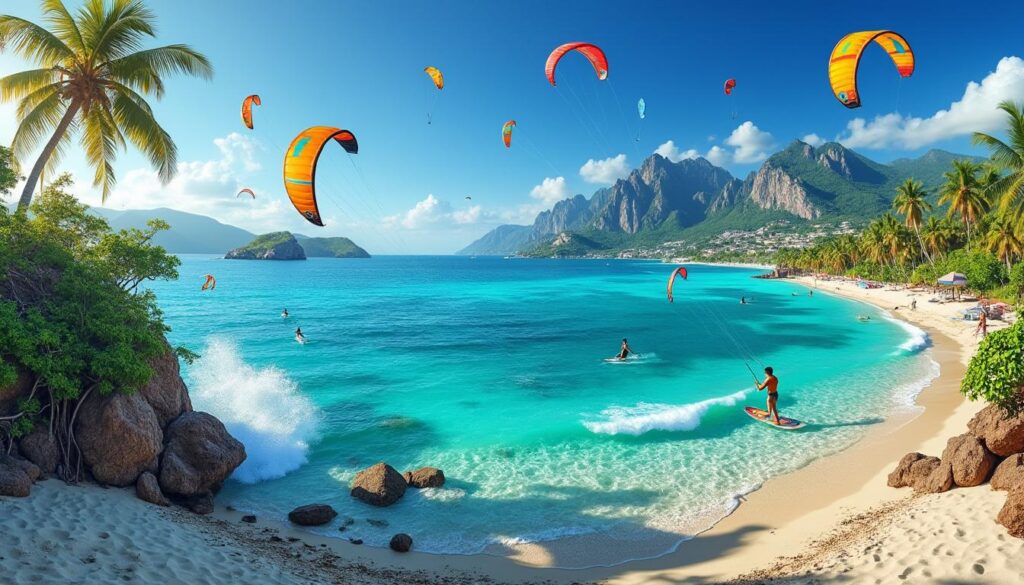
The wind that pushes the kite in front of the Le Morne mountain, the turquoise lagoon that looks ruler‑straight and the Indian Ocean waves that only wait for a committed bottom turn: kitesurfing in Mauritius is not a postcard, it’s a serious playground. Here the wind blows regularly for months, the spots are very different from each other and you can go from a butter‑flat lagoon to powerful waves within a few hundred meters. Those who arrive on the island thinking only about “doing a few upwinds” soon discover that you need to understand season, wind direction and spot choice well to truly make the most of Mauritius.
This article goes straight to the point: how to choose the best Mauritius kitesurf spot based on level, when to schedule your kitesurf holidays to find the most reliable wind, how to combine waves, lagoon, reef and logistics without wasting days watching the kite fall in the water. The info doesn’t come from brochures, but from the kind of approach used at the best spots in the Mediterranean, from kitesurf Salento up to big kite trips like Cape Verde or Brazil. The idea is simple: give you a clear mental map, so you can land in Mauritius already with a plan for every wind direction, every month and every progression goal, whether you’re at your first water starts or looking for your first strapless barrel.
In short
- Le Morne is the heart of kitesurfing in Mauritius: a wide lagoon, famous waves and different zones for every level, but you must respect currents and reefs.
- The best wind season generally runs from May to November, with steady South‑East winds and cooler but still pleasant water.
- From December to April the wind is more variable, but some spots on the East and South‑East coast remain interesting with the right conditions.
- Those in kitesurf beginner mode should look for wide lagoons and well‑structured schools, avoiding the more challenging waves straight away.
- A good reading of wind, tide and reef makes the difference between a full session and a wasted day; prepare before you leave.
Kitesurf Mauritius: overview of the main spots and what to expect
On a relatively small island like Mauritius, the number of kite spots is surprising. It’s not just Le Morne: the South‑East coast, the East and some more sheltered areas in the North offer around twenty active spots, with conditions that change a lot depending on wind direction and strength. For those used to kitesurf Italy, especially on the Adriatic and Ionian, the jump is evident: here the ocean comes into play with oceanic swells, marked tides and reefs that create textbook lagoons but won’t forgive inattention.
One of the most interesting figures often cited by international guides mentions 26 spots in Mauritius ranked by wind reliability, with the highest frequency in the area called La Passe Sud Est, which reaches about 69% of useful windy days on an annual basis. Even if for many European riders the most famous name remains Le Morne, it is useful to know that there are valid alternatives to combine in case of different weather fronts or high season crowding, just like riders moving between kitesurf Lecce and kitesurf Taranto switch spots depending on the Salento wind.
Imagine a typical character: Luca, an intermediate rider who learned with a kitesurf course on the coasts of Salento. He can tack, do transitions, some basic jumps, but comes from closed seas and Mediterranean chop. In Mauritius he immediately discovers that you have to change mindset: the wind is stronger but often cleaner, the lagoon seems easy but currents near reef passes can drag you towards unfriendly areas. Local schools insist on thorough briefings, just like a good kitesurf school in Puglia would do before sending you into a narrow channel with side‑off wind.
Mauritius’s real strength is the combination of lagoon and waves. Inside the barrier, water relatively flat or only slightly rippled: perfect to learn kitesurfing, work on hooked‑in jumps, start freeride or foil. Beyond the reef, the Indian Ocean raises walls of water for surf‑kite and for those who love strapless wave riding. All this within a handful of coastal kilometres, which basically works like a “larger” version of some stretches of the Adriatic kitesurf and Ionian kitesurf, where you change side of the peninsula according to the wind but stay in the same area.
To plan well it’s useful to mentally divide the island into four zones: South‑West (Le Morne and surroundings), South‑East (between La Passe Sud Est and other windy lagoons), East (lagoons more exposed to the trade wind) and North (less wind on average, more interesting when the South is calm). Each has precise characteristics of depth, access and services, which affect the choice according to rider level, exactly like choosing between a quieter Puglia kitesurf spot or one with challenging shorebreak.
At the end of this overview, what matters is a simple principle: Mauritius is not “one famous spot”, but a system of spots with different logics that you must learn to read, exactly as you do along the whole Italian coast when you jump from one spot to another chasing the wind.
Best kitesurf spots in Mauritius: Le Morne, South‑East and the East coast
When people talk about the best kitesurf spot in Italy, the discussion lights up about Salento, Sardinia, Sicily. In Mauritius the same happens between those who love Le Morne and those who prefer the South‑East passes. Le Morne remains the “capital” because it offers everything in one place: a wide lagoon with calmer water, teaching areas for schools, and right behind the reef waves of world class. It’s the ideal spot if the group includes riders of different levels, from kitesurf beginners to the expert wave rider seeking heavy tubes.
The South‑East area, with La Passe Sud Est leading the wind reliability charts, is instead more technical but often less crowded. The wind comes in clean, the reef channel creates long, more orderly waves. Here riders used to changing power in the air, managing high speed and escaping big sets with precise timing come into play. It’s an area that rewards those already comfortable on directional boards or foil, and who want long sessions with steady wind but a more “real” sea.
On the East coast, various spots offer interesting lagoons with sandy bottoms and reefs relatively far away, an environment that partly recalls some spots described in guides about kitesurfing in Bali, where the game is managing the combination of reef and thermal wind. Here the wind range is often good during the trade season, and those who love freestyle or freeride can exploit stretches of less choppy water near the shore.
The point is to understand, before you leave, which area best matches your goals. If you’re a beginner, it’s better to aim for spots with schools visible from the water, compressors on land, rescue boats and clearly marked course areas, just like at a good kitesurf school in Salento. If you’re advanced and looking for serious waves, then the Le Morne reef or the South‑East passes become your playground, but with all the necessary precautions.
To close this part, a key idea: choose the spot based on the wind and your level, not on the most spectacular photo you saw online.
Best season for kitesurfing in Mauritius: wind, months, temperatures
The question everyone asks before booking is always the same: “When does the wind blow best for kitesurfing in Mauritius?”. The short answer: the most reliable period for steady South‑East wind is roughly from May to November. In these months the trade winds stabilize, the statistics of windy days rise, and spots like Le Morne, La Passe Sud Est and various East coast spots work regularly, a bit like the Mistral season in some areas of the Adriatic kitesurf or the Ionian kitesurf.
During this window, average wind strength often ranges between 15 and 25 knots, with peaks above that when more marked fronts occur. The water remains pleasant, but a light wetsuit is advisable, especially at the start and end of the windy season. Those coming from an Italian winter between kitesurf Lecce and northern lakes will find air and water much more tolerable, but you shouldn’t underestimate the long hours in the water: the combination of constant wind + long sessions cools you more than you think.
From December to April the picture changes. The wind becomes more irregular, periods of calm increase and you enter the season when the risk of cyclones in the Indian Ocean area is statistically higher. That doesn’t mean “no kite”, but it requires more flexibility: some days you ride hard, other days you stay ashore or choose to surf, SUP or just rest. It’s a situation similar to what many riders find on winter trips to destinations like Dakhla or the Red Sea, described in guides such as those on kitesurfing in Sharm on the Red Sea.
For a concise view of the seasons, a summary table is useful:
| Month | Wind reliability | Average strength (knots) | Useful notes for kite |
|---|---|---|---|
| May – June | High | 18 – 25 | Start of the windy season, great mix of wind and manageable waves. |
| July – August | Very high | 20 – 28 | Strong trades, periods requiring small kites; beaches more crowded with riders. |
| September – October | High | 18 – 25 | Often considered the best compromise between wind, swell and climate. |
| November | Medium | 15 – 22 | End of the windy season, still many very good days but more variable. |
| December – April | Low / variable | 10 – 20 | More unstable, possible calm phases and attention to cyclone season. |
For an intermediate rider who wants to optimize days on the water, the ideal target remains between July and October. Beginners who do not like very strong conditions may prefer May‑June or late September‑November, when the wind still blows well but with a few knots less and beaches slightly less crowded with sails.
An often underestimated aspect is the combination of wind and swell. Not all windy months are the same for wave riding: some windows bring a more consistent sea, others flatter periods. If your goal is strapless wave riding, it’s worth cross‑checking wind and swell statistics, just as you would when planning a trip between kitesurf Italy and the Atlantic.
The point to remember: the best season for kitesurfing in Mauritius is long, but requires a conscious choice of month based on your level and the type of riding you look for.
Mauritius wind: directions, intensity and reading forecasts
Understanding the wind in Mauritius is like learning to speak a new sea language. The dominant direction in the windy season is South‑East, which comes side or side‑on on many spots of the South‑West, South‑East and East. This orientation is perfect for kite: it pushes toward the shore, leaves enough maneuvering space and creates workable waves beyond the reef. In practice, it’s the oceanic version of what the Salento wind does when it forces riders to move from Ionian to Adriatic to keep a safe direction.
Wind strength can change a lot over the day. Often it’s softer in the morning, builds toward early afternoon and drops near sunset. For those starting out or in kitesurf beginner mode, morning or late afternoon are ideal times: fewer gusts, less pressure on the kite, more time to focus on water starts and first tacks. Advanced riders, on the other hand, often aim for the central window when the wind is full and steady.
A list of key points to read the wind well:
- Always check multiple weather sources: Windguru, Windy, local models. Combining them gives a stronger forecast.
- Observe trends from the previous days, not just the single day of your arrival.
- Talk to local schools: they have a trained eye on each spot’s microclimate, as happens for kitesurf Salento.
- Consider tide and swell: they can completely change how the wind feels on the water.
- Adjust kite size: don’t be fixed on a “favorite” size, Mauritius rewards those who can change kites without hesitation.
Being able to read forecasts here is a skill that will stay with you for life, valid wherever you go, whether on a trip to Brazil or a quick session near home in Puglia.
Which spot to choose in Mauritius based on level: beginners, intermediates, advanced
One of the most common mistakes of those who fly to Mauritius with a board under the arm is skipping the analysis phase: seeing a Le Morne video in full swell and thinking it’s the right choice for your first trip, even if your level is still that of a student finishing a kitesurf course. In reality, the island offers options perfect for every level, you just need to recognize them and not get pulled into places where you’re not ready.
For those in kitesurf beginner mode, the priority is a wide lagoon, relatively uniform bottom and presence of schools with support boats. Some parts of the Le Morne lagoon, delimited and organized for courses, are perfect for first attempts, learning to control kite power and recovering the board without panic. Here pedagogy matters more than spectacle: the kite must always be under control, the rider must be able to stop safely and return to shore without complications.
Intermediate riders, like our Luca who comes from years of kitesurf Italy, look for spots to improve pointing, basic jumps, clean transitions and maybe start some simple rotations. For them, lagoons with light chop are ideal, together with consistent but not excessive wind. In these conditions you work a lot on timing: the body coming out of the water in sync with the kite, a clean trajectory and soft landings. Mauritius offers several zones perfect for this step, even outside Le Morne, especially along the East coast.
Advanced riders and wave riders enter the reef and wave discussion. Here the game changes. Reef pass spots, like certain sections outside Le Morne or the South‑East passes, require total board control, power management even in gusts and absolute respect for priority rules. Those who come from Mediterranean wave contexts or challenging spots like Dakhla or Cape Verde feel at home, but those arriving only from lakes or sheltered bays are advised to approach gradually.
An intelligent way to tackle Mauritius is to create a small “progression plan” before leaving, similar to what you’d set up to really learn among Puglia kitesurf spots, Sardinia and Sicily. For example: first two days in an easy lagoon with an instructor to check level and adjust setup; following days more intense freeride; last days dedicated to a taste of wave with local support, without forcing it if conditions blow up too much.
The takeaway is clear: not all Mauritius spots are for all levels, but for every level there’s the right spot if you take the time to find it.
Practical tips to learn kitesurfing in Mauritius safely
Learning directly in the ocean is dreamy, but reality requires organization and method. Those who arrive in Mauritius to learn kitesurfing have often only seen videos of riders jumping the reef, while the first thing to do is find a serious kitesurf school and a structured course. Exactly as you would in Salento, Sicily or any spot where the sea can change in an hour.
Some concrete advice:
- Book the course before leaving: in high season places fill up and you risk missing the best windy days.
- Always ask about wind and depth of the teaching spot: sandy bottom and few emergent rocks are better.
- Check for a safety boat: in a wide lagoon it’s a must, not an extra.
- Do not force outings on the reef until you are completely autonomous in the lagoon.
- Wear a helmet and impact vest, even if you see expert riders without them: your priority is to get out of the water smiling.
A student who cut his teeth in the Adriatic, for example, may find power management easier thanks to cleaner wind, but will have to get used to currents and variable depth. Those coming from the Ionian kitesurf already know the concept of quickly dropping bottoms, but often have no experience with sharp reefs. This makes local instructors who live on the island year‑round even more valuable.
Moral: learning kitesurfing in Mauritius is possible and fun, if you approach it with the same seriousness as you would a course in Italy.
Equipment, logistics and connections with other kite trips
A kite trip to Mauritius is not just wind and spots. It’s organizing equipment, choosing kites and boards, and logistical decisions that save you time and energy once on the island. Those who regularly travel between kitesurf Italy, Greece, the Red Sea and farther spots know well that the difference between a successful holiday and a nightmare can be a poorly packed suitcase.
For kites, the typical combination for the windy season is a quiver of three sizes, for example 7‑9‑12 m for an average rider. The 7 is used on really full days or by those who always want to stay loaded; the 9 covers most sessions, while the 12 is for lighter days or heavier riders. Those who also travel often to destinations like Brazil or Dakhla will immediately recognize the pattern: small kites almost never stay in the bag.
For boards, a versatile twin‑tip covers most freeride and early manoeuvre situations. Wave riders often bring one or two directionals, one more robust for the reef (possibly with an integrated pad) and one more “performant” for clean waves. Foil is spreading here too, but must be used intelligently: variable bottoms and emergent reef require particular attention in spot choice and tide timing.
Internal island logistics mostly run on rental cars or transfers organized by local accommodations. For those used to moving between kitesurf Lecce and kitesurf Taranto with the car loaded with kites and boards, not much changes: the important thing is to always have gear well protected, solid straps and a freshwater rinse routine to extend equipment life.
Mauritius fits easily into a personal “route” of kite trips many riders build over the years: Salento in summer, Greece or Corsica in transition, and then big winter trips to Mauritius, Cape Verde, Sri Lanka, Bali. Each destination adds a piece to your ability to read wind and water, and trains you for different conditions. Just as a trip to Greece or Hawaii opens your mind to how wind works around islands, Mauritius teaches you to manage reef and ocean trade winds.
In short: prepare equipment thoughtfully, think about your riding goals and consider Mauritius as a key stop in your growth as a global rider.
Mauritius in your rider journey: comparison with Salento, the Mediterranean and other destinations
Those who arrive in Mauritius after years of kitesurf Salento immediately perceive the difference: there two seas, here ocean and reef. In Salento, the game is moving between Ionian and Adriatic to follow the Salento wind; in Mauritius, you rotate around the island to align with the trades. But the mental approach is the same: there is no perfect fixed spot, there is the best daily combination between wind, tide and wave direction.
Compared to Mediterranean destinations covered by Salento Kiter – like Paros, Corfu or Corsica – Mauritius adds another level of intensity. Wave sessions on the reef, for example, are a step forward for those who so far have surfed chop and light onshore waves. For this reason it makes sense to arrive with a solid base built among Puglia kitesurf spots, Greek islands and some windy spots in North Africa.
Mauritius does not replace the places where you train all year: it completes them. You will continue to make progress between Adriatic kitesurf and Ionian kitesurf, taking advantage of summer thermal winds and winter perturbations, but every time you return to Mauritius you will notice that your way of reading the sea has changed. It’s like moving from a training ground to a real full stadium: same discipline, but different intensity.
In the end, one idea remains clear: Mauritius is not just a warm getaway, it’s an important piece for anyone who wants to become a complete rider, capable of understanding the wind anywhere.
What is the best period to kitesurf in Mauritius?
The most reliable wind season generally runs from May to November, when the South‑East trades blow steadily between 18 and 25 knots. July and August are often the windiest months, while May‑June and September‑October offer a great balance of full wind, manageable waves and less crowded spots.
Is Mauritius suitable for beginner kitesurfing?
Yes, Mauritius offers several protected lagoons with relatively uniform bottoms and structured schools, ideal for those taking their first water starts. It is essential, however, to choose a serious kitesurf school with a support boat and a well defined teaching area, and to avoid reef and wave zones intended for advanced riders.
What equipment should I bring for kitesurfing in Mauritius?
For the windy season the most used combination is a quiver of 2‑3 kites in sizes around 7, 9 and 12 m, depending on rider weight. A twin‑tip covers most sessions, while wave riders bring one or two directionals suited to the reef. A light wetsuit (shorty or 3/2) is often sufficient, but it depends on sensitivity to cold and the number of hours spent on the water.
Where are the best kitesurf spots in Mauritius?
The main hubs are the Le Morne area on the South‑West coast, famous for the large lagoon and reef waves, and the South‑East area, with passes like La Passe Sud Est noted for high wind reliability. The East coast also offers interesting lagoons for freeride and progression, while the North is more variable and works better in certain wind configurations.
Do you need wave experience to kite in Mauritius?
No, it is not mandatory: many lagoons allow you to ride in relatively flat water. However, those who want to go out on the reef and into the waves should already have good board control, confidence managing power and a solid kite relaunch technique. When in doubt it’s advisable to start with a session guided by local instructors.